Axios Future of Energy
July 02, 2026

🎯 Big energy and climate trends are converging in Colorado, so we're starting the morning there, and then moving on to...
- Big Tech's emissions jump, gas prices, and lots o' policy news, all in 1,433 words, 5.5 minutes.
🇺🇸 Housekeeping note: We're off tomorrow in celebration of July 4 and America's 250th birthday. Enjoy the weekend, and Future of Energy will return Monday.
🎸 This week marks 30 years since Neil Young & Crazy Horse released "Broken Arrow," and they're in fine, churning form on today's intro tune...
1 big thing: Polis defends data centers as Colorado juggles energy demands
ASPEN, Colo. — Colorado's Democratic governor, Jared Polis, defended data centers, touted oil and gas rules and bemoaned climate change in a recent interview in this mountain town.
Why it matters: Colorado has long been a microcosm of the nation's debates on energy, AI and the effects of a warming planet.
- Polis, who is leaving office in January due to term limits, has spent nearly eight years governing through each of those fights.
Inside the room: In an interview with Axios on stage at the Aspen Ideas Festival last weekend, Polis argued the backlash against data centers is aimed more at AI itself than the infrastructure needed to power it.
"Of course, there needs to be data centers," Polis said. "As long as you can show me it's going to reduce our utility rates and be consistent with our water use, then absolutely we want them here."
- "There's a general frustration about what the rise of AI means," Polis said. "I think that's what is giving people pause."
State of play: Colorado has become one of the country's clearest examples of an "all of the above" energy economy.
- Renewable electricity generation has more than tripled over the past decade even as natural gas remains a dominant fuel, a mix that has shaped Polis' pragmatic approach to energy.
Flashback: Colorado was ground zero for oil and gas fights in the 2010s.
- Polis backed ballot measures to limit drilling near homes before becoming governor, but instead pursued sweeping regulatory changes rather than drilling restrictions once in office.
- In Aspen, he said "the world evolved to me" as Colorado tightened rules while continuing to produce oil and gas.
Zoom out: The issue Polis spoke about most personally wasn't energy production. It was how climate change is reshaping Colorado.
"The way we did things 50 years ago simply won't lead to the same positive outcomes of diverse wildlife and healthy landscapes that make Colorado special unless we are very thoughtful about how we do this for the future."
Threat level: Climate change has increased wildfire risk across much of the West, making fires one of the defining issues of Polis' tenure.
- He pointed to Colorado's investment in its own aerial firefighting fleet, arguing the state can no longer depend on neighboring states for aircraft because wildfires are worsening across the West.
What we're watching: One of Polis' final challenges will be negotiating new Colorado River operating rules as the region's megadrought stretches into a third decade.
What's next: The seven states that depend on the river face an Oct. 1 deadline to reach agreement before the federal government steps in.
2. 📈 Amazon's AI expansion drives emissions to record high
Amazon's greenhouse gas emissions rose sharply last year as the company raced to expand AI infrastructure.
Why it matters: Amazon's annual environmental report, released a day after Google's report unveiled similar increases, adds to mounting evidence that AI growth is making it harder for tech giants to maintain climate ambition.
Driving the news: Just like Google, Amazon's aggregate growth in data center capacity is outpacing its stated efficiency gains.
- Amazon said it added more data center capacity globally than any company last year, while insisting it continues to improve efficiency.
By the numbers: Amazon's greenhouse gas emissions rose more than 16% last year, a record jump fueled largely by a 34% increase in electricity and a 20% increase from manufacturing supply chains.
Between the lines: Amazon's report is considerably shorter and generally offers less discussion of its environmental metrics than Google's, although the companies emphasize and disclose different measures.
- Google's report spans 117 pages versus Amazon's 51.
3. ⛽ July 4 gas prices will be the highest since 2022


The average regular U.S. gasoline price is $3.84 this morning, per AAA data.
Why it matters: That's lower than it was, but it's by far the highest price heading into the July 4 weekend since 2022, when the national average was $4.80 on the holiday itself.
The big picture: The politics of gas prices are tricky these days.
- The price surge during the Iran war that started in late February, which you can see above, could hurt Republicans in the midterms.
- On the other hand, the trajectory has been sharply downward in recent weeks since prices peaked at $4.56 per gallon in May.
What we're watching: President Trump this week issued a vague threat of "big problems" unless gasoline retailers cut prices more quickly.
4. 👟 Catch up quick on policy: Nuclear and SCOTUS, gasoline, data centers
⚛️ Nuclear Regulatory Commission head Ho K. Nieh said this week's Supreme Court decision expanding White House power over independent commissions will not change the body's decision-making.
- Why it matters: Critics of the 6-3 ruling fear less independent decision-making on energy from bodies including the NRC and FERC. And even before this week's ruling, President Trump has been expanding policy control over the NRC.
- The big picture: "There's no political pressure on our safety decisions. We're making safety decisions that are consistent with our statutory responsibilities," he told reporters yesterday.
⚛️ Speaking of the NRC, yesterday it proposed revisions to radiation exposure policies and, separately, updated plant licensing rules aimed at speeding deployment of new reactors.
- The big picture: It would maintain existing worker and public dose limits, but remove the "as low as reasonably achievable" principle, known as ALARA.
- Driving the news: Nieh said the commission is "raising the bar on clarity" and "not lowering the bar on our safety standards." A wide-ranging 2025 White House executive order had called on the NRC to revisit ALARA. The NYT has more.
⛽ House Speaker Mike Johnson (R-La.) and other senior House GOP lawmakers are urging President Trump not to extend waivers of the Jones Act once they expire in mid-August.
- The latest: The White House did not say whether it planned to extend waivers of the law that requires U.S.-built and crewed ships to move fuel between domestic ports. The waivers have enabled more shipments of gasoline and other fuels during the Iran crisis.
➡️ Per the New Jersey Monitor, lawmakers sent bills to Gov. Mikie Sherrill's (D) desk that would: cut tax breaks for data centers; create new electricity rate policies intended to shield other ratepayers from new costs; and require new reporting on energy and water use.
- Why it matters: New Jersey is a hot spot in the wider trend of states imposing new restrictions on AI data centers.
5. 👓 Hot Reads: European heat lessons, Colorado wildfires

Doomsday Climate Scenarios Were Wrong. That Doesn't Help Europe. (Foreign Policy)
Ben says: Columbia scholars Jason Bordoff and Noah Kaufman remind us to allow two big concepts to co-exist in our brains — and that policymakers should do the same.
- Yes, it's bad that advocates, academics and journalists touted unrealistically high emissions and warming projections.
- Yet after Europe's deadly heat wave, "the evidence still points to a far hotter, more dangerous, and more disruptive world well beyond what Europe just endured."
Three Wildland Firefighters Killed in Colorado Blaze (Inside Climate News)
Amy says: This happened the same day I interviewed the Colorado governor in those same whipping winds in Aspen. This is a tragic risk of wildfires, one that's worse due to climate change.
We Need to Retrofit the Planet. The Heat Wave Proves It. (New York Times)
Ben says: Of course Europe needs more air conditioning, but that's nothing approaching a cure-all for a warming planet in those nations or anywhere else, David Wallace-Wells writes.
- "It does not address crop losses and the mass deaths of animals, as we've seen in Europe, let alone evaporative damage to soil and waterways or the effects on outdoor labor and infrastructure designed and built under entirely different climatic regimes," he writes.
6. 🇺🇸 One July 4 thing to go: American energy since 1776
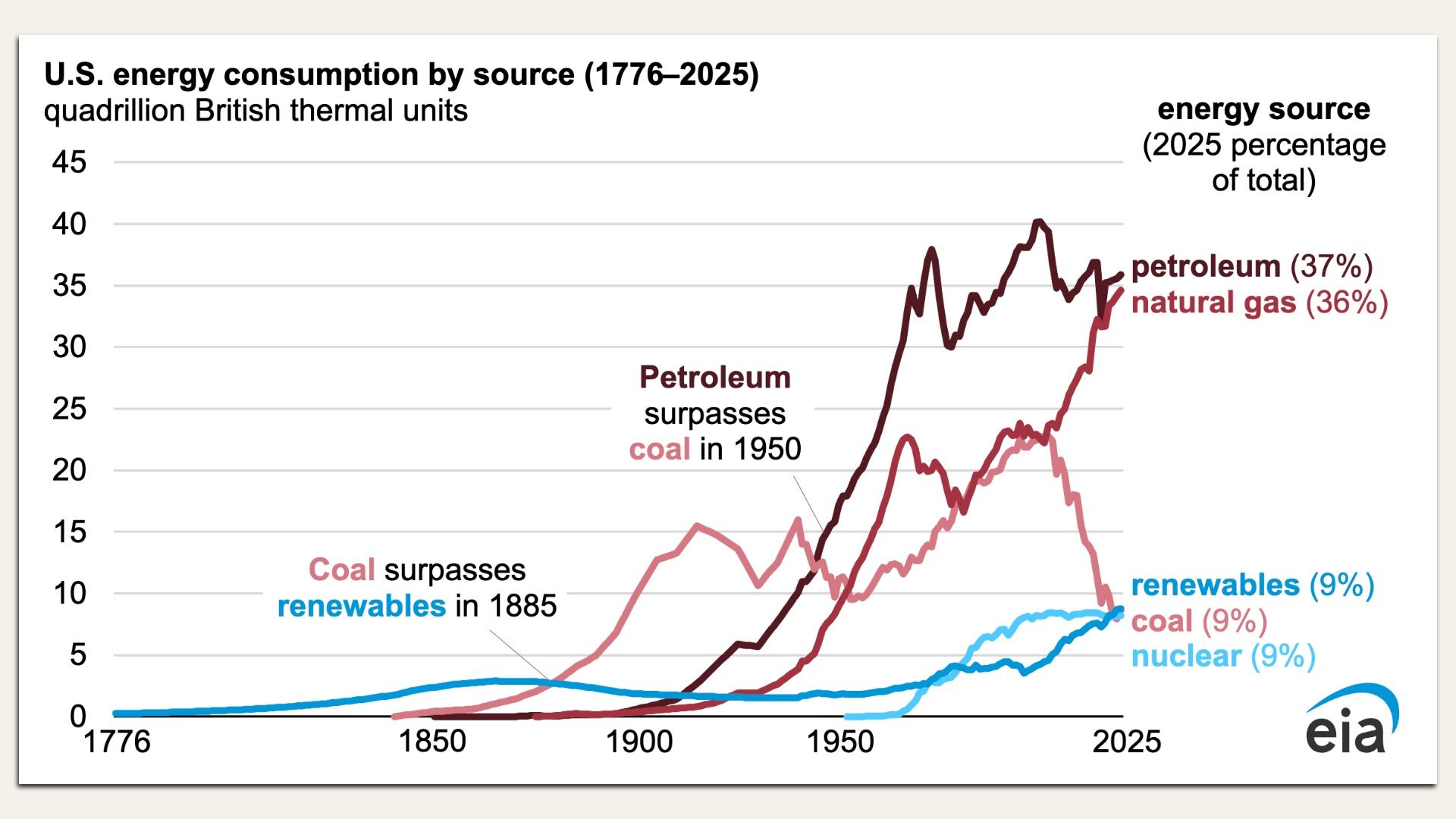
The Energy Department's stats arm has a nice look at the history of U.S. energy going all the way back to the founding.
Flashback (way back): "When the Declaration of Independence was signed in 1776, wood, a renewable energy source, was the main source for heating, cooking, and lighting," it states.
- "Earlier, in 1742, one of our nation's founding fathers, Benjamin Franklin, designed a more efficient, metal-lined wood stove."
- Check out the quick history.
🙏 Thanks to David Nather, Mackenzie Weinger and Chris Speckhard for editing and to our brilliant Axios visuals team.
📫 Did a friend send you this newsletter? Welcome, please sign up.
Sign up for Axios Future of Energy