Axios Future of Energy

February 26, 2026

🧭 The weekend is appearing on the horizon, and we're getting closer with news and analysis on...
- The politics of Trump's data center "pledge"
- A very big loan, new AI estimates, power M&A and more, all in 1,306 words, 5 minutes
🙏 Thanks to Chuck McCutcheon and Chris Speckhard for edits to today's newsletter, along with the brilliant Axios Visuals team.
🎸 This month in 1988, Toto released the album "The Seventh One," which provides today's expertly crafted intro tune...
1 big thing: Tech ratepayer pledge may be more bark than bite — but still matters
Big Tech's coming vow to pay for its own power amid the data center boom may be light on policy specifics. But it could still pack a political punch.
Why it matters: Electricity markets are largely regulated at the state and regional levels, limiting Washington's direct sway.
- Even so, the White House-tech initiative "is a big bully pulpit that could influence state economic regulators around the country even if it lacks an implementation plan or regulatory teeth," said Rob Gramlich, founder of Grid Strategies, a consulting firm.
Catch up quick: Tech execs are expected at the White House next week to sign what President Trump called a "ratepayer protection pledge" during Tuesday's State of the Union.
- OpenAI and Amazon are taking part in the "pledge" initiative, the companies confirmed. Others expected include Google, Meta, Microsoft, xAI and Oracle, Fox News reported.
The intrigue: It's still not clear how it might change policies and practices.
- Several tech giants have already vowed to prevent consumers from getting stuck with the energy bills for the AI buildout.
- "Data center 'pledges' to ring-fence costs are both non-binding and not new," TD Cowen analysts said in a note.
- FERC, with urging from DOE, is working on policies that push large industrial customers to cover costs like needed grid upgrades.
State of play: More than a dozen states in recent years have changed power rules to require data center developers to shoulder more of their electricity costs, Gramlich said.
- The "sharp end of policy developments in this space" is already unfolding at FERC, in wholesale markets including the massive PJM grid region covering much of the Northeast, and in state regulatory commissions, the TD Cowen analysts said.
- But as more states weigh similar moves, a high-profile tech pledge could shape those hyperlocal debates, Gramlich said.
Reality check: Power market rules already require new large customers to pay their fair share, wrote one leading data center developer on LinkedIn.
- Current pricing structures — known as tariffs (not to be confused with import duties) — are generally designed around "cost causation" principles, meaning costs are allocated to the customers that drive them, said Brian Janous, chief commercial officer of Cloverleaf Infrastructure.
- That framework is intended to minimize cross-subsidies between rate classes, such as residential and industrial customers.
The biggest tech players like OpenAI and Amazon have been making various promises.
- For instance, Microsoft last month said it will "ask utilities and public commissions to set our rates high enough" to cover costs of adding and using power.
The bottom line: Several experts say the pledge is more about optics than overhaul. But optics matter as power prices rise.
- "Clearly the public is blaming data centers for cost increases, so these sorts of announcements are probably necessary," Janous said.
2. 🧁 Bonus: New global and U.S. AI projections
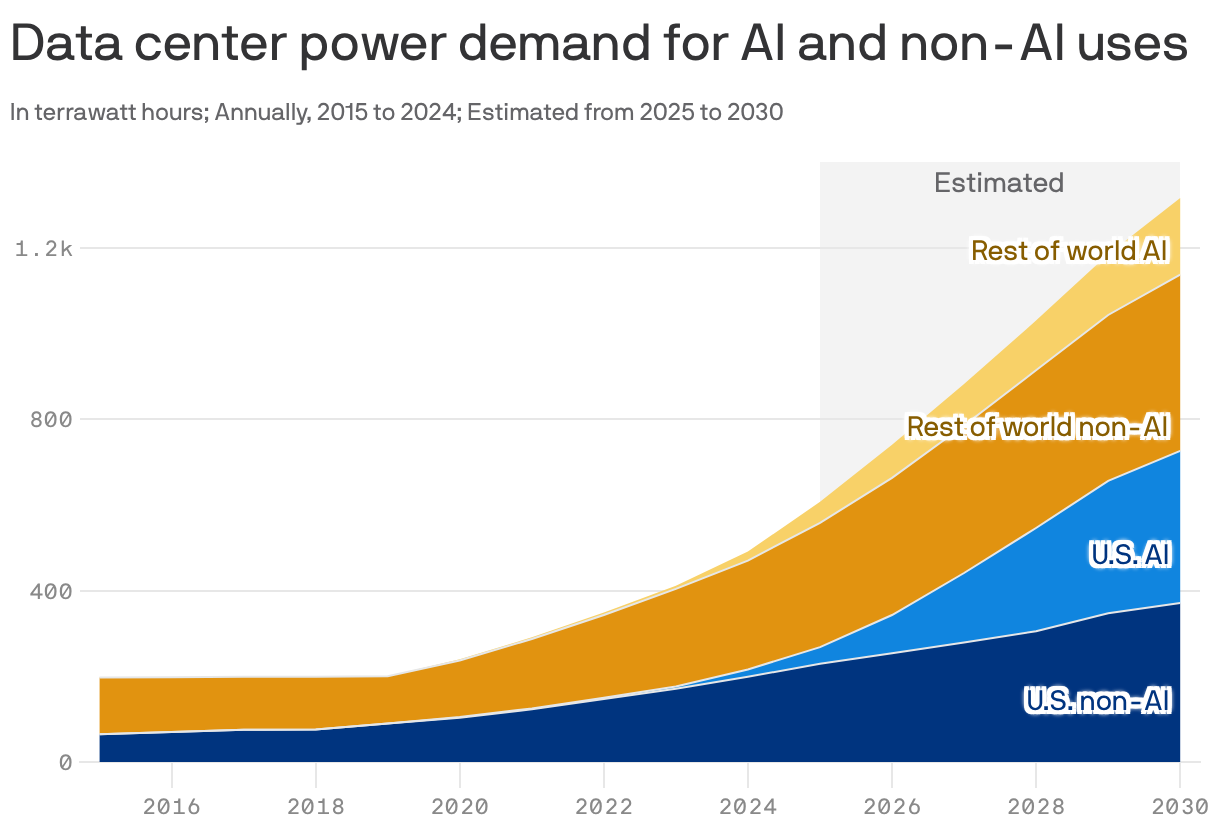
AI, for all the headlines, remains a small share of total data center power demand — but that's changing very fast, as you can see above.
Why it matters: In addition to the total demand growth, huge new data centers risk creating localized grid strains.
Driving the news: Goldman Sachs, in an updated analysis, sees 220% growth in data center power demand between 2023 and 2030, up from 175% in their prior outlook.
The big picture: In the U.S., the Electric Power Research Institute projects that data centers could soak up 9% to 17% of U.S. power generation by 2030.
- The nonprofit research group's just-released estimate is a big jump from a 2024 version of the report.
- Data centers are currently around 5% of U.S. demand.
Stunning stat: Data centers could consume between 39% and 57% in Virginia by 2030, EPRI projects.
- "By 2030, seven additional states — Arizona, Indiana, Iowa, Nebraska, Nevada, Oregon, and Wyoming — could see data centers exceeding 20% of their respective electricity usage," it finds.
The intrigue: EPRI is working with tech and power companies to help transform data centers into more flexible assets.
What we're watching: Goldman's analysis explores various threats to the build-out.
- "We continue to see risks that skilled labor availability constraints — particularly electricians — represents a key risk to execution," its report states.
- That will drive on-site power solutions that require less transmission, it projects.
3. 🏃 Quick takeaways on DOE's big loan to Southern Company

A few notes on the $26.5 billion (!) DOE loan to Southern Company subsidiaries unveiled yesterday for projects in Georgia and Alabama...
ICYMI: It will support new gas-fired generation, expanding output from existing nuclear and hydro plants, transmission, storage projects and more.
Why it matters: It's DOE's largest loan ever, officials said, and will support 16 gigawatts' worth of projects.
- And DOE's rollout captured the moment's wider political focus on power prices and data centers as Republicans face blowback on both topics.
State of play: Secretary Chris Wright, in a call with reporters, was quick to argue that it helps support Southern's existing plan for a multi-year rate freeze.
- He said the AI build-out can occur alongside lowering prices.
- "We're going to massively expand the capacity of the U.S. electric grid, allowing us to lead in AI, allowing us to reshore manufacturing and next-generation jobs for American workers across the country so that we can push their wages up," he said.
The intrigue: The financing encapsulates how Trump's DOE has reconfigured the long-standing loan office away from a focus on climate tech, though there's some overlap (think nuclear).
- Gregory Beard, who heads what's now called the Office of Energy Dominance Financing, told reporters yesterday that "every dollar" deployed going forward will be about energy reliability and affordability, with an eye toward winning on AI.
Friction point: Clean energy groups and many Democrats see Trump policies eroding U.S. competitiveness in emerging tech areas and, more immediately, thwarting renewables that can quickly help meet rising demand.
What's next: Beard told reporters to watch for more loan announcements covering areas like critical minerals, coal, oil and gas, transmission, nuclear, geothermal and more.
Go deeper: DOE loans Southern $26.5B for 5 GW of new gas, other grid investments (Utility Dive)
4. 💰 Nuclear startup SHINE raises $240 million
Nuclear startup SHINE Technologies said today it has raised $240 million in equity funding.
Why it matters: SHINE is among the companies working on two areas that are drawing attention: fusion and recycling nuclear waste.
Driving the news: The round was led by NantWorks with additional participation from Fidelity Management & Research Company, Sumitomo Corporation of Americas, Pelican Energy Partners, Deerfield Management, Oaktree Capital Management, and other investors.
- SHINE said in a statement it has now raised more than $1 billion in total funding, "reflecting sustained investor confidence in its commercially-driven path to fusion energy."
- CEO Greg Piefer has a four-part strategy to commercialize technologies on the way to generating fusion energy, one of which is waste recycling. Another is making medical isotopes to treat cancer and other diseases.
Zoom in: The company also appointed Patrick Soon-Shiong, executive chairman of ImmunityBio and founder of NantWorks, to its board of directors.
- Soon-Shiong — who provided $150 million of the investment in SHINE — is the Los Angeles Times' owner and executive chairman.
5. 🧮 Number of the day: Over 144 gigawatts
That's how much U.S. power generation capacity changed hands in 2025 M&As in the sector, per a new Deloitte report.
Why it matters: That's over 10% of total nameplate capacity, the firm finds. The combo of rising demand, grid constraints and high upfront investment requirements drove dealmaking.
- Renewables accounted for over half the capacity in the deals as consolidation in the sector accelerates.
📬 Did a friend send you this newsletter? Welcome, please sign up.
Sign up for Axios Future of Energy