Axios Future of Energy

October 03, 2025

šŗ Hello Friday! We're heading into the weekend with an exclusive story and plenty more, all in a quick 1,415 words, 5.5 minutes.
šļø Join us in D.C. on Thursday, Oct. 9, at 8am ET for an event focused on building a more secure energy economy, featuring conversations with Rep. Julie Fedorchak (R-N.D.), CSIS analyst Joseph Majkut & more. RSVP.
šø Happy birthday to guitar great Lindsey Buckingham, whose stellar solo caps off today's intro tune...
1 big thing: Pollution trading's next frontier is in the global south
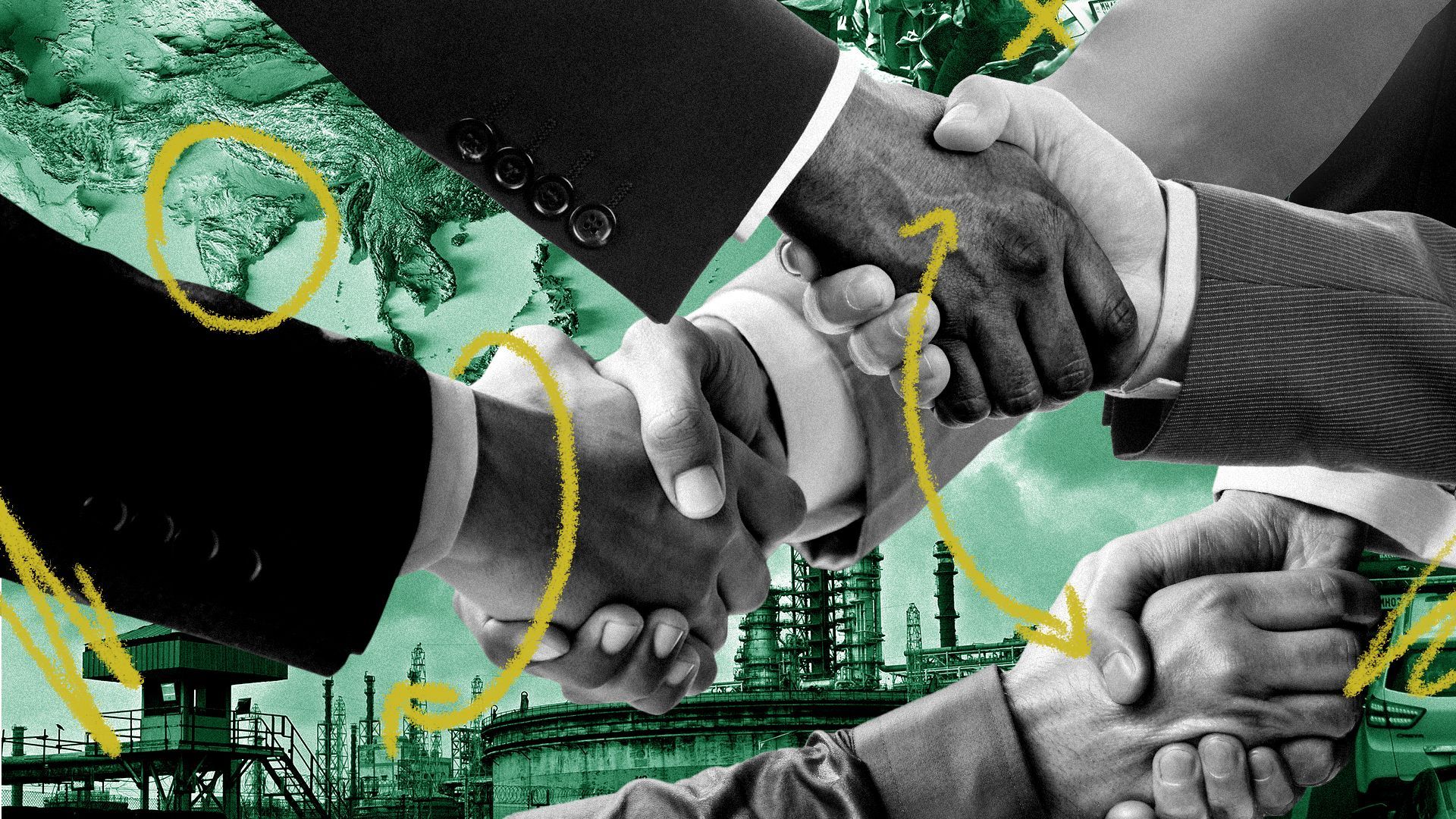
Exclusive: After years of behind-the-scenes work, a pollution trading initiative is publicly launching today that works in India and plans expansion to other developing nations.
Why it matters: The Emissions Market Accelerator sees openings, based on its on-the-ground work to date, to cost-effectively cut pollution and CO2 using emissions trading on a very large scale.
- It looks to bring cap-and-trade methods associated with richer countries ā think the successful U.S. acid rain trading program and regional CO2 work ā to the global south countries in Africa, Asia, South America and other developing regions.
Driving the news: It's a joint effort between the University of Chicago's Energy Policy Institute (EPIC) and the Abdul Latif Jameel Poverty Action Lab, which works in developing nations including India.
"We have really compelling evidence that emissions markets are excellent ways, and inexpensive and cost-effective ways, to confront environmental problems almost exclusively in rich countries," said EPIC director Michael Greenstone, the new group's co-chair.
- "There's a mismatch. You have this excellent tool. And yet, the largest pollution problems are not in the rich countries, and the global south is where the need for keeping things inexpensive is even greater," he said.
- Forty-nine of the 50 countries with the worst air quality are outside the OECD, he notes. And most CO2 emissions increases are happening in the developing world.
State of play: EMA has roots in pilot-scale work starting in 2019 with regulators in the Indian state of Gujarat to cut particulate pollution in Surat, a big city, and it extended to the city of Ahmedabad.
- Surat and Ahmedabad each have an estimated population of more than 8.5 million.
- It achieved 20%-30% steeper cuts from industrial plants there ā and at lower cost with higher compliance ā than a control group covered by conventional rules, researchers said.
- Over 20 million people have seen air quality improvements thanks to the efforts, EMA said.
What's next: It's working with the Gujarat state government to create larger-scale sulfur dioxide (SO2) and wastewater trading systems.
- It's also helping launch SO2 trading in the state of Maharashtra, targeted for early 2026, and beginning market design in the state of Rajasthan.
- There's a possibility of linking all three markets, Greenstone said, to create the largest SO2 market ever.
- Stemming air pollution typically cuts CO2 as well, and Greenstone said discussions with some other countries are explicitly about potential CO2 markets.
How it works: Trading markets set caps on industrial pollution, and companies trade allowances under that ceiling.
- The idea is that market forces guide cost-effective cuts. It became notorious in the collapse of the CO2 cap-and-trade bill in Congress in 2010.
- But the Acid Rain Trading Program launched in the 1990s cut SO2 and nitrogen oxides from U.S. power plants.
- And today CO2 trading systems operate in Europe, Quebec, California and among northeast and mid-Atlantic states.
What we're watching: EMA is scaling up and seeking funding from private philanthropies, Greenstone said.
- He ultimately sees a $5 million to $10 million annual budget. One big goal: for pollution markets to benefit 1 billion people in the global south by 2030.
The bottom line: "We're working with governments to implement a market approach that proves economic growth and environmental quality can go hand-in-hand," says Bala Srinivasan, co-chair of the Emissions Market Accelerator.
2. ā The Net-Zero Banking Alliance is kaput
The Net-Zero Banking Alliance will "cease operations immediately," the UN-convened group said today, a move that follows a wave of member defections.
Why it matters: It's a stark sign of the industry's ESG pullback amid resilient fossil fuel demand and conservative pressure.
Driving the news: The move comes a month after the group, launched ahead of the 2021 UN climate summit, paused to weigh next steps.
- Members have now voted to "transition from a member-based alliance and to establish its guidance as a framework," it said today.
- It's among the constellation of financial industry climate groups that have hit rough seas or even paused work.
- Numerous major banks have left the initiative, including Barclays, UBS, Morgan Stanley and JPMorgan Chase.
What's next: NZBA's materials will remain publicly available to help banks create and implement their own climate plan, it said.
3. š Tesla's sales bounce and the questions in tow


Tesla notched an all-time quarterly high for vehicle deliveries as consumers rushed to capitalize on the federal EV tax credit before it expired Sept. 30.
State of play: The automaker yesterday reported 497,099 deliveries in the third quarter, up 7.4% from a year earlier, exceeding Wall Street estimates.
What we're watching: The showing suggests that the backlash from CEO Elon Musk's association with President Trump may be fading.
- But future sales for Tesla ā and EVs more broadly ā are cloudy due to lapsed tax credits but also Trump 2.0's pullback of vehicle emissions rules and other climate policies.
What they're saying: "I'm skeptical that this will be sustainable, and I think we could see a soft couple of quarters," Elliot Johnson, chief investment officer at Evolve ETFs, tells Reuters.
š What's next: Some investors are looking past vehicle sales as a driver of Tesla's stock valuation.
- They're focused more CEO Elon Musk's priorities ā self-driving car technology and humanoid robots.
4. āļø SPACs offer nuclear investors an escape hatch

Some investors who backed nuclear reactor startups at the height of the climate-tech boom three years ago are diving for the exits: namely, through SPAC mergers.
Why it matters: "This is the epitome of dumping on retail investors," a venture funder tells Axios Pro.
Context: These are fission companies, not fusion ā startups seeking to leverage established nuclear technologies to deliver smaller, cheaper reactors.
Yes, but: After many years and billions of dollars, the first advanced fission reactors aren't set to begin commercial operation until 2027 at the earliest.
- Some investors and potential customers have lost patience as timelines and budgets have expanded.
Friction point: Such disillusionment has occurred as soaring electricity demand from AI data centers has transformed conventional nuclear energy ā and a select few startups ā into the hottest sector in energy.
- Power producer Constellation Energy, which owns the country's largest nuclear power fleet, has seen its stock price soar 770% over five years.
- Shares of uranium miner Cameco, part-owner of reactor builder Westinghouse, have experienced a similar jump.
Between the lines: Startups pursuing advanced designs hope to ride the wave.
- Oklo, the Sam Altman-backed SMR developer that had a rocky SPAC in May 2024, has since seen its stock soar over 1,000%, even as its first reactor remains years from supplying an OpenAI campus or utility power grid.
- Publicly traded developers NuScale and Nano Nuclear have seen similar gains.
What we're watching: The next surfers.
- For instance, micro-reactor developer Hadron Energy announced Monday it will merge with GigCapital7 Corp. in a SPAC deal.
Unlock the whole story, and for a steady diet of scoops and smart analysis, talk to our sales team about Axios Pro Deals.
5. š Specifics, breadth of DOE pullbacks emerge

DOE's termination of $7.56 billion of financial awards includes cuts spanning carbon removal, renewables, hydrogen, transmission, cleaner use of fossil fuels and more.
Why it matters: The cuts ā aimed mostly at Democratic-led states and announced in broad strokes on Wednesday night ā speed the reversal of Biden-era climate and clean energy finance.
Driving the news: A document obtained by Axios that's circulating among states and other stakeholders lists the more than 300 initiatives that DOE seeks to pull back.
- It includes an array of awards to companies, universities, nonprofits and others.
- DOE did not respond to multiple requests for comment.
The intrigue: The cuts overwhelmingly target states that voted for Kamala Harris and have Democratic senators. But it also lists initiatives in some red states.
6. š¬ Quote of the day: coal extensions edition
"We're seeing energy needs over the next 15 years that are expected to grow at eight times the growth rate of the past 15 years."ā Kendal Bowman, Duke Energy's North Carolina president, via Reuters
Why it matters: The comment comes alongside the power giant's new long-term plan for the Carolinas, which includes potential extensions of some coal-fired power plants.
- The full plan also explores new nuclear reactors and more.
š¬ Did a friend send you this newsletter? Welcome, please sign up.
š Thanks to Chuck McCutcheon and Chris Speckhard for edits to today's edition, along with the brilliant Axios Visuals team.
Sign up for Axios Future of Energy