Renewables, hydrogen, transmission projects eyed for DOE cuts


Add Axios as your preferred source to
see more of our stories on Google.
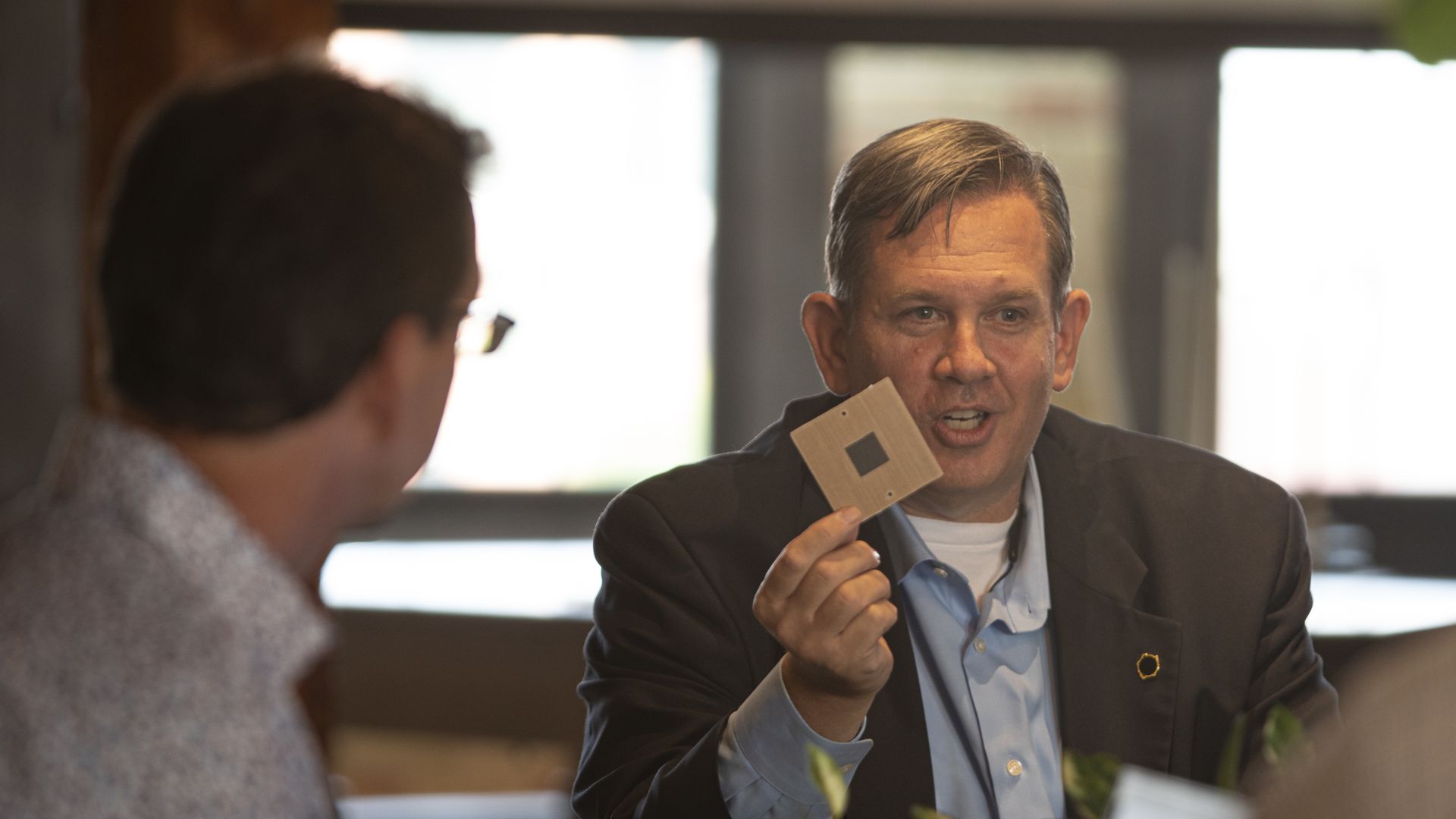
Pajarito Powder board chair Tom Stephenson holds an electro-coated wafer that makes up a component of a hydrogen-powered fuel cell. Photo: J. Kyle Keener
The Energy Department's termination of $7.56 billion of financial awards includes cuts spanning renewables, hydrogen, transmission, cleaner use of fossil fuels and more.
Why it matters: The cuts — aimed mostly at Democratic-led states and announced in broad strokes on Wednesday night — speed the reversal of Biden-era climate and clean energy finance.
Driving the news: A document obtained by Axios that's circulating among states and other stakeholders lists the more than 300 initiatives that DOE seeks to pull back.
- It includes an array of awards to companies, universities, nonprofits and others.
- DOE did not respond to multiple requests for comment.
The intrigue: The cuts overwhelmingly target states that voted for Kamala Harris and have Democratic senators. But it also lists initiatives in Iowa, Florida and Tennessee.
Zoom in: In Colorado, the cutbacks cover over 30 awards and over $500 million for projects ranging from oil and gas methane reduction to grid resilience to support for utility programs in low-income areas, officials said.
- "Colorado is proud to lead the nation in clean energy and consumers in our state continue to choose low cost renewable energy and clean, reliable technologies," the Colorado Energy Office said in a statement.
- "Cancel culture shouldn't apply to the federal government and the only scam would be the government picking winners and losers," it said.
In New Mexico, the cutbacks "put hundreds of millions of dollars at risk," said Michael Coleman, spokesman for Gov. Michelle Lujan Grisham (D).
- Among the targeted companies is Pajarito Powder, an Albuquerque firm that manufactures a fine black powder used as a catalyst in fuel cells and the electrolyzers that split water molecules into hydrogen and oxygen through a process called electrolysis.
- It grew out of technology from Los Alamos National Laboratory. The company received a DOE grant last year to scale up production and seeks to be a preeminent U.S. supplier in a supply chain now largely based in Asia and Europe.
- Another cutback was for a study to examine the feasibility of retrofitting a New Mexico coal plant with carbon-capture technology.
California Gov. Gavin Newsom (D) said DOE canceled up to $1.2 billion in funding for the Alliance for Renewable Clean Hydrogen Energy Systems (ARCHES), the state's hydrogen hub.
- Other cancellations included another hydrogen hub in the Pacific Northwest set to span parts of Washington, Oregon, and Montana.
Between the lines: The publication Heatmap explores how the pullback includes some projects slated for red states.
- For instance, there's a "$10 million grant for Carbon Capture Inc, a California-based company, to conduct an engineering study for a direct air capture plant in Northwest Louisiana," the outlet reports.
Environmental groups and Democrats condemned the cuts, which Office of Management and Budget director Russ Vought initially announced in a post on X.
- "At a time when energy demand is increasing, costs are already rising, and job losses are mounting, Trump and Republicans in Congress should be focused on funding and deploying the cheapest and fastest energy sources — clean energy — not gutting or banning them," said Sara Chieffo, the League of Conservation Voters' vice president of government affairs.
The other side: DOE said in announcing the cuts on Wednesday night that it carefully reviewed the 321 financial awards supporting 223 projects.
- "DOE determined that these projects did not adequately advance the nation's energy needs, were not economically viable, and would not provide a positive return on investment of taxpayer dollars," it said, calling many awards rushed.
What we're watching: The agency said recipients have 30 days to challenge terminations and that some have already begun that process.
Chuck McCutcheon contributed reporting.
