Axios Future of Energy

April 21, 2026


😬 We're all watching possible U.S.-Iran talks as the ceasefire nears its two-week deadline.
- But higher pump costs will linger no matter what happens, our lead item explains.
- We've also got coverage of Trump's latest energy policy moves and more, all in 901 words, 3.5 minutes.
📈 If you're a CEO or on a CEO's team: Request to join Axios CEO Jim VandeHei's free new Axios C-Suite weekly newsletter.
🙏 Thanks to David Nather and Chris Speckhard for editing and to our brilliant Axios visuals team.
🎶 This week in 1998, Massive Attack released the darkly ethereal album "Mezzanine," which provides today's intro tune...
1 big thing: Get used to higher gas prices this year
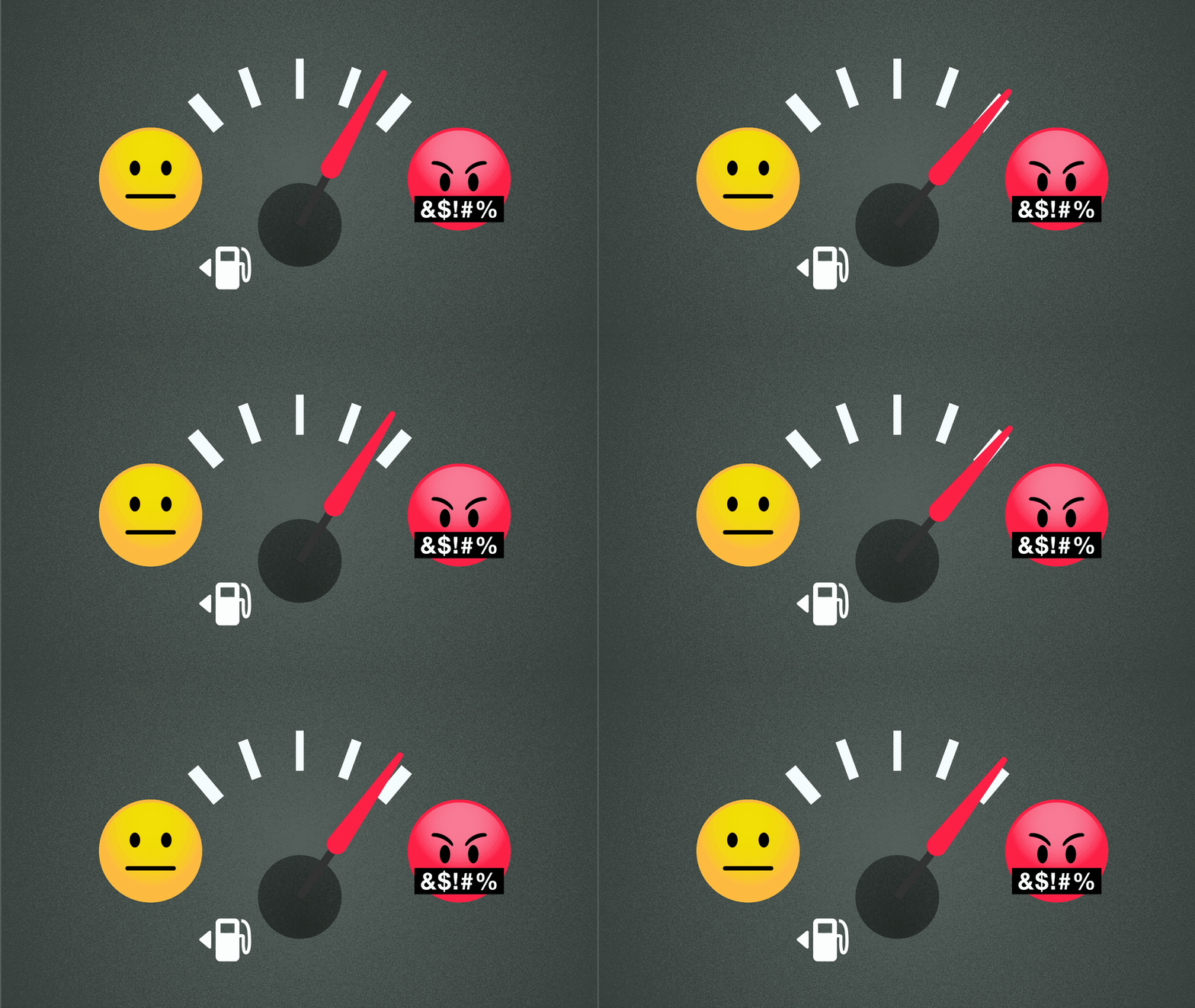
Even if the Iran conflict ended now and the Strait of Hormuz fully opened, don't look for a quick return to pre-war gas prices.
Why it matters: Costlier fill-ups are the most direct and visible economic effect of the war for many Americans, and could sway midterm election races.
Driving the news: Energy Secretary Chris Wright told CNN Sunday that gas might not drop all the way down to the pre-war level — averaging just under $3 per gallon in the U.S. — until next year.
- But President Trump appeared to contradict him in comments to The Hill yesterday, seeing a faster drop.
The big picture: Researchers and the analysts we've talked to see slower price drops — pretty close to Wright's prediction.
- And the Iran war — and threats to oil supplies — remain so unpredictable that the country could even face more spikes.
What they're saying: The research and consulting firm S&P Global has modeled three near-term price outlooks, given the "extreme uncertainty" associated with the conflict.
- "Even in the most optimistic of these scenarios, in which flows through Hormuz recover quickly with no restrictions, U.S. retail gasoline prices are likely to face an uphill battle to return to pre-war levels until 2027," Rob Smith, the firm's director of refining and marketing, said via email.
Other fuel analysts also caution against expecting a quick return to pre-conflict levels.
- That's even if there's a deal soon that gives shipping companies enough confidence to enter the strait in large numbers.
- Oil price declines take a long time to completely filter through refining, wholesale fuel markets and eventually retail stations where drivers fill up.
And that's under normal circumstances, and these are hardly normal times in energy markets.
- The throttled strait has had secondary effects that tighten the global oil market and keep prices high — which also filters down to gasoline pumps.
- Persian Gulf states, lacking their main export route, cut oil production by millions of barrels per day — and reviving it is a lengthy and often tricky task.
What we're watching: I asked Patrick De Haan of the price tracking and analysis firm GasBuddy how long it would take U.S. prices to reach pre-war levels if the strait opened fully and permanently immediately.
- The short answer? Months.
- "I think there's a chance we could see prices in some states fall below $3 by the end of the year," said De Haan, the firm's head of petroleum analysis, said via email.
Catch up quick: U.S. gasoline prices averaged $4.04 per gallon yesterday, per AAA, down from the $4.16 reached earlier in the conflict that has both sent oil prices skyrocketing and made them very volatile.
The bottom line: Trump is looking for a near-term deal, but fuel markets operate on longer timelines — and that likely means more expensive trips this summer.
2. 🏭 ICYMI: Trump wields the Defense Production Act
President Trump said yesterday he'll use a Cold War-era national security law to try to bolster domestic production of motor fuels and electricity.
Why it matters: His use of the Defense Production Act comes amid high gasoline prices during the Iran war, and rising power costs.
- The presidential memos Trump signed are needed for the Energy Department to use funding secured in last year's GOP budget law, a White House official said.
Driving the news: The memos address petroleum production and refining, coal-fired power, natural gas pipelines and processing, and more.
- They invoke the 1950 law that gives presidents substantial powers to try to bolster private industrial production of materials and supply chains deemed vital to U.S. security.
- Trump and President Biden have previously employed the law.
State of play: The documents make a wide-ranging case for invoking the law.
3. 👟 Catch up quick: Nuclear finance, solar, drilling
⚛️ Nuclear developer Blue Energy raised $380 million to help fund its first project. Go deeper via Axios Pro Deals.
🇨🇳 Via Bloomberg, Interior Secretary Doug Burgum told a House panel that China's supply of solar equipment for U.S. projects warrants tougher reviews of security risks.
⚖️ Environmental groups sued Interior over its approval of BP's ultra-deepwater Kaskida drilling project in the U.S. Gulf. The NYT has more.
4. 🛢️ Quote of the day: Second-order effects edition
"Sustained high oil prices are the best friend of exploration ... In the medium to longer term, there will be a risk premium attached to every barrel coming out of the Persian Gulf that will push people into frontier exploration."— Schreiner Parker, an analyst with Rystad Energy, quoted in the Wall Street Journal
The WSJ piece explores how the Iran war is bolstering oil giants' ongoing efforts to find and produce barrels in Africa and South America.
📫 Did a friend send you this newsletter? Welcome, please sign up.
Sign up for Axios Future of Energy