Axios Future of Energy

April 01, 2026

👋 We're back. Today we have:
- How bad oil prices could get
- The data center spending surge
- The "God Squad" species ruling and more, all in 1,406 words, 5.5 minutes.
🏦 On the next episode of "The Axios Show," JPMorgan Chase CEO Jamie Dimon defends the Iran war as overdue: "They've been killing people around the world for 45-plus years," he told Axios CEO Jim VandeHei. Watch the clip.
🎵 Today's intro tune is in honor of April Fools Day (don't be fooled!), by this classic song invoking fools...
1 big thing: Get ready for $200 a barrel oil prices if Hormuz stays closed
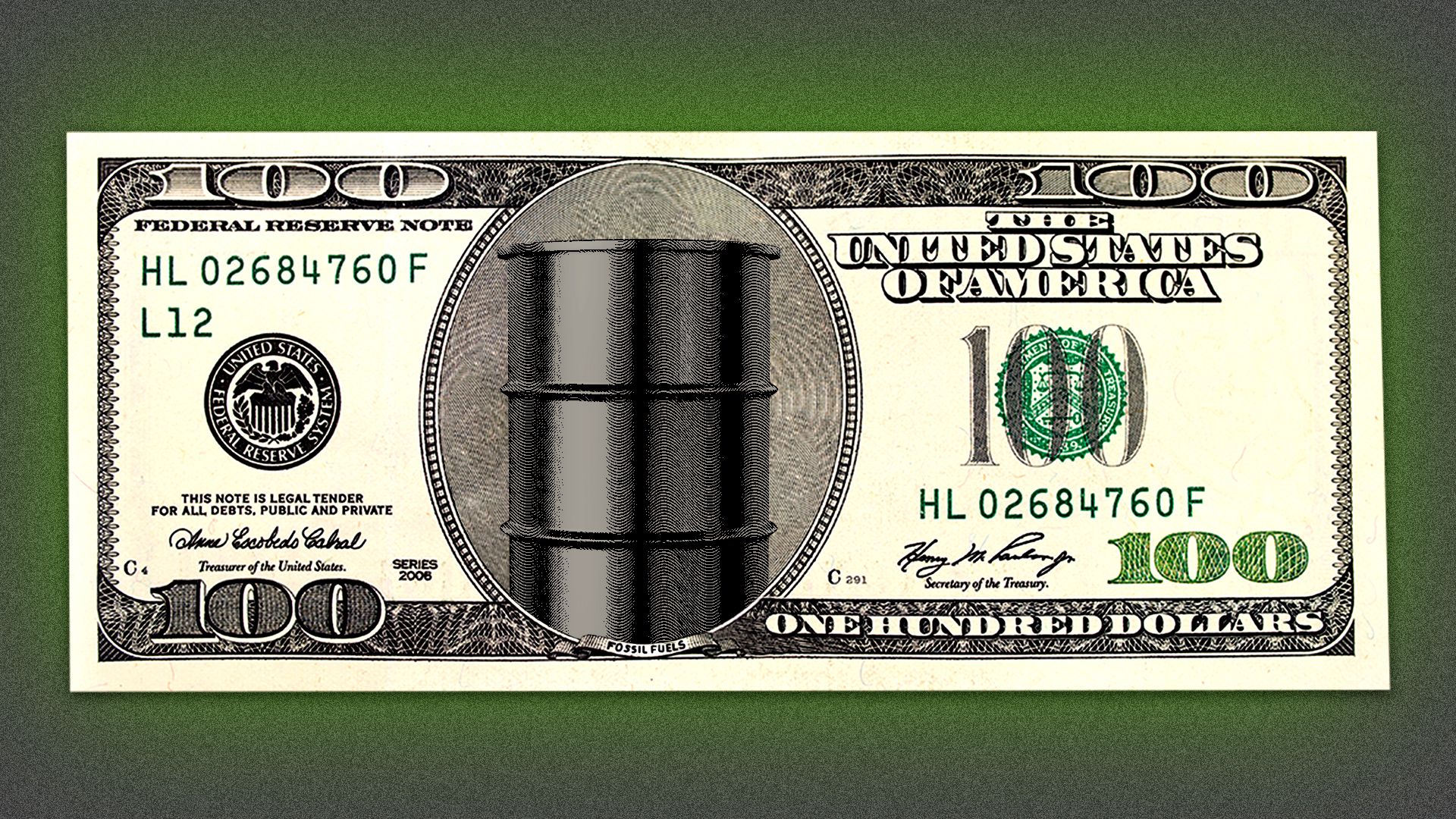
Oil prices could surge to an unprecedented $200 a barrel if the Strait of Hormuz remains closed, analysts warn.
Why it matters: President Trump is weighing ending the U.S. war on Iran without reopening the strait — raising the once-unthinkable prospect that this key energy artery could stay shut indefinitely.
- If that happens, oil's recent rise — briefly nearing $120 a barrel — could look modest.
Driving the news: U.S. gasoline prices have jumped 35% since the war began last month, topping $4 a gallon earlier this week.
- Countries more dependent on Middle East oil are already seeing worse, including fuel shortages.
What they're saying: Eurasia Group, a political risk consulting firm, puts 55% odds on the war lasting through May. If Iran damages oil infrastructure, prices could spike above $150 a barrel, it said yesterday.
"There is no policy option to prevent oil prices from marching up toward $200 a barrel if the Strait of Hormuz remains closed," said Jason Bordoff, founding executive director of Columbia University's Center on Global Energy Policy.
- "It's too large of an amount of supply to the global market."
Daniel Yergin, who hosted the world's premier energy conference in Houston last week, declined to give a specific forecast — but noted: "You do hear $200."
Catch up quick: Roughly 20% of global oil and liquefied natural gas flows through the narrow waterway of the Strait of Hormuz.
State of play: Prices have actually been somewhat contained because of short-term buffers — oil already in transit and releases from strategic reserves. But those cushions are fading.
- "Ships that escaped the Strait of Hormuz before [the war] began have reached port," former Secretary of State John Kerry said last week at the Houston conference. "They're empty now."
Flashback: Oil's historic peak was just under $150 a barrel in 2008, in nominal terms, before the Great Recession. That's roughly $230 in today's dollars.
How it works: The focus on $200 a barrel "is not an accident," said Kevin Book, managing director of research firm ClearView Energy Partners. It echoes the 2008 record.
- If reopening the Strait doesn't rebalance supply and demand, or if the Strait doesn't reopen for a long time, "then economic calamity is likely to follow," Book said.
What's next: "In the next several weeks, you're going to see the physical reality of oil shortfalls catching up to market trading activity," Bordoff said. "And that's going to cause oil prices to have to rise fast enough to make people use less oil."
The bottom line: "When it comes to energy crises, our memories are short," Bordoff said. "I think this has more potential than anything since the 1970s to create traumatic experiences that lead to lasting change."
2. 📈 Data center boom rivals energy sector


Spending on data centers is surging to levels that rival investments in energy, according to a new report by Norway-based Rystad Energy.
Why it matters: The research firm's findings underscore how the AI boom is reshaping global capital flows.
The big picture: The race to build AI infrastructure is turning data centers into one of the world's largest energy investment categories — with major implications for power demand and emissions.
By the numbers: The U.S. accounted for 42% of the installed capacity of data centers in 2025 — double that of mainland China, the second-place market, Rystad found.
The intrigue: The chart also shows that renewable energy, despite facing criticism from Trump, continues to tick upward on a global basis.
What we're watching: Rystad sees potential risks ahead for the AI boom.
The bottom line: "The various constraints, supply chain delays and disruptions are not likely to be solved in the next few years, which carries a chance of a further spike in prices."
3. 🏛️ "God Squad" species ruling continues court battle

Top Trump officials' ruling yesterday allowing oil and gas drilling to supersede endangered-species concerns fans the flames of an ongoing legal brawl with environmentalists.
Why it matters: The Endangered Species Committee's exempting of oil and gas operations in the Gulf of America (renamed from Gulf of Mexico) from Endangered Species Act requirements is one of only a few it has granted in more than half a century.
Driving the news: The committee — dubbed the "God Squad" — voted unanimously for the exemption, citing national security. Environmental groups earlier had unsuccessfully challenged that the group could meet.
- Interior Secretary Doug Burgum, Defense Secretary Pete Hegseth and EPA Administrator Lee Zeldin were among the panel members in support.
- "Recent hostile action by the Iranian terror regime highlights yet again why robust domestic oil production is a national security imperative," Hegseth said.
The other side: The National Marine Fisheries Service determined last year the Gulf's oil and gas program was likely to harm several species of whales, sea turtles and Gulf sturgeon that could face harm from oil spills as well as other impacts.
- Environmental groups contend drilling could make extinct the Rice's whale, the only large whale living year-round in the Gulf.
What we're watching: The Center for Biological Diversity quickly amended its lawsuit challenging Hegseth's national-security determination to include the exemption.
- "This amoral action by Pete Hegseth and Trump's cronies is as horrific as it is illegal, and we'll overturn it in court," said Brett Hartl, the center's government affairs director.
- California Rep. Jared Huffman, the House Natural Resources Committee's top Democrat, said: "My Democratic colleagues and I will fight this in court, in Congress."
4. 🗒️ Iran notes: Birol assessment, China-Pakistan offer, competing realities
🌍 Europe woes: IEA International Energy Agency head Fatih Birol said oil supply disruptions will hit Europe harder this month.
- Why it matters: "The loss of oil in April will be twice of oil loss in March, on top of the loss of LNG ... The biggest problem today is the lack of jet fuel and diesel," Birol told a podcast with Nicolai Tangen, head of Norway's sovereign wealth fund.
🇮🇷 New Iran plan: China and Pakistan yesterday unveiled a new initiative for ending the war in Iran that includes an immediate ceasefire and the reopening of the Strait of Hormuz.
🪖 Blurry victory vision: One month in, Trump's Iran war has fractured into three competing realities: A military campaign that has largely delivered; a strategic vision that hasn't; and a political and economic problem getting worse by the day.
5. 🏃♀️ Catch up fast: Emerald AI, Hill-California fight, new CEO, power deal, Shell
💻 New advisers: Emerald AI, which develops software to curb data-center energy demand, said yesterday it's launching a strategic advisory board that includes seven Fortune 500 companies.
- Why it matters: The board — unveiled with the news that Emerald raised $25 million — "is designed to bridge the AI and energy divide, enabling us to collaborate with partners across the entire value chain to transform data centers from grid liabilities into flexible assets," founder and CEO Varun Sivaram said.
🚙 CARB subpoena: House Energy and Commerce Chair Brett Guthrie (R-Ky.) said yesterday he's subpoenaing California's air pollution regulator, accusing it of essentially mandating EV sales in the face of emissions rules that Congress struck down.
- Why it matters: "Forcing Americans to buy unreliable, and costly, EVs would eliminate consumer choice, strain our electric grid, raise costs, and increase our reliance on entities tied to the Chinese Communist Party," Guthrie said in a statement.
💼 New CEO: Data center developer Prometheus Hyperscale announced that Bernard Looney will be its chairman and CEO.
- Why it matters: Looney spent over 30 years at BP, including serving as its CEO from 2020 to 2023. He oversaw efforts there to deepen the company's climate change commitments and diversification.
⚡️ Power deal: Per Reuters, "Microsoft, Chevron and investment fund Engine No. 1 have entered into an exclusivity agreement for power generation and supply, the three companies said on Tuesday."
🇻🇪 Venezuela and Shell: Also per Reuters, "Shell is in advanced talks with Venezuela's government to develop four large areas near Trinidad and Tobago, in two of the South American country's largest offshore natural gas fields, two people familiar with the discussions said."
✅ Thanks to Chuck McCutcheon, David Nather and Chris Speckhard for editing and to our brilliant Axios visuals team.
Did a friend send you this newsletter? Welcome, please sign up.
Sign up for Axios Future of Energy