Axios Future of Defense

August 27, 2025

Good morning! I spent the past two days in Indianapolis. I'd recommend the Whistle Stop Inn if you're ever out that way.
- Later this week, I'm interviewing Colin Miller with Boeing Phantom Works at the Emerging Technologies for Defense conference in Washington.
- We're also cookin' up an Axios event in early September. Stay tuned.
💎 Situational awareness: The Trump administration is "thinking" about taking an equity stake in defense and munitions companies, like Lockheed Martin, Commerce Secretary Howard Lutnick told CNBC. There's a "monstrous discussion about defense."
- Are you a defense contractor? Have thoughts? Give me a ring. Or reply to this email.
Go, go, go: Pentagon pink slips, F-35 engines and another Palmer Luckey lookalike.
Today's newsletter is 1,785 words, a 6.5-minute read.
1 big thing: Pit(fall) production

The U.S. has for almost a decade been on a cross-country nuclear weapons odyssey known as plutonium pit production.
- The project to pump out cores for nuclear warheads in South Carolina and New Mexico, as drawn up in 2018, is now years behind schedule and billions beyond budget estimates.
Why it matters: A memo this month from Energy Department leadership reignites questions about the future of the effort, which has become a punching bag for critics and a pea among the mattresses of nuclear modernization.
Driving the news: Deputy Energy Secretary James Danly earlier this month ordered a 120-day "special study" of the pit production endeavor overseen by the National Nuclear Security Administration.
- It includes a review of NNSA leadership and management practices; individual projects at Savannah River Site and Los Alamos National Laboratory; and contractual mechanisms "to hold contractors to account."
- Both the current leader and head of defense programs at NNSA are working in an acting capacity.
Threat level: Danly said he is "increasingly concerned" about NNSA's "ability to consistently deliver on nuclear weapons production capabilities."
- Further delays to pit production, he added, could "result in significant cost increases and risks to national security."
Between the lines: This is a marked departure in tone from the top.
- "We do think it's very serious, especially with this administration that is willing to make, as we've seen, drastic personnel decisions," Greg Mello with the Los Alamos Study Group told me.
- "Sooner or later, DOE is going to recognize that it can't build and operate two pit factories at once," he said. "That two-site plan costs four to six times more than was thought when the plan was first approved."
The intrigue: To run the investigation, Danly tapped the Office of Enterprise Assessments, an internal oversight group that typically probes cyber, site security and environmental concerns. That choice has drawn the curiosity of experts.
- "It is very interesting that they're doing this," Stephen Young with the Union of Concerned Scientists told me. "Who they chose to do it is also interesting."
Flashback: A two-pronged production plan was greenlit during the first Trump administration by Ellen Lord and Lisa Gordon-Hagerty, at the time the Pentagon's chief weapons buyer and the NNSA administrator, respectively.
- Biden administration Energy Secretary Jennifer Granholm and NNSA boss Jill Hruby also endorsed the tandem approach.
What they're saying: "The current plan for pit production is one of the most expensive endeavors that the U.S. has ever undertaken in its nuclear complex," Dylan Spaulding, also with the Union of Concerned Scientists, told me.
- "It's good that the DOE apparently recognizes how troubled this program really is," he said, "and this study is a chance for a much-needed change of course."
- "The important takeaway is that pit production, at scale, is simply not necessary right now," he added. "There are other options that don't detract from national security ... and that would help open doors for arms control and a more secure future."
The other side: The Energy Department did not respond to my questions about the selection of the Office of Enterprise Assessments, the potential repercussions of its findings and the overall timing of the deep dive.
Zoom out: The combined 2025-34 nuke plans of the Defense and Energy departments amount to $946 billion, according to the Congressional Budget Office.
- That includes big-ticket items like the fickle Sentinel missile, meant to replace Minuteman III.
Go deeper: Boeing nabs $2.8 billion nuke communications contract
2. New digs for the Navy

The U.S. Navy is cannibalizing innovation offices and resources dedicated to the Replicator drone-counter-drone initiative to establish a new entity, the Naval Rapid Capabilities Office.
Why it matters: The NRCO is charged with assessing and fielding materiel to ensure "U.S. maritime supremacy," according to an Aug. 19 memo from Navy Secretary John Phelan.
- The office director, not named in the document, will report directly to the secretary.
- Its portfolio will cover "all naval warfare domains," with priorities also reviewed by the chief of naval operations and the Marine Corps commandant.
Context: Creation of the NRCO appears to be a response to an April executive order meant to overhaul defense acquisition and invigorate the industrial base.
Zoom in: The Disruptive Capabilities Office, Maritime Accelerated Response Capability Cell and NavalX are being absorbed. As are the Navy's closely guarded Replicator activities.
- Additional organizations could also be incorporated, according to the memo, which seeks recommendations.
What's next: The next 60 days look busy.
- Tasks laid out in the memo include identifying secure office space, crafting a communications plan and recommending at least five programs for prioritization.
3. You're fired

Hundreds of years of experience have been wiped from the highest levels of the U.S. military, the result of retirements and removals in the first year of the second Trump administration.
Why it matters: Ask anyone — seriously, anyone — in the national security space and they'll tell you: Expertise greatly matters, especially at this precarious moment in history.
Driving the news: In recent days, Defense Innovation Unit boss Doug Beck abruptly resigned and Defense Intelligence Agency director Lt. Gen. Jeffrey Kruse was sacked.
- The DIU did not respond to a request for comment. The DIA referred questions related to timing and reasoning to the Pentagon. (The New York Times reported the dismissal was due to a "loss of confidence," a vague description used across the services.)
- Kruse's ouster came shortly after the sudden retirement of Gen. David Allvin, the Air Force chief of staff. He's served only two of the four years typical of that role.
Zoom in: Here's who else has been booted in the last few months, plus the roles they held.
- Gen. Charles "CQ" Brown Jr., Joint Chiefs chair
- Gen. Tim Haugh, head of the NSA and Cyber Command
- Adm. Lisa Franchetti, chief of naval operations
- Adm. Linda Fagan, Coast Guard commandant
- Gen. James Slife, Air Force vice chief of staff
- Vice Adm. Nancy Lacore, Navy Reserve chief
- Vice Adm. Shoshana Chatfield, senior NATO official
- Rear Adm. Jamie Sands, Naval Special Warfare Command boss
Context: Defense Secretary Pete Hegseth has railed against Brown as well as alleged "woke" ideology and DEI initiatives in the military.
- While the administration hasn't provided explanations for each individual firing, Hegseth and others have emphasized Trump's authority to bring in leaders he trusts.
What they're saying: "The firing of yet another senior national security official underscores the Trump administration's dangerous habit of treating intelligence as a loyalty test rather than a safeguard for our country," Sen. Mark Warner (D-Va.) said in a statement reacting to Kruse's exit.
- Warner is the vice chair of the chamber's intelligence committee.
Go deeper: Trump's D.C. utopia
4. Engine money
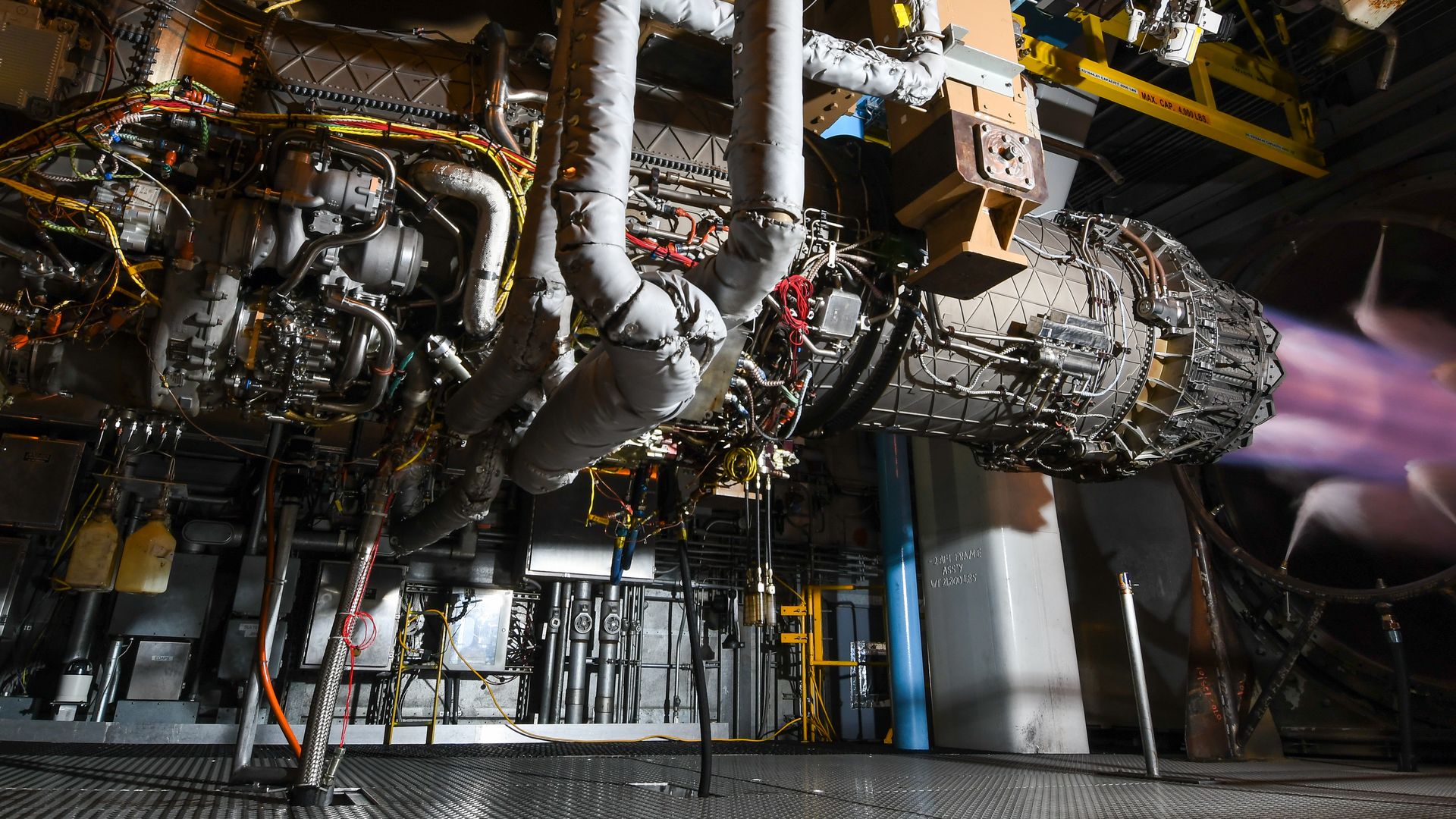
RTX subsidiary Pratt & Whitney will build more F-35 fighter engines following a contract update inked by the U.S. Navy worth as much as $2.9 billion.
The big picture: The company is expected to produce 141 F135 engines for U.S. military and international customers.
- The work is expected to wrap in 2028.
- It will be spread across several states, including California, Connecticut, Indiana and Washington.
Context: Lockheed Martin makes the stealth aircraft. There are more than 1,100 around the world.
Go deeper: Navy nominee wants futuristic fighter despite White House doubts
5. Quick hits

🛩️ Sierra Nevada Corporation entered the T-45 Goshawk replacement competition, unveiling its Freedom Trainer aircraft at the Tailhook conference.
- Why it matters: The trainer is "a purpose-built, clean-sheet design for the U.S. Navy," SNC said in an announcement. The company does a good bit of aircraft conversion work already.
- 💭 My thought bubble: Credit to Aviation Week's Brian Everstine, who had the scoop.
🏜️ A Roadrunner Venture Studios-led coalition plans to build a quantum campus in Albuquerque, New Mexico. The state-backed initiative is initially pegged at $25 million.
- Why it matters: "In this pivotal moment for New Mexico and for America, we are stepping forward to help lead the coming quantum revolution," Roadrunner CEO Adam Hammer said in a statement.
- 💭 My thought bubble: Hammer featured prominently in a deep-tech article I wrote in April. Check it, here.
🔌 Soldiers with the 25th Infantry, 101st Airborne and 11th Airborne divisions spent weeks experimenting with the Spectrum Situational Awareness System, among the latest additions to the service's electronic-warfare toolbox.
- Why it matters: "The Army has been pressing very hard on what it means to own" the electromagnetic spectrum, Col. Leslie Gorman, capabilities manager for electromagnetic warfare, said in a statement.
- 💭 My thought bubble: The Program Executive Office for Intelligence, Electronic Warfare and Sensors gets all the cool toys.
💸 Sikorsky, part of Lockheed Martin, won a $43 million contract to upgrade Black Hawk airframes and work in launched effects, or drones that can be catapulted from the helicopter.
- Why it matters: The company "is ready to implement new technologies that will strengthen the combat-proven Black Hawk helicopter and give U.S. Army soldiers greater advantage in areas like the Indo-Pacific," Hamid Salim, vice president of Army and Air Force systems, said in a statement.
- 💭 My thought bubble: The drone in Lockheed's announcement looks similar to the Hurricane made by Firestorm Labs, no?
6. Check this out

They're saying it's the summer of Palmer Luckey lookalikes.
The big picture: First, we had Robo-Palmer at Reindustrialize. Now, we have former acting Defense Secretary Chris Miller cosplaying as the Anduril Industries founder.
Driving the news: Miller was a guest on the 100th episode of Second Front's podcast.
- It was taped live. Miller wore shorts and a Hawaiian shirt (of course).
What they're saying: "You didn't comment on my attire," Miller said to Second Front CEO Tyler Sweatt at the top of the episode.
- "Dude, I thought Luckey Palmer was going to be here. I thought we were going to be playing Call of Duty and we were going to talk about combat and defense tech, man."
Go deeper: Defense tech giant Anduril now valued at over $30 billion
Shoutout to Dave Lawler for editing and Matt Piper for copy editing.
👋🏼 Thanks, as always, for reading and sharing. Tell your friends to subscribe here.
Sign up for Axios Future of Defense