Axios Future of Defense
August 14, 2024

It's Wednesday morning. Y'all know what that means.
- Have someone in mind for our Q&A section? Send suggestions my way!
- I'm headed to Toronto this weekend. Accepting all bar and restaurant recommendations, too.
On tap this week: A defense-innovation heyday, another "blue" list and a snapshot of the Kursk offensive.
Today's newsletter is 1,029 words, a 4-minute read.
1 big thing: A new era of defense innovation
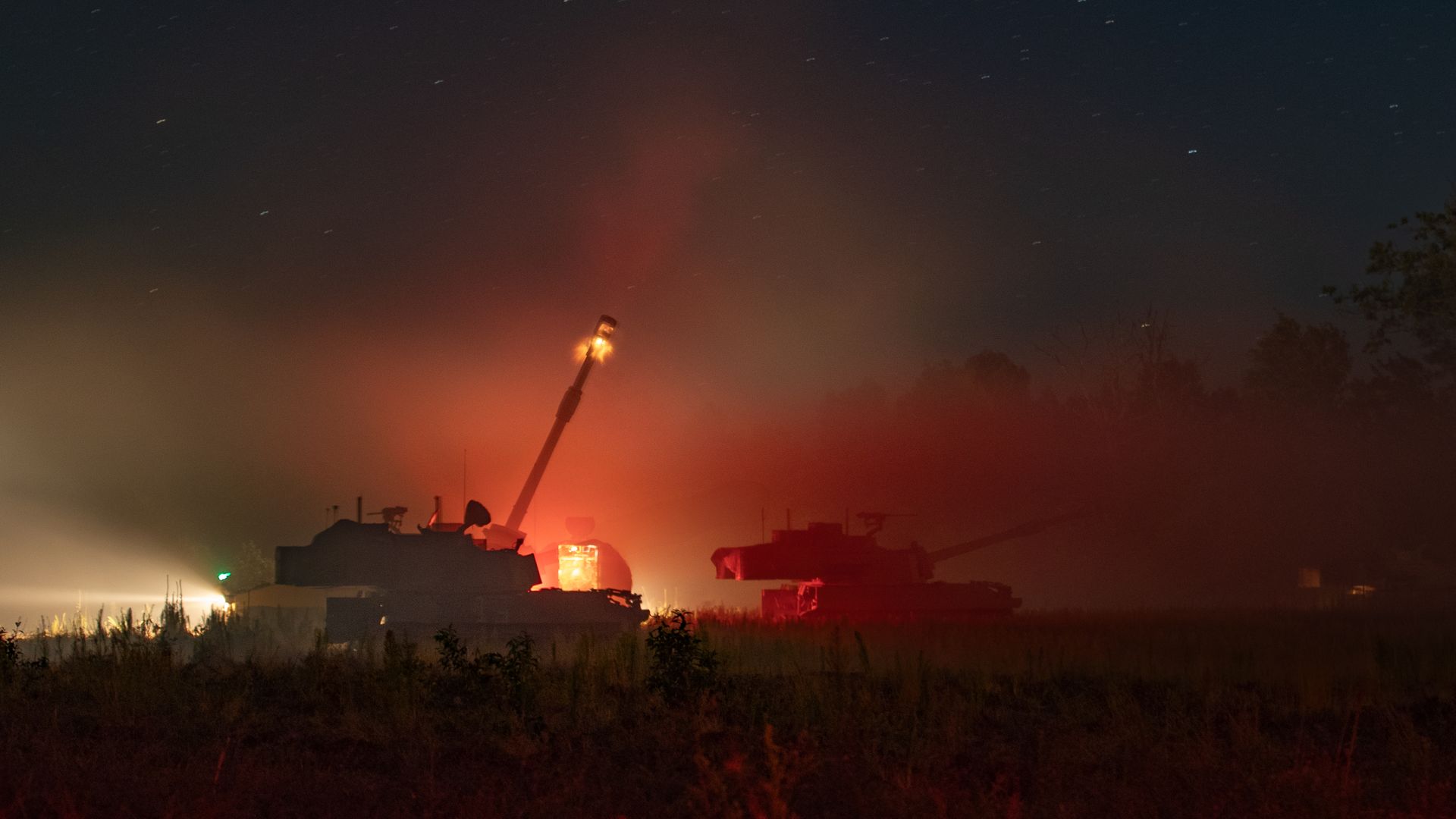
Pentagon officials say the U.S. stands at the precipice of a new golden age of defense innovation driven by upstart contractors, advances in technology and a world brimming with threats.
Why it matters: The Defense Department's inability to make unorthodox bets, feed a vibrant industrial base and embrace readily available technologies has rendered it under-supplied, the target of dual-use evangelists and vulnerable to more nimble adversaries.
Driving the news: Deputy Defense Secretary Kathleen Hicks said in a speech last week the department "cannot tolerate the same old mindsets" as it butts heads with Russia and China, while also invoking America's mass production overhaul during World War II.
- Heidi Shyu, the Pentagon's chief tech officer, separately called the clip of "nontraditional, venture-backed companies" entering the defense industry "unprecedented," adding: "They're nipping at the heels, I tell you. I have traditional defense contractors say, 'Hey, this isn't fair.'"
- Defense Innovation Unit director Doug Beck said the department is at a "positive tipping point."
- "We've been given the tools, and now it's about execution and delivery," Beck said. "I think we're well on our way out of the dark age."
Catch up quick: Hicks' declaration comes one year after she stuck her neck out for Replicator, meant to arm troops with thousands of drones and prove the Pentagon can be agile.
- That $1 billion gambit is on track, with more than 1,000 AeroVironment-made Switchblade 600 drones already in the pipeline, according to officials.
- Meanwhile, the DIU has been praised for its ability to break the Pentagon's addiction to the bespoke and funnel Silicon Valley-style equipment into the hands of troops. (More on that below.)
Our thought bubble: As I've written before, a group of novel defense contractors, fueled by software and outside expertise, is breaking onto the scene, hungry for big-money contracts.
Yes, but: Progress is easily undone — especially by a new administration, its spending plans and a lumbering bureaucracy happy to revert to tradition.
- "Efforts like [Rapid Defense Experimentation Reserve] and Replicator absolutely have been successful, but they aren't instantiated in the Pentagon's way of doing business," Govini chief executive Tara Murphy Dougherty told Axios.
The bottom line: "The system itself has to change" for recent wins to stick, Dougherty said. Otherwise, "American mediocrity" is on the menu.
2. Where to put Arsenal-1

Plenty of replies arrived last week with thoughts on where Anduril Industries should build a weapons megafactory known as Arsenal-1.
- Nevada, Southern California and Texas were leading candidates. One reader warned against putting it near either coast, lest it be easily targeted.
- Keep it "secret as long as possible," one writer warned.
Our thought bubble: Expect a bunch of political, regulatory and tax considerations to play a role in the pick. Texas might work, with plenty of room, a central location, friendly politicians and a growing high-tech workforce.
What are you thinking? Spot a site plan in a city council agenda? Tell me!
3. DIU's next list

The Defense Innovation Unit will start vetting advanced manufacturing companies and technologies, like 3D printers and digital modelers, in an effort to expand the pool of defense contractors and secure it from malign influence.
Why it matters: Defense Department arcana is a roadblock for smaller firms that want to fulfill military orders for weapons, software and spare parts.
- The department's inventory of suppliers, meanwhile, has shrank over three decades.
Driving the news: DIU boss Doug Beck unveiled the Blue Manufacturing endeavor last week in an on-stage discussion with me.
- It's modeled after the organization's similarly named Blue UAS and Blue UAS Framework, which spit out a roster of approved commercial drone merchants and accessories that can be quickly tapped.
Beck wants to link reputable firms that otherwise might not have connected. The payoff? Building "the defense industrial base in a new way, and [doing] it right here in the U.S."
- "We can make that introduction, build the bridge, help both sides to scale," he said.
Between the lines: Foreign hands in the supply chain complicate national security.
- Imagine Chinese-made tools in a super-sensitive U.S. factory or outright reliance on Russia for raw materials.
What's next: The Blue Manufacturing endeavor is still in its infancy, with planning just now underway. The exact regime is to be determined.
4. Quick hits

☢️ Nuclear microreactors can "revolutionize warfare" and free the "military from the tether of fuel," Andreessen Horowitz general partner David Ulevitch argues in a piece first shared with Axios.
- Why it matters: Fuel and food constrain armies. Both lawmakers and defense officials are eyeing alternative sources of energy to propel the force of the future.
- 💭 My thought bubble: The Pentagon recognizes climate change as an existential threat but is also considered, by one measure, the largest institutional source of greenhouse gas emissions in the world.
💥 U.S. Army leadership is doubling down on plans to deploy long-range missiles, including the SM-6 and Tomahawk, in Germany. Undersecretary Gabe Camarillo told reporters the service wants to "give commanders options" but "first and foremost" deter aggression.
- Why it matters: Russian President Vladimir Putin predictably described the future deployments as provocative and reminiscent of the Cold War.
- 💭 My thought bubble: European governments are rightfully girding their borders and realizing the "house is on fire," as the U.S. European Command chief put it.
🇮🇷 Iranian hackers targeted a presidential campaign amid a wider push to influence U.S. elections and, ultimately, who becomes the next commander in chief.
- Why it matters: Iran is following in the footsteps of Russia, which is notorious for its 2016 hacks of major U.S. political parties and successful disinformation operations, Axios Codebook author Sam Sabin writes.
- 💭 My thought bubble: U.S. Cyber Command leadership said 2024 will be the most secure election to date. That pledge is now being tested.
5. Check this out
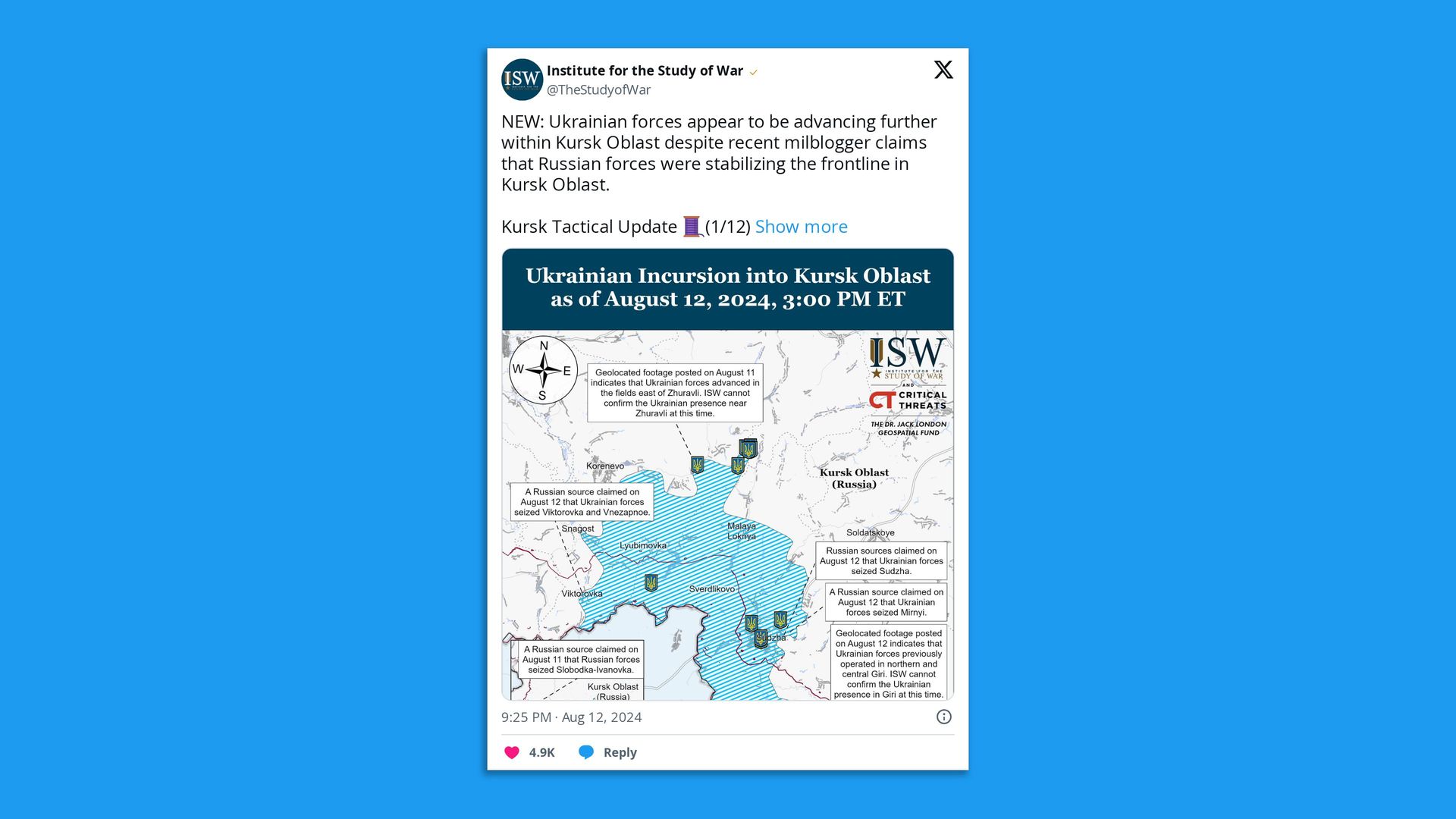
The Ukrainian military has punched a hole into Russia's Kursk region. It now holds 386 square miles of territory, according to a top commander.
- Here, the Institute for the Study of War logs the gains of the surprise offensive.
Why it matters: The Kursk raid marks the largest attack on Russian soil since World War II, the Associated Press reported.
My thought bubble: The land grab is an embarrassment for Moscow and is likely underpinned by ever-evolving electronic warfare and unmanned weaponry.
Shoutout to Nicholas Johnston for editing and Matt Piper for copy editing.
Did I miss something? What did you like or dislike? Shoot me a message by replying to this email.
Sign up for Axios Future of Defense