Axios Future of Defense
July 17, 2024

Welcome back to the Future of Defense. What's up?
- ⛰️ I'm in Colorado keeping tabs on the Aspen Security Forum. Expect a full dispatch next week.
- Want to meet, grab lunch or dish out secrets while I'm here? Hit reply!
👀 Here's a rundown on the defense industrial base, a Q&A with Anduril Industries chief executive Brian Schimpf and a few other things that caught my eye.
Today's newsletter is 2,049 words, a 7.5-minute read.
1 big thing: The new defense disruptors

A global technology race, supercharged by a combative China and daily innovation on the Ukrainian front line, is fostering a fresh crop of companies capable of reshaping the U.S. military-industrial complex.
Why it matters: A flood of investment is fueling these artificial intelligence, autonomy, cyber and space specialists at a time when weapons-buying orthodoxy is being questioned.
- The entrants are feeding a pool of Defense Department suppliers that has for decades consolidated, posing "serious consequences for national security," according to a 2022 review of industrial base competition.
- Some of the standouts are dubbed dual-use, serving both commercial and defense markets.
Among the most discussed are Anduril Industries, Palantir Technologies and SpaceX. Other buzzy players include Applied Intuition, Capella Space, Epirus, Scale AI and Shield AI. Here's a look what they have cooking:
- The Air Force in April selected Anduril and General Atomics to work on robo-wingmen known as collaborative combat aircraft. The two bested defense behemoths Boeing, Lockheed Martin and Northrop Grumman.
- The Army in May awarded Palantir a $480 million deal to expand access to software that streamlines a deluge of battlefield information. The company topped RTX, formerly Raytheon, for a $178 million Tactical Intelligence Targeting Access Node contract, as well.
- SpaceX hoists clandestine payloads and is also building a network of "hundreds of spy satellites under a classified contract with a U.S. intelligence agency," Reuters reported.
- Capella builds and operates synthetic aperture radar satellites that render Earth, even in adverse weather conditions. It now works closely with the intelligence community, and recently automated vessel detection and classification in its images.
- Epirus wrapped delivery of four directed-energy drone zappers earlier this year, satisfying a $66 million deal with the Army. It's also eyeing naval applications, to fend off attacks similar to those being launched by Houthi rebels in Yemen.
- Shield AI's digital pilot has been folded into several types of aircraft, with plans to expand to "every aircraft under the sun." The Coast Guard tapped the company this month for a drone-surveillance contract worth up to $198 million.
This revolution is driven by software and private-sector aptitude to build equipment before the military knows it even needs it.
- "The long and the short of it is: Behaviors are changing," Jason Brown, Applied Intuition Defense's general manager, told Axios. "There's no comparison between what existed before 1995, let's say, and today."
- "Software and data are now, really, the weapons that matter most," he said. "A lot of people don't consider them weapons, but I think that's shortsighted."
By the numbers: Over the past three decades the Pentagon's contracting Rolodex shrank from 51 to five in aerospace and defense primes, or companies that maintain long-term and high-dollar relationships with the government.
- Tactical missile suppliers dropped from 13 to three, fixed-wing aircraft suppliers declined from eight to three and satellite suppliers halved from eight to four, according to the 2022 assessment.
- And large, established defense contractors still play a pivotal role in some of the most complex projects: aircraft carriers, stealth aircraft, tanks.
Such massive undertakings "are not going away," according to Mike Brown, the former head of the Defense Innovation Unit now with Shield Capital. But competition is good, and can drive down prices.
- "I would hope you'd see the existing defense primes continuing to do well — we need their capability — but also for the Pentagon to have chosen a number of these new players," he told me.
- "We need to diversify the mix of what we buy, which means we need more small drones, more data from commercial satellites, more AI software."
The intrigue: A question remains: Can the Defense Department learn to embrace this cutting-edge tech at a faster clip?
- "We need to be as innovative, or more innovative, in how we execute the acquisition process as we are in the technology," Gen. James Rainey, the head of Army Futures Command, said at a conference hosted by Scale AI.
- "I don't, personally, think we have a technology problem. I think we have a tech-adoption problem."
2. Sabotage in Europe
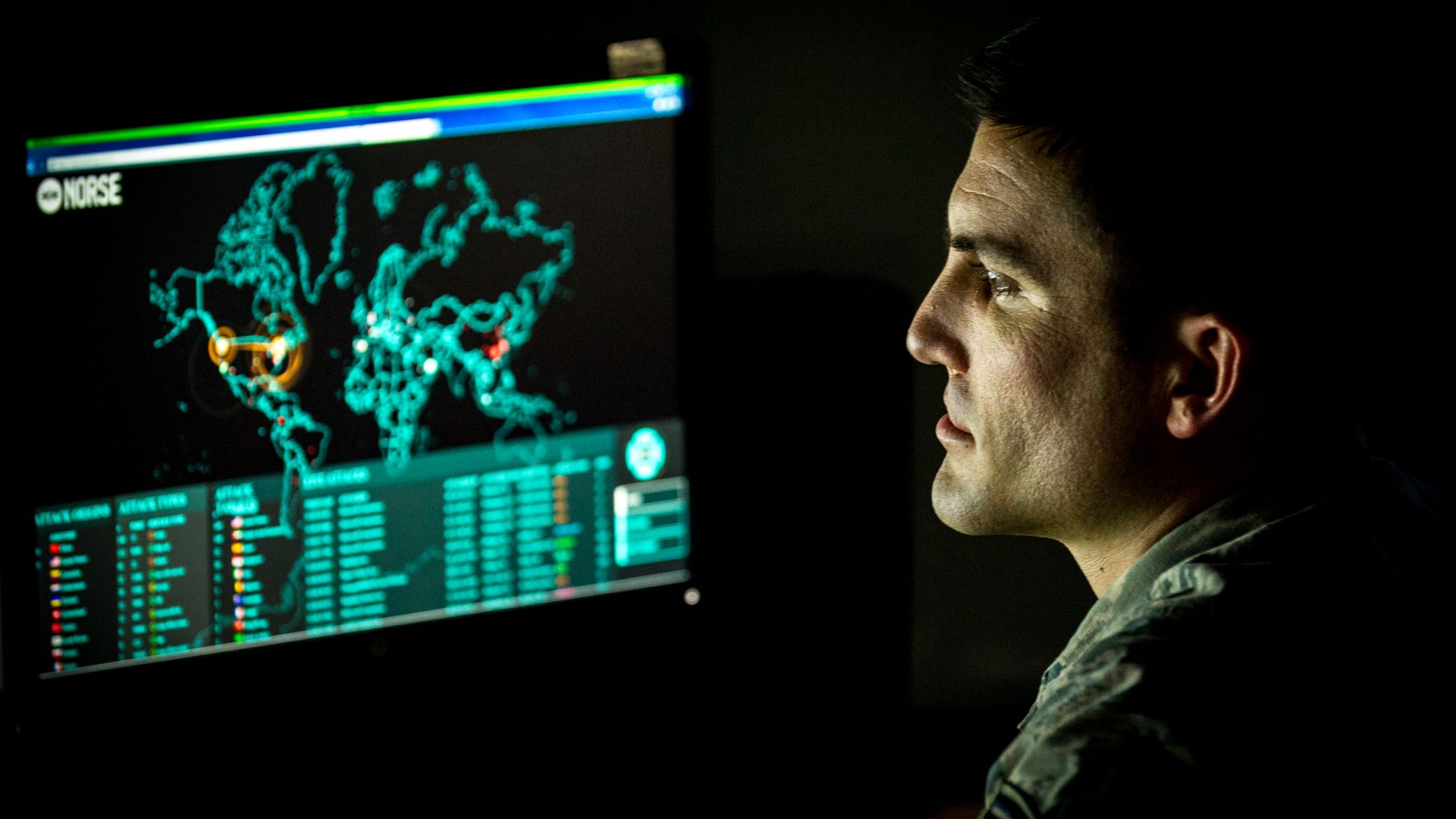
Russia's surreptitious war in Europe, relying on new-school digital attacks and old-school sabotage, received special attention at last week's NATO summit, including from U.S. Secretary of State Antony Blinken and the alliance's boss, Jens Stoltenberg.
Why it matters: This coordinated chaos — cyberattacks, propaganda, arson, weaponized migration — harries efforts to arm Ukraine as it battles back.
What they're saying: "We have seen a pattern, a Russian campaign, organized by the security services to conduct hostile actions against NATO allies across the alliance," Stoltenberg said at a press conference.
- Stoltenberg promised to boost intelligence-sharing "to help allies protect against these actions."
Zoom in: Russia's neighbors are among those feeling most acutely the Kremlin's pressure. Officials touted their experience dealing with the harassment and pledged to be proactive, not reactive.
- "When we talk about the hybrid attacks, yes, this is a constant situation for us," Hanno Pevkur, Estonia's defense minister, said at a Politico-Welt event held on the summit sidelines. "Our obligation is not to fall into that trap."
- "We are facing an aggressive country. We are facing consequences, which have much wider consequences," Andris Sprūds, the Latvian minister of defense, said at the same event. "We should, of course, look with a clear mindset. We should do our homework."
- "Russians are not attacking when you are strong — a very simple thing. 'If you're weak, if you are divided, we can do it,'" said Laurynas Kasčiūnas, the minister of defense in Lithuania.
Related: Why it took the U.S. nearly 10 years to ban a Russian cyber vendor
3. Quick hits

🦾 One-third of the U.S. military will be robotic in the next 10-15 years, Mark Milley, the retired Army general and former chairman of the Joint Chiefs of Staff, told my Axios colleague Mike Allen at our Future of Defense kickoff event.
- Why it matters: Such widespread adoption would be a major reshaping of the force — one that would also raise serious moral and ethical questions.
- 💭 Our thought bubble: Creating trust between man and machine is difficult, as watchdogs have warned. This would be the ultimate test.
🤖 A Pentagon report on generative AI and its defense applications is expected in the next month or two, Chief Digital and AI Officer Radha Plumb tells me.
- Why it matters: The findings from Task Force Lima, established one year ago, will shape how the Pentagon adopts, uses and refines the popular technology.
- 💭 Our thought bubble: Big questions remain about the security and biases of generative AI products, which can be helpful but not always accurate.
💵 German AI company Helsing raised €450 million in Series C funding led by insider General Catalyst at a nearly €5 billion valuation.
- Why it matters: Helsing is now one of Europe's most valuable startups, Pro Rata author Dan Primack wrote.
- 💭 Our thought bubble: This is another vote of confidence for a software-centric defense industry, this time from across the Atlantic Ocean.
4. Axios interview: Brian Schimpf
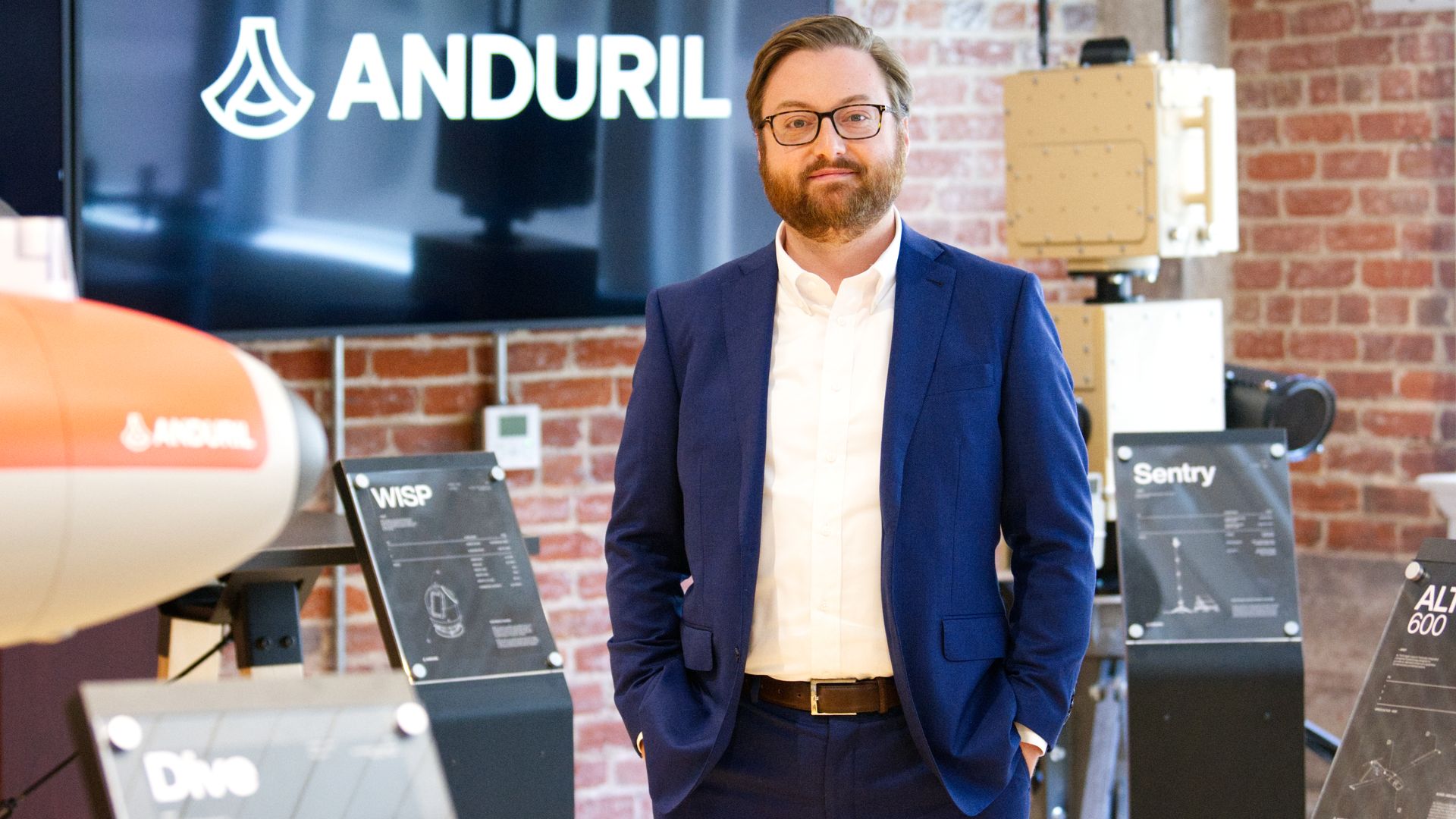
Keeping abreast of the evolving defense landscape requires talking to those shaping it.
- Our first conversation is with Brian Schimpf, the chief executive at Anduril Industries.
- We chatted recently at the company's offices in Washington. He had a cold brew coffee; I had a Celsius energy drink.
Why he matters: Schimpf leads what may be the splashiest defense contractor of the moment.
Q: When will wars be waged solely by robots?
A: My take is never. The argument for that is: Wars are about accomplishing some political end. That is the objective, and that is about forcing humans to capitulate in some way. That is ultimately what most wars are fought over. So I think in that end, there's always a human dimension to warfare.
Q: What's the biggest challenge the defense industry faces? What can be done to alleviate it?
A: We have a military that is addicted to exquisite, very high-end, very irreplaceable systems. These are becoming increasingly unaffordable. The timelines to field them are becoming longer and longer and longer.
- That is causing, in many ways, an over-concentration of the industrial base and making it so the U.S. cannot be as responsive as it needs to be to changes in warfare.
Q: What's a national security trend we aren't paying enough attention to?
A: Allies and partners, I think, are probably the most underserved part of what the U.S. national security strategy needs to take into account.
- The way they fight, the way they operate, what they can afford, and the problems they have to tackle are very different than what is the U.S. problem.
- They face a much more defensive and short-range problem. So the equipment and technology that [the U.S. builds] is not always fit for purpose for what they need, and they can do with much cheaper systems that can actually start to solve their problems.
- But it's nobody's job to sort of equip Poland or Estonia or Finland or Sweden, right? It's their own job. But they are often utilizing the fact that America has led the way on technology development. Nobody's looking at what is the technology that they need to be successful for their national security needs.
Q: How many emails do you get a day? And how do you deal with them?
A: I get a shockingly few number of emails a day because Anduril is not an email company. But I get thousands of Slacks a day.
- That one is very much about consuming the right information in very high quantities, and it's something I happen to be really good at. But we are fortunately not an email-heavy culture. In fact, everyone I know in tech has basically written off email as too old school.
Q: What's your secret to a successful overnight flight?
A: Don't do them is the No. 1 secret. If you have to? Sleep every minute you can because you're just going to be miserable no matter what.
Q: What time do you wake up? What does the morning routine look like?
A: I wake up around 6:30 or 7am with my two small children, ages 3 and 5.
They get up at 6:30-7 every morning, and I actually really try to spend time with the kids in the morning because they're generally in a pretty good mood — kind of sit with them, eat breakfast. It's actually a pretty nice routine. Then I head off to work, 7:30, 8 o'clock. It's great.
Q: What's a piece of gear or tech you can't go without?
A: I have an extremely boring answer, which is obviously my iPhone. But I've gotten obsessed with having chargers that actually work on airplanes and don't blow the circuit out. I have found one, and it's incredible.
Q: What are you currently reading, or what's a book you'd recommend?
A: A book I finished recently that I really enjoyed was "Stranger in a Strange Land," by Robert Heinlein. It's a great sci-fi book, and it kind of is exploring if Martian society was real, and different versions of society and how that plays out. It was a really interesting book.
- I've been trying to plow my way through all the classic sci-fi novels. That one was high on the list.
Q: What advice would you give your younger self?
A: It's pretty cliche, but what's worked out for me has been: Just get on the biggest opportunity, the fastest rocket ship, and just work on hard problems. It turns out that's really fun. It's really exciting. You meet very smart people, who are actually learning with you. It's a really great time.
5. Check this out

Drone kill marks are seen on an aircraft in a video shared by U.S. Navy Capt. Chris "Chowdah" Hill, the commanding officer of the USS Dwight D. Eisenhower.
- Warships have for months patrolled the greater Middle East, swatting down missile and explosive drone barrages launched by Iran-backed Houthis in Yemen.
Our thought bubble: Is catapulting a multimillion-dollar airplane from a multibillion-dollar aircraft carrier to intercept a drone that can cost thousands of dollars the best way to do this? Is there a better solution?
- This is a conundrum we expect to write about a lot.
The bottom line: Follow "Chowdah" wherever you can. He's a social media pro, whose posts debunk disinformation and provide a glimpse at life at sea, including Taco Tuesday.
Shoutout to Nicholas Johnston for editing and Matt Piper for copy editing.
Did I miss something? What did you like or dislike? Shoot me a message.
Sign up for Axios Future of Defense