Axios Future of Defense
August 19, 2026

Welcome back. What's up?
- For your calendars: I'm moderating a discussion with Emil Michael, the Pentagon's chief technology officer, Sept. 10 at the NDIA emerging technologies conference.
- Got questions? Send them my way!
🏭 Situational awareness: A Council on Foreign Relations report published this morning argues the U.S. lacks the weapons and industrial heft to beat back Chinese aggression in the Western Pacific and must prioritize "precise mass" and multiyear contracting, among other fixes. Read it here.
Now boarding: CenCore Group's big reveal, super-mobile missile radars and lots and lots of Tomahawks.
Today's newsletter is 1,688 words, a 6.5-minute read.
1 big thing: Carrier chaos
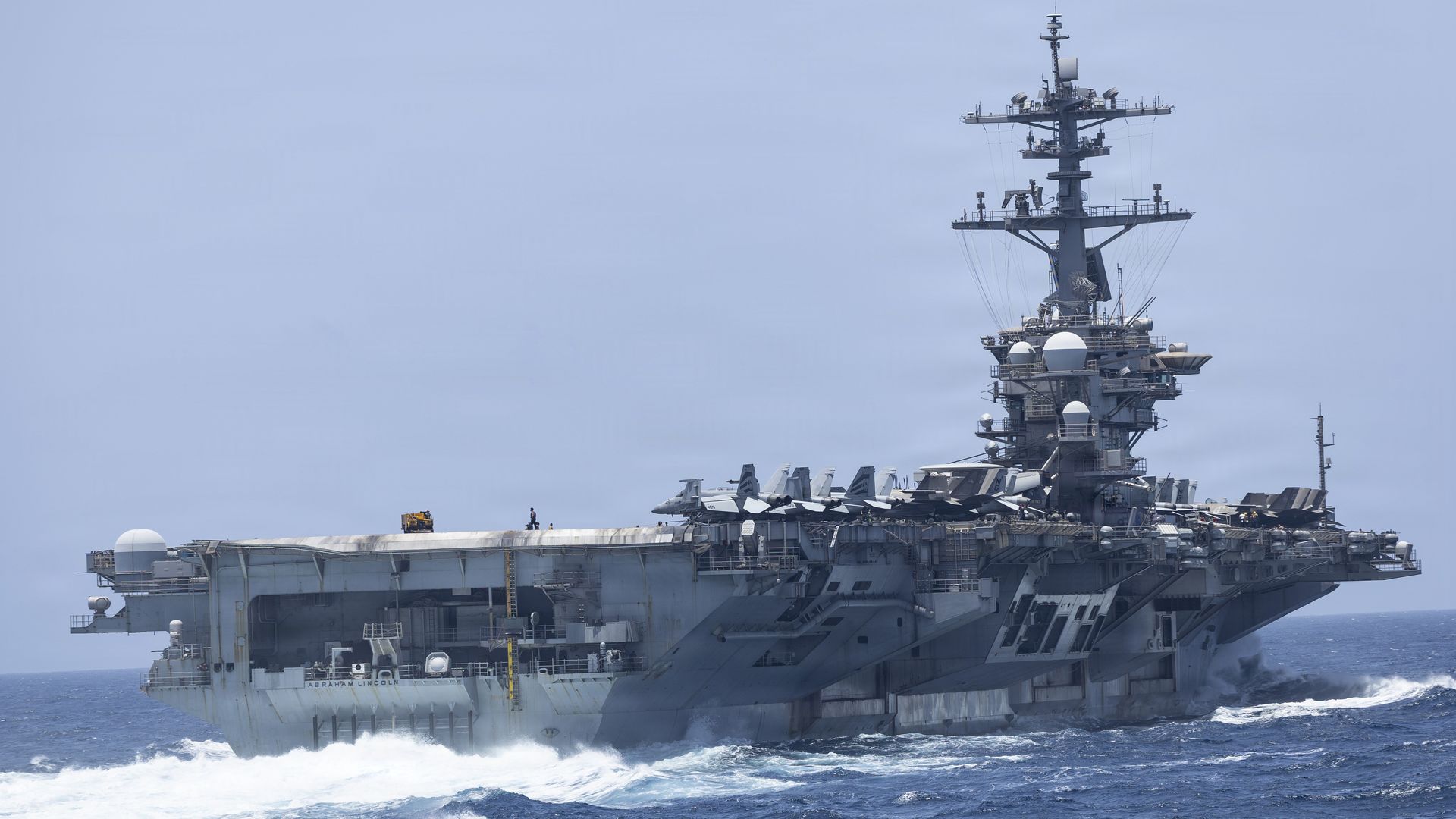
The U.S. Navy is in the throes of a roller-coaster news cycle.
The big picture: In just the past few days and weeks, we have heard:
- Reports of deteriorating conditions on multiple warships, illuminating how difficult at-sea logistics is and how quickly a deadly conflict can fuel online culture wars.
- A call from President Trump to overhaul shipbuilding as well as the physical design of some of America's largest and most expensive vessels.
- The dispatch of the last aircraft carrier in the Indo-Pacific to the Middle East and news of a destroyer stalled in the South China Sea, inspiring obituaries for the "Asia pivot" crowd.
Driving the news: A combination of war, dogged journalism, White House fiats, statements from uniformed and civilian military leadership, X feuds and lawmaker inquiry has kept any sort of summertime news slump at bay.
Here are some of the finer details, plus bits you may have missed:
⚓ The USS Abraham Lincoln, deployed for more than 265 days with few port calls in between, "will return home soon," according to acting Navy Secretary Hung Cao. "Unfortunately," he said in a statement, "the media are trying to paint our warriors as victims."
‼️ Several outlets, including the personnel-focused Military Times and Stars and Stripes, reported that distressed service members have tried jumping overboard.
⛔ The 5th Fleet publicly denied word that the USS Boxer, an amphibious assault ship, was running low on feminine hygiene products just months after departing California.
☁️ Trump, after years of beefing with electromagnetic launchers on aircraft carriers, directed the adoption of steam catapults and hydraulic lifts, namely for the future USS Doris Miller. (Trump in his first term said the Navy should revert to "goddamn steam.")
🔬 He also directed a comprehensive review of Naval Sea Systems Command, whose leader, Vice Adm. James Downey, just retired, as well as planning for a potential fifth stateside shipyard. The Office of Management and Budget teased another public yard this summer.
🪫 The USS Benfold, a guided-missile destroyer, was without power for days, knocking out air conditioning, toilets and showers, according to USNI News. It was aided by the George Washington carrier strike group, which is expected to relieve the Lincoln in the near future. (The Navy told me it does not comment on movements for security reasons.)
👀 And Sen. Ruben Gallego (D-Ariz.) said he wanted to inspect warship conditions himself. A group of 50-plus House Democrats pressed the Navy in a separate letter dated Aug. 14.
What we're watching: Whether the Pentagon responds to congressional pressure on time — or at all.
The bottom line: These are matters of life and death and financial consequence.
- Sailors and Marines contend with unique stressors and pressures, and tearing up blueprints will cost billions and billions of dollars.
Go deeper: Middle East-bound Ford aircraft carrier could break records
2. Exclusive: Strength in numbers

CenCore Group will on Friday unveil the Integrated Warfighter Ecosystem, a coalition of 150 businesses it has networked to win defense and intelligence-community contracts and arm U.S. troops with the best available gear.
Why it matters: "For me, personally, this really is the culmination of several years of work, to get this in place," CenCore chief executive Adam Fife told me.
- "When I spent my years downrange, we would get some really cool, engineered shit, but it didn't work."
Driving the news: Utah Gov. Spencer Cox is expected to speak at the launch and inaugural summit, to be hosted at CenCore's 55,000-square-foot headquarters in Utah.
- Senior defense officials were invited, as well.
State of play: A vast majority of IWE members are small to midsize businesses. Many are veteran-owned. And some have never even worked with the Defense Department.
- Their product lines comprise both hardware and software: autonomy, command-and-control, counter-drone, energy, manufacturing.
What they're saying: The Defense Department has "leaned very far forward, and they have started to put out dozens and dozens and dozens of very specific requirements that no single service provider can meet or match," Fife said.
- "To provide the best of, from a solutions perspective, you've got to work together. You have to collaborate. And so the IWE exists to enable that collaboration."
- Membership in IWE is described as "deliberate and limited."
Context: CenCore makes mobile SCIFs and deployable data centers. It employs about 1,700 people and operates across more than two dozen sites.
- Last month, it won a hush-hush contract with the intelligence community. (Fife declined to describe it in detail.)
- Before that, it won a $44 million contract to build up to eight relocatable SCIFs at Naval Information Warfare Center Atlantic sites.
What's next: The IWE is expected to have offices in Washington, D.C., and Utah.
The bottom line: "The CenCore tagline is, 'The warfighters are shareholders.' We have no investors," Fife said. "The tagline for the Integrated Warfighter Ecosystem is, 'By the warfighter, for the warfighter.'"
Go deeper: On the defense-tech road with Jamie Dimon
3. Juiced up JASSM
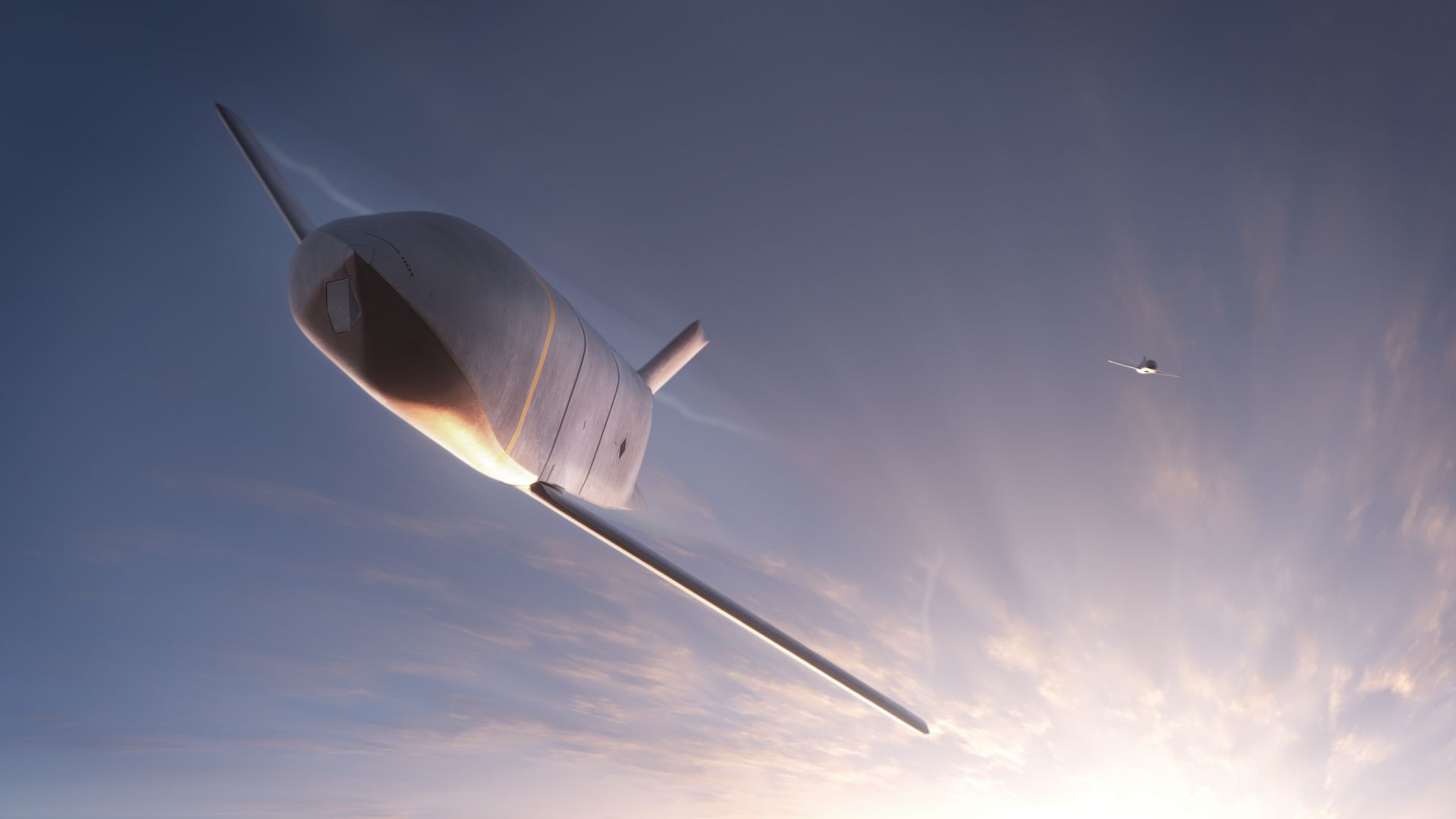
GE Aerospace and Kratos were together named a secondary propulsion supplier for Lockheed Martin's Joint Air-to-Surface Standoff Missile.
Why it matters: Another option never hurt.
Driving the news: The companies on Monday announced their co-branded GEK800, a turbofan capable of generating 800 pounds of thrust, was designated the F143 by the U.S. military and secured an engineering, manufacturing and development contract.
- The dollar value was not disclosed.
What they're saying: "This reflects years of disciplined engineering to deliver propulsion systems that meet the evolving, mission-critical requirements of our military customers," Amy Gowder, president of defense and systems at GE Aerospace, said in a statement.
- The GEK800 completed altitude testing last year.
Context: Lockheed describes JASSM as one of its first cruise missiles; it has since grown to include extended- and extreme-range variants. They are used on fighters and bombers alike.
Zoom out: Pentagon chief weapons buyer Michael Duffey visited GE Aerospace's facilities in Cincinnati on Monday.
Go deeper: Lockheed eyes Air Force test of extreme-range missile by year's end
4. Radar request
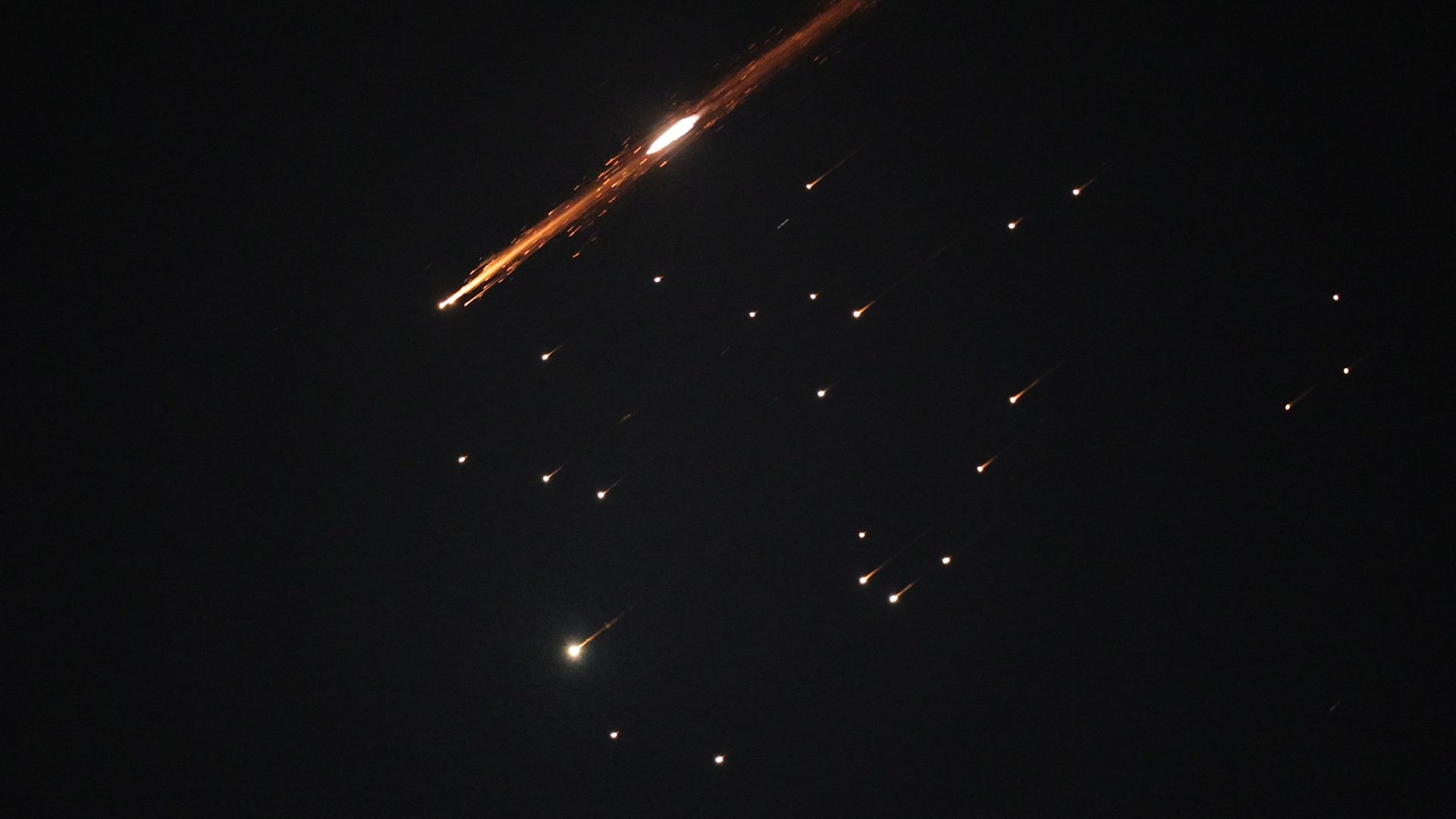
The U.S. Missile Defense Agency is on the hunt for mobile radars that can track ballistic, cruise and hypersonic missiles from remote outposts where few troops are stationed.
Why it matters: Static sensors and established bases are easy targets.
- Iran in recent months has targeted both, including an RTX-made AN/TPY-2 radar in Jordan.
Driving the news: The MDA this month published details on the upcoming Forward-Based Mode Radar Next competition, led by its Mobile Land-Based Sensors Project Office.
Zoom in: FBM Radar Next prototypes are expected to:
- Fit in Boeing C-17 transporters;
- Be set up within hours of arrival and torn down in minutes to evade fire;
- Seamlessly work with existing command-and-control networks;
- And be designed for rapid mass production while keeping costs low.
What they're saying: "As adversarial missile capabilities become increasingly sophisticated, the need for agile, survivable and highly precise forward-based sensors has never been greater," the MDA's notice reads.
What's next: Several phases of development, testing and evaluation are planned. Exactly when they begin is not clear.
More from Axios:
Northrop upgrading "the critical eyes" of F-16
5. Quick hits
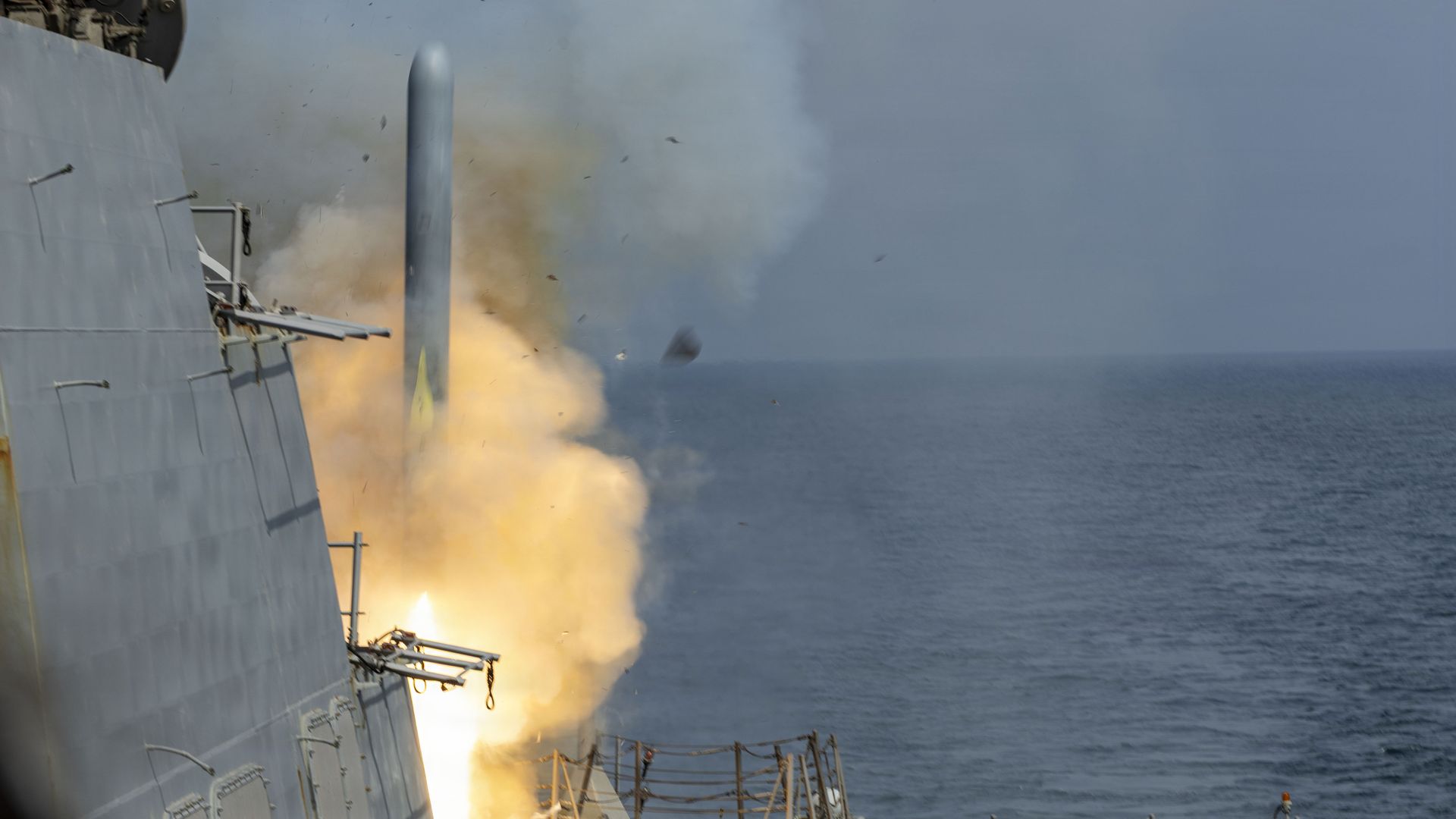
📈 RTX was awarded a $23 billion contract to greatly boost Tomahawk production. Raytheon president Phil Jasper in a statement described the missile as "the Navy's most important strike weapon."
- Why it matters: The U.S. military has expended incredible amounts of ordnance, including TLAMs, in fights across the Middle East. Resupply has not kept up.
- 💭 My thought bubble: This is fresh on the heels of a Standard Missile deal, too!
🚚 Radiant shipped its Kaleidos microreactor to Idaho National Laboratory, an almost 1,000-mile road trip, where it will be rigorously tested.
- Why it matters: "Radiant is the only company doing a full-scale test of our commercial reactor at DOME, where we have exclusive access to test for a year," COO Tori Shivanandan told me. "This is very different from others that build their reactors on site, because our whole system ships as a box that can be plugged in at the customer site."
- 💭 My thought bubble: There have been so many nuclear and energy-security announcements this summer. It's a sign of many more to come.
📃 The U.S. and dozens of other countries demanded at least a day's notice ahead of future intercontinental ballistic missile, submarine-launched ballistic missile and space-launch vehicle tests. The formal statement was issued Aug. 11, about a month after China's surprise JL-2 or -3 trial in the Pacific.
- Why it matters: "China cannot simultaneously expect to be respected like a global leader and still behave like North Korea when it comes to basic rules of the road around missile testing," Chris Estep, an Indo-Pacific security expert with the Foreign Policy Research Institute, told me.
- 💭 My thought bubble: More on that Chinese missile launch (with dummy warhead) here.
↔️ Aevex is buying BlackSea Technologies for as much as $650 million. The deal is expected to close in September.
- Why it matters: "Together, we intend to create one of the largest pure-play multi-domain autonomous systems providers, delivering effects to the battlefield across air, surface, and subsea domains," Aevex CEO Roger Wells said in a statement.
- 💭 My thought bubble: Are we beginning to see defense-tech consolidation? The balloon hasn't popped. But is it leaking?
6. Check this out
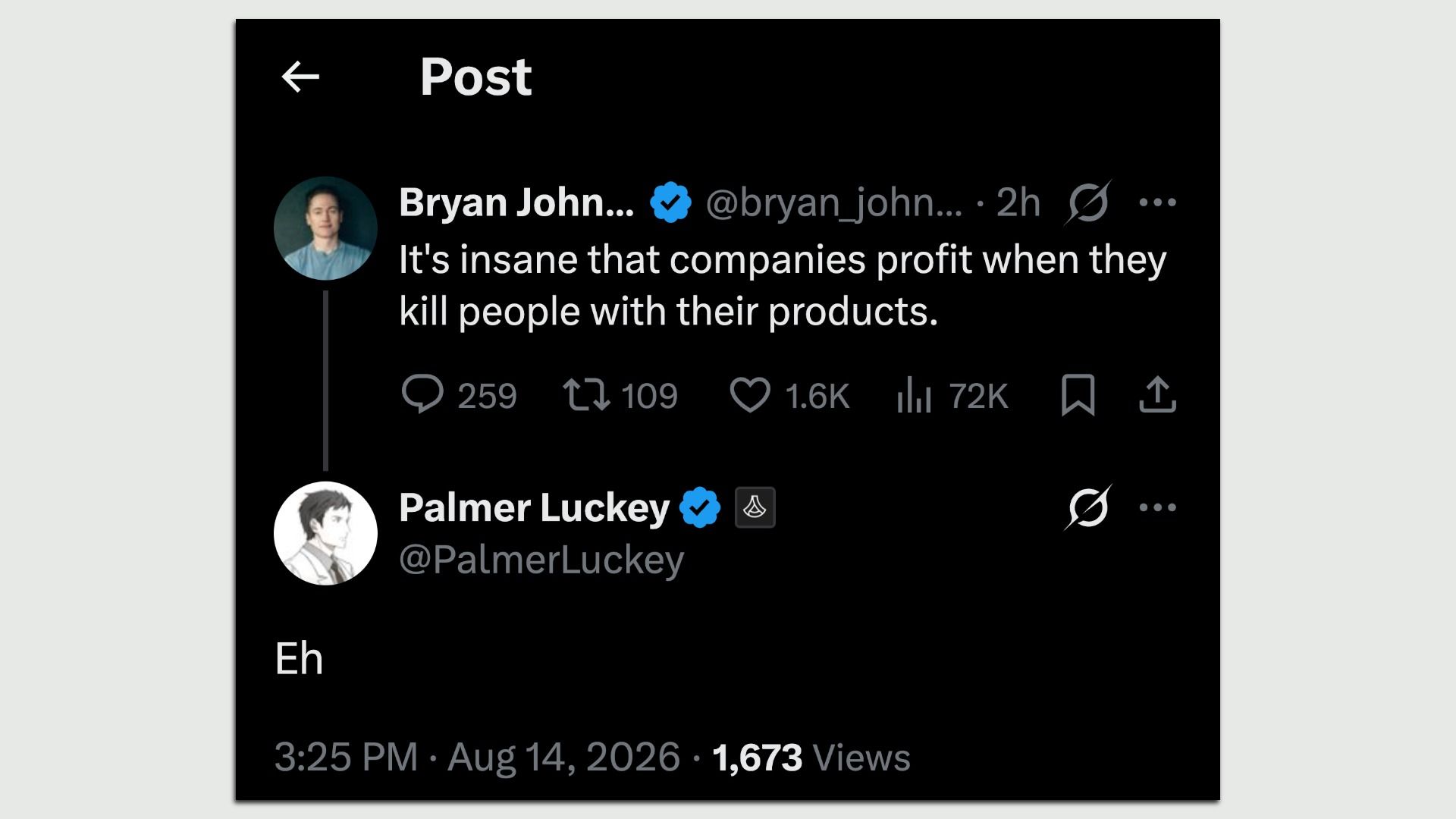
What happens when the Live Forever Guy and the Flip Flops Arms Maker Guy meet?
- This.
My thought bubble: X — Twitter! — is the gift that keeps on giving.
Go deeper: Anduril's Palmer Luckey on AI, nukes, and the war in Iran
Shoutout to Jeffrey Cane for editing and Matt Piper for copy editing.
👋🏼 Thanks, as always, for reading and sharing. Tell your friends to subscribe here.
Sign up for Axios Future of Defense