Axios Future of Defense
November 12, 2025

Hello, hello. It's cold. It's Wednesday. It's November.
- What defense events are on your calendar as 2025 wraps? Let me know!
🇻🇪 Situational awareness: The Gerald R. Ford carrier strike group, including thousands of sailors and dozens of aircraft, yesterday entered U.S. Southern Command's area of responsibility.
Inbound: Counter-Air Missile Program details, AMRAAMs and windmills, and catching up with Planet's Will Marshall.
Today's newsletter is 2,072 words, an 8-minute read.
1 big thing: A call to arms

Pete Hegseth is right now the belle of the defense acquisitions ball.
Why it matters: The defense secretary's Friday speech — invoking Donald Rumsfeld; roasting the way the U.S. military assesses and purchases weapons; warning that companies unable to modernize will "fade away"; promising to put portions of the Pentagon on a "wartime footing" — was the antithesis of his Quantico rally just weeks ago.
- While that address was heavy on nostalgia and MAGA ideology, this latest one avoided such trappings. It instead offered an ambitious roadmap.
- "This is the equivalent of the 'Ninety-five Theses' posted to the door of Castle Church in Wittenberg, Germany, in 1517," Steve Blank, a founding member of the Gordian Knot Center for National Security Innovation, told me.
- "This whole game is changing."
Driving the news: Alongside Hegseth's speech, the Pentagon this week shared the Acquisition Transformation Strategy and three related memos, each detailing changes to a system critics say is designed for industries and wars of yesteryear. Among the planned updates:
- Awarding bigger, longer contracts to companies to stimulate internal investment in production capacity and workforce training.
- Replacing program executive offices (PEOs) with portfolio acquisition executives (PAEs), a "single accountable official" with more decision-making power, as Hegseth put it.
- Amending the contract protest process to discourage frivolous claims and accelerate adjudication.
- Delivering realistic cost estimates, as projects continuously overrun their initial price tags and deadlines.
- Trading a predilection for bespoke, one-off products for a preference for commercially available and tested systems.
- Aligning the Defense Security Cooperation Agency and the Defense Technology Security Administration with the Undersecretary of Defense for Acquisition and Sustainment.
What we're hearing: Praise for Hegseth and the broader reformation poured in from builders, coders, industry groups, financiers, think tankers, startups and primes. (Few other Pentagon actions in recent memory have garnered such uniform reaction or so much LinkedIn pontification.)
- "By removing barriers that have, for too long, slowed innovation and deployment across the defense industrial base, Secretary Hegseth is positioning a broader range of firms to contribute to our national security strategy," said Keith Webster, president of the U.S. Chamber of Commerce's Defense and Aerospace Council.
- "Secretary Hegseth's speech is the most promising announcement for defense-tech innovators since the creation of Defense Innovation Unit itself," said Anshu Roy, the chief executive at Rhombus Power.
- "Treating weapons more like software — modular, upgradeable and built across a network of trusted factories — means we can field better kit in weeks, not years," said Chad Steelberg, the co-founder of Tiberius Aerospace. "Open up competition on the parts that matter, protect the IP and let performance decide the winners."
The intrigue: The business-first turn and corporate stylings were inevitable. The Trump administration is studded with businesspeople turned defense officials.
- Deputy Defense Secretary Steve Feinberg co-founded Cerberus Capital Management.
- Navy Secretary John Phelan was the chairman of private investment firm Rugger Management.
- Army Secretary Dan Driscoll was COO at a $200 million venture capital fund.
- Pentagon chief technology officer Emil Michael was chief business officer at Uber and served on the Defense Business Board.
Friction point: None of these changes happen overnight.
What we're watching: How the average Joe deep inside the Pentagon or at a PEO digests the changes — or the degree to which these roles and the folks holding them look different months from now.
- "There may be some challenges in the early days, but this is a pivotal moment for defense-tech companies and the investors who already know how critical it is to move quickly from innovation to adoption," said Veronica Daigle at Red Cell Partners.
More from Axios:
The Pentagon's software-hardware tug of war
Trump's Pentagon pick wants to "Make America Lethal Again"
What Hegseth thinks of Russia and China as he takes the Pentagon reins
2. Happy CAMPers

The U.S. Air Force is mulling a future anti-air weapon that should cost less than $500,000 when mass produced.
The big picture: While the Counter-Air Missile Program is very much in its infancy, the service has identified a need to "trade exquisite capabilities for affordability and producibility."
- Munition and interception costs have been heavily debated in the wake of recent Middle East exchanges, including with Iran and Houthi rebels in Yemen.
- Drones can cost thousands of dollars. Using multimillion-dollar missiles — among other costly countermeasures — to blast them is unsustainable.
State of play: CAMP will begin with ground launches and provide "a viable pathway to a low-cost air-to-air missile," according to documents posted Nov. 7.
- As many as 3,500 could be sought annually during full-rate production.
Flashback: The Air Force and Defense Innovation Unit this year picked Anduril Industries and Zone 5 Technologies to move forward on the Enterprise Test Vehicle project.
- Other competitors included Integrated Solutions for Systems and Leidos Dynetics.
Go deeper: AeroVironment nabs $96 million for counter-drone Freedom Eagle missile
3. "We are not doing this in a vacuum"

The U.S. must stomach the risks of artificial intelligence to ensure Western primacy and reap its long-term benefits, Palantir Technologies CEO Alex Karp said on "The Axios Show."
Why it matters: The U.S. and China are wrestling for geopolitical pole position. That competition colors everything from shipbuilding to cyber to microelectronics to munitions stockpiles.
- And, of course, Karp and his big-tech compatriots have every incentive to argue moving too slow is more dangerous than moving too fast.
Driving the news: AI "could go wrong in lots of ways. But, again, I would say we need to absorb a lot of risk there, because it's either going to go right and wrong for us or it's going to go right and wrong for China," said Karp, who has long espoused West-must-win views.
- "I get yelled at all the time for Ukraine, ICE, Israel and generally telling the truth."
Zoom out: China's DeepSeek and pennies-on-the-dollar models scrambled AI watchers and raised alarms among national security analysts earlier this year.
- "We're not doing this in a vacuum," Karp told Axios' Mike Allen. "We are going to be the dominant player, or China is going to be the dominant player, and there will just be very different rules depending on who wins."
- "You will have far fewer rights if America is not in the lead."
Follow the money: Palantir, the world's 70th largest defense contractor by revenue, this year inked a potential $10 billion software-and-data deal with the U.S. Army and continued delivering to the service Tactical Intelligence Targeting Access Nodes.
- The high-tech trucks promise to improve intelligence parsing and targeting via AI and machine learning. (Also involved are Anduril Industries, Northrop Grumman and L3Harris Technologies.)
The bottom line: "Honestly," Karp said, "the most important thing Palantir does is prevent war."
Go deeper: Palantir's $10 billion Army contract continues its D.C. win streak
4. AMRAAMs go Dutch
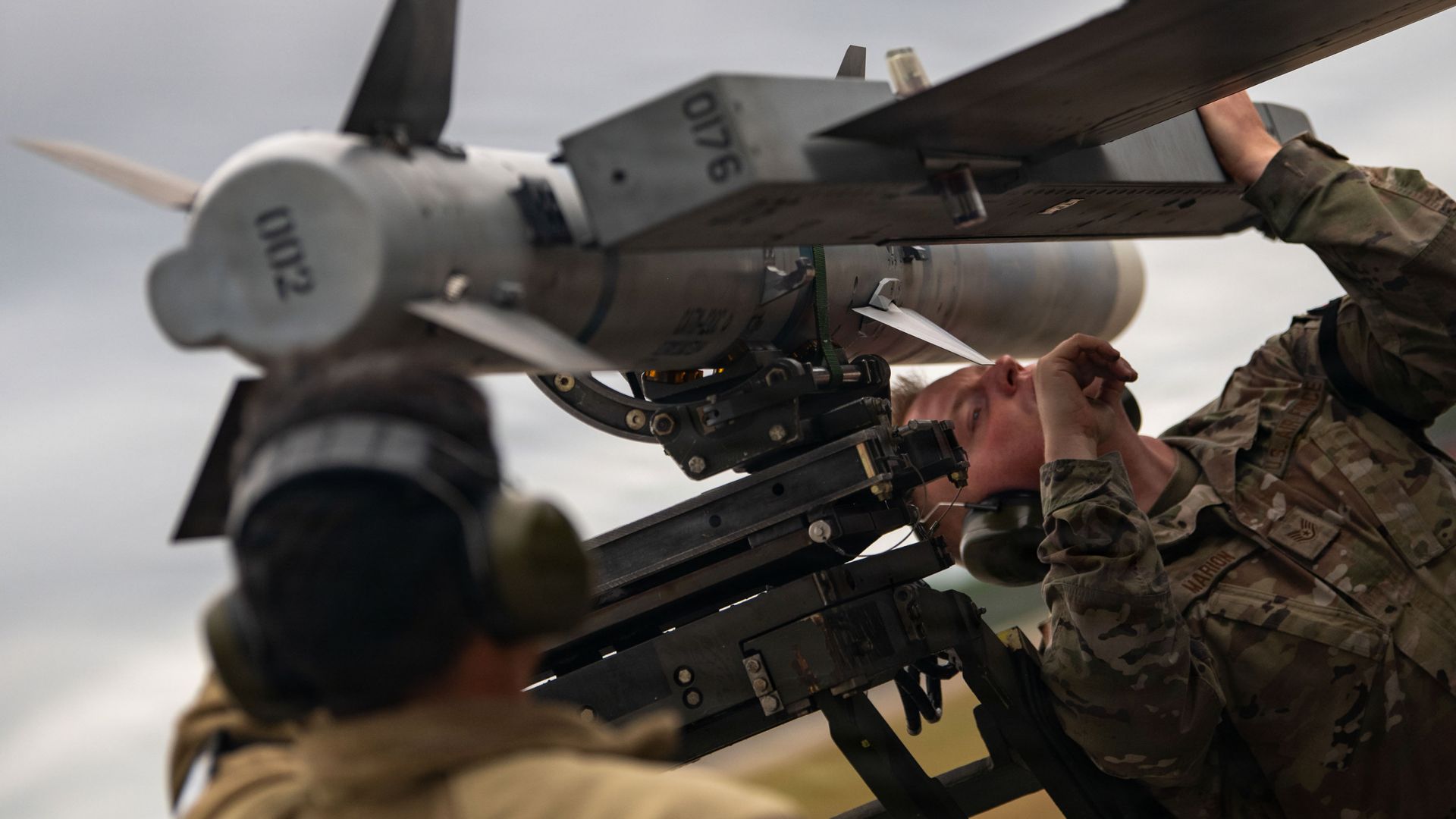
RTX is exploring production of its AIM-120 Advanced Medium-Range Air-to-Air Missile in the Netherlands, following a go-ahead from the U.S. government.
Why it matters: Such an arrangement would likely strengthen transatlantic ties and boost stockpiles.
State of play: The study, commencing next year, will consider how Dutch industry can contribute to the manufacture, assembly and maintenance of the missiles, according to the country's defense ministry.
- "Scaling up production is essential to continuing support for Ukraine and defending NATO territory," it said in a statement.
Friction point: An RTX spokesperson declined to answer my questions, referring them instead to the U.S. government, "which oversees those discussions."
Flashback: The State Department in September approved the potential sale of up to 232 AIM-120C-8 to the Netherlands.
- The deal was valued at $570 million.
Go deeper: Business groups pledge improved NATO industrial output
5. Quick hits
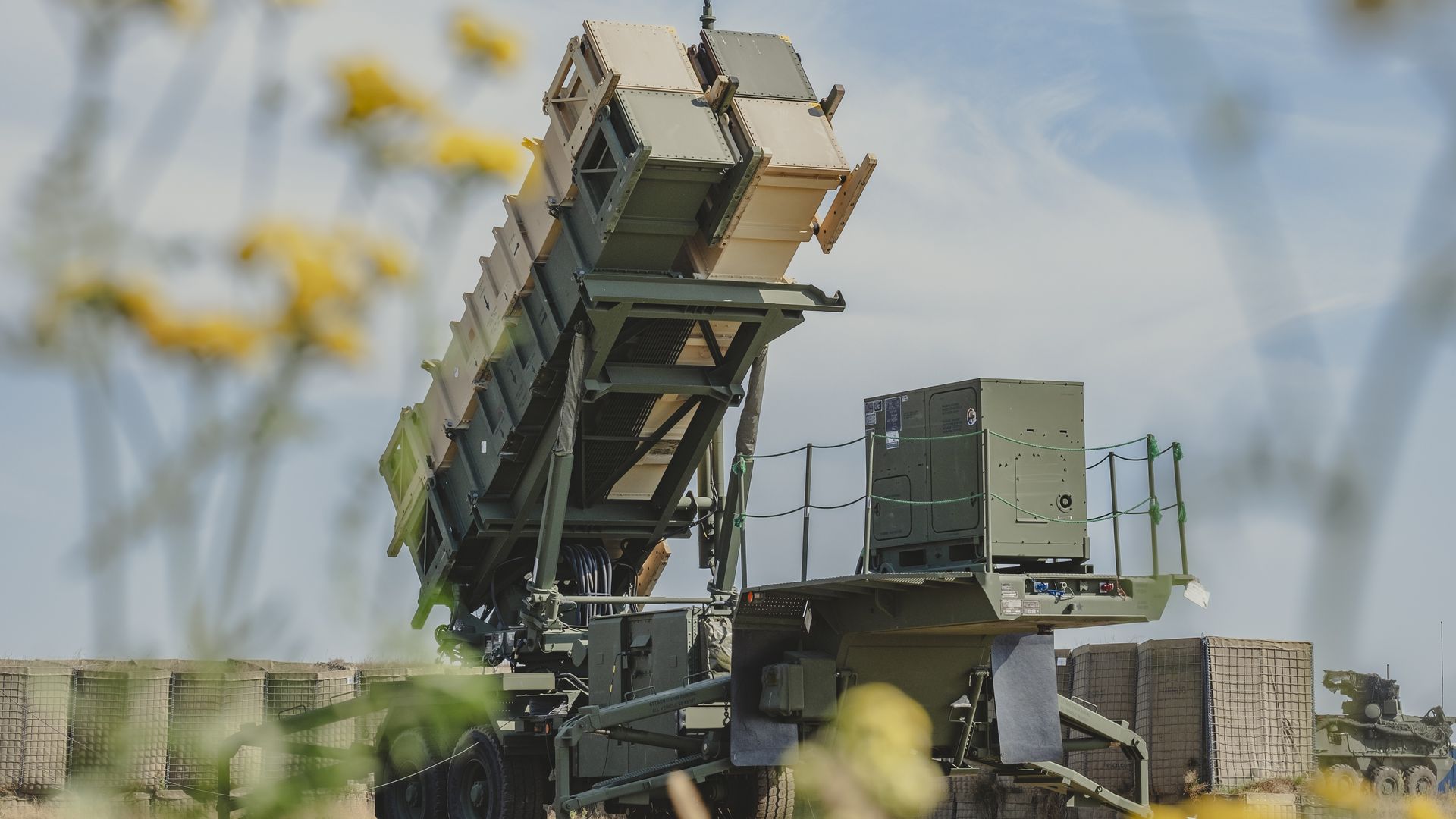
🇺🇦 Ukrainian President Volodymyr Zelensky said his embattled country wants to buy 25 Patriot systems. He acknowledged such a move would likely take "several years."
- Why it matters: Increased numbers and improved performance of air defenses has been a Ukrainian refrain.
- 💭 My thought bubble: Politico reported some interesting details on U.S.-Ukraine talks in October. Check that out, here.
🏧 J2 Ventures closed a $250 million fund, which will be spent on advanced computing, cybersecurity, AI and other dual-use investments. It previously backed Aalyria, Apex Space, Oura Ring and SkyFi.
- Why it matters: "We're entering a moment where urgency and investment are converging across both private venture and government to solve hard, consequential and high-stakes problems," co-founder Alex Harstrick said in a statement.
- 💭 My thought bubble: Notable: They're expressly not investing in weapons production, et cetera.
📈 Lockheed Martin delivered its 750th High Mobility Artillery Rocket System. The U.S. Army first fielded HIMARS in 2005; more than a dozen countries are now armed with it.
- Why it matters: "HIMARS was built to move, shoot and survive — and it was built to grow," Carolyn Orzechowski, vice president of precision fires launchers and missiles, said in a statement.
- 💭 My thought bubble: Interested in launchers? What about autonomy? I wrote about their intersection in October. Read it, here.
🚀 An unarmed Minuteman III intercontinental ballistic missile was test fired Nov. 5. It was initiated aboard a U.S. Navy E-6B Mercury aircraft.
- Why it matters: "As we modernize to the Sentinel weapon system, we must continue to maintain the readiness of the existing Minuteman III fleet," Gen. S.L. Davis, Air Force Global Strike Command boss, said in a statement.
- 💭 My thought bubble: Will Minuteman III outlive me? We shall see!
6. Axios interview: Will Marshall

This week's conversation is with Will Marshall, the chief executive at Earth-imaging and satellite company Planet.
Why he matters: His company's raison d'être, he told me, "is helping us to take care of this spacecraft — one spacecraft — called the Earth."
- Marshall was previously a systems engineer on the lunar orbiter mission LADEE and a member of the science team for the lunar impactor mission LCROSS.
Q: When you hear "future of defense," what comes to mind?
A: Not surprisingly, satellites and drones and AI. Also cyber. That combo is significantly important for information advantage in a conflict.
Q: When will wars be waged solely by robots?
A: At some level, it's starting to happen, right? Not solely, obviously, but I think there's more of that happening in the cyber realm than we might be publicly aware of already.
- I don't have a specific guesstimate, but 10 or 20 years seems like there may be real changes in this.
Q: Where are you investing internally, and how could it shake up the status quo?
A: Always better satellites — but AI is the place that's going to change the status quo. It's going to democratize, it's going to scale up and it's going to speed up the ability to extract information out of satellite data.
Q: What region of the world should we be watching? Why?
A: If you want to learn, it's Ukraine, Ukraine, Ukraine, because they're, I think, at the forefront of what's going on. If you're worried about future things, obviously there's Taiwan. But I'm not telling you anything new here.
- What else is interesting? I think the hybrid stuff is interesting, and a lot of that is happening in the maritime domain, and I'd imagine that would continue and be pretty serious.
Q: How many emails do you get a day, and how do you deal with them?
A: I don't know; I don't check. Kidding. Not kidding. I would say a few hundred a day.
Q: What's a piece of gear or tech you can't go without?
A: My tennis racket.
Q: What advice would you give your younger self?
A: Carpe diem. You think you've got infinite time, but you don't.
7. Check this out

Terranova exited stealth this week with $7 million in hand.
Why it matters: The upstart plans to terraform with robots roughly the size of cars.
What they're saying: "We've solved the challenges related to flooding, that's the headline," CEO Laurence Allen said in a statement.
- "We're combining heavy robotics and geotechnical innovation to literally reshape the world."
Follow the money: The seed round was led by Outlander and Congruent Ventures.
My thought bubble: There are certainly defense applications here. Earthen fortifications? Critical infrastructure? (Reply to this email with your best ideas.)
Shoutout to Dave Lawler for editing and Matt Piper for copy editing.
👋🏼 Thanks, as always, for reading and sharing. Tell your friends to subscribe here.
Sign up for Axios Future of Defense