Axios Future of Defense

February 18, 2026

Happy Wednesday, everyone.
- Got news planned for the Warfare Symposium in Colorado? Send it my way!
💵 Situational awareness: Seasats, a maker of small uncrewed surface vessels, on Tuesday announced a $20 million Series A. The round was led by Konvoy Ventures. Other backers include Shield Capital and Techstars.
Let's get it: Construction in Indiana and South Carolina (go Gamecocks), a look at Lockheed Martin's Lamprey, and a chat with Eric Jensen of ICEYE US.
Today's newsletter is 2,003 words, a 7.5-minute read.
1 big thing: "The factory is the weapon"

The Gauntlet kicks off at Fort Benning, Georgia, this week.
- The trials run through early March, putting small, inexpensive drones and their makers through the wringer as the U.S. attempts to learn the lessons of war in Ukraine.
The big picture: The tests, announced earlier this month, are part of the Defense Department's Drone Dominance push, which seeks to arm American troops with hundreds of thousands of expendable drones in a few short years.
- Ukrainian troops have successfully used such weaponry to battle back a Russian invasion.
- The stateside initiative, though, is less about crowning the next aerial ace and more about identifying reliable supply chains and cost-effective factories.
- "They're very blunt about it at Drone Dominance: If you can't produce them and deliver them on time — if you're two weeks late — you're out," Red Cat CEO Jeff Thompson told me.
- "It's all about production. The factory is the weapon."
Catch up quick: The Defense Department on Feb. 3 named 25 companies as participants in the first Gauntlet. They include Dzyne Technologies, Firestorm Labs, Neros, Performance Drone Works, Red Cat's Teal Drones and Vector Defense.
- Roughly $150 million in prototype delivery orders will be placed at its conclusion.
Zoom out: The Pentagon expects to spend a little more than $1 billion on the program over the course of four increasingly competitive phases.
What they're saying: Drone Dominance is "creating a demand signal for industry" and motivating people to plan "their manufacturing processes at scale" rather than one-offs, Connor Toler, a Dzyne product manager, told me.
- A separate official said the initiative has the potential to shift supply chains and change "how the drone industry does business with the department."
By the numbers: Some 70-80% of casualties in the Russia-Ukraine war are caused by drones, according to a recent Latvian intelligence report. Kyiv alone is said to be using 9,000 drones per day, many of which are produced domestically.
- The U.S. is not ready to deploy or destroy cheap drones on that scale.
- Drone Dominance "is catching the U.S. up to where they perceive — and it's true — the Ukrainian market has been at for quite some time," Amol Parikh, the co-CEO at Doodle Labs, told me. (Doodle has a handful of customers in the cohort.)
- "There's structure to the program," he said. "There's structure to the fly-offs right from the outset and structure to how this thing will advance."
What we're watching: Whether Drone Dominance can distinguish itself from Replicator, the Biden-era push for unmanned mass to counter China, which critics say failed to meaningfully move the ball forward.
Go deeper: RTX downs drone swarms at Army trials
2. Exclusive: Breaking ground in Indiana

The American Center for Manufacturing and Innovation will break ground tomorrow on a 1,100-acre defense-tech development and manufacturing hub in Indiana.
Why it matters: The venture is backed by a $75 million Defense Department munitions campus investment. It also neighbors Naval Surface Warfare Center-Crane Division, one of the largest naval installations in the world.
The latest: Defense officials and members of Congress — Republican Rep. Mark Messmer and Sens. Jim Banks and Todd Young, all of the Hoosier State — are expected to attend the shovel-turning.
- "Indiana is a high-capacity manufacturing state, historically. We've got the workforce and defense partners," Messmer told me.
- "As we work on this year's NDAA, we're going to continue to look at building out a more robust supply chain and how we can most effectively do that."
State of play: This first National Security Industrial Hub is meant to springboard emerging technologies, bulk up domestic resources and foster national security collaboration, including with academia, according to ACMI Group chief executive John Burer.
- "As we launch this, it's a template for rebuilding the defense industrial base, the manufacturing capability," he told me.
Zoom in: Prometheus Energetics, a Kratos and Rafael Advanced Defense Systems joint venture, will establish its headquarters and main solid-rocket motor facilities on 600 acres of the property.
- "There is a significant demand in the marketplace for solid-rocket motors and energetics," Daniel Merenda, the COO, told me. "The inventory has been depleted over the last several years, given what's happened on the national stage."
- Merenda expects a prototype factory to be "turned on" this year. The first proper production line could be up and running toward the end of 2028. Long-term, four full production lines are envisioned, "approaching tens of thousands of rockets a year."
By the numbers: The project is advertised as creating thousands of jobs and catalyzing $600 million in private spending.
What's next: Burer teased two other groundbreakings that could happen as soon as this summer.
Go deeper: Army kickstarts plans for huge artillery ammo factory in Iowa
3. Boom or bust
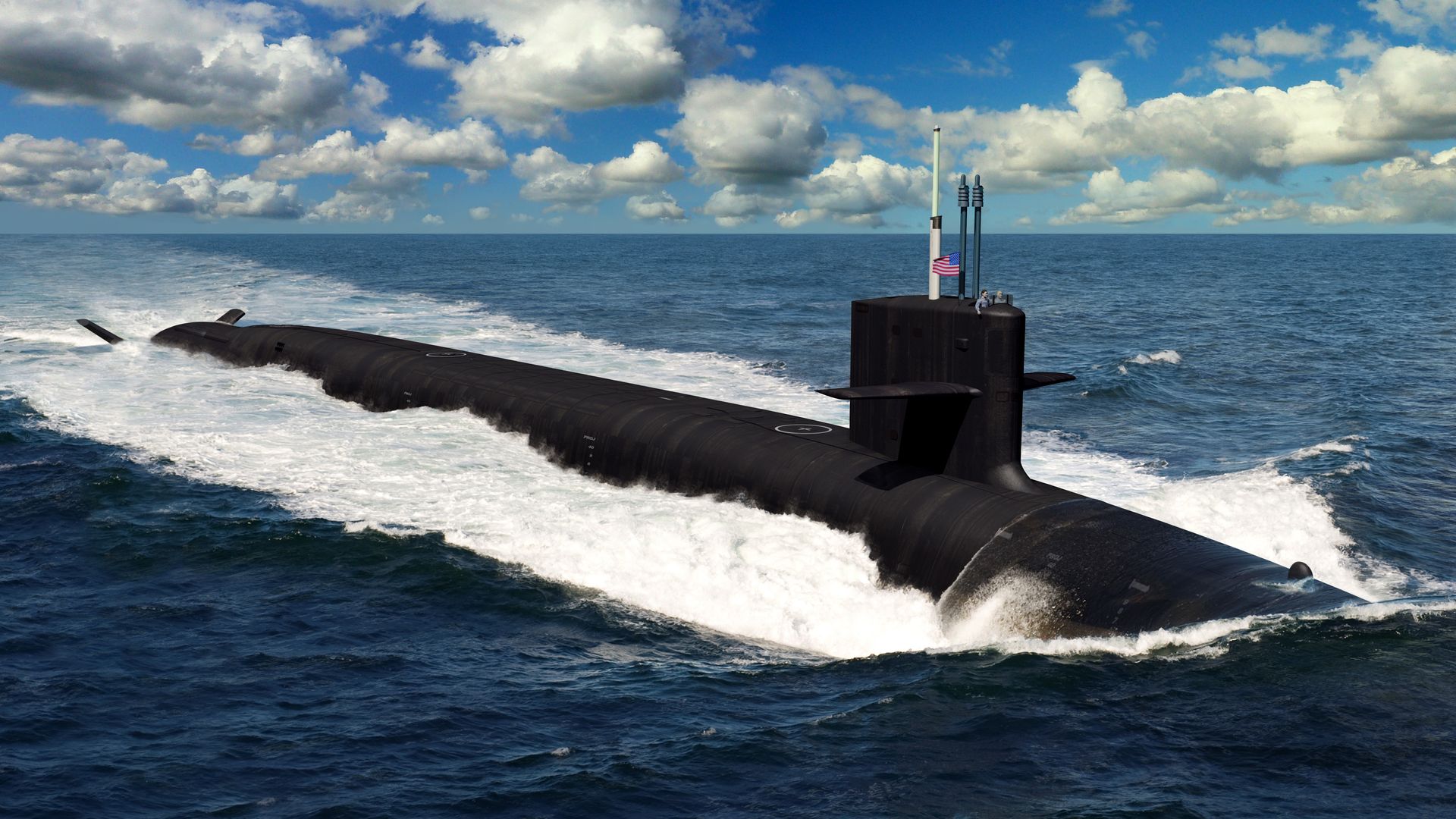
The first Columbia-class ballistic missile submarine, the District of Columbia, is 66% complete and is now expected to be delivered in 2028, according to a U.S. Navy official.
- The second, the Wisconsin, is 35% complete. The third, the Groton, is 10% complete.
Why it matters: Columbia-class subs have long ranked as the service's No. 1 priority. They will be armed with nuclear weapons, like the aging Ohio-class they succeed.
Driving the news: Program Executive Officer for Strategic Subs Rear Adm. Todd Weeks provided an update on the boomers at the WEST naval conference in San Diego.
- "With Columbia, we've been on a steady ramp up to full-rate construction, and we will hit full-rate construction in 2031," he said.
Friction point: American shipbuilding has been beset by workforce woes and schedule slips.
- "This time last year, we sat down with our shipbuilding partners and we realized that we were not where we needed to be on the District of Columbia," Weeks said.
Zoom out: Trump 2.0 has fixated on seapower. Take, for example, the Golden Fleet.
Go deeper: Navy unveils "ShipOS" with Palantir to speed up shipbuilding
4. Exclusive: CenCore construction

CenCore Group will build up to eight modular, relocatable SCIFs at Naval Information Warfare Center Atlantic sites under a contract with the U.S. Navy.
Why it matters: The deal gets the service "mission ready literally five to seven years faster than they would have if they had done a traditional stick build and gone through the" military construction process, CEO Adam Fife told me.
Driving the news: The contract is valued at $44 million.
- It was awarded in September but is just now being publicized.
Zoom in: Each building will be a single story tall and cover 4,800 square feet. They will be placed on preexisting concrete pads in the Charleston area.
- "We don't go for sexy," Fife said. "We go for critical."
Follow the money: The contract follows a $19 million arrangement with the Marine Corps announced last year.
Catch up quick: CenCore is based in Utah and employs about 1,000 people. It has manufacturing facilities in Colorado and South Carolina.
The intrigue: The company works closely with the intelligence community.
- Fife declined to detail those arrangements.
5. Quick hits

🦈 Lockheed Martin trotted out its Lamprey multi-mission autonomous undersea vehicle at the WEST conference in San Diego. The MMAUV can hitch rides on ships or submarines (hence the name) as well as launch torpedos and aerial drones.
- Why it matters: The Lamprey was internally funded, and there's already "significant interest across the board," according to Stephanie Hill, president of Lockheed's rotary and mission systems division. "The idea of crewed-uncrewed teaming is taking off."
- 💭 My thought bubble: Check out Lamprey in action, here.
ℹ️ The U.S. Navy plans to embed more-senior information warfare officers (O-4 level) aboard destroyers. The pilot begins this summer, according to Vice Adm. Michael Vernazza, the head of Naval Information Forces.
- Why it matters: The decision was spurred by a "discussion about how we could improve readiness at the tactical level," Vernazza told reporters at WEST. "Being at sea is a good thing, and I have no shortage of folks who want to do that."
- 💭 My thought bubble: WEST remains my favorite conference on the circuit. Tacos, anyone?
🇸🇾 Syrian forces took over al-Tanf garrison in the country's east, following a planned U.S. withdrawal.
- Why it matters: Al-Tanf played a major role in the fight against the Islamic State. Central Command boss Adm. Brad Cooper said in a statement that American forces "remain poised to respond to any ISIS threats that arise in the region."
- 💭 My thought bubble: Remember this headline from April 2025? "U.S. slashing military presence in Syria."
🤖 Widespread adoption of DeepSeek springboards China's "new industrial revolution" and serves as a channel for "promoting Chinese propaganda in the West," according to a report from Estonia's foreign intelligence agency.
- Why it matters: Such claims do not mince words. "In the West, many assume that DeepSeek's distortions are limited to highly sensitive issues such as Tibet, human rights, Taiwan, the Tiananmen Square massacre, and the Uyghurs," the report reads. "However, the reality is far more nuanced."
- 💭 My thought bubble: I don't use DeepSeek. Or TikTok.
6. Axios interview: Eric Jensen

This week's conversation is with Eric Jensen, the chief executive at ICEYE US.
- We've chatted a few times, and most recently linked up at the Reagan National Defense Forum in California.
Why he matters: ICEYE is part of the remote-sensing boom, as it designs, builds and operates a fleet of satellites that collects information about the Earth.
- Jensen also has years of experience at Boeing, including at its clandestine Phantom Works division.
Q: When you hear "future of defense," what comes to mind?
A: Cross-domain platform integration. That is what AI allows us to achieve.
Q: When will wars be waged solely by robots?
A: The next war.
Q: What's a national security trend we are not paying enough attention to?
A: Decision autonomy in space.
- In the same breath today, we can say "AI, quantum and space-based capabilities." We can talk about them all in the same paragraph.
- There are a lot of things that we DARPA-fied in the 1990s — envisioning all these amazing things that we would do in space, and we demonstrated a lot of them. Now we can actually operationalize them.
Q: How many emails do you get a day, and how do you deal with them?
A: About 200-300. AI has been great at helping consolidate those down into what's urgent, what's important and what's trashable.
- Really, the absolute best way to deal with email is just not read it.
- If people need you or you need to help them, you're going to find a way to do that.
Q: What's your secret to a successful overnight flight?
A: Three-part secret. Part one: water, water, water and nothing else. Part two: high-thread-count onesie. Part three: half of a Tylenol PM, but no other heavier aids. And lie flat if possible.
Q: What's a piece of gear or tech you can't go without?
A: An off-road espresso machine.
- I love to hike, hunt, explore the wilderness, camp. I would prefer always to do it with my single serve manual espresso maker.
- What's something I believe that no one else does? You can make a barista-quality shot of espresso on your own — off grid — without any steam or anything like that.
7. Check this out
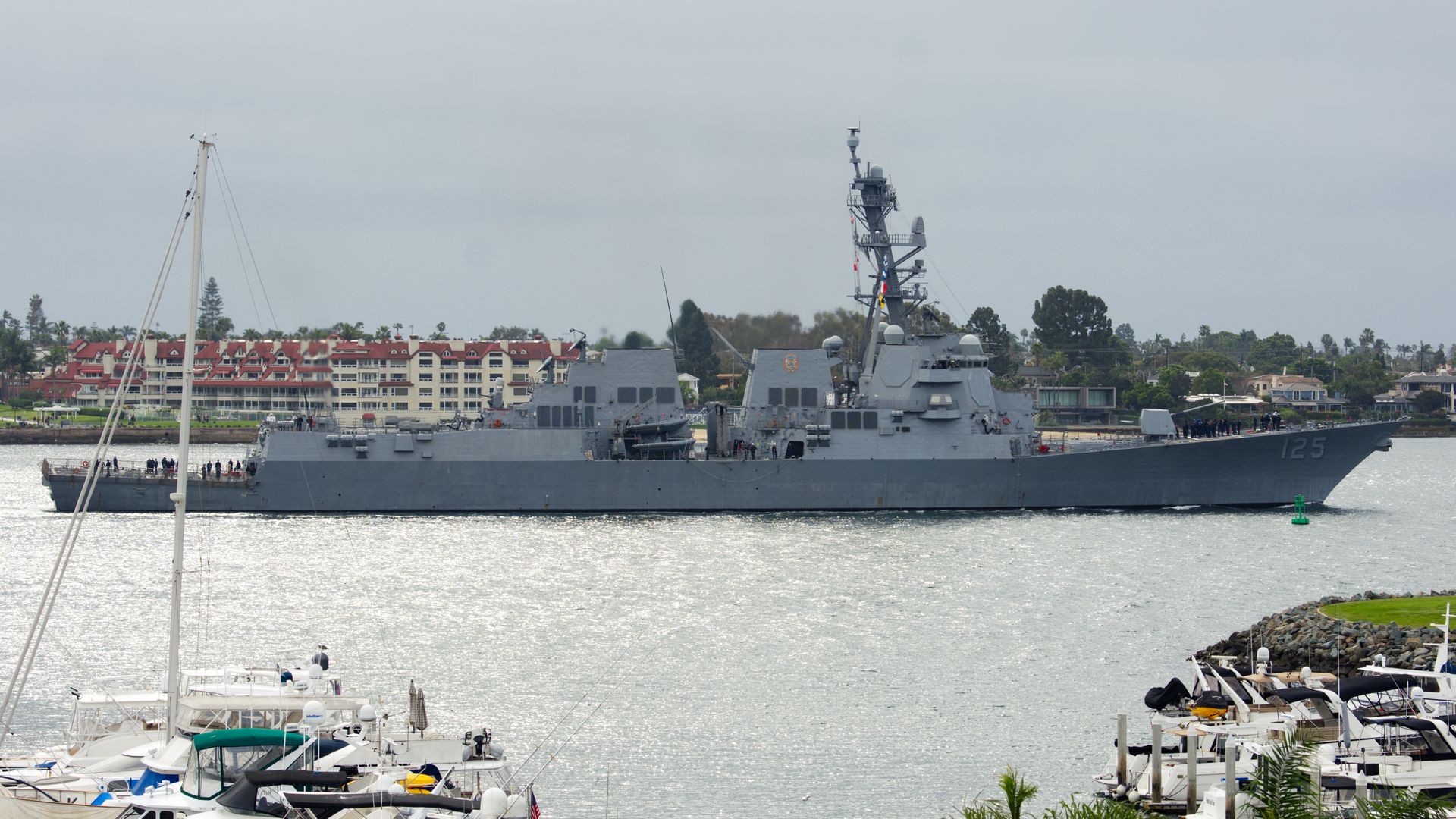
The USS Jack H. Lucas pulled through the San Diego Bay on the first day of the WEST conference.
The big picture: It's an Arleigh Burke-class guided missile destroyer — and the first Flight III in the U.S. Navy. It was commissioned in 2023.
My thought bubble: Big boat!
- Also, thanks to Riley Ceder at Military Times for letting me back in the building after locking myself out taking this photo.
Shoutout to Dave Lawler for editing and Matt Piper for copy editing.
👋🏼 Thanks, as always, for reading and sharing. Tell your friends to subscribe here.
Sign up for Axios Future of Defense