Axios Future of Defense

May 28, 2025

Hello from St. Thomas. I'm off this week; give my inbox a breather.
- We're sticking with the schedule, though. Next newsletter's out June 4.
🇩🇪 Situational awareness: Germany lifted range restrictions on weapons supplied to Ukraine, allowing for deeper strikes on Russian infrastructure, according to Chancellor Friedrich Merz. (He did not name-drop Taurus, missiles that have a range greater than 300 miles.)
- My thought bubble: Better late than never!
What's to come: Shahed blasters, a Pentagon clampdown and North Korea's ill-fated warship.
Today's newsletter is 1,356 words, a 5-minute read.
1 big thing: Bloat spells Dome's doom

Intercepting missiles — hitting a bullet with a bullet — is difficult. Overcoming bureaucracy may be even harder.
The big picture: President Trump's Golden Dome, a continent's worth of 24/7 overhead defense, will be a jigsaw puzzle of ideas, authorities, personalities, contractors, procurements, production lines, users, fixers, technological leaps and diplomacy.
- Realizing even the most basic form in three years, as the president and Pentagon promised, will require intense coordination.
- Getting it done fast means resisting Washington's greatest vice: new offices, task forces, branches, blue-chip studies and advisers.
Driving the news: I consulted a half-dozen analysts, businesspeople and former defense officials and tuned into some timely think-tank discussions to get a temperature check.
- Simply put, Golden Dome is polarizing. (And that's without asking what the Chinese or Russians think of it.)
The latest: "I think there's been a lot of discussion about the capability ... and there's been little discussion about the organization and the authorities to get stuff done," Tom Karako, an expert at the Center for Strategic and International Studies, said in an interview.
- "We don't need to re-create the wheel."
State of play: Trump this month gave the world its best look yet at Golden (née Iron) Dome during an Oval Office address. He was accompanied by Defense Secretary Pete Hegseth and a handful of lawmakers.
- The president tapped Gen. Michael Guetlein, the vice chief of space operations, as his lead. Folks I spoke with applauded that choice.
- Trump, who mentioned "super technology," also slapped on a $175 billion price tag. That's low, considering the cost of the space-based interceptors at the heart of the concept.
- He also described Alaska as a key contributor to the vision. A Boeing-led team recently finished building 20 new silos for the homeland missile defense system at Fort Greely, Defense News reported.
What they're saying: "There was a rollout, but there was almost no information," Laura Grego, a senior research director at the Union of Concerned Scientists, told me.
- "I think the way most people are starting to use 'Golden Dome' is synonymous with space-based missile defense. But the executive order covered every missile from every adverse area every time," she said.
- "I can hardly imagine potential adversaries just sitting still, not developing the ways to counter such a system."
Yes, but: The defense industry is raring to go.
- Jordan Blashek, a managing partner at America's Frontier Fund, told me "breakthrough technologies have now made something like Golden Dome possible, fulfilling the Reagan administration's vision" for the Strategic Defense Initiative.
- Trump cited Reagan several times in his Oval Office remarks.
Case in point: Apex, a satellite bus maker, is "heavily investing in internal research and development funding for this, as are our partners," CEO Ian Cinnamon told me. (The company recently announced a $200 million Series C.)
- Cinnamon foresees different methods for different threats: intercontinental ballistic missiles, hypersonic glide vehicles, fractional orbital bombardment systems.
- "There are so many pieces ... and they all need to talk," he said. "They all need to listen. They all need to be able to do that within milliseconds."
What we're watching: Where political deadlines clash with technical readiness.
- How much of what will be called Golden Dome in 2028 already exists today?
2. Dan Driscoll's backup

Defense Secretary Pete Hegseth and the wider Trump White House are providing "air cover" for the U.S. Army's ongoing vehicle-and-weapons upheaval, the service's top civilian told me.
Why it matters: System shocks are exactly that — a shock. Executing them requires support, especially at such a politically volatile moment.
- "Fundamentally, they just have a risk tolerance that doesn't match, I think, previous administrations," Secretary Dan Driscoll told me at an Axios event.
- "There are a lot of states and congressional districts and lobbyists; there are rational reasons why it exists the way it is today," he said. "Those reasons are just not in the best interest of soldiers."
Friction point: On the materiel chopping block are longtime favorites (Humvee, Apache and the Improved Turbine Engine Program) as well as relative newcomers (M10 Booker).
By the numbers: The Army is expected to save $48 billion over the next five years.
- Driscoll told me he and others consider comparisons between the Army Transformation Initiative (ATI) and Elon Musk's DOGE a compliment.
- "I think DOGE is loaded," he added. "You have a lot of people who have these feelings about it."
The intrigue: Both Driscoll and Army Chief of Staff Gen. Randy George have been working the media circuit since ATI was announced May 1.
- That includes an appearance on Fox News, in which George said the service is cutting "some of the bloat, making sure that we get after the inefficiencies, so that we're completely focused on buying war-winning technologies."
Go deeper: U.S. Army seeks better batteries as it battles the cold
3. Blastin' clays in Ukraine
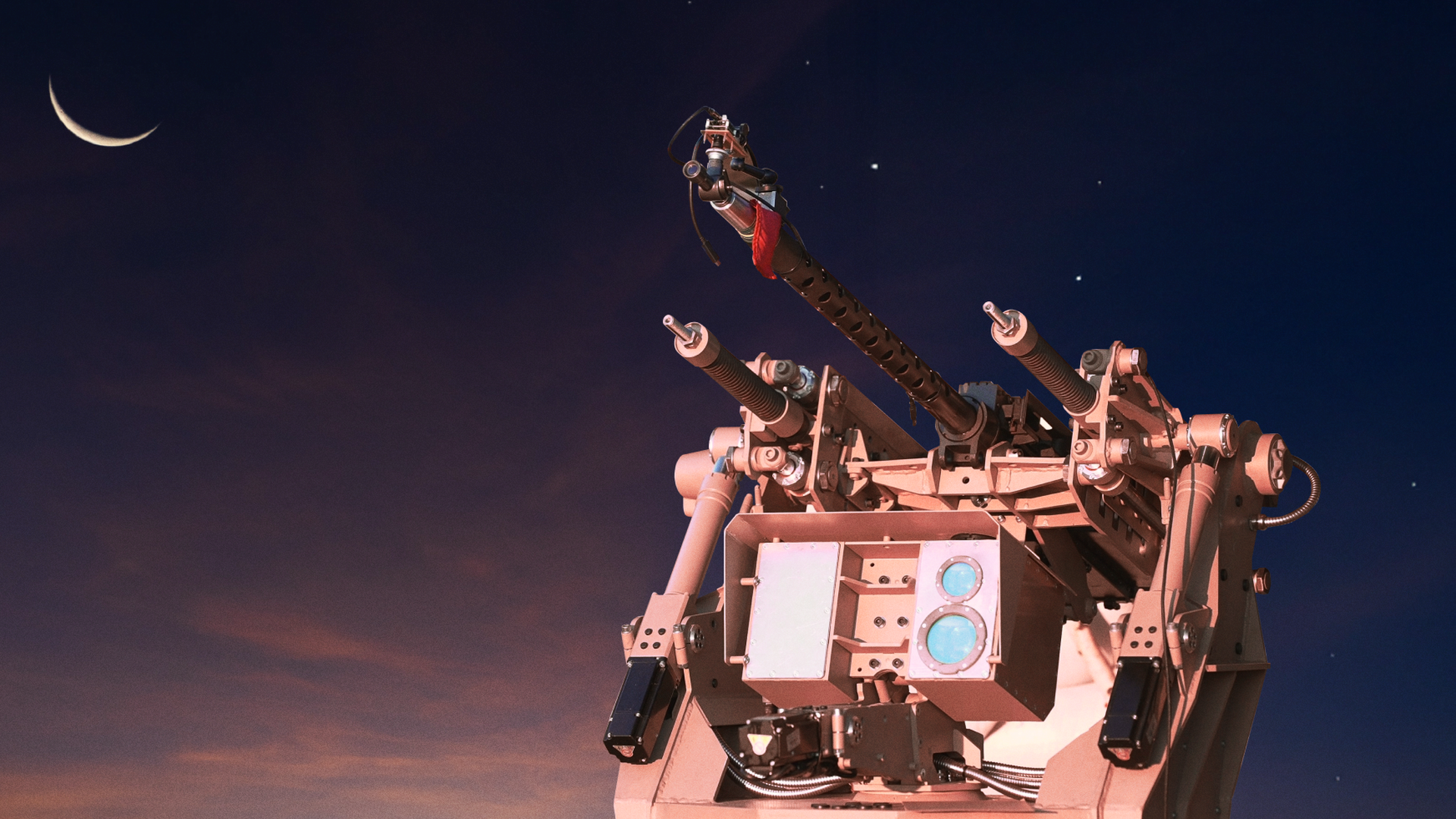
Ukraine is trotting out automated turrets to blast incoming Shahed drones and other airborne barrages.
Why it matters: Traditional interceptors can be time-consuming and expensive to produce en masse.
- Bullets and machine guns? Not so much.
Zoom in: Each Sky Sentinel costs roughly $150,000. It relies on foreign-made components for targeting and range-finding, but its software is domestic.
- A turret prototype has already seen action, downing a handful of Shaheds, according to United24, a fundraising organization launched by Ukrainian President Volodymyr Zelensky.
- United24 is seeking $1.5 million to build and deploy more of the defenses.
What they're saying: "Technology is our key advantage on the battlefield," Mykhailo Fedorov, Ukraine's digital-transformation minister, said in a statement.
- "Turrets, artificial intelligence, automation — these are not just innovations, but tools for protecting lives."
Go deeper: Ukrainian feedback is fueling L3Harris radio updates
4. Quick hits

🚷 Defense Secretary Pete Hegseth cracked down on press access in the Pentagon, restricting reporter movements without escorts and blocking access to common areas.
- Why it matters: It's a break from decades of tradition. The National Press Club and the Pentagon Press Association called for an immediate reversal.
- 💭 My thought bubble: Trump 2.0 has held only one public Pentagon briefing. That was March 17.
🇺🇦 Russia unleashed on Ukraine at least 83 missiles and 548 drones over the weekend, according to the latter's foreign affairs ministry.
- Why it matters: "Moscow drags this war out daily, continuing to kill and destroy," the ministry said in a statement. "Every one of these terrorist strikes is a clear reason for new, tougher sanctions against Russia."
- 💭 My thought bubble: Peace talks are having zero effect on Russian President Vladimir Putin.
✂️ The U.S. Defense Information Systems Agency will lose 10% of its staff as a result of the Trump administration's reduction of the federal workforce, according to Army Lt. Gen. Paul Stanton.
- Why it matters: "It's giving us an opportunity to ruthlessly realign and optimize how we're addressing what is an evolving mission," Stanton told lawmakers last week.
- 💭 My thought bubble: My colleague Emily Peck has been all over the Beltway hiring-firing saga. Check out one of her most recent articles, here.
🚧 L3Harris Technologies broke ground for five new solid rocket motor facilities in Virginia. The expansion includes a 12,000-square-foot cast and assembly plant.
- Why it matters: The project will "strengthen our national security, rebuild America's defense industrial base, and build key components for munitions such as the Javelin," Rep. Eugene Vindman (D-Va.) said in a statement.
- 💭 My thought bubble: Growth is good, especially in the rocket-motor market.
5. Check this out
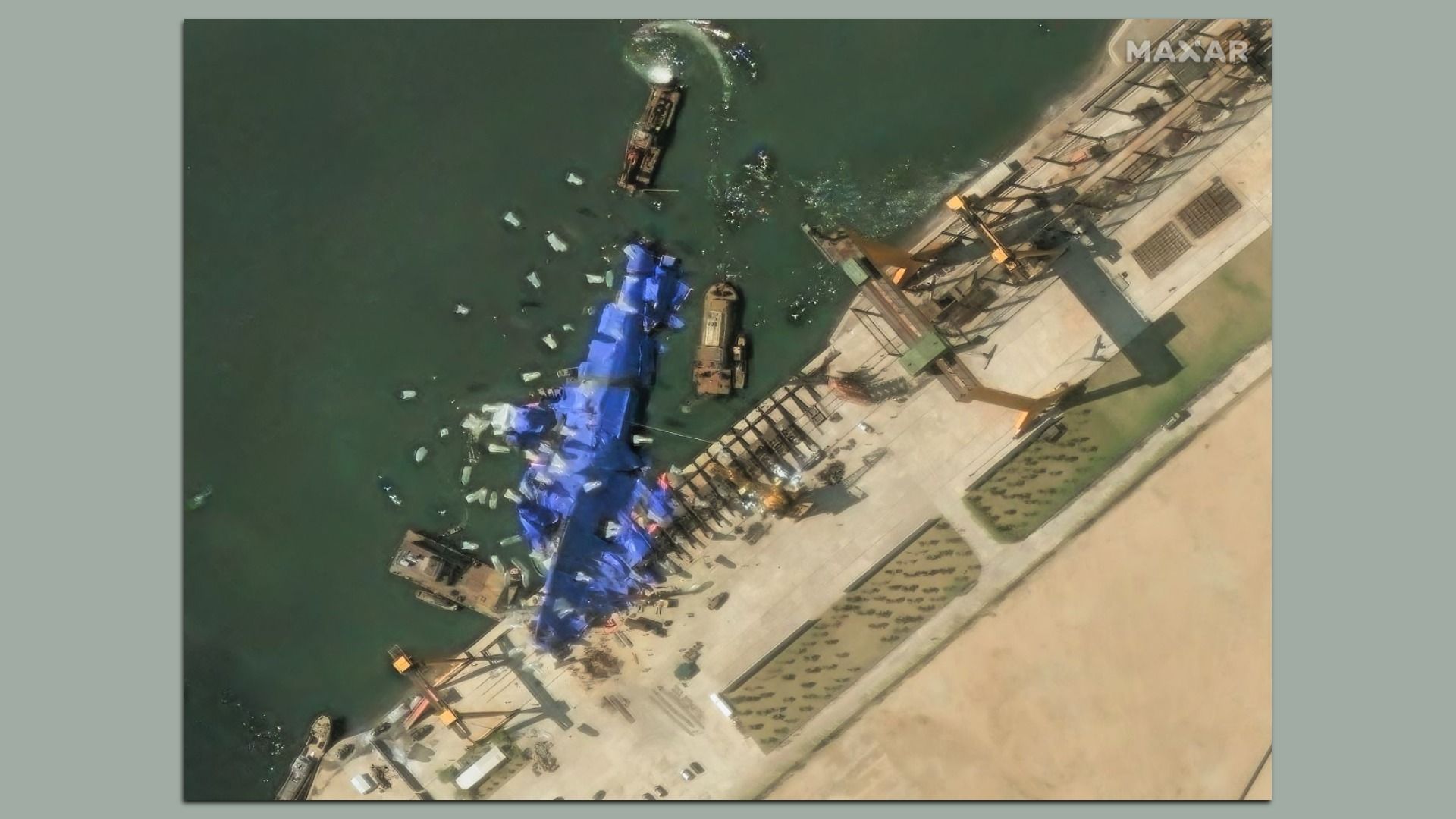
North Korea's destroyer is, uh, destroyed.
The big picture: Satellite imaging firm Maxar is keeping close tabs on the disastrous warship launch and recovery effort at the port of Chongjin, above.
The latest: The destroyer remained on its side and wrapped in blue tarps over the weekend.
- Cranes, barges and a VIP viewing area can be seen in various overhead photos.
What they're saying: "North Korea appears to be attempting to lift up their destroyer with methods inspired by Pixar's hit 2009 film 'Up,'" Decker Eveleth, an expert at the Center for Naval Analyses, said in a post on X.
- "Note the numerous balloons in the air above the destroyer."
Go deeper: North Korea detains 4 officials over failed warship launch
Shoutout to Dave Lawler for editing and Matt Piper for copy editing.
👋🏼 Thanks, as always, for reading and sharing. Tell your friends to subscribe, here.
Sign up for Axios Future of Defense