What the "rocket drone" Palianytsia means for Ukraine

Add Axios as your preferred source to
see more of our stories on Google.
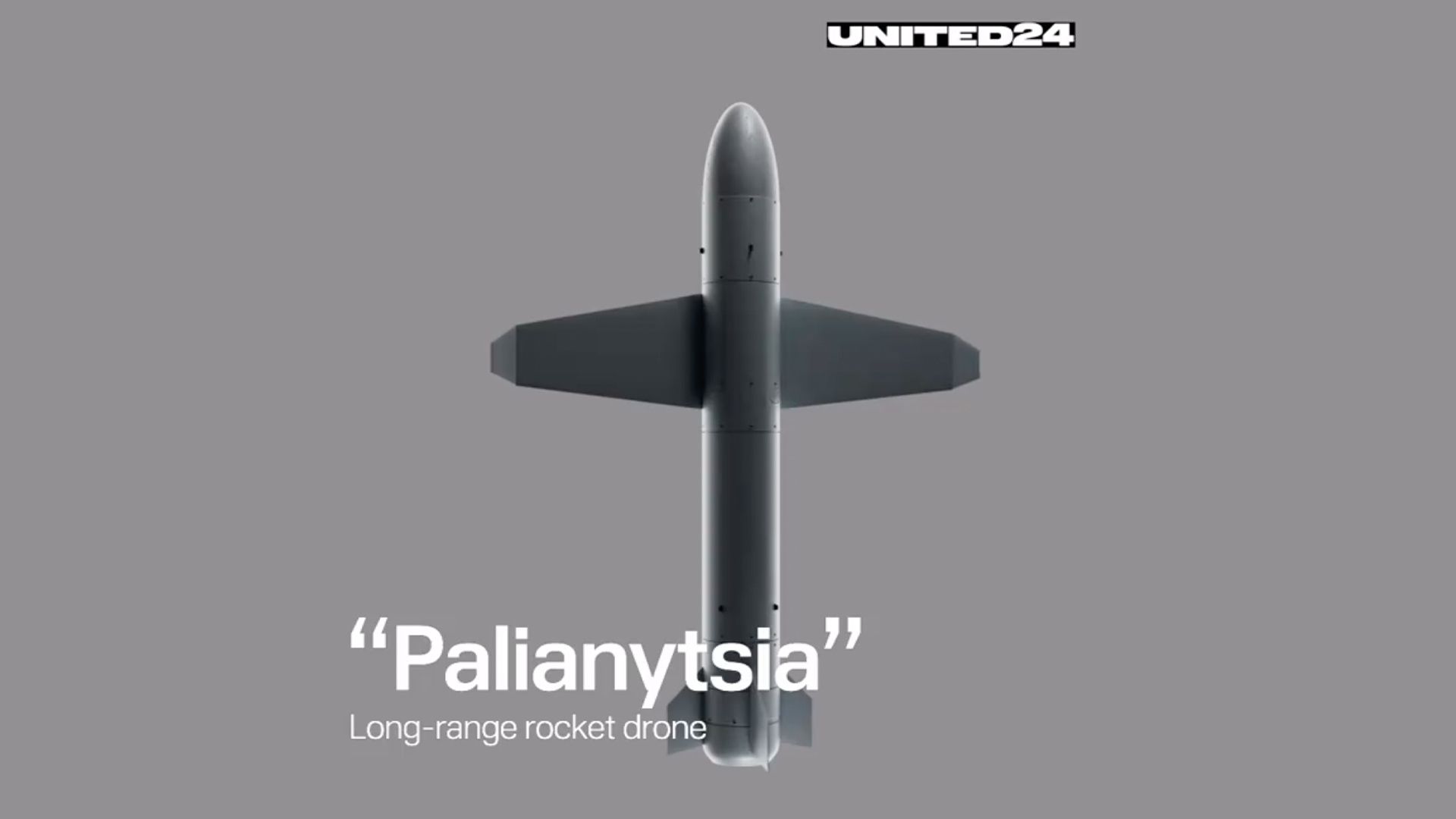
Ukrainian President Volodymyr Zelensky teased this weapon on social media. Screenshot: United24media/via X
Military analysts are buzzing online about a new, secretive Ukrainian weapon that blurs the line between missile and drone.
Why it matters: The Palianytsia, named after a Ukrainian bread, highlights the country's wartime ingenuity, with from-scratch design and production taking 18 months.
- It also sidesteps prohibitions on using Western weapons to strike deep into Russia.
- "We've not even allowed the Ukrainians to fight under the circumstances that we would allow ourselves," George Barros, the Russia team lead at the Institute for the Study of War, told me. "Palianytsia is the Ukrainian response to Western feet-dragging."
Driving the news: President Volodymyr Zelensky said last week that "our new weapon" had been used for the first time in combat.
- A video he shared on X described Palianytsia as a "long-range rocket drone" launched from the ground. Its maker and warhead were labeled secret.
- The same clip displayed two dozen Russian airfields within Palianytsia's purported range while also criticizing foreign governments for dictating how their arms could be used in an existential fight.
The intrigue: In an era of easily accessible frontline footage and Instagram-ready montages, even the closest watchers of the Russia-Ukraine war are short on details.
- Search "Palianytsia" on X and unfurl the threads; there are more questions than answers. Was it used here? Why call it a rocket drone? Will it make a difference?
- The Kyiv Independent reported that "most of the weapon's characteristics are classified." The Associated Press put the price of each at $1 million. Forbes said it was "like a cruise missile but different." And defense analyst HI Sutton warned some footage was pulled from Northrop Grumman archives.
Between the lines: Palianytsia arrives amid a back-and-forth about when, where and how donated weapons can be used against Russia, including its factories, repair depots and ammo caches.
- "The frustrating thing is we've had this sort of debate, but just ad lib in the system or the policy," Barros said. "It was 'We're not going to send them vehicles, we're never going to send them HIMARS, we're not going to send them F-16s, we're not going to send them main battle tanks.'"
- Ukrainian officials are lobbying their benefactors to ease constraints. It's been a mixed bag.
Yes, but: Whether Palianytsia greatly influences the war remains to be seen.
- Talk of mass production suggests the weapon is not a cure-all. Many are needed — like much smaller FPV drones — and that invites questions about raw resources and timeliness.
The bottom line: "I don't think this is a game-changing capability," Stacie Pettyjohn, the defense program director at the Center for a New American Security, told me.
- But if "Ukraine can acquire hundreds of Palianytsia, it would be a significant step up in its deep-strike capability and could be used to impose more costs on Russia, while degrading some key capabilities."
