Axios Future
November 25, 2020

Welcome to Axios Future, where we will be making a slow-roasted pork shoulder for our small Thanksgiving tomorrow and no one can stop us.
- I'll be on vacation for the following week and a half, so the next Future newsletter will come on Dec. 9.
- If you haven't subscribed, please do so here.
- Send feedback and tips to [email protected].
Today's Smart Brevity count: 1,843 words or about 7 minutes.
1 big thing: COVID-19 shows a bright future for vaccines
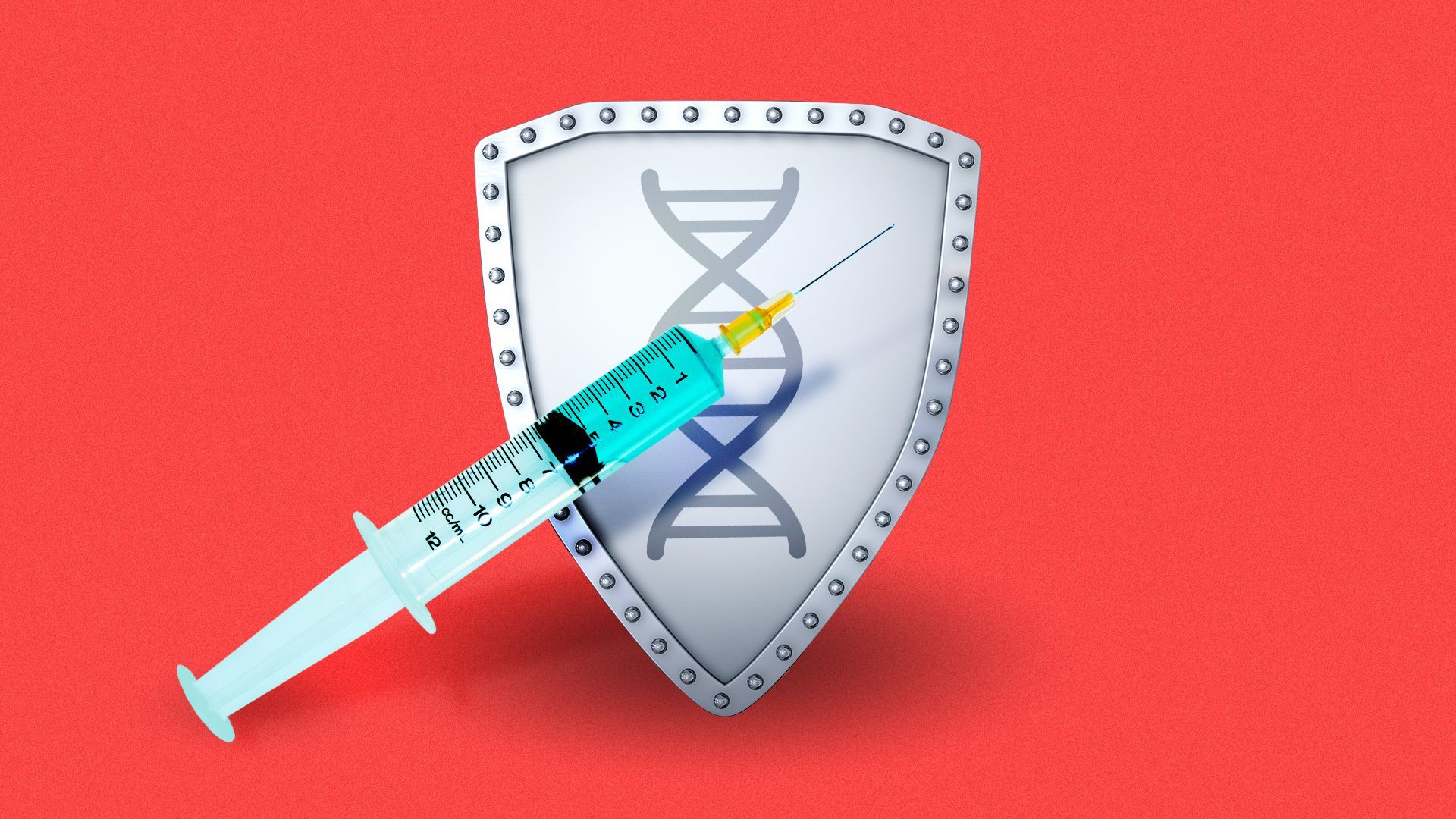
Illustration: Annelise Capossela/Axios
Promising results from COVID-19 vaccine trials offer hope not just that the pandemic could be ended sooner than expected, but that medicine itself may have a powerful new weapon.
Why it matters: Vaccines are, in the words of one expert, "the single most life-saving innovation ever," but progress had slowed in recent years. New gene-based technology that sped the arrival of the COVID vaccine will boost the overall field, and could even extend to mass killers like cancer.
By the numbers: As the first COVID-19 vaccines near emergency authorization, it's worth reflecting on just how fast their development has been.
- Vaccines usually take more than 10 years to go from discovery to regulatory approval, and the fastest on record was four years, for the mumps.
- The world now has three vaccines — from Pfizer, Moderna and AstraZeneca — ready for regulatory approval just one year after what are believed to be the first confirmed cases of COVID-19 in China.
How it works: The COVID-19 vaccines progressed so swiftly because they were built using a new platform: gene-based technology that harnesses messenger RNA (mRNA) to essentially instruct the human body to make the vaccine itself.
- Conventional vaccines use either a weakened virus or purified signature viral proteins to prompt the body to safely generate immunity. That's effective, but the act of growing the attenuated virus or purifying the proteins is slow and laborious.
- mRNA vaccines, by contrast, can be developed almost as quickly as a virus can be genetically sequenced — Moderna shipped the first batch of its vaccine for clinical study a month and a half after Chinese authorities shared the genetic sequence of the novel coronavirus.
What they're saying: "It could be quite a new era for vaccines and vaccinology," Brendan Wren, a professor of vaccinology at the London School of Hygiene and Tropical Medicine, told USA Today. "We seemed to move ahead in this one year 10 years."
What's next: As mRNA technology improves, so should the speed at which new vaccines can be developed and rolled out, which would be hugely beneficial when the inevitable next pandemic hits.
Our thought bubble: The COVID-19 vaccine represents technological innovation at its best, in that it can save us from ourselves.
- The ability to rapidly develop a vaccine for every new disease would relieve human beings of the need to make social distancing tradeoffs they can't seem to make.
Scientists are also hopeful that mRNA and other gene-based platforms could improve mediocre existing vaccines like the perennially underwhelming flu shot and give researchers a new approach for challenging viruses like HIV.
- Pharma companies are even exploring whether the technology could yield treatments for heart disease and cancer, which between them kill more than 1.2 million Americans a year.
Yes, but: While both the effectiveness and the safety data of the COVID-19 vaccines have been sterling — albeit with some questions around AstraZeneca's candidate — mRNA vaccines have never been used before, and we won't know for sure how well they work until they go to work.
- Distributing vaccines to just about everyone on the globe has also never been attempted before, and unfortunately there's no gene-based shortcut for the hard work of logistics.
The bottom line: The proof will be in the shots themselves, but right now it looks like finding a new and better way of making vaccines will be one of the few good things to come out of our plague year.
2. Remote learners may suffer in the new economy

An empty classroom in New York City, which closed its schools earlier this month because of rising COVID-19 levels. Photo: Michael Loccisano/Getty Images
School districts are reporting declining grades as students struggle to adjust to the challenges of remote education.
Why it matters: It's bad enough that many children around the country are receiving sub-par remote schooling. But in an economy that will increasingly reward cognitive skills, those struggling today risk being left behind permanently.
What's happening: The Washington Post reported this week that an internal analysis by Virginia's Fairfax County — one of the largest school districts in the country, and one that has been operating largely online — found that the percentage of middle school and high school students earning F's in at least two classes had increased 83% from the same time last year.
- More than 40% of students in Houston's Independent School District are earning failing grades in at least two of their classes, while nearly 40% of public high-schoolers in St. Paul, Minnesota, have failing marks.
- In New York, the nation's largest school system, 60,000 kids can't even participate in remote learning because they lack the necessary devices.
- A "60 Minutes" report on Sunday found that in a single county school district in Tampa, 7,000 students have simply disappeared, never logging in for remote classes.
Be smart: There are kids who would've gone to college but won't, who would've graduated from high school but won't, because this country has prioritized other, riskier activities over in-person schooling.
- For too many kids — and especially for those who were already disadvantaged — remote education is like a band-aid that won't stick.
What's next: When these kids do become adults, they'll be entering an economy that will place an even greater premium on the cognitive skills that can only be obtained through education.
- Robots aren't coming for all of our jobs, but technology is automating low-skilled, repetitive tasks.
- "Education and training are central to helping the current and next generation thrive in the labor market," said Elisabeth Reynolds, the executive director of the MIT Task Force on the Work of the Future, at an event last week.
The bottom line: CEOs and politicians love to tell Americans that they need to up their skills to thrive in a more competitive economy. Yet during the pandemic, we've crippled their ability to do so.
3. A global search for the geniuses of tomorrow
A Silicon Valley-based nonprofit is creating a talent program called Rise to cultivate and support young people from around the world.
Why it matters: Talent doesn't respect geography — but too often, opportunity does. The new program seeks to identify future leaders wherever they are, which research suggests may be one of the best ways to help the world advance.
What's happening: Schmidt Futures — a philanthropic initiative founded by former Google CEO Eric Schmidt and his wife Wendy — last week opened applications to Rise.
- The program aims to identify young people between the ages of 15 and 17 who "need opportunity but whose talents can help address problems in their community and the rest of the world," says Eric Braverman, the chief executive of Schmidt Futures.
- The project is being carried out in collaboration with the Rhodes Trust, which oversees the Rhodes scholarships, as well as a number of other NGO partners from around the world.
How it works: Each year Rise will select 100 global winners and provide them with "individualized support to help harness their talents over the course of their lives," says Cassie Crockett, head of strategy at Schmidt Futures.
- That might include needs-based scholarships for higher education, funding for internships or social impact enterprises and, when the pandemic allows, in-person meetings and mentorships.
What they're saying: "We are optimistic that the talent in the world is there to solve the problems that face us," says Braverman. "We just need to give them extra help."
By the numbers: Rise's mission dovetails with a growing body of research that suggests cultivating human talent is one of the best ways to advance global knowledge.
- An IMF working paper from 2018 found that individuals who demonstrate exceptional talent in their teenage years have an "irreplaceable ability to create new ideas over their lifetime."
- Since talented individuals in poor- and middle-income countries are less likely to work in knowledge fields — largely because the opportunity has been missing — policies that open up that opportunity could “accelerate the advancement of the knowledge frontier.”
The bottom line: We all benefit when talent isn't limited by borders.
4. Venus' phosphine puzzle

Illustration: Aïda Amer/Axios
Scientists are trying to parse out whether a possible sign of life seen in Venus' clouds is truly there, my Axios colleague Miriam Kramer writes.
Why it matters: The announcement that researchers may have spotted a signal of the phosphine gas in Venus' atmosphere was met with excitement by the public and scientists alike, heralded as a possible sign that microbes could live in the planet's clouds.
The intrigue: Now, the researchers behind the study and others aren't so sure that gas signal is real.
- Some researchers have criticized the way the data used for the phosphine result — which was gathered at the limits of currently available technology — was processed, suggesting that the phosphine signal was actually just noise.
- The ALMA Observatory data used to make the phosphine claim were also taken offline for reprocessing.
- Once that reprocessing concluded, the scientists behind the initial study found that the phosphine signal was perhaps still there but weaker than what the original data showed.
What's next: Scientists likely need new data.
- If the signal does turn out to be real, researchers still haven't come up with any viable alternative explanations for how phosphine could be on Venus without the possible presence of life.
5. Worthy of your time
Vaccines are coming, but there's no such hope for my blindness (Michael Schuman — Bloomberg)
- My former TIME magazine colleague on his struggles with progressive vision loss, and why only some conditions are amenable to sudden technological cures.
Part human, part machine: is Apple turning us all into cyborgs? (Alex Hern — The Guardian)
- Being a modern cyborg isn't necessarily about Matrix-style implants but about being so dependent on a machine — even one you hold in your hand — that you can't imagine life without it.
How close is humanity to the edge? (Corinne Purtill — The New Yorker)
- A profile of the brilliant existential risk scholar Toby Ord, whose recent book "The Precipice" is well worth reading.
When A.I. falls in love (Cade Metz, sort of — New York Times)
- The language prediction model GPT-3 dashes off mostly realistic Modern Love columns, and instantly scores of Brooklyn freelance writers become as obsolete as a Microsoft Zune MP3 player.
6. 1 good thing: 3D printed prosthetics for dogs

A very good boy using 3D-printed prosthetics. Photo: Courtesy DiveDesign
Startups are using 3D scanning and printing to rapidly create custom prosthetics for pets that have lost limbs.
Why it matters: Because dogs who've suffered an accident or were born without limbs can go for a walk! But it also demonstrates how improving 3D-printing technology can be used by almost anyone to quickly manufacture products to their needs.
How it works: Conventional methods for creating prosthetics for individual pets often required hours of labor involving plaster molds, plastic sheeting and foam, which then had to be laboriously personalized to the pet.
- DiveDesign, a New Jersey-based development studio, developed a new and faster prosthetic-making process that involves taking a 3D scan of the mold of a prosthetic limb.
- A proprietary algorithm generates a design of the prosthetic, when can then be manufactured with a 3D printer, with the final product being shipped out to another startup called Bionic Pets.
- All in all the process can do in one or two hours what used to take as many as 15, and cuts the final cost by hundreds of dollars.
Context: 3D printing has long been used for rapidly iterating prototypes, but as both the printers and the design software has improved, it's increasingly being used by even small players to manufacture finished products.
- In the same way that web design tools made it easier for anyone to put something up on the internet, better 3D printing software and hardware promises to create "a major shift in the power structure of how products are made," says Brad Rothenberg, the CEO of nTopology, a leading 3D printing software company.
The bottom line: Anything that gets a disabled pet on its feet again is something to be thankful for.