Axios Finish Line

January 06, 2026



🥳 Welcome to the new year! Axios national energy correspondent Amy Harder is diving into how AI has — and hasn't — changed her life and work.
- Smart Brevity™ count: 898 words … 3½ mins. Copy edited by Amy Stern.
1 big thing: A journalist's view of AI
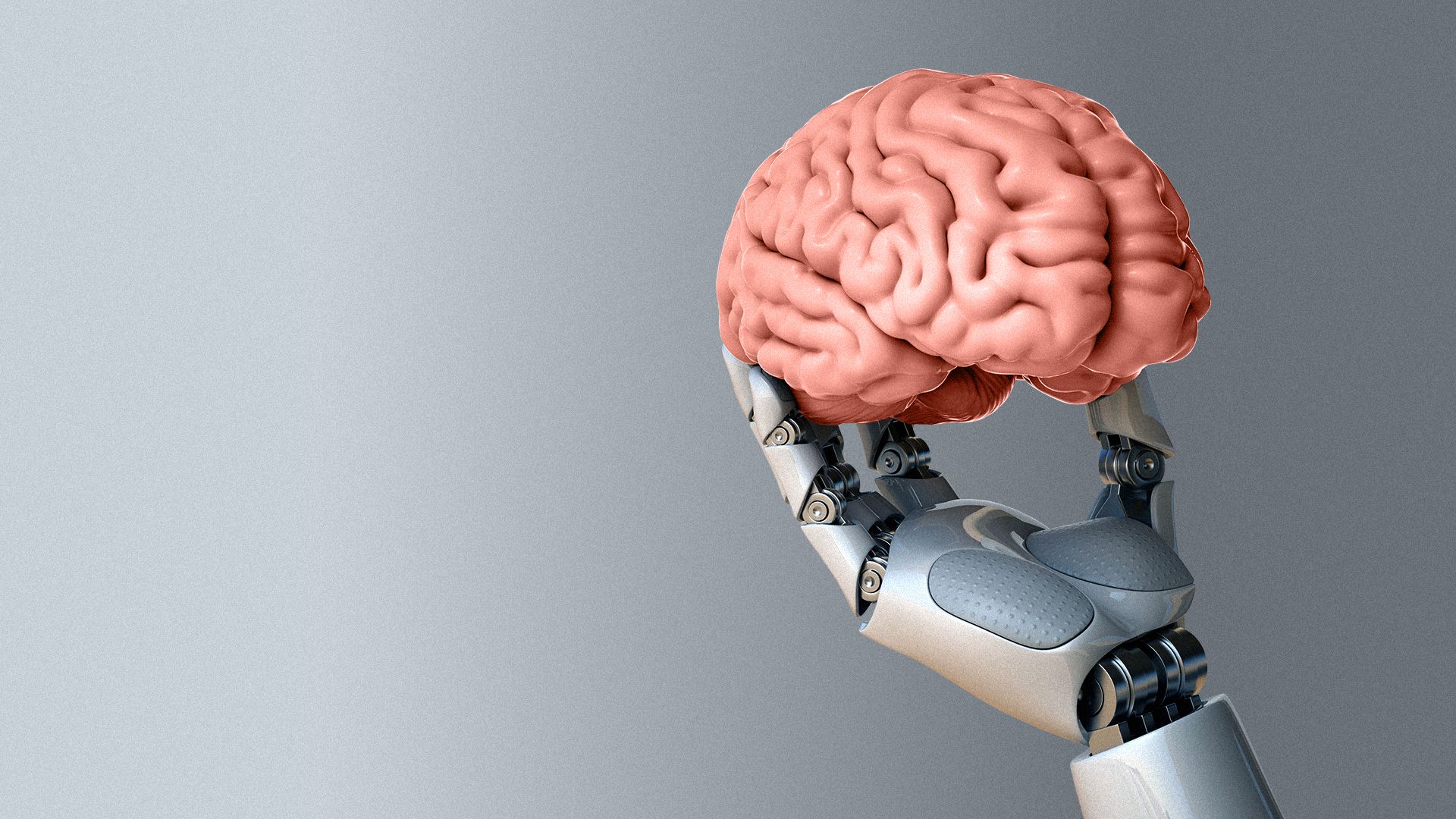
AI is making my life more convenient and my job more efficient. But it's also tempting me to think less — and sparking new frustrations, Axios' Amy Harder writes.
- Why it matters: AI is infiltrating daily life faster and more aggressively than any modern technology. We're all living experiments in its effects: the good, the bad and the unknown.
Early research, and plenty of anecdotes, suggest AI is already reshaping our brains.
- A recent MIT Media Lab study found students who used ChatGPT to write essays showed significantly lower cognitive engagement.
- One of the researchers, Nataliya Kosmyna, put it bluntly: Evolution pushes us to adopt tools that make life easier, "but your brain needs friction to learn."
⚡ Catch up quick: When I rejoined Axios in September and jumped into the AI-and-energy beat, it felt like AI immersion therapy.
- Axios itself is integrating AI tools into our newsroom workflow. Our journalists can use them to take a first stab at alt text for photos and charts (descriptive text to aid accessibility), to research new topics, to sort through huge datasets for trends, and to get suggestions for smoother language.
- The effect: I'm covering AI while also depending on it.
Flashback: History shows a long list of technologies that've made our lives easier while compelling us to let go of certain skills.
- We ceded handwriting to computers.
- We ceded math to calculators.
- We ceded direction to GPS.
- We ceded our attention to social media.
🧠 I worry we are ceding our thinking to AI.
You know the saying, "The whole is greater than the sum of its parts." With AI, I worry the opposite might be true — that the sum of what we're offloading is starting to add up to something ... that's the opposite of great.
- I don't need good handwriting, I never liked math, and I don't mind following Google's blue dot around the world.
- But AI goes after our thinking itself, the foundation beneath all the other skills we've offloaded over time.
🛠️ How it works: Early on in this job, I could feel AI making a difference to my mind, so I started taking notes:
- It's tempting me toward intellectual laziness. I could ask ChatGPT to do big pieces of my job. I resist it, but the temptation exists — and humans are efficiency-maximizing creatures, as Kosmyna said.
- Learning feels heavier. Diving into a new topic — traditionally the joy and oxygen of journalism — now sometimes makes my brain groan like it's heading to the gym.
- I'm retaining less. Reading, listening, interviewing, prepping for talks — it all feels less "sticky."
- AI's "magic" leaks into real life. When my jacket zipper jammed the other day, I caught myself frustratingly thinking: Why can't this just work? AI always just works. The feeling of AI's magic in the digital world is setting impossible expectations for the physical one.
The intrigue: Late October was my peak use of AI, when I ceded my thinking to it more — driven by both temptation and experimentation.
- Since then, I've intentionally pulled back, putting guardrails around when and how I use it.
Between the lines: I never let ChatGPT write drafts. And I use it sparingly for public speaking, since the success of a live interview or talk depends so much on the written prep process itself.
💡 To be sure, I do use AI for a lot of things (still).
- Professionally, I ask it to help refine interview questions (originally created by me), and use it for initial research (specifying that it should mine only legitimate sources).
- Personally, it's been a lifesaver simplifying complex finance and tax guidance (which I then run by human professionals). And I enjoy asking it to write satirical versions of songs and speeches.
Reality check: This is just one person's snapshot of a few months inside a fast-evolving technology.
- Mark Manson, a bestselling self-help author, wrote recently: "The more I use it, the more I think, 'I should be finding more ways to use this.' And that is something I've never experienced in my life."
- He just launched an app that offers AI coaching.
🔭 Zoom out: AI could help cure cancer or commercialize fusion. It could also trigger mass layoffs. It'll likely do things we can't imagine today.
- Its impact on the human brain is just one thread in a sprawling tapestry — but considering we each only get one brain, it's a pretty important one.
The bottom line: Despite my unease, I don't think AI is inherently bad — or that we shouldn't use it. After all, I ran this story through ChatGPT to make it better. It did. Of course.
🦾 Tell us how YOU use AI, and what you wonder. We'll share your thoughts and get some answers: [email protected]. (Please include your name, occupation and hometown.)
📸 Pic du jour

Reader Stewart Verdery — who's sent us some brilliant parting shots over the years — tells us: "I actually think this was the coolest photo of 2025."
- "On a transatlantic flight in September into Dulles, I ... happened to look over and see the sunset from 35,000 feet over the Atlantic. Looks like the sun is sitting on top of the clouds."
🏁 Please invite your friends to join Finish Line.
Sign up for Axios Finish Line