Axios Detroit

May 21, 2025

It's Wednesday, folks.
- Keep your umbrella handy this week.
🌂 Today's weather: Cloudy, with showers likely and a high in the mid-50s.
Sounds like: "Can You Stand The Rain" by New Edition
Today's newsletter is 883 words — a 3.5 minute read.
1 big thing: The opioid crisis' economic impact

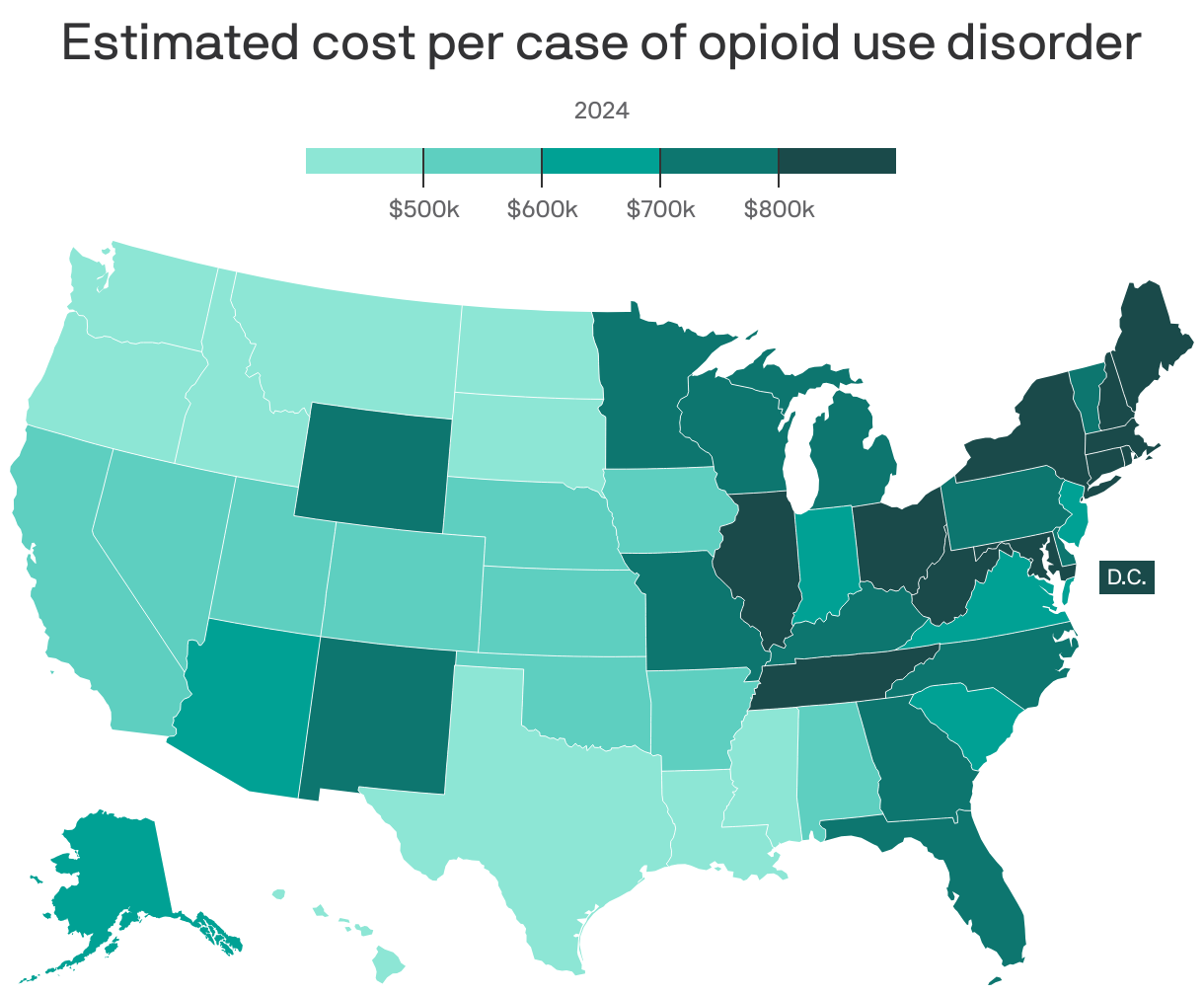
Opioid misuse is as much an economic problem as a public health one, according to a comprehensive analysis provided first to Axios that shows Michigan spends an average of more than $700,000 annually on each such case.
Why it matters: The cost burden falls unevenly across the country, with states in a belt stretching through Appalachia to New England typically having bigger caseloads and a higher cost per case.
Context: Opioid use disorder — defined as frequent opioid use and unsuccessful efforts to quit — is estimated to affect more than 6 million people in the United States, costing the nation an estimated $4 trillion last year, per health care consulting firm Avalere Health.
- The cumulative economic burden on patients, including years of life lost and reduced quality of life, exceeded $3 trillion in 2024, Avalere estimated.
Zoom in: Michigan borders the states with the highest share of opioid misuse cases.
- At $742,799, our average cost per case is slightly higher than the national average, per the analysis from Avalere, which used 2017 figures to project 2024 net costs.
Zoom out: Private businesses absorbed more than $467 billion in costs from lost productivity and health insurance costs, while the federal government bore about $118 billion in Medicare and other federal insurance costs, lost taxes and criminal justice expenses.
What they're saying: Reports such as Avalere's help local officials across the state better understand the opioid crisis and how to address it with the state's $1.6 billion in opioid settlement funds, Joyce Fetrow, project director of the Northern Michigan Opioid Response Consortium, tells Axios.
- Every dollar spent on recovery provides a 10% return, Fetrow says. Investment in recovery services leads more people to spend on housing, transportation and other needs instead of their addiction.
Follow the money: The projected cost of opioid use disorder in 2024 ranged from $419,527 per case in Idaho to more than $2.4 million in D.C.
- Some of the regional variation in costs is from lost tax revenue, which varies by state. The local availability of treatment for opioid use disorder may also drive the cost, said Avalere's Margaret Scott.
2. Walkable commons envisioned for Belle Isle
A new public square on Belle Isle could make the spacious island feel more walkable.
Why it matters: The 1.5-square-mile park with wide roads isn't perceived as easily navigable on foot, though trails have improved in recent years.
- Popular spots like the aquarium and beach are just a 15-minute walk apart, but many visitors drive between them, or hit one spot and leave.
Driving the news: Park leaders, including Belle Isle Conservancy CEO Meagan Elliott, gave a presentation to the City Council yesterday about the latest plans for the city's island gem.
State of play: The conservatory and the state, which operates the park, are wrapping up a preliminary design this month for the Belle Isle Commons, an area that would be a central point to make the island feel more connected.
- They plan to get public input on the idea this summer to flesh it out and then create something more concrete, Elliott said.
3. The Grapevine: You heard it here
🏈 The Lions announced their preseason schedule:
- July 31 in Canton, Ohio, against the Chargers.
- Aug. 8 at the Atlanta Falcons.
- Aug. 16 against Miami and Aug. 23 against Houston, both games at Ford Field. (Free Press)
⚕️ Union workers at five local nursing homes owned by Ciena Healthcare held a one-day strike yesterday after working without contracts for months, according to SEIU Healthcare. (Detroit News)
4. Frame Work: Water and us
A new art exhibition on the east side interrogates our relationship with nature, amid past struggles and current ones like climate change.
The big picture: "The Sea and the Sky, and You and I" is open at the Shepherd gallery through Aug. 30.
- The show with nearly 30 artists, half based in Detroit, examines the relationships between humans and water, or the environment at large, whether that's the landscape of Detroit, places under the sea, or even imaginary future lands.
Zoom in: One artist, Doug Jones, interprets the work of techno act Drexciya, which envisioned a mythology around an alternate world under the sea starting in the early '90s.
- Jones' work also represents R&B legend Aaliyah, who died when her plane crashed into a Bahamas marsh, with themes of water.
- Sculptor Scott Hocking will also have a sculpture of discarded maritime items installed on the Shepherd grounds.
Plus, organizations that helped create the exhibition are hosting their own installations and events in tandem with it, including a Sunday block party 3-8pm at the Garage, a cultural space led by activist Bryce Detroit.
If you go: The Shepherd, 1265 Parkview St., is open Wednesday through Saturday, 11am-5pm.
5. Tiger's golf league adds Detroit
The indoor golf league that Tiger Woods and Rory McIlroy debuted this year just added a new franchise, the Motor City Golf Club.
Why it matters: The expansion strengthens Detroit's connection to the world's best golfers, some of whom visit each year for the PGA's Rocket Mortgage Classic at the Detroit Golf Club.
Zoom in: TGL announced yesterday that the Motor City Golf Club will start play in 2027, the Detroit News reports.
- Lions owner Sheila Ford Hamp and her sons Michael Hamp and Peter Hamp are leading the Detroit ownership group.
What's next: TGL is exploring expansion in other markets such as Chicago and Dallas, per the News.
Our picks:
🤣 Joe finished the last season of "The Righteous Gemstones." He thought the season's story arc was well-executed, with hilarious one-liners in every episode, like Uncle Baby Billy's "This ain't no Hobbit house" scolding in the last episode.
😅 Annalise also really liked the final "Gemstones" season — especially the more serious drama of the first and last episodes — but if she had creative license, she'd probably delete 54% of the show's more crude jokes.
Edited by Chloe Gonzales.
Sign up for Axios Detroit