
Axios Crypto

May 13, 2025

Last night the new SEC chair said that he wants to create a way for blockchain projects to sell tokens with appropriate registration with the SEC, among other things β an enormous step change for the industry.
π State of play: The contest to own enough Official Trump meme coin to get into the dinner with President Trump ended yesterday.
- The holder earning the last seat has 8,728 Official Trump coins, and held an average of 4,196 (valued at $54,716 at today's prices) during the contest.
π¬ [email protected]
Today's newsletter is 1,074 words, a 4-minute read.
1 big thing: β Bills to stop Trump's tokens
Congressional Republicans have two pieces of stablecoin legislation crafted, STABLE and GENIUS, acronyms assumed to be devised β though no one would ever confirm this β as a nod to their party leader's famous construction.
Why it matters: President Donald Trump's commercial extracurriculars are making him look somewhat less politically savvy right now.
The big picture: The Senate would probably have debated and voted on GENIUS, the first bill to move, if not for the actual stablecoin proposed by a company whose profits largely flow back to the Trump family.
- That stablecoin is known as USD1. The company in question is World Liberty Financial.
- And an announcement this month that Abu Dhabi's sovereign wealth fund will use USD1 to make a $2 billion investment in Binance β and the perceived conflicts of interest it creates β has slammed the brakes on bipartisan legislation that Congress has been working on for months.
Between the lines: The deal would not mean that World Liberty and its backers would earn $2 billion in profit.
- But they would get all the yield earned from the cash infusion into USD1. Stablecoin issuers invest these reserves in short-term Treasuries or other highly liquid assets.
- Another advantage β it's a leg up in the stablecoin race for a brand new offering, allowing USD1 to become the world's seventh-largest stablecoin out of the gate.
What we're watching: There's a number of pieces of legislation out there created to block elected officials (always including the president) and, sometimes, appointees as well, from backing or endorsing new cryptocurrencies.
Four we are following:
- HR 1712: The MEME Act, Rep. Sam Liccardo (D-Calif.). Introduced in February, it's the first one we saw. As the name suggests, it was created in response to the Trump family's meme coins.
- S. 1620: Companion to Liccardo's bill, from Sen. Chris Murphy (D-Conn.). This one was released amid stablecoin legislation discussions last week.
- End Crypto Corruption Act: Sen. Jeff Merkley (D-Ore.) and minority leader Sen. Chuck Schumer (D-NY). This one was also released last week. Theirs includes members of Congress.
- HR 3314: Rep. Ritchie Torres (D-NY). His office tells me that this one names stablecoins, which catches it up to the latest controversy.
What they're saying: "As another famously impeached White House occupant once said, 'the people have got to know whether or not their President is a crook,'" Liccardo said in a statement last week.
Reality check: It's hard to imagine that any of these bills even see discussion in committee, but the topic seems to be making it hard for crypto-leaning Democrats to stick with crypto legislation.
- And the GOP needs some party crossover to get legislation through.
The other side: "Today, Senate Democrats made a deliberate choice to play partisan games," Bo Hines, the executive director of the president's crypto advisory council, wrote on X. "They had the chance to leadβand instead, they obstructed."
2. World Liberty Financial stablecoin airdrop


Trump family-linked World Liberty Financial is making a plan to give holders of its WLFI governance token free money in the form of its stablecoin, USD1, by airdropping it to wallets that already hold its token.
- Why it matters: It's the first form of profit potential that we've seen for buyers of the token.
Context: World Liberty raised $550 million selling WLFI, but the token isn't tradable β so far.
- Which has raised the question: Why would anyone buy it?
The latest: Free money is one good answer.
- Now, holders are voting about whether or not they should permit World Liberty to give them money.
By the numbers: 99.96% of votes so far are in favor of the company giving them money.
- The vote does not indicate how much will be budgeted for the airdrop.
- Over 85,000 separate Ethereum wallets have some amount of the token.
The big picture: Ostensibly, this distribution is to test the airdrop mechanism that the company has built.
- Zooming even further out, USD1 has been a hot topic amid this year's peak interest in stablecoins.
The intrigue: World Liberty has also never launched the decentralized finance (DeFi) borrowing platform discussed when this whole thing was announced.
In the weeds: WLF is a governance token, so in theory holders could one day vote to make it tradable, too. Folks are asking for that in comments on the current vote, and it hasn't happened.
What we're watching: The voting ends later today.
3. Alex Mashinsky gets 12 years

Celsius founder Alex Mashinsky has been sentenced to 12 years for committing commodities and securities fraud at Celsius, one of the centralized crypto lenders.
Why it matters: There's a list of key miscreants in the 2022 crash of the cryptocurrency market, and Mashinsky is on there, alongside Sam Bankman-Fried and Do Kwon.
- Mashinsky pled guilty to the charges.
What they're saying: "Alexander Mashinsky targeted retail investors with promises that he would keep their 'digital assets' safer than a bank, when in fact he used those assets to place risky bets and to line his own pockets," U.S. Attorney Jay Clayton said in a statement.
- Clayton served as chairman of the SEC during Trump's first term, supervising digital asset markets in Celsius' earliest days.
Catch up fast: Celsius was one of the first companies to quit honoring withdrawals, though its executives were making withdrawals ahead of the bankruptcy.
- Customers did ultimately get paid back quite a bit, partly due to the good luck of the crypto market surging again last year.
4. Catch up quick
π Coinbase has been added to the S&P 500. (CNBC)
π’ Treasury Secretary Scott Bessent blasted the Senate for failing to move stablecoin legislation. (Decrypt)
π Stripe turned on USDC-powered stablecoin accounts in 100+ countries. (Bloomberg)
π€³ Meta sees a use case for stablecoins in paying creators globally. (Bitcoin News)
πͺπΊ Robinhood is considering making a special blockchain for trading in Europe. (Bloomberg)
- Go deeper: Johann Kerbrat, SVP and GM of Robinhood Crypto, spoke with Axios Pro.
5. What we're watching: Quintenz nomination
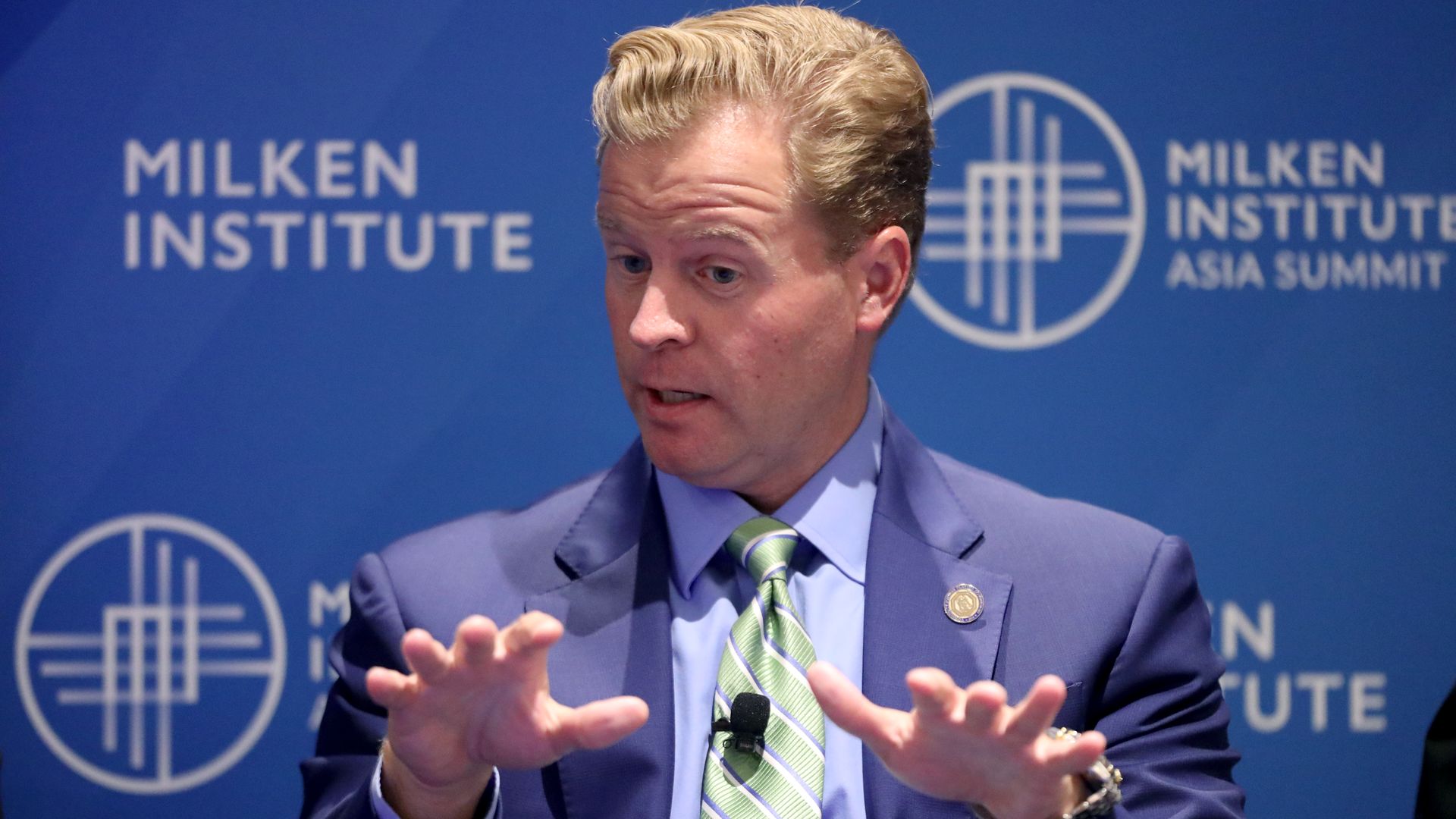
The nomination of Brian Quintenz for the head of the Commodities Futures Trading Commission is just sitting there on the Senate to-do list.
Why it matters: The CFTC is one of the two key regulators for the crypto industry. And it's the one the industry hopes will end up handling most tokens and coins, particularly the really big ones, like bitcoin, ether and solana.
Catch up fast: Trump announced the nomination in February.
- No updates since.
- Senate Ag Committee staff tell me that they are just working through the list and haven't gotten there yet, as several other nominations have moved through.
This newsletter was edited by Pete Gannon and copy edited by Carolyn DiPaolo.
ποΈ For what it's worth, I'm wandering around D.C. this week. βBrady
Sign up for Axios Crypto