
Axios Crypto

July 22, 2025

Good afternoon. How's the first week after the first blockchain law ever got signed by the president going for you?
🚨 Situational awareness: Fight Fight Fight, LLC, the company behind the Official Trump token, still hasn't sold any more of the tokens (look at the first line on the "holders" page — still 80%), even though there was a big unlock Saturday.
Today's newsletter is 1,176 words, a 4.5-minute read.
1 big thing: What's next after GENIUS

President Trump has signed the GENIUS Act, so now it's worth revisiting how the world might change with regulatory clarity around dollar-backed stablecoins in the USA.
Why it matters: With clear legal guidelines for the killer app of blockchains, we expect lots of companies to start using them.
For consumers, there are two ways stablecoins might improve the bottom line of regular people.
- Savings. On exchanges like Coinbase and apps like PayPal, users can buy stablecoins with dollars and earn 4% interest on their money (for now). That blows away the classic bank savings account.
- (Yes, but: While your deposits won't be lent out like banks do and are 100% reserve-backed, they don't have FDIC insurance.)
- Shopping. Osama Bari, with the D24 Fintech Group, tells Axios that he's looking for instant rebates coming soon for stablecoin transactions. For instance, a consumer might get an instant $2 back when they buy a $100 watch. One thing making that possible: Retailers don't pay interchange fees when they get paid with stablecoins.
For businesses: We already know that stablecoins have been useful for paying global teams and managing corporate treasuries around the globe.
- It will be interesting to see if some companies start finding the same domestically. Even within the U.S., it can still take a long time for a big check to clear.
- We may see more of those transactions moving to blockchain payments which can settle nearly instantly at any size.
Threat level: Stablecoins are bearer instruments, much like cash, meaning whoever holds it, owns it. This creates a new category of security concern.
- "Security expectations haven't evolved with the scale of risk," Mitchell Amador, CEO of security platform Immunefi, said via email.
- Firms and people working with these new assets will need to evolve the ways they keep their money safe.
What we're watching: Content creators. Now they have to rely on platforms to get payment from fans, sites like Patreon, Substack and Gumroad.
- Look for stablecoins to enable more creators to go it alone.
If they build it, will they come? Adoption is a big wildcard. It can be tough to get people to use new payment systems if they're accustomed to another way that already works pretty well.
- However, stablecoins could give consumers better deals sometimes.
Big players are stepping in to make the new technology work.
- "We've invested in the tools, partnerships and standards that can help stablecoins scale responsibly," Mastercard's head of policy, Jesse McWaters, said in a statement after GENIUS passed.
- Western Union sees efficiency gains and a new business line in storing funds abroad.
The big picture: Beyond Wall Street banks and fintechs looking at their own projects, stablecoins are increasingly being accepted as currency everywhere from restaurants to movie theaters — and massive retailers are leaning in.
- From Walmart and Amazon, to Apple, Airbnb, and Google, businesses are reportedly lining up to see how they can lower transaction costs and speed up payments.
- And that means the stablecoin economy's about to get a whole lot bigger than the $260 billion already committed around the world before regulatory clarity was stamped into law in the U.S.
Reality check: Yes, but it's going to be a minute. "The industry should anticipate a lengthy rulemaking process before final regulations are fully phased in," the law firm Gibson Dunn wrote in a client update.
- Max timeline: 18 months. It could be less, but, either way, the new law has not kicked in.
2. Senate discussion draft on market structure

Key senators just released a discussion draft of their market structure legislation, right as we were finishing today's newsletter.
Why it matters: This is the legislation that will define how the issuance and trading of cryptocurrencies will be regulated, updating laws for the new realities afforded by blockchain technology.
What they're saying: "We cannot allow regulatory confusion to continue driving American innovation overseas," Sen. Cynthia Lummis (R-Wyo.) said in a statement.
- Senators also released a long list of questions to stakeholders for feedback on the legislation, due Aug. 5.
By the numbers: The House version of Clarity, which just got voted over to the Senate, runs to 253 pages.
- The Senate's discussion draft is 35.
💭 Our thought bubble: There's some differences between the bills.
Between the lines: The big critique of the House's version, that seemed to be catching on in hearings, was that it got too specific.
3. Most adults don't plan to buy crypto: Gallup
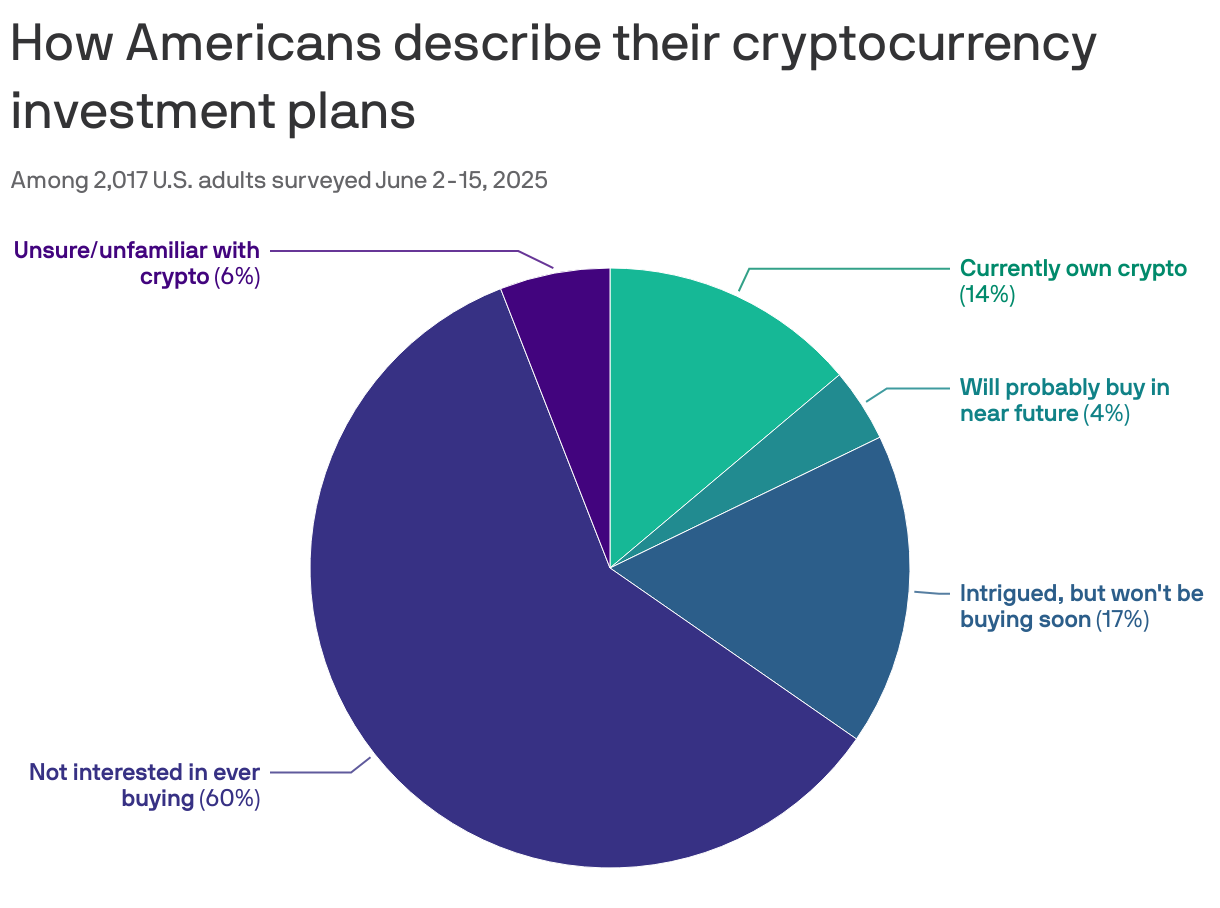
Most of the folks who own digital assets in the U.S., according to new research by the Gallup Organization, are youngish men.
- And most U.S. adults, youngish men included, say that they have no intention to ever buy any.
Zoom out: This is the first general survey of the U.S. on the question of cryptocurrency ownership and familiarity from Gallup, the long-time surveyor of U.S. opinion.
- But while that adoption is limited compared to other assets classes — especially considering the attention the industry has gotten as of late — Gallup pointed out signs of growth.
- In 2018, they asked U.S. investors (as opposed to adults in general) about bitcoin specifically, and found that only 2% owned any. That number increased to 6% in 2021, and now 17% of investors say they own bitcoin or another cryptocurrency.
Context: There're a lot of different estimates out there.
- Security.org, a media site focused on security products, surveyed approximately 2,000 adults and got 28% saying they own cryptocurrencies.
- The St. Louis Fed used the Survey of Consumer Finance to estimate that 4.3% of Americans owned cryptocurrency — but that data was also from 2022 (prices falling, Terra, FTX), not the industry's finest hour.
- At the same time, JPMorgan Chase used account data back in 2022 to find that about 15% had transferred funds to cryptocurrency accounts.
Our thought bubble: This pie chart is a Rorschach test.
- Skeptics will see evidence that the sector is a dismissible niche.
- Enthusiasts will see confirmation that "it's still early."
4. Catch up quick

👨🌾 The Senate ag committee failed to vote on Brian Quintenz to head the CFTC yesterday because it couldn't reach quorum. (US Gaming Hub)
🔮 Polymarket made an acquisition in order to come back to the U.S. (Axios)
🏦 JPMorgan Chase is exploring lending against clients' cryptocurrency holdings. (FT)
🔊 Bitcoin ETFs see outflows while ether ETFs see another day of inflows, signaling a move to alternative coins. (The Block)
5. Roman Storm trial: Possible mistrial

Roman Storm, the developer behind the Ethereum privacy protocol, Tornado Cash, may move for a mistrial, according to Decrypt.
The latest: Federal prosecutors brought a witness to the trial who was a victim of pig-butchering, and she believed her funds were hidden away using Tornado Cash.
Yes, but: It looks like they weren't.
How it works: Provenance of digital assets is highly traceable on chain.
- The defense tried to retrace the funds stolen from the witness to Tornado Cash, and they didn't see it going there.
- Other on-chain experts have since agreed.
What they're saying: "We need to confer with Mr. Storm about moving for a mistrial," the defense told Inner City Press.
What's next: The government says they have an agent who can describe the path the victim's funds took to the protocol.
This newsletter was edited by Pete Gannon and copy edited by Carolyn DiPaolo.
Sign up for Axios Crypto