Axios Crypto

April 22, 2025

🐣 Happy spring! My weekend was a solid torrent of rain, but now things are coming up all over. Even bitcoin price!
🔬 Situational awareness: Everyone seems to be assuming that Circle's IPO is on pause, but, because it has filed an S-1 with the SEC, it can't say. The silent period extends even to whether or not the IPO is still happening!
- Got tips on crypto IPOs? [email protected]
Today's newsletter is 1,173 words, a 4.5-minute read.
1 big thing: 📿 Alex Mashinsky's last swing

Celsius founder Alex Mashinsky, who pled guilty to fraud in December, is expected to learn his fate next month from a federal court judge.
Why it matters: The case tied to the defunct crypto lender is one of the last big ones from the 2022 crypto collapse still unresolved, and could stick Mashinsky with a sentence similar to Sam Bankman-Fried's 25 years in prison.
State of play: Mashinsky's legal team is doing all they can to soften the perceived scale of fraud at Celsius, filing a 69-page pre-sentencing letter late last week that's filled with bold claims and spin.
- The filing attempts to recast Mashinsky — a charismatic and garrulous CEO who was combative with traditional finance — as a Robin Hood-like character who was out to make money for the little guy, paying 4% or 5% interest on deposits as opposed to banks, which were paying less than 1%.
- And unlike Robin Hood, his legal team claims, Mashinsky was eager to work with regulators, viewing compliance as a top priority.
- "Alex Mashinsky's life has been defined by humility, gratitude, intellectual curiosity, and, above all, service," his lawyers at Mukasey Young argued in the preliminary statement.
Catch up quick: Mashinsky, arrested and charged in 2023, pled guilty in December to two of the five counts against him, commodities fraud and securities fraud.
- Celsius froze withdrawals on its platform during the crypto crash in June 2022, with about $4.7 billion in assets from hundreds of thousands of customers still under its control. It declared bankruptcy the following month.
- Mashinsky in his guilty plea admitted to misleading customers by providing a false sense of security for their investments. Specifically, he claimed Celsius had regulatory approval when it did not, and he admitted to illegally manipulating the price of Celsius' token CEL, and profiting from its sale.
Between the lines: The company spent as much as $8 million a week to support the price of CEL, which ultimately enabled Mashinsky to sell his holdings at a robust return, even though he knew the finances of his company were hopeless.
- And unlike Robin Hood's Merry Men, records show that Celsius executives were getting out of Celsius before the public knew how bad its books looked.
Celsius' business model was much like that of a bank, only with digital assets. A customer could deposit cryptocurrency and earn a small yield on it. Customers could also borrow against the value of their deposits.
- Mostly, people deposited assets like BTC and ETH and borrowed stablecoins, such as USDC, usually to place other, more short-term bets in the market.
- Unlike with lending protocols in decentralized finance, there was very little visibility into who Celsius lent funds to.
The big picture: Though the facts of Celsius' fraud are separate from those tied to Bankman-Fried and the collapse of FTX, Mashinsky's sentencing will serve as the latest penalty verdict for financial misconduct in crypto.
What's next: The judge yesterday extended the government's deadline for submitting its sentencing memo from April 24 to April 28, in light of the letter.
- The sentencing is scheduled for May 8. Mashinsky's team argues that he should receive a sentence of one year, plus one day.
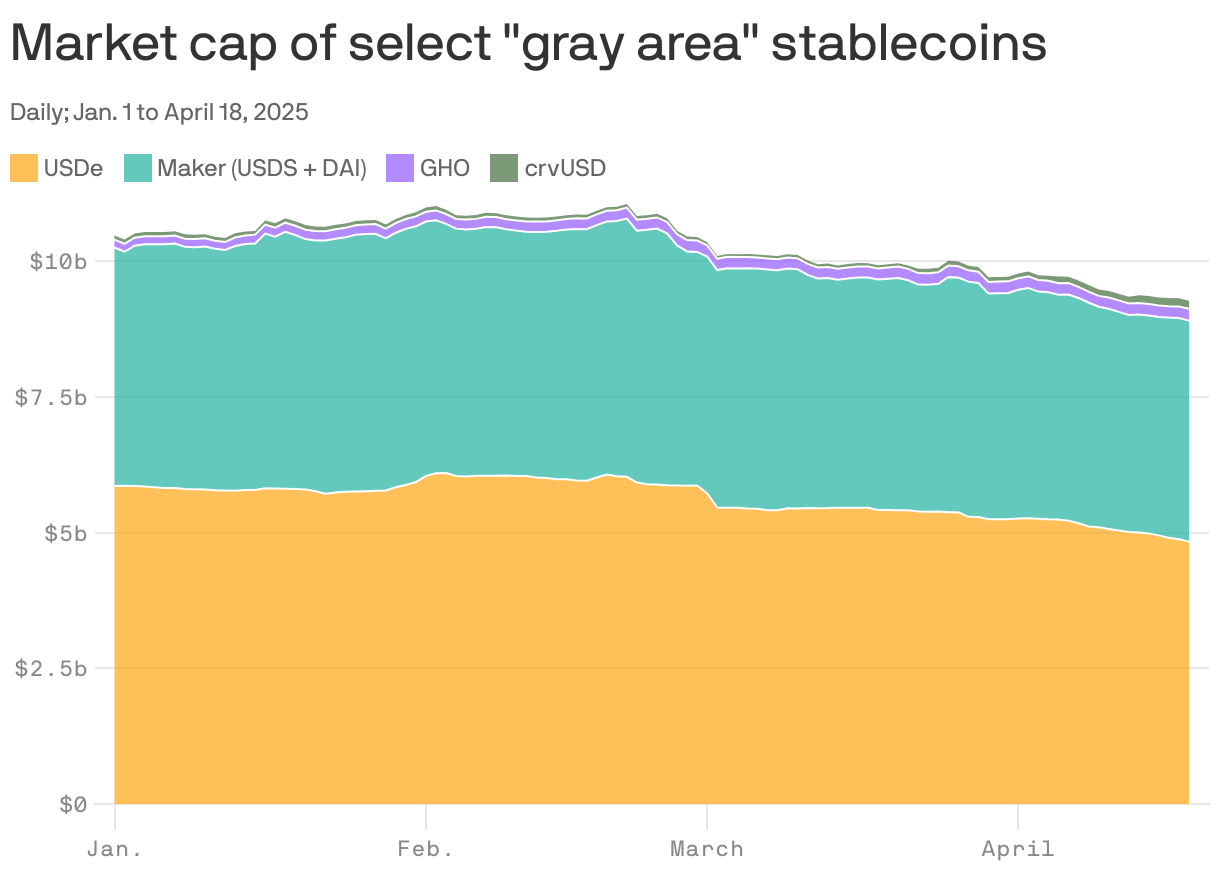
2. Charted: Stables in the gray area

Many more creative stablecoins will find themselves in a legal gray area if something like the STABLE Act passes, because it calls for a moratorium on issuing new "endogenously collateralized" stable tokens.
- Which leaves the ones that exist in a strange spot.
Why it matters: The market for such tokens (known better as algorithmic stablecoins) is much smaller than that of the big guys, Tether's USDT and Circle's USDC, but the market for these more decentralized alternatives exists and persists into the billions of dollars.
How it works: Unlike stablecoins backed by real-world assets like dollars or U.S. Treasuries, algorithmic stablecoins seek to maintain their peg using code and innovative financial schemes. (Like how MakerDAO/Sky issues DAI as loans against collateral.)
- Under the STABLE Act, these kinds of coins can't be issued (at least not for use by U.S. users) for two years.
- Meanwhile, the U.S. Treasury will study the matter of payment stablecoins, including these.
- In a report last week from Nansen Research, the authors point out that this new legislation could provoke changes in these coins, either carving out the U.S. or changing their fundamentals in some way, in response to policy.
Between the lines: Not all these stablecoins are competitors with Tether and Circle.
- For example, Ethena's USDe is mainly used to access yield from a crypto-native carry trade, and crvUSD seeks to offer more liquidation-resistant lending to borrowers in DeFi.
- Yes, but: The MakerDAO/Sky tokens, USDS and DAI, seek to be more decentralized, more censorship-resistant solutions to the same problems that USDT and USDC seek to solve (fast payment, low fees, zero intermediaries).
What we're watching: Their collective market cap has receded somewhat as it looks more likely that these stablecoins won't have a place in the first draft of the U.S. regulatory regime for stablecoins.
- But only a little.
3. Catch up quick

⛏️ How President Trump's tariffs have hit Bitcoin miners. (Unchained)
💰 Among the many people who donated heavily to Trump's inaugural party, there were several major crypto companies and founders. (Bloomberg)
😒 One coin issuer intends to fight the SEC, and the agency is not backing down. (Decrypt)
💸 Circle has announced a payment network for stablecoins, to make plugging in easy for banks and other traditional companies. (Bloomberg)
🏧 Sources say a consortium of European banks is working on a stablecoin. (CoinDesk)
4. Digital (actual) gold
Blockchain investors don't need to leave the decentralized web to invest in the only truly hot commodity these days: actual gold, because gold has long been tokenized, basically just like the dollar has been.
Why it matters: Gold has proven to be the real safe haven in the current economic turmoil, hitting another all-time high price yesterday.
- Tokenized gold gives digital-asset investors an easy path to retreat from the crypto markets without moving their portfolio off blockchains.
How it works: Much like stablecoins, issuers of tokenized precious metals find a way to custody physical supply. They then create tokens that correspond to a fixed amount of those assets.
- The two biggest are Paxos' pax gold (PAXG) and XAUT from Tether.
- Tether issues the world's largest stablecoin, while Paxos is a stablecoin support company best known for running PayPal's PYUSD.
The big picture: Gold broke $3,000 in March amid tariff uncertainty, and it has continued to trend up.
- It broke through $3,400 yesterday
By the numbers: The supply of XAUT has been flat at 246,524 tokens since 2022.
- PAXG has been increasing in supply lately, up 15% since the end of last year, based on its transparency reports. But it's well down from the 318,060 tokens we reported the last time we touched on this topic, in 2022.
- (PAXG's market cap is higher now than it was then, because the value of the underlying gold is up so much. Its market cap is $791 million.)
💭 Brady's thought bubble: Tokenized gold hits Bitcoin in the feelings.
This newsletter was edited by Pete Gannon and copy edited by Carolyn DiPaolo.
🎭 Is everyone following the Trump-Powell melodrama? Axios has got the play-by-play if you've missed any of the many acts. Bitcoin isn't missing a minute! —Brady
Sign up for Axios Crypto