Axios Crypto

December 07, 2023
Thursday is about busting out of walled gardens. Plus, USD vs. EUR.
Today's newsletter is 1,212 words, a 4½-minute read.
🥖 1 big thing: A big bank lists its own stablecoin

Illustration: Shoshana Gordon/Axios
Enterprise blockchain projects from the world of traditional finance usually go nowhere, but one European bank's stablecoin could flourish outside the confines of its walled garden, Crystal writes.
Why it matters: Bank-issued stables are a big no-go in the U.S. and how to regulate it remains a point of contention for the industry and policymakers.
- But with Europe's MiCA set to go into effect next year — its comprehensive regulatory framework for digital assets — big businesses there can push ahead.
Driving the news: Société Générale's digital-asset arm turned heads yesterday when it listed its own euro-backed stablecoin called EUR CoinVertible (EUR-C) on Luxembourg-based crypto exchange Bitstamp, opening the stablecoin to anyone.
- SocGen's SG Forge first unveiled the stablecoin on Ethereum in April as an on-ramp for private clients of France's third-largest bank by assets to settle tokenized green bonds, opening a cashless avenue to complete a securities transaction.
How it works: The structure of EUR CoinVertible, in compliance with regulations, means the collateral backing the stablecoins — cash or equivalents — is legally separated and dedicated as collateral.
- If something goes bump in the night, holders would have recourse on the collateral backing the stablecoin to protect them, according to the project's whitepaper.
- Yes, but: While SocGen's stablecoin being listed on a crypto exchange opens it to more people, those who buy it on third-party platforms will bear additional counter-party risk, the whitepaper notes.
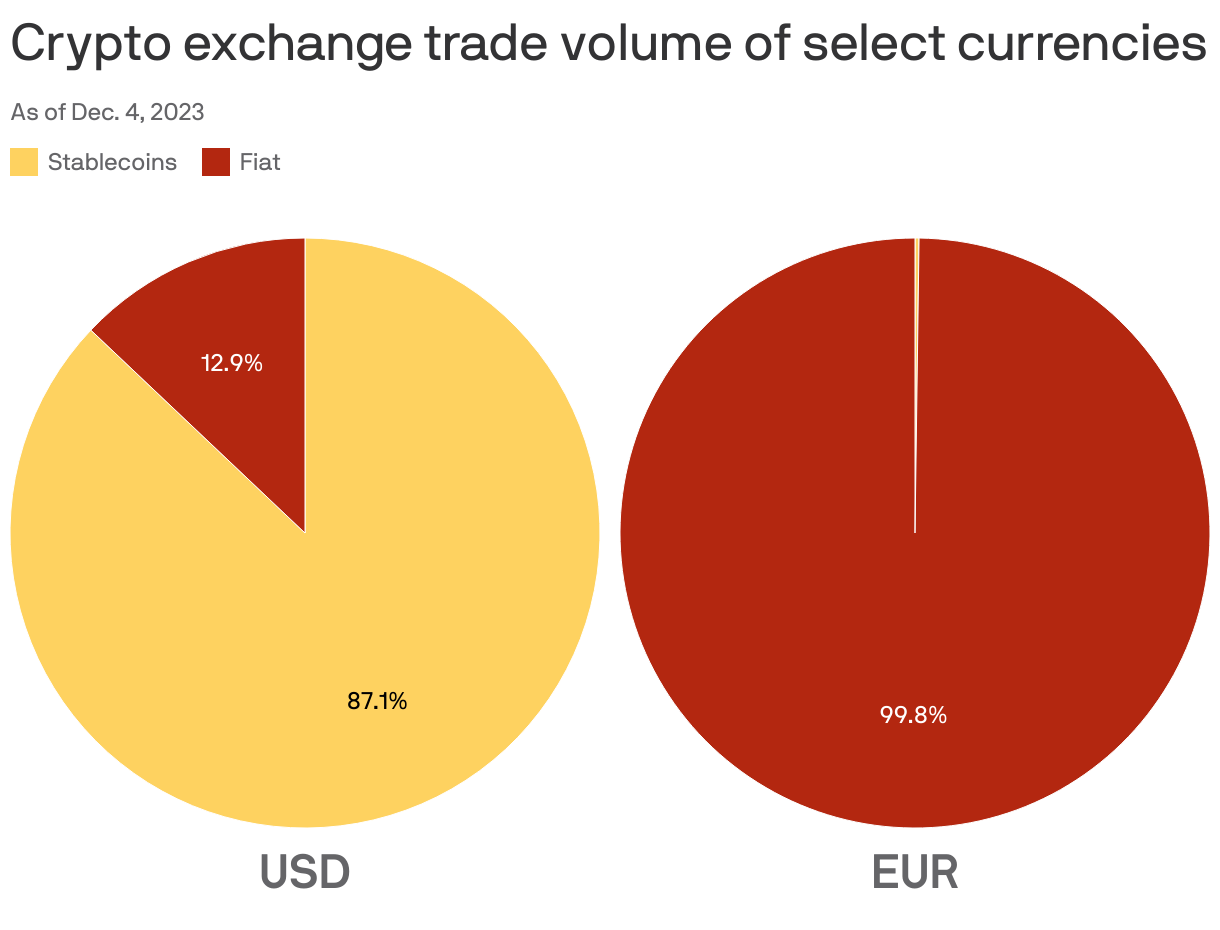
State of play: Euro-denominated stablecoins make up a teensy sliver of cumulative trading on exchanges, according to Kaiko Research (see below), but that could change with the entrance of a big bank-issuer.
What they're saying: "SocGen is really pushing the envelope and experimenting, and that's good because stuff like that has to happen for this industry to move forward," Lucas Vogelsang, cofounder of Centrifuge, tells Axios in an interview.
The U.S. picture: Caitlin Long, CEO of Custodia Bank, said the SocGen event was "extremely meaningful," confirming her worst fears that the U.S. would fall behind in the stablecoin race.
- "This is what U.S. policy has thrown shade on," Long tells Axios. "We've lost at least a year in a market that moves at lightning speed — while Europe and the Middle East try to grab the regional power centers in technology, the U.S. is ceding it to rest of the world."
- Custodia Bank had plans to issue a stablecoin but has been drawn into a legal battle with the Federal Reserve Bank in Kansas City over its denial of a master account.
Context: Among the Kansas City Fed's concerns: how dangerous the bank's stablecoin could be if Custodia were allowed into the Fed's banking system.
Separately, recall that Facebook unceremoniously shuttered its Diem project, saying U.S. regulators had made it clear it wouldn't fly. Silvergate Bank, which later bought it, never moved beyond plans to launch and the bank was closed after the FTX crash.
What we're watching: Perhaps Europe's lead will move Congress to pass stablecoin legislation.
🤼♀️ 2. Stablecoins vs. fiat

The stablecoin pie is almost all backed by U.S. dollars, Crystal writes.
Zoom in: Some centralized exchanges don't even offer euro-based trading.
- Of the CEXs under Kaiko Research's coverage, only 14 of 25 do —and of those, euro-backed stablecoin trading chips in just 0.2%, compared to 87% of USD-backed stablecoins.
Of note: It's not just about euros; most crypto exchanges in Canada don't support the Canadian dollar.
Between the lines: It'll probably stay that way.
- Case in point: Circle's euro-denominated stablecoin hasn't yet moved the needle of adoption, with just 50 million euros worth in circulation since its June 2022 launch, according to Circle.
The big picture: The stablecoin market has not fully recovered since the crash and burn of yesteryear's crypto firms — and it might not bounce back.
- What's standing in the way? There's a new darling on the blockchain that serves a similar purpose: T-bills.
And unlike stables, they deliver yield.
🇪🇺 3. Rolling out in Europe, U.K.
Illustration: Brendan Lynch/Axios
Bitcoin's number is going up, pushing some trading platforms to seek new customers outside the U.S., where the rules to operate are clearer, Crystal writes.
Driving the news: Robinhood is rolling out crypto trading to customers in Europe, bandying bitcoin rewards for signing up and referring a friend.
- Meanwhile, Coinbase, the U.S.'s largest exchange, added a feature to its wallet product, allowing users to send funds via text. It isn't specific to Europe, but it will roll out across 120 countries all the same. (The exchange picked Ireland as its hub just this year.)
Yes, but: The bar has been set higher for crypto firms operating in the U.K. and Europe, as the region moves ahead with broad regulatory frameworks that would govern digital assets.
- Unlike the U.S., the rules for how to operate a crypto business in those places are clearer, but that also means adhering to new compliance standards.
Case in point: The EU's MiCA has been giving Binance a run for its money.
Zoom in: A marketing crackdown in the U.K., for example, is already underway, and the Financial Conduct Authority, its finance watchdog, appears to be circling unauthorized exchanges.
- It has issued warnings on exchanges linked to Justin Sun, including HTX, KuCoin and now Poloniex.
- Guidance published yesterday said of Poloniex: "This firm may be promoting financial services or products without our permission. You should avoid dealing with this firm."
The other side: Meanwhile, big banks, already familiar with onerous compliance standards, could move in.
- Bitstamp recently said it was in talks with three large banks to offer crypto services — one of those was very likely SocGen's stablecoin initiative.
What we're watching: It wouldn't be surprising to see bank chiefs who are slightly more open to crypto than say, JPMorgan's Jamie Dimon (👇), seek new business lines in the digital asset space.
⌚️ 4. Catch up quick
Illustration: Annelise Capossela/Axios
👯♂️ Crypto makes strange bedfellows — JPMorgan chief Jamie Dimon and Sen. Elizabeth Warren. (Axios)
💰 The U.S. crypto lobby is on track to hit a record for spending. (Reuters)
🔎 Bitcoin ETF hopefuls have advanced to discussions of key technical details in talks with the SEC. (Reuters)
🧼 Anatoly Legkodymov, co-founder of Hong Kong-based crypto exchange Bitzlato, pled guilty to U.S. money transmitter charges and agreed to dissolve the exchange. (CoinDesk)
🎮 5. Culture hash: Grand Theft Bitcoin

Screenshot: @WallStreetBTCX (social media)
It's a tale as old as time: Man hacks triple-A rated video game company, steals an unreleased trailer, releases it on the internet as a way to promote buying bitcoin, Brady writes.
Driving the news: The cybercriminal who forced Rockstar Games to post their preview of the long-awaited Grand Theft Auto VI plastered the words "BUY $BTC" over the entire video that went up online.
- The version above isn't the original version, which showed up on X and promptly got the account banned.
- But, you can still see his version there.
Be smart: Grand Theft Auto is a controversial game franchise where players can act out the fantasy of being a street criminal in American cities. This next one visits Miami.
- The first one came out in 1997. The last one came out in 2013.
Check out the un-vandalized video on the Rockstar Games YouTube page.
- Yes, that is a Tom Petty song: "Love is a Long Road," off 1989's "Full Moon Fever" — not as good as "Wildflowers," but it gave the world "Free Fallin'" and it's from Tom Petty, so it's still pretty great.
This newsletter was edited by Pete Gannon and copy edited by Carolyn DiPaolo.
Crypto newsletter Advent calendar— we've got eight more issues to go until we take a break! What do y'all wanna read? —B & C.
Sign up for Axios Crypto

Brady Dale covers crypto and blockchain impacts on markets and regulation.