Axios Crypto

March 05, 2024
Howdy! Bitcoin broke its nominal all-time high in dollars today. It teased the all-time high last night but gave up early. It's funny how the market gets nervous around milestone numbers. With that said...
π¨ Situational awareness: Ether (ETH) is at its highest price since Jan. 1, 2022.
- How high will they go this week? [email protected]
Today's newsletter is 1,336 words, a 5-minute read.
π 1 big thing: Bitcoin sets new all-time high
Illustration: Shoshana Gordon/Axios
Bitcoin has reached a new all-time high, breaking its prior nominal record of $69,225 hit on Nov. 10, 2021, on Coinbase, the largest crypto exchange in the U.S., Brady writes.
Why it matters: The original cryptocurrency is driving the latest industry bull market.
Between the lines: Bitcoin continues to exhibit the four-year cycle associated with the regular halving of its supply issuance. The next halving is due sometime in April.
- Exchange-traded funds launched in January have also put the cryptocurrency in the realm of mainstream investors. So-called spot bitcoin ETFs have finally allowed heavily regulated funds to enter the market.
By the numbers: Coinbase charted a high of $69,324 a little after 10am today. Bitcoin (BTC) is trading at $64,348 on the exchange.
- In recent days, it had already broken its all-time high when denominated in other major currencies.
- Adjusted for inflation, its all-time high relative to the U.S. dollar is closer to $77,000 today.
Caveat: Each price is typically composed of market inputs from around the world, so they can have slightly different readings.
- Axios usually cites CoinGecko data, which has not yet charted a price above $69,000. The all-time high on that site is $69,044.
- The CoinDesk Bitcoin Price Index also shows the original cryptocurrency breaking $69,000 this morning.
Flashback: Since its prior high in November 2021, bitcoin's price graph has been anything but a straight line.
- A billion dollars in value evaporated a year after that mark, when a crypto market downturn was sent into a full-blown crash with the terra usd stablecoin meltdown in May 2022.
- Bitcoin fell below $29,000 that November.
The big picture: Crypto has been through several booms and busts, and in each bust, the bottom has been far higher than the time before.
- While the cinematic string of scandals that rocked the industry through 2022 captured the public imagination, none of those companies represented the core value proposition of blockchain technology: decentralized networks that no person or group can control.
My thought bubble: Despite the tumult, we told you in December 2022 that crypto would be fine.
What they're saying: "Ultimately, what we're seeing now is the market catching up to crypto-native founder and investor momentum β which never wavered," Soona Amhaz, a general partner at Volt Capital, tells Axios.
- "It feels like we're only seeing the beginning of the retail demand that will pile in. I think that the all-time high is going to unlock even more FOMO from people," Jake Dwyer, founder at Factor Capital, tells Axios. "I suspect most holders are targeting $100K as an exit, not $75K."
The other side: JPMorgan analysts see bitcoin potentially falling back to $42,000 after the halving, as miners struggle with reduced profitability.
What we're watching: Bitcoin is up more than 57% over the last three months, and strong growth may continue through the halving β but returns probably won't match 2021's.
- The market is maturing.
πΈοΈ 2. ETHDenver dispatch: Fixing internet creep

Brady at ETHDenver. Photo: Crystal Kim/Axios
The internet knows too much and if unchecked, stands to keep eroding individual privacy, Crystal writes.
Zoom in: That's where validity proofs, also called "zero-knowledge" proofs, come in. The technology enables one party (the prover) to show transactions are valid, without sharing transaction information.
- This tech delivers privacy. If pointed at identity validation, it could theoretically enable a bouncer at a club to verify that you're 21 years old without telling them your name, address or, even, your birthdate.
Driving the news: At a panel on the promise of zero-knowledge proofs to fix the creepiness of the internet at ETHDenver, experts in ZK technology discussed how that tech can be used to address "the internet's original sin" (surveillance capitalism).
- Case in point: Google Maps, while helpful in getting a person where they need to be, also keeps a record of where they were.
Behind the scenes: Experts in ZK tech spoke of others, real and hypothetical.
- Airbnb has a way of checking people out, determining for example, how likely they'd be to "film something" or "throw a party," according to Ian Miers, an assistant professor of Computer Science at the University of Maryland.
- Folks who get on that block list have no way of knowing how or why they got on that list and have no recourse, one panelist noted.
Artificial intelligence, meanwhile, makes "privacy gone," said Elena Nadolinkski, from IronFish, a fully encrypted proof-of-work Layer 1.
- She worries about a future in which AI finally really puts the oceans of data companies have gathered about us to even more productive use.
State of play: Today, it takes effort to scrape and analyze personal data to figure out who an individual is, but superintelligence could make that all the easier.
- "My pet peeve is that it's gotten so bad and nobody I know cares," Matthew Green, a John Hopkins University professor, said. "Nobody realizes how much of their data is being sold, and it's just part of life."
What we're watching: The underlying tension with the privacy tools being built is whether they will cater to regulators and authorities and either be made "weak" to comply or go HAM, driven by core principles of developing some kind of unstoppable technology.
π 3. Washington halts Bitcoin-specific power inquiry
Illustration: Gabriella Turrisi/Axios
The Energy Department has dropped its "emergency" survey of crypto-miners' power use, ending litigation against the effort, Ben Geman of Axios Generate writes.
Why it matters: DOE's stats arm, the Energy Information Administration, cited concerns over strained grids, power prices and emissions when launching the data collection in January.
State of play: An agreement filed Friday with a Texas federal judge says the EIA will destroy any info received to date.
What's next: EIA may revive some kind of data gathering after going through formal regulatory notice-and-comment.
- The agency is "hopeful" about working with the industry to provide the public a "clear understanding" of its of energy use, it said.
Catch up quick: The Texas Blockchain Council and bitcoin miner Riot Platforms sued to block the survey, alleging an "invasive" move that jeopardized sensitive info.
- "It is critical that our nation's data remain impartial and that starts with an open and transparent process," attorney Kara Rollins of the New Civil Liberties Alliance, which represented the plaintiffs, said in a statement.
Friction point: An attorney with the Sierra Club, which hoped to join the case on EIA's side, called the settlement "disappointing"
- Kate Huddleston said EIA should move quickly through notice-and-comment to enable the data gathering.
- "The demand that cryptocurrency places on the grid and the lack of predictability of miners' behavior is gambling with grid reliability and ultimately lives," she said in a statement.
The bottom line: This is one skirmish in a wider war over crypto energy use.
π€ 4. Charted: Power in Texas

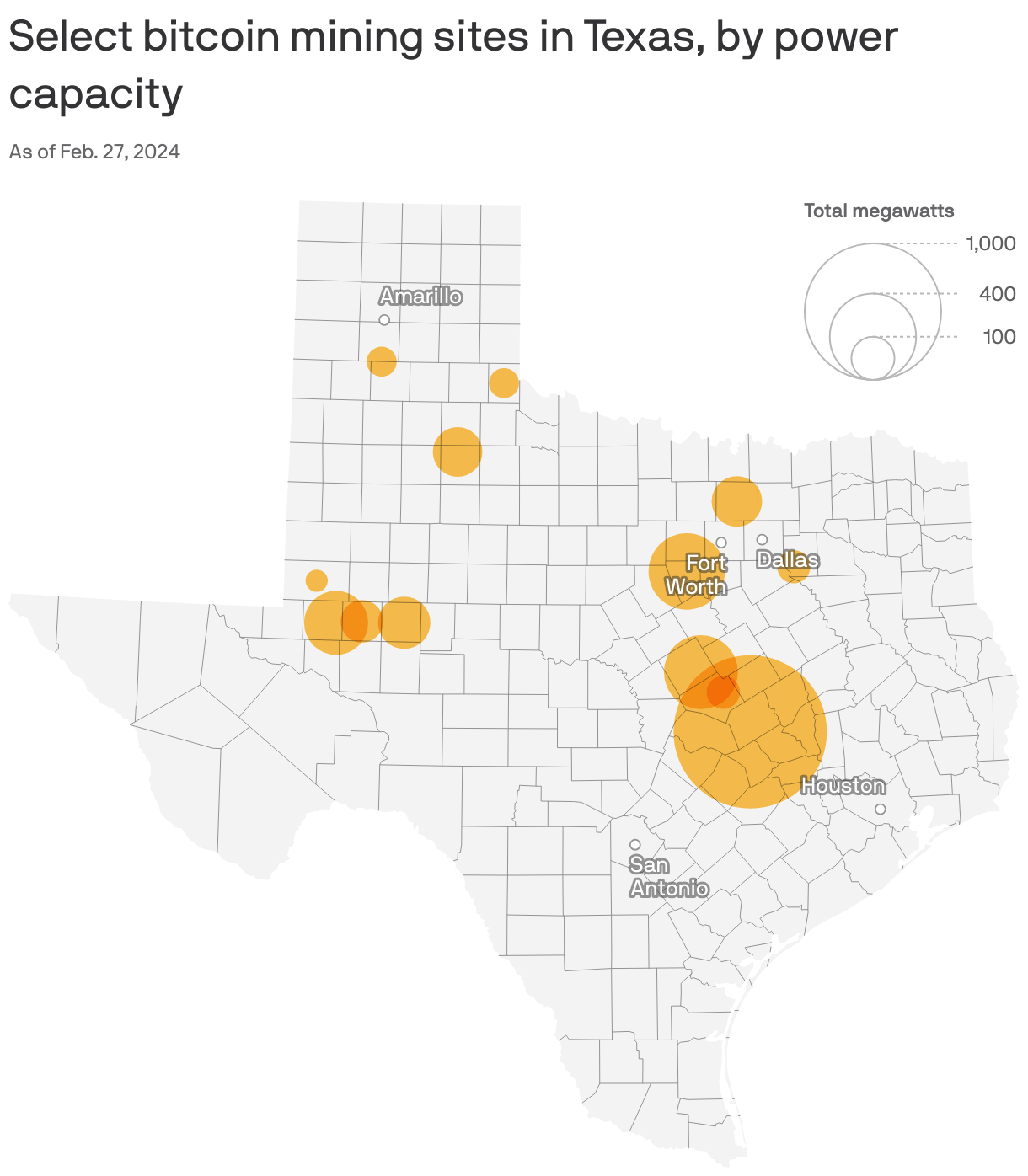
The lion's share of conversations we have about bitcoin mining end up taking us to Texas, Brady writes.
- So we asked our friends at the bitcoin-mining publication, The Miner Mag, to peel off the Texas data set from their national map, adding details about how much power each site uses.
Why it matters: Texas is the most popular place for bitcoin mining in the nation, largely, we are told, because of the free-market approach it takes to its energy market.
- It's also a hot spot for building wind and solar capacity. Unfortunately, its grid is not up to the task of making good use of it.
What they found: As this map shows, most of the wattage is near where most people live in Texas, but there's quite a bit out in West Texas, too.
- West Texas is a more thinly populated part of the state. It is also home to lots of wind and solar power.
- The forecast for Texas is more wasted wind and solar power β that is, electricity generated that can't get to end users. (Enter: bitcoin miners.)
In the weeds: Some of the biggest operators in the state are Marathon Digital, Iris Energy, Riot Blockchain and Hut 8.
β° 5. Catch up quick
Illustration: Annelise Capossela/Axios
This newsletter was edited by Pete Gannon and copy edited by Carolyn DiPaolo.
Brady made a gentleman's bet about the impact of an ETF with another reporter early one morning outside the SBF trial. Brady just won it. βC & B
Sign up for Axios Crypto

Brady Dale covers crypto and blockchain impacts on markets and regulation.