Axios Crypto

February 21, 2023
Howdy! Today we venture into the space between blockchains and check in on the whales.
🚨 Situational awareness: Paxos Trust, the white-label stablecoin issuer behind Binance's namesake stablecoin binance usd (BUSD), severed its relationship with the crypto exchange. (Axios)
- Seeing something we aren't? [email protected].
Today's newsletter is 1,183 words, a 4-minute read.
🤝 1 big thing: Trading between blockchains

Illustration: Brendan Lynch/Axios
It's not all bad news out there in crypto land. Blockchain investors have recently been moving funds into the Stargate system, and its token is seeing corresponding price appreciation, Brady writes.
Why it matters: Stargate pitches itself as a safer, faster approach to move funds between chains, a concept vital for broadening the crypto ecosystem.
- So-called interoperability solutions lost about $2 billion in user funds in 2022, according to data firm Chainalysis.
How it works: Underneath it all, Stargate is basically an email system for blockchains. That's a bit of an oversimplification, but it's close enough.
- Essentially it sends messages between chains to manage trades.
Context: In truth, blockchain assets can really only exist on the chain where they originated. If they are moved elsewhere, they become very unreliable copies.
- Think of it like this, imagine that dollars simply vanished at the border of the U.S. They just couldn't exist off U.S. soil. Same thing for pound sterling. It doesn't exist outside Britain.
- Stargate acts like a shop with offices in both the U.S. and Britain. If you drop off $1,000 in New York, you can pick up £830 in London. The first shop would send a message to the second that you'd bought the cash.
Zoom in: If you had your money in ether (ETH) on Ethereum and you wanted to invest in something on the Avalanche blockchain, you could use Stargate to buy AVAX on Avalanche in one transaction.
- The ETH would leave your Ethereum wallet and AVAX would show up in your Avalanche wallet, all with one fee, in one transaction.
Be smart: Stargate enables cross-chain trades between native assets.
- Of note: The project has published three security audits.
Zoom out: Stargate works much like automated market makers do, such as Uniswap and Curve Finance. Supporters (called liquidity providers, or LPs) deposit funds in its smart contracts on each chain that can be used to make trades.
- Users pay a small fee to trade, and that's shared with LPs, but that's not where the money is made. If you look, LPs can earn returns of 10% or more on deposits.
- How do they earn so much? Simple, they are being rewarded with Stargate's STG token.
That's right, the difference comes from a token the team made. It's a governance token that will be used to vote on how the project will change over time.
- Obviously, arrangements like this are under a lot of scrutiny these days. Beware!
Details: It looks like lots of the movement on Stargate is between stablecoins, which makes sense. The big stablecoins are natively issued on multiple chains.
🔢 2. Charted: Stargate, by the numbers
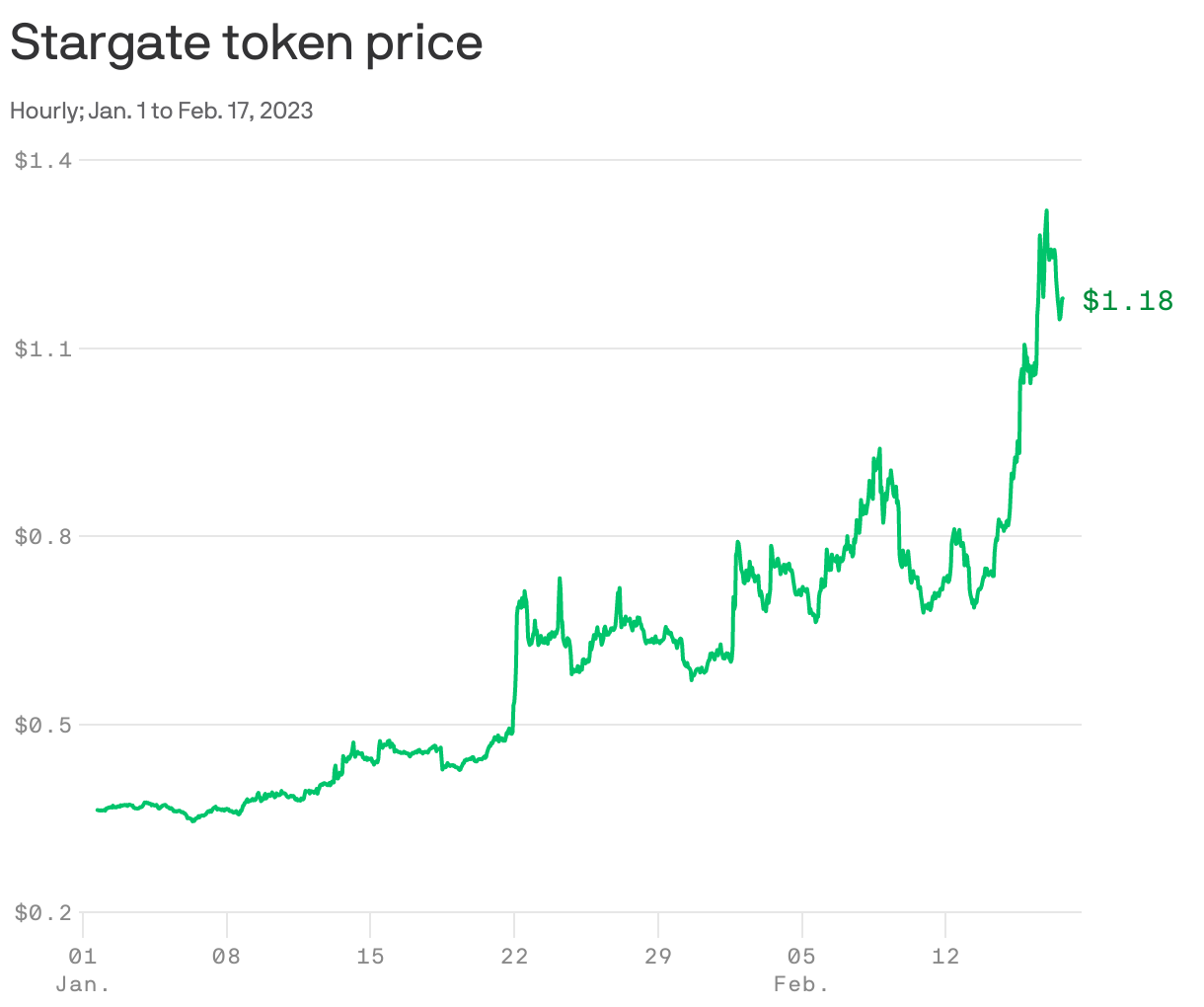
Stargate's token, STG, is up over 300% since Jan. 1, at $1.18 on Friday. It's dropped to $1.10 today.
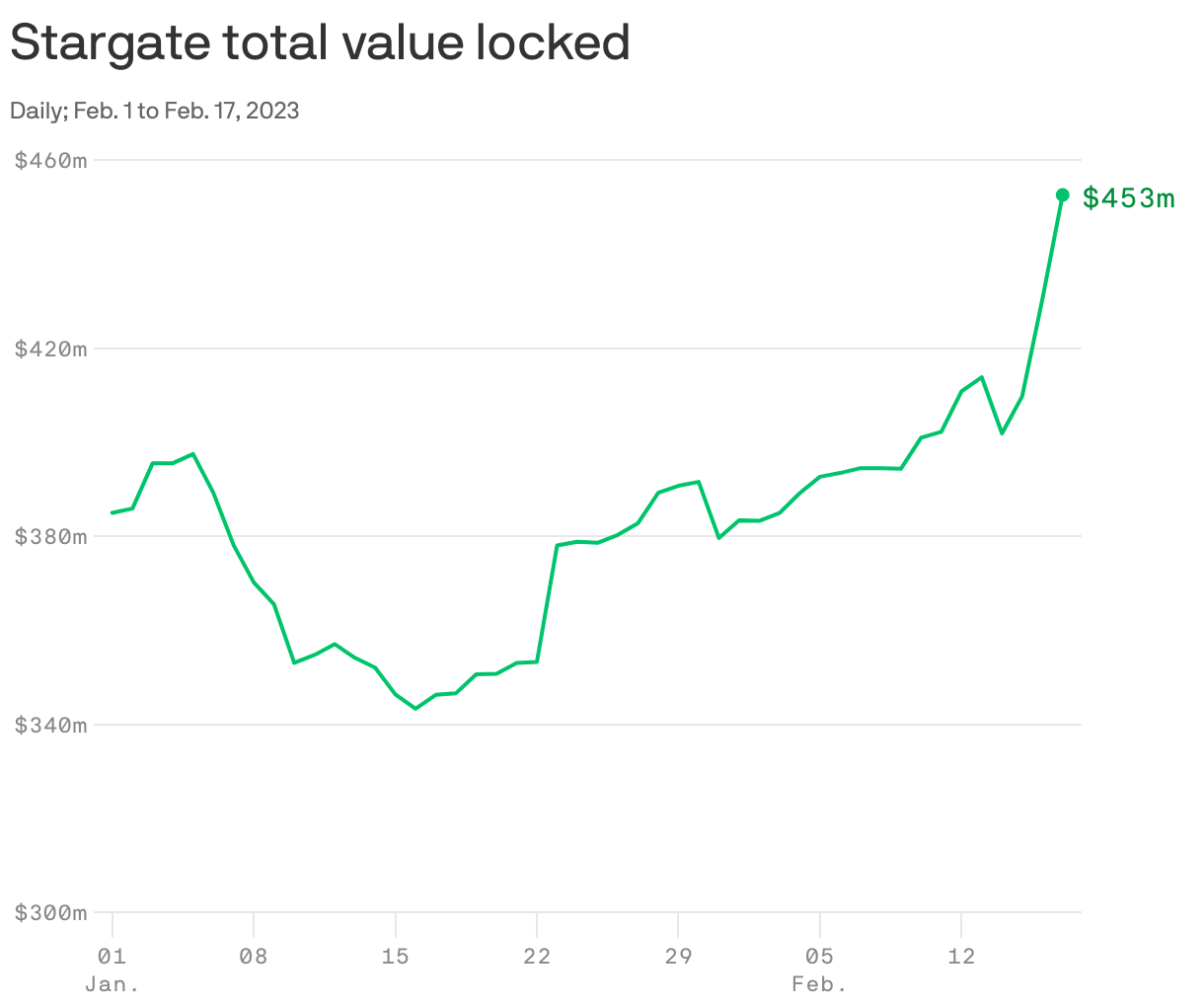
Total value locked (TVL) in the protocol reached $453 million late last week, up 20% from Jan. 1, Brady writes.
- Total value locked reflects all the funds liquidity providers have deposited in the protocol to facilitate its trades.
Be smart: The more funds are deposited, the less prices will slip from their prevailing market level when large trades are made. So more deposits attracts more liquidity.
Zoom in: Its TVL is still well down from its high last April, when more than $4 billion had been committed to Stargate.
The intrigue: Its token price is growing much faster than TVL.
- Make of that what you will.
👛 3. Whales gain at retail investors' expense, BIS says

Illustration: Shoshana Gordon/Axios
"Crypto shocks and retail losses," the latest crypto report out from the central bank of central banks, tries to measure what impact the biggest disasters of last year had on individual investors compared to large, well-heeled ones, Crystal writes.
What they found: "Larger investors probably cashed out at the expense of smaller holders," the report from the International Bank of International Settlements says.
- Trading activity spiked in the days following the events, but as bitcoin whales sold, individual investors were buying.
- Of note: Probable, but not definitive.
Why it matters: While BIS reports are more "handy research for reference" than they are "broad edict for member central banks to follow," the tone of this most recent one on digital assets nods to the general messaging from financial authorities as of late: Investors need more protection from crypto.
Details: Data tracking the daily frequency of crypto-exchange app use by retail traders across 95 countries from August 2015 to mid-December 2022 reveals that owners of large wallets reduced bitcoin holdings in the days after the shock events, according to the report.
- Meanwhile, medium- and small-sized holders raised theirs.
- The price pattern suggests "larger investors were able to sell their assets to smaller ones before prices fell sharply," the report says.
The big picture: Almost three-quarters of users downloaded a crypto platform app when the price of bitcoin was above $20,000, according to BIS, and assuming they bought bitcoin at download, the median investor would have lost $431 by December 2022.
- That's almost half of their total $900 in funds invested since downloading the app.
- A simulation study also models monthly increases after initial download, after which almost all, or four-fifths, of users would have likely lost money.
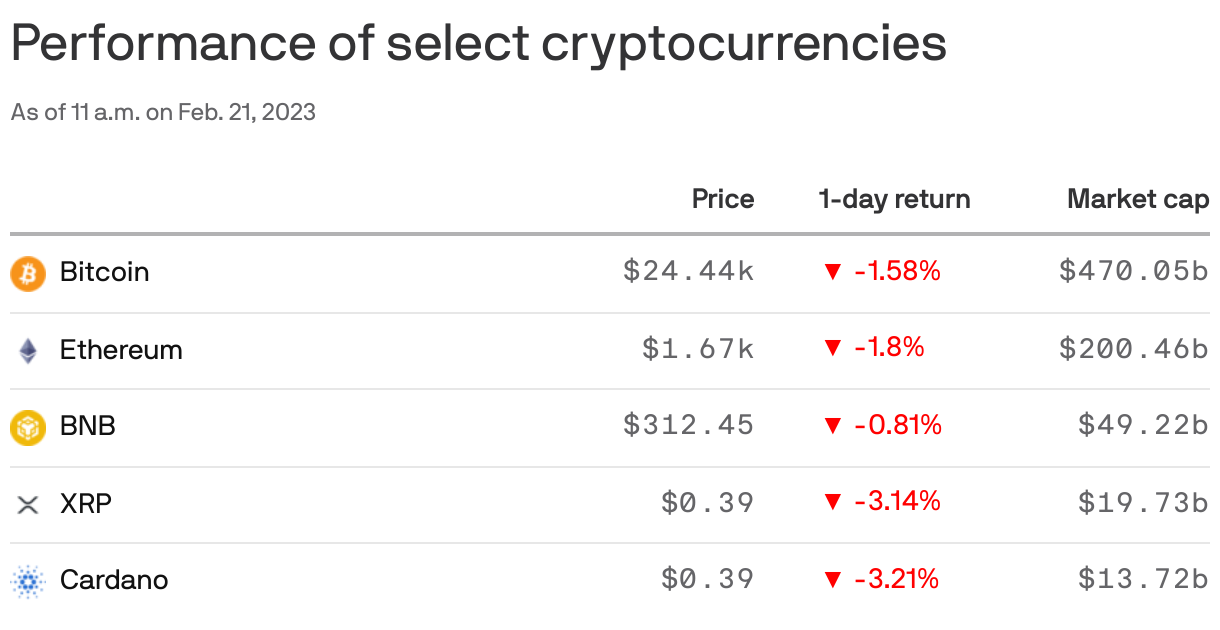
Yes, but: The price of bitcoin has rebounded to more than $24,400 as of this afternoon, up almost 50% so far this year.
What they're saying: Lucky for major banking systems around the world, last year's events mostly inflicted harm on the sector itself. But there's more to be done, the BIS says.
- To secure financial stability, "options include banning specific crypto activities, containing crypto, regulating the sector or a combination of these," the report said.
- "Containment may prevent risks in crypto from spilling over to the real economy and traditional financial system."
The bottom line: Some mix of those three things is already happening in the U.S.
☄️ 4. Catch up quick
🧬 Polygon Labs, an Ethereum scaling protocol, cut 20% of its workforce or roughly 100 jobs. (CoinDesk)
🦉 The collective behind Moonbirds NFTs Proof is canceling its conference in May, citing the general market malaise. (Decrypt)
🇯🇵 FTX Japan is expected to restart asset withdrawals at the unit of the now-bankrupt crypto exchange. (Reuters)
🚪Update: Kyle Chayka, a co-founder of Dirt, the media company we just profiled, is "stepping back" and directing followers to his personal newsletter. (Dirt)
Top coins

🦧 5. Culture hash: Apes and triangles
Source: @Ivan87403 (Twitter)
Move over Mary Kay, Crystal writes.
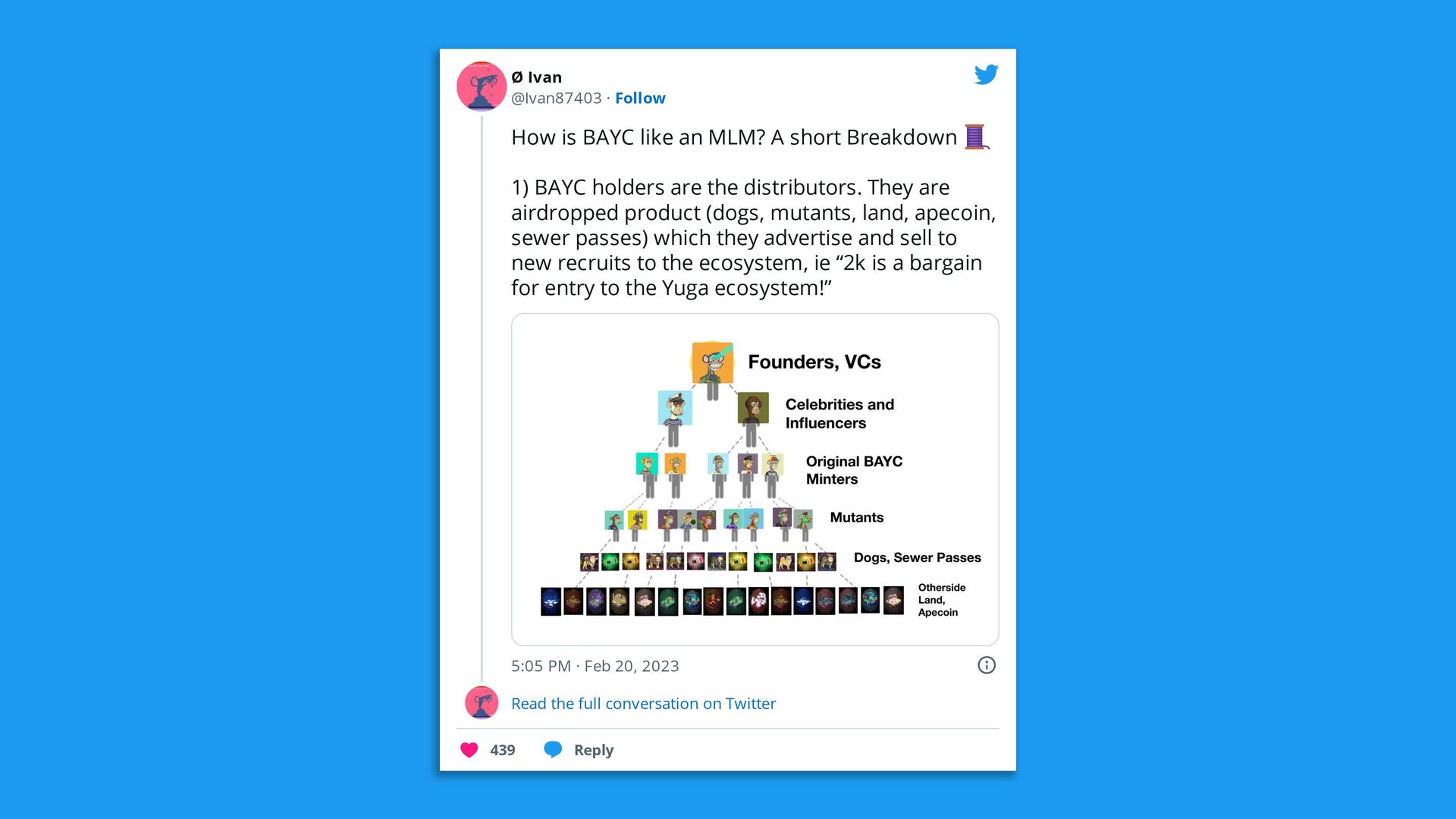
The big picture: Enthusiasm around the Bored Ape Yacht Club (BAYC) and associated NFT collections appears to be waning amid general market dreariness, with one Twitter user likening them to an MLM, or a multilevel marketing scheme.
- Maybe everything's a Ponzi?
What they're saying: Founders, VCs, celebrities, influencers and original BAYC minters are at the top of the pyramid, and relying on new recruits "is the only way to make meaningful money," the thread argues.
Be smart: MLMs are legal, but pyramid schemes or Ponzis are not.
- Amway, Avon and Herbalife, OK; Bernie Madoff and Greater Ministries International, not OK.
Yes, but: The top four NFT collections on NFT Price Floor are owned by Yuga Labs, the company behind BAYC. So demand is holding up.
The bottom line: Yes, there is a buyer for every seller.
This newsletter was edited by Pete Gannon and copy edited by Carolyn DiPaolo.
State of play: Coinbase announces its earnings today, after markets close. —C & B
Sign up for Axios Crypto

Brady Dale covers crypto and blockchain impacts on markets and regulation.