Axios Crypto

February 08, 2023
Hello, hello! If we seem a little frazzled it's because we've been conferencing with fellow Axios staff while also writing our newsletter this week.
- They've told us we should remind everyone to forward the email around. So, hey, forward it around! If not, tell us why not: [email protected]
Today's newsletter is 1,167 words, a 4-minute read.
🍄 1 big thing: Pioneering a web3 business model
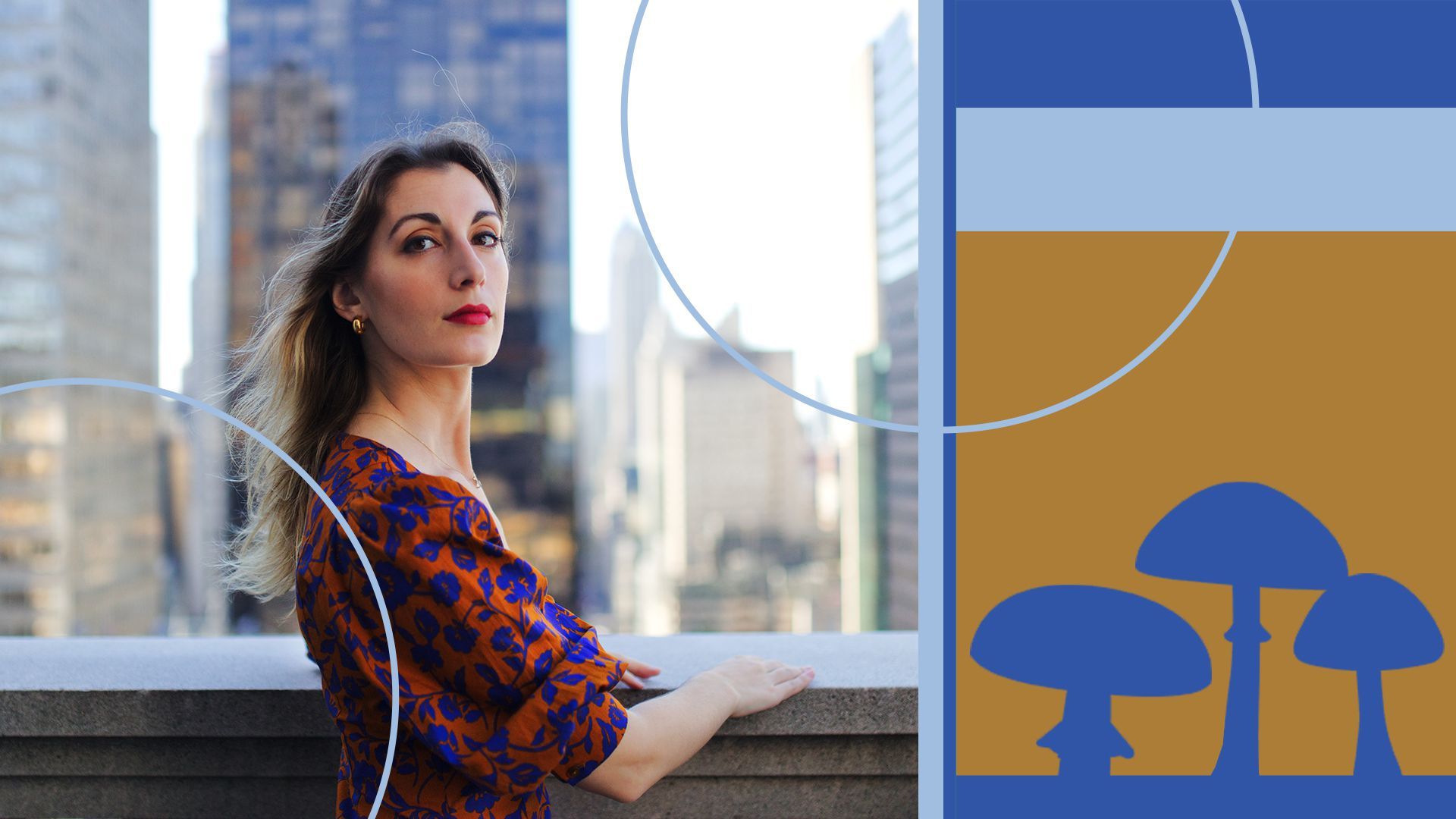
Daisy Alioto, Dirt co-founder and CEO. Photo illustration: Annelise Capossela/Axios. Photo: Sami Hobbs
Daisy Alioto didn't specifically set out to build a web3 media brand when she co-founded Dirt alongside Kyle Chayka. They set out to found a media brand that took advantage of web3, Brady writes.
Context: Dirt's a culture site, covering books, entertainment and the internet. It might pick up on blockchain-related news, but it's not central to its coverage.
- It's aiming more to cultivate a particular viewpoint, one that certain readers can gravitate to and identify with.
Why it matters: Dirt has now sold 142 subscriptions in the form of NFTs since it opened up the feature in January.
- They've brought in the equivalent of around $75,000 across its supporters, in two different tiers of NFTs: subscribers and founders.
- Alioto believes it shows that the web3 model is one where people will spend more for a subscription because it feels different.
How it works: People who want access to its premium content buy a subscription on the website by connecting their Ethereum wallet and then paying to mint one of the NFTs.
- Then, when a user wants to use their subscription, they authenticate using their Ethereum wallet, verifying that it holds a valid NFT.
- It's like a traditional website sign-in, but it's also different.
Details: Subscriber NFTs are good for a year. Founder NFTs are good for life. They both get access to subscriber-only content that can be seen on the web.
- The NFTs aren't transferrable, so buyers can't resell them or share them.
Fun fact: The art for the subscriber NFT was made by Amber Vittoria, who we covered back in June.
What's next: Dirt is only the beginning. The company is building its own platform to operate other web3-enabled media brands to function in parallel, like a Conde Nast for the blockchain age.
- "They will all be verticals with a strong lifestyle and consumer affinity," Alioto says.
Between the lines: Alioto sees untapped opportunities in web3 wallets for such brands.
- While the web, so far, has used cookies to target readers with content or advertising, Dirt aims to look at the public information in users' wallets as its starting point.
- For example, by looking at wallets, they can see what NFTs a user holds or which decentralized apps they frequently use. Those could eventually become key clues for how to target them.
What they're saying: "We believe the wallet address is going to be the new fundamental unit of consumer data," Alioto told us.
Flashback: Dirt raised $1.2 million in a seed round in May.
- It built up its following on Substack as it put together its own website and tech platform. It went independent in mid-January, migrating readers over to its own infrastructure.
There's a free newsletter for people who want to try out Dirt's vibe and see what they are missing.
🇹🇷 2. Charted: A currency crisis as seen on chain
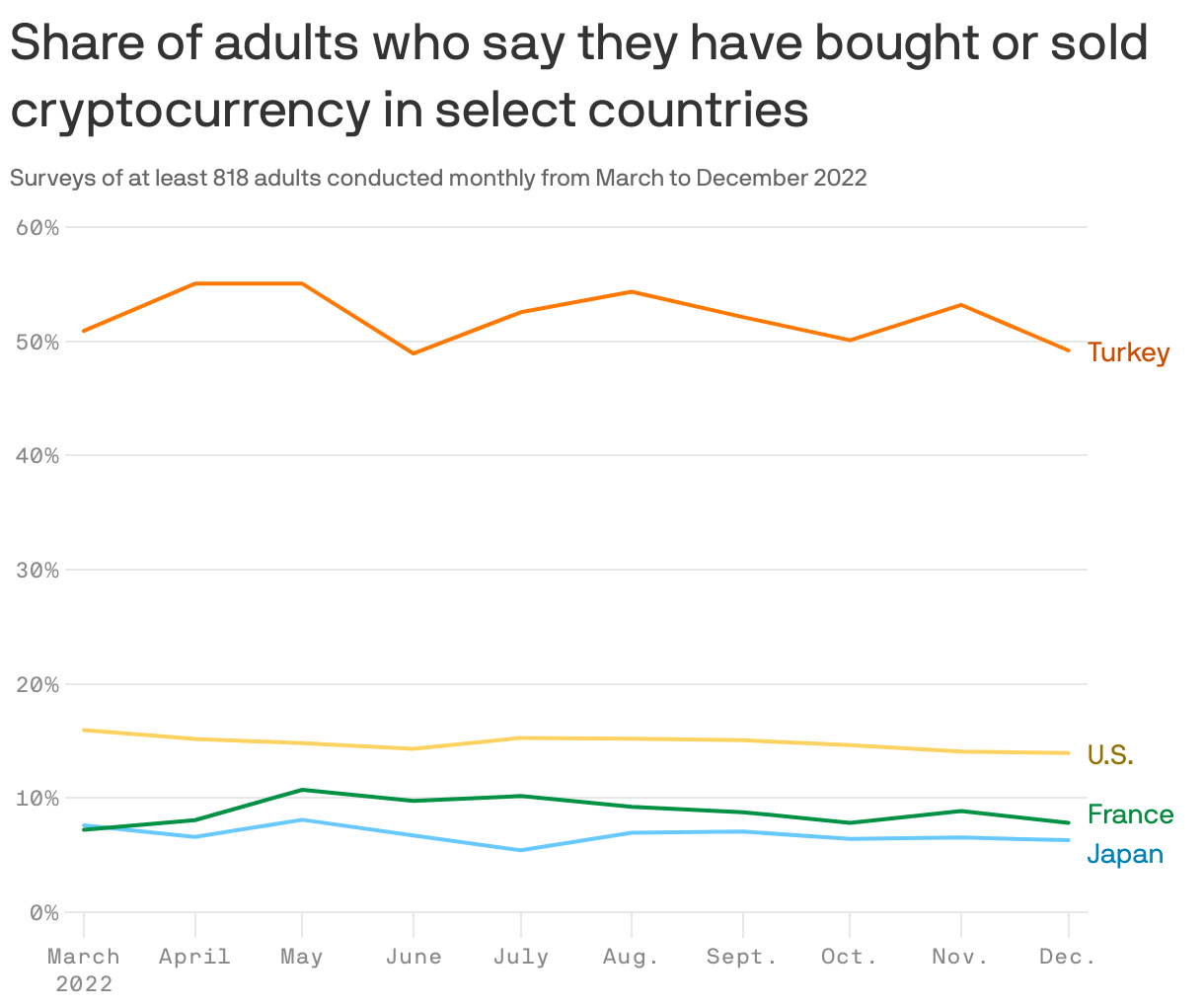
One of these lines is not like the others, Brady writes.
Why it matters: Cryptocurrency mavens have always promised that it would take off in places where the local currency is going off the rails. It took longer than anyone expected, but it might actually be happening.
- For example, the Turkish lira has been in a multiyear currency crisis.
Morning Consult shared this polling data with us, where they surveyed thousands of people around the world about whether or not they have bought or sold any cryptocurrency in the last month.
- They also asked respondents about their trust in crypto. While responses on that level dropped 30% by the polling firm's read, it doesn't show up much in crypto use from place to place.
A couple other countries reported outsize use too: Brazil came in at about 19+%; South Africa was 30+%.
🤺 3. SEC examiners are coming for crypto
Illustration: Aïda Amer/Axios
The Securities and Exchange Commission division in charge of putting firms through inspections appears to have shifted its priorities for the crypto industry, slightly, Crystal writes.
Driving the news: The SEC's Division of Examinations yesterday announced its annual list of priorities. Obvi, crypto was on the agenda.
- The intrigue: This year, though, the SEC wants to focus on the way crypto firms are peddling their wares and services to Americans; last year they were more interested in how they were running their businesses as it related to risk and compliance.
Why it matters: The regulator has faced questions about whether it did enough to protect customers, many of whom have assets frozen on platforms or caught up in bankruptcy proceedings.
- The shift in priorities could signal it is honing its methods of keeping the industry in line
Be smart: The examinations are supposed to prevent fraud, monitor risk, improve compliance and inform SEC policy.
What they're saying: "Examinations of registrants will focus on the offer, sale, or recommendation of, advice regarding and trading in crypto or crypto-related assets."
- Specifically, they will assess whether crypto firms "met and followed their respective standards of care when making recommendations, referrals, or providing investment advice, to the extent required."
Context: "Given the disruptions caused by recent financial distress among crypto asset market participants, the Division will continue to monitor and, when appropriate, conduct examinations of potentially impacted or affected registrants," they said.
The intrigue: U.S. federal prosecutors asked a judge yesterday to postpone the SEC and CFTC cases against FTX founder Sam Bankman-Fried.
Quick take: While the published list isn't a definitive guide to what the SEC will pursue, it does a good job of laying out what's to come.
- The division last year said it would go after "finfluencers," and then, nabbed Kim Kardashian.
Of note: Also "...the Division will focus on new or never before examined registrants offering crypto or crypto-related assets."
- Perhaps those that are more familiar than Bitzlato.
🛼 4. Catch up quick
🦅 The Fed issued a policy statement saying that member banks may not hold cryptocurrency as principal. (Federal Register)
😣 Sullivan & Cromwell billed over $7 million with an average hourly rate of $1,400 for less than a month of work on the FTX case. (CoinDesk)
🌦 Cloud mining shop BitFuFu pushes deadline to close SPAC deal and go public. (CoinDesk)
👥 SBF appealed the decision that would reveal the identities of two cosigners of his $250 million bail bond in court filings. (CoinDesk)
Top coins

🧊 5. Culture hash: What follows betrayal
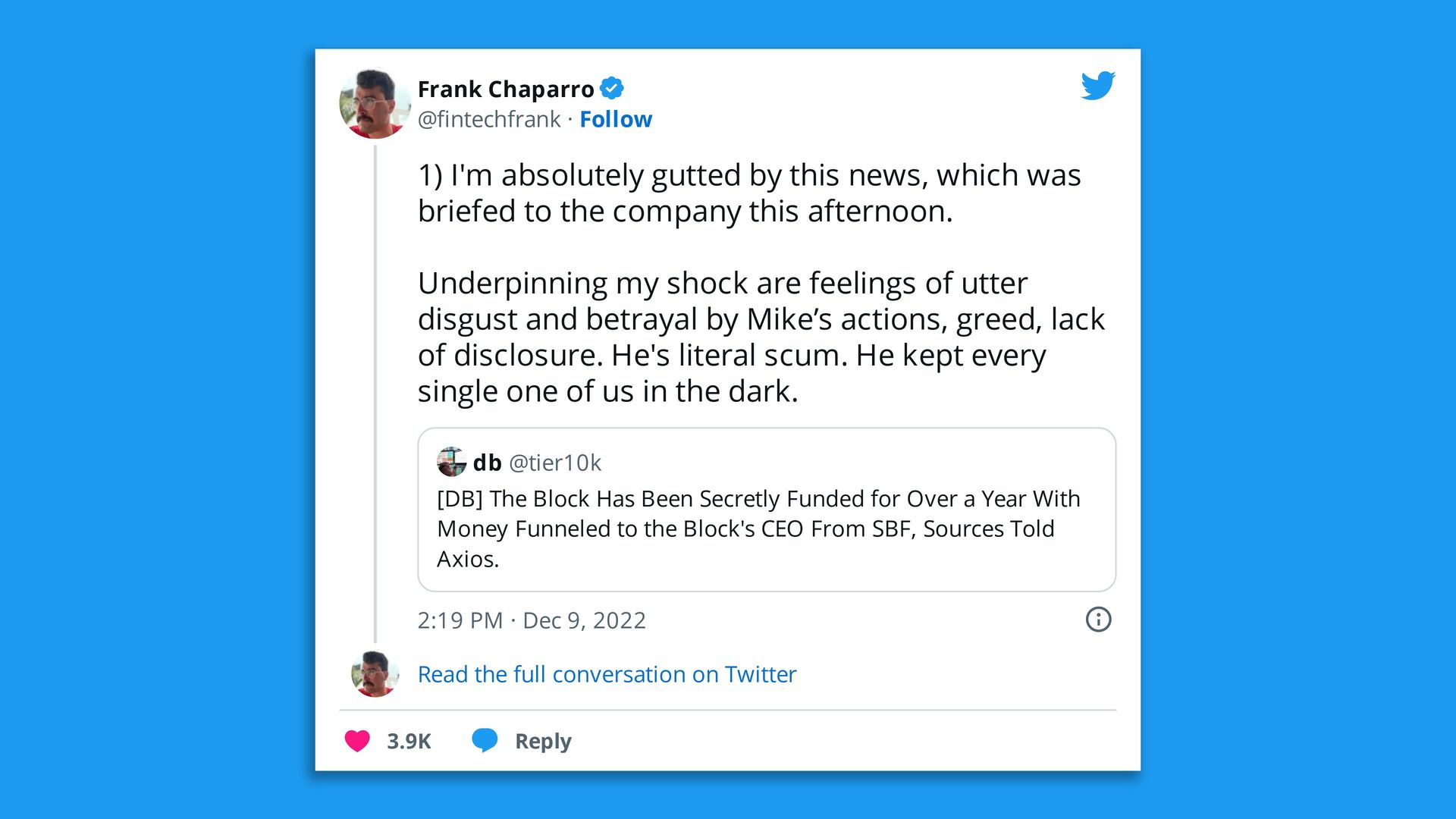
Source: Twitter @fintechfrank
The steady drumbeat of layoff announcements has not stopped, and the latest casualty in crypto also happens to link with bankrupt crypto exchange FTX, Crystal writes.
Driving the news: Crypto media site The Block let go 27 members of its staff Friday, reported by peer crypto media site Blockworks.
- The layoffs follow a discovery made by Axios in December connecting the media outlet to FTX founder Bankman-Fried. Thus, Block reporter Frank Chaparro's tweet above.
Flashback: Axios' Sara Fischer uncovered that The Block had been secretly funded for over a year from FTX, with money funneled to The Block's now-resigned CEO Michael McCaffrey.
- The layoffs also followed expansion plans announced in March, with the intention of quadrupling its staff to 80.
The bottom line: Assuming The Block achieved those goals, those 27 would represent a little over 30% of the 80. If not, it would be more.
- Gutted indeed.
This newsletter was edited by Pete Gannon and copy edited by Carolyn DiPaolo.
Hey, Gemini Earn users: Are y'all worried that you'll get cashed out instead of getting your coin holdings back? —C & B.
Sign up for Axios Crypto

Brady Dale covers crypto and blockchain impacts on markets and regulation.