Axios Crypto

June 15, 2023
π₯ Here's to moving on. Plus, a crypto use-case database.
Today's newsletter is 1,117 words, a 4-minute read.
π 1 big thing: MakerDAO breaks away from GUSD

Illustration: Sarah Grillo/Axios
MakerDAO is breaking up with Gemini by cutting its position in the exchange's GUSD stablecoin, Brady and Crystal write.
Why it matters: The decision is largely informed by a desire for MakerDAO, which has $8 billion in assets, to take advantage of generous interest rates on U.S. Treasuries.
Be smart: MakerDAO is sometimes called the Central Bank of DeFi.
- It's one of the oldest decentralized finance projects, issuing the dai (DAI) stablecoin, which is collateral-backed, as opposed to directly backed by dollars in a bank.
Zoom in: Gemini pays MakerDAO 2% on its deposits of GUSD, which represent about 88% of all the GUSD in existence, according to CoinDesk.
- But on the other hand, it is looking at 5% returns from U.S. government debt.
Flashback: Gemini first approached MakerDAO about making a deal to support GUSD last September.
- In January, amid larger uncertainty in the market, MakerDAO entertained a prior proposal to cut loose from Gemini's house stablecoin.
- That proposal failed narrowly.
Zoom out: MakerDAO functions as a decentralized autonomous organization, or DAO, and it did so long before there were really tools or norms for functioning in that way.
- It is governed by its governance token, maker (MKR).
- These days, however, there is a growing recognition that, in practice, the DAO is controlled by its founder.
Between the lines: The point of MakerDAO was always to issue DAI. That said, the way it used to do it was by making loans. Users would post collateral and MakerDAO would let them borrow some of its value in the form of DAI.
- In 2021, it created the Peg Stability Module which, at first, was a way to turn fiat-backed usd coin (USDC) into DAI.
- Meanwhile, the DAO was beginning to execute a long-term plan to diversify its treasury away from being 100% cryptocurrency. It always wanted to incorporate assets from the regular world.
For example, it has been collaborating with Centrifuge, a firm that's been tokenizing assets such as trade receivables.
- However, the organization has also been somewhat panicky since the Treasury smacked down the privacy protocol Tornado Cash.
The intrigue: On the one hand, cutting loose a fiat-backed stablecoin like GUSD squares with MakerDAO's desire to increase its censorship resistance.
- But if it turns and just invests that money into the most traditional of instruments, bonds, it seems to be moving in the other direction.
By the numbers: At the close of the vote today, 63,275 MKR had been posted in favor of the proposal, with 84.18% of the vote going yes.
The bottom line: It's just a skirmish over the long-term direction of one of DeFi's defining projects.
π¨ 2. Charted: Every Crypto Winter


Yesterday, Fed chair Jerome Powell and his colleagues voted to keep interest rates steady, as expected, and bitcoin basically did the same, Brady writes.
- Looking at bitcoin another way, though, it has been steadily rising for months. It's like clockwork: Whenever the broader crypto market tanks, Bitcoin Dominance (BTC.D) rises.
Be smart: BTC.D measures the percentage of the overall crypto market cap represented by the original cryptocurrency.
- 10,000 or more coins out there, but one and only one accounts for half the market's value.
This means that while everything has fallen, all other cryptocurrencies have fallen much further relative to the original, and that's how we see BTC.D rising through the last eight months.
What they're saying: "Bitcoin is the only credibly neutral digital currency," Grant Gilliam, managing partner of Ten31, a venture firm focused on Bitcoin, tells Axios via a spokesperson.
- "More are realizing that fact over time and seeking safety in bitcoin, which is a long-term trend we expect to continue."
ποΈ 3. A crypto use-case database
Illustration: Shoshana Gordon/Axios
Polygon Labs created a database cataloging the different ways folks are using blockchain-related services across verticals from social impact to education, Crystal writes.
Why it matters: The initiative was inspired to answer the question of "what is crypto's value proposition," Rebecca Rettig, chief policy officer at Polygon, tells Axios, and in part, to push back on Washington criticism enshrined in the president's economic report that its innovation has been mostly about creating "artificial scarcity."
- Between that criticism, the crime and fraud, the good in crypto is being eclipsed by the bad.
Zoom out: Polygon Labs is the company behind the network Polygon, a sidechain of the Ethereum blockchain, or what is called a Layer 2.
- The database, called The Value Prop, includes things in widely known categories like remittances and investments, plus more obscure projects that deal in things like behavioral nudging.
How it works: The database is crowdsourced, and the projects listed are not endorsed by Polygon Labs.
- It's meant to be a "living document" like Wikipedia, according to Rettig.
Quick take: The website is useful for discovery, with sorting available by use-case, network, and "verticals" β business-speak for industry.
- There's not a ton of information about each, though.
Zoom in: Projects that make it onto the site are checked for:
- Public information that can be independently verified as accurate
- Operational or near-operational apps associated with the use
- Current or past users and a valid working website about the app
- Use on, or having been built on a blockchain, or inclusion of crypto in the app
Rettig's favorite is UNICEF DAO, which is in the testing phase of making the funding process for digital public goods more efficient. It's built on Polygon.
- There's also QuestBook, which promotes learning web3 development that rewards completed quests with NFTs and crypto.
- And an XR metaverse RecycleFarm, which promotes recycling β that's in the behavioral nudging category.
π 4. Catch up quick
Illustration: Annelise Capossela/Axios
π€ Amy Wu, the former head of FTX Ventures, has joined Menlo Ventures. (Axios)
π£ BlackRock is reportedly close to filing an application for a Bitcoin ETF. (CoinDesk)
π¦ HSBC and Standard Chartered are among the banks being pressured by a Hong Kong regulator to take on crypto clients. (FT)
π Celsius updated its bankruptcy plan to include winning bidder Fahrenheit, a consortium of buyers that includes venture capital firm Arrington Capital. (CoinDesk)
βοΈ 5. Culture hash: Never skip
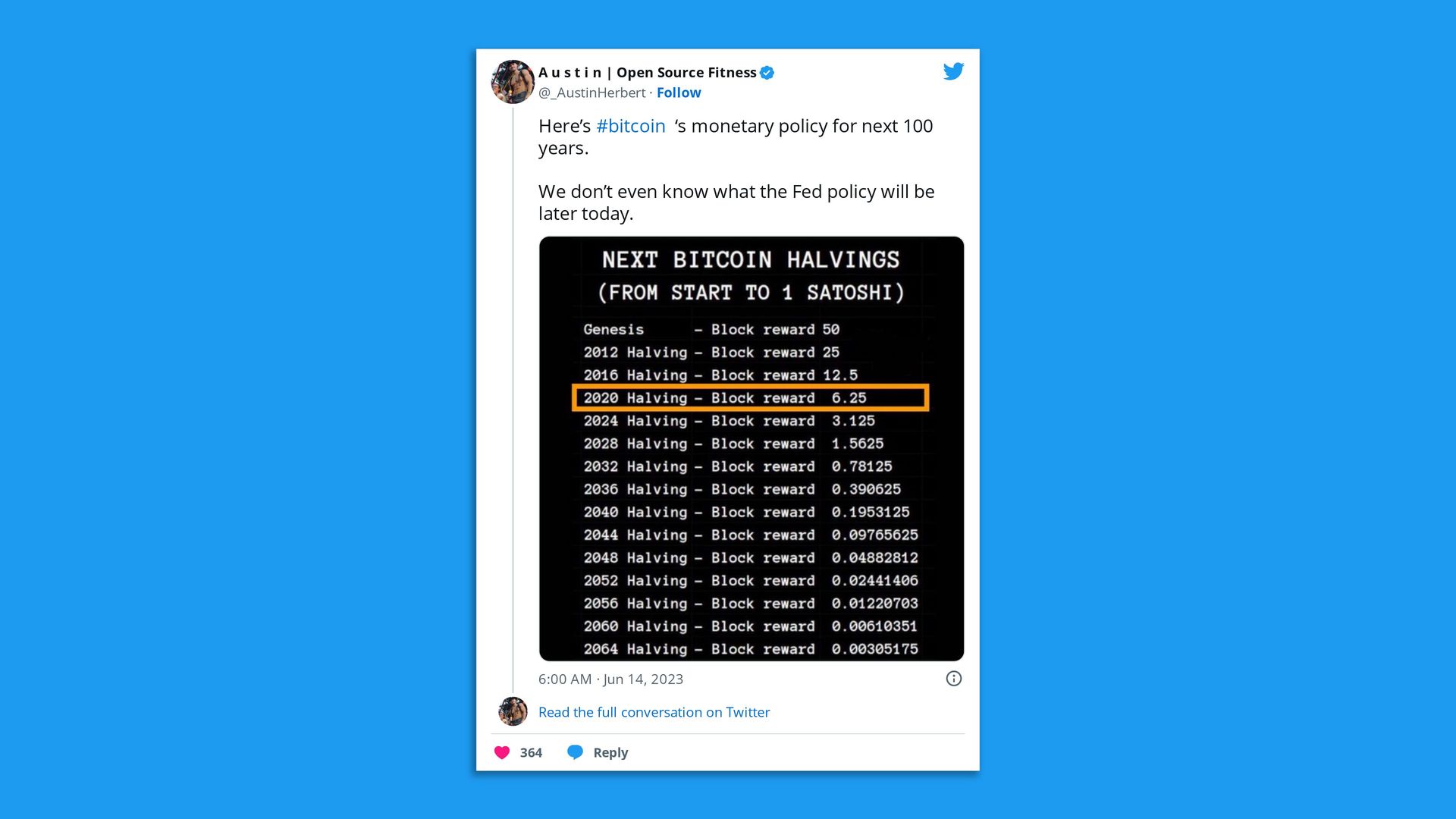
Screenshot: @_AustinHerbert (Twitter)
Bitcoin fights inflation by halving, Crystal writes.
- And it'll never skip or pivot or pause.
What's happening: A bitcoiner is touting the reliability of the Bitcoin "monetary policy," which says the rewards per block mined would be halved every four years for the next 100 years.
Between the lines: A bitcoiner is trolling the Fed.
The big picture: The next halving is set to occur in April 2024, when the reward will be cut to 3.125 BTC from 6.25 BTC now.
- That reward will be halved again in 2028, taking the reward down to 1.5625.
Zoom in: That puts the pressure on miners, with the very next halving projected to double the break-even cost of mining to $20,000 to $30,000.
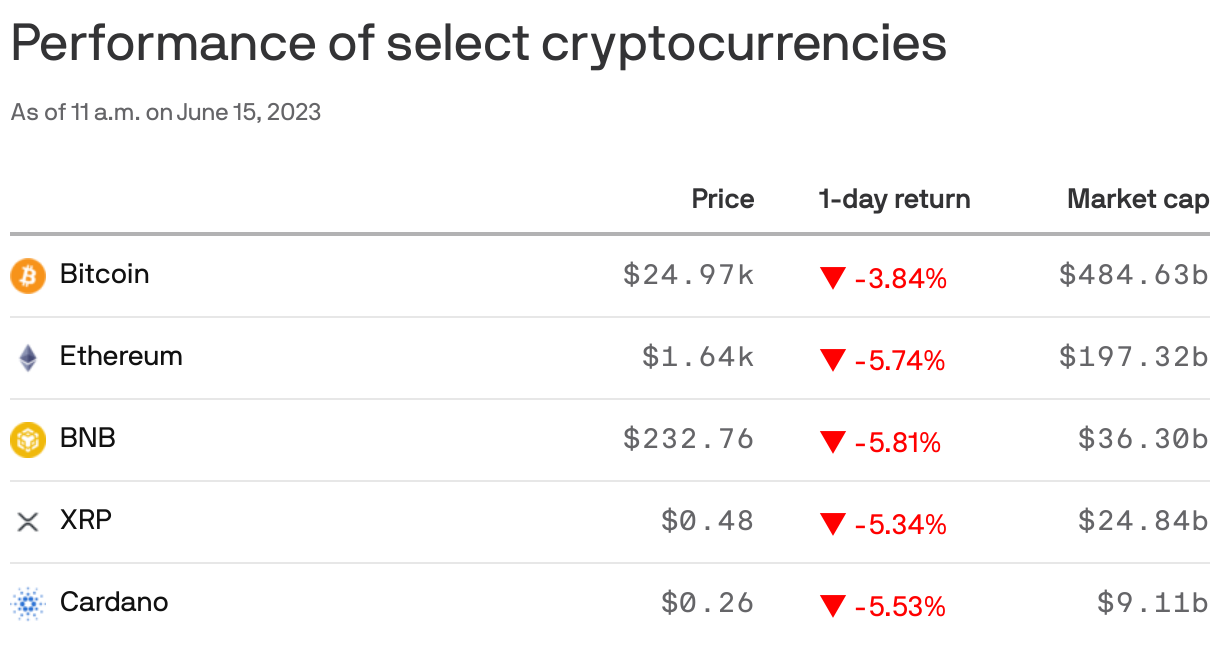
By the numbers: Bitcoin is trading at just under $25,000.
This newsletter was edited by Pete Gannon and copy edited by Carolyn DiPaolo.
The crypto market is bleeding againβwas it something J Powell said?βB & C.
Sign up for Axios Crypto

Brady Dale covers crypto and blockchain impacts on markets and regulation.