
Axios Crypto

February 05, 2024
GM! Today we dig into the only thing in DeFi that has people really excited these days.
🚨 Situational awareness: The chief financial officer for the Terra blockchain, whose fall turned Crypto Winter of 2022 from a slow decline to a disaster, will be extradited from Montenegro to South Korea. We're still waiting on a decision about the CEO, Do Kwon.
Today's newsletter is 1,361 words, a 5-minute read.
🦾 1 big thing: Security-as-a-service
Illustration: Lindsey Bailey/Axios
Over the last year, digital asset investors have staked over $2 billion in deposits into projects renting Ethereum's security infrastructure, by way of EigenLayer, a restaking protocol.
Why it matters: It's something like the software-as-a-service moment for blockchains, but instead, it's offering something more like security-as-a-service, Brady writes.
How it works: Ethereum pivoted in 2022 to a model where its security was based on professional validators setting up computers to check the validity of transactions on the world's second-largest blockchain.
- To make sure those validators didn't cheat, screw up or neglect their duties, they are required to post assets as insurance of their work. If other validators catch them letting the network down, they lose a meaningful hunk of those assets.
- This has created a vast network of people and companies who are good at checking transactions 24/7. So, why just use that expertise for Ethereum alone?
Enter EigenLayer, a marketplace that invites other applications to rent that security infrastructure and offers code that makes it easier. The company, which raised $50 million last March, describes its function as "borrowing programmable trust" from the Ethereum trust network.
- Zoom in: Imagine a startup providing a "bridge," an application that allowed deposits of assets on one chain to issue derivatives on another chain.
- Such an app could decentralize by creating a token and spreading those tokens around to lots of investors. Then the state of the network could only be changed by someone who got hold of 51% of the tokens, which would be expensive, but not impossible.
- EigenLayer enables such an application to plug into Ethereum's stakers instead of using the token model.
Of note: Rather than wait for applications to plug in, EigenLayer also built one: EigenDA. It's a pool of data that blockchains built on top of Ethereum can use.
- It's faster than looking directly at or posting directly to Ethereum, which improves the apps that use it.
- Other applications have plugged in, however.
💭 Our thought bubble: Typically, the value of a liquid staking token — central to EigenLayer's structure (see below 👇) — is at parity with the underlying asset, which has always struck us as a little weird.
- Using an asset as security insurance then also using the derivative of that asset as security insurance also sounds weird. It feels like a turducken of risk.
Yes, but: We ran this by a spokesperson for 1kx, a VC firm, and Wei Dai from its research team told us he disagreed.
- While it does increase an investor's risk (in exchange for more reward), it's a reasonable arrangement, in his view.
Reality check: However, Ethereum's creator Vitalik Buterin is nervous about the arrangement. In a blog post last year, he wrote, "There is a natural urge to try to extend the blockchain's core with more and more functionality because the blockchain's core has the largest economic weight and the largest community watching it, but each such extension makes the core itself more fragile."
The bottom line: If fewer apps need to issue tokens, that means less token shilling in the world. No complaints.
2. Charted: EigenLocked


Nothing else in DeFi has had this kind of growth over the last year. Deposits are generally still way down from 2021.
- They are ticking up a bit these days, but nothing like this, Brady writes.
Show me the money: Casual followers of crypto news have probably heard the term "restaking." This is where EigenLayer's proof-of-stake comes from.
- As mentioned above, when a validator participates in Ethereum's security, they stake their ether (ETH) to a pool like Lido or Rocketpool. This is the "insurance" we mention above.
- They then get a derivative of their stake — a liquid staking token, or LST — that earns a portion of the validator's income, Lido's staked ETH (stETH) is the most common.
- EigenLayer permits users to stake that derivative to some other application's security. That application pays for that service, and it gives the investor a bit of additional yield.
Take our example bridge app from 1️⃣. People are moving tokens back and forth between the two blockchains, paying a small fee for each such move.
- EigenLayer's validators are constantly checking all the sums and data feeds and verifying that all looks good.
- The bridge shaves off a bit of those fees, converts them to LSTs and feeds them back to EigenLayer to pay its validators.
- Which explains why EigenLayer calls itself a "restaking collective."
The intrigue: Puffer Finance, a new protocol that builds atop EigenLayer, launched and shot to $200 million in deposits super fast.
📋 3. Just a bulletin
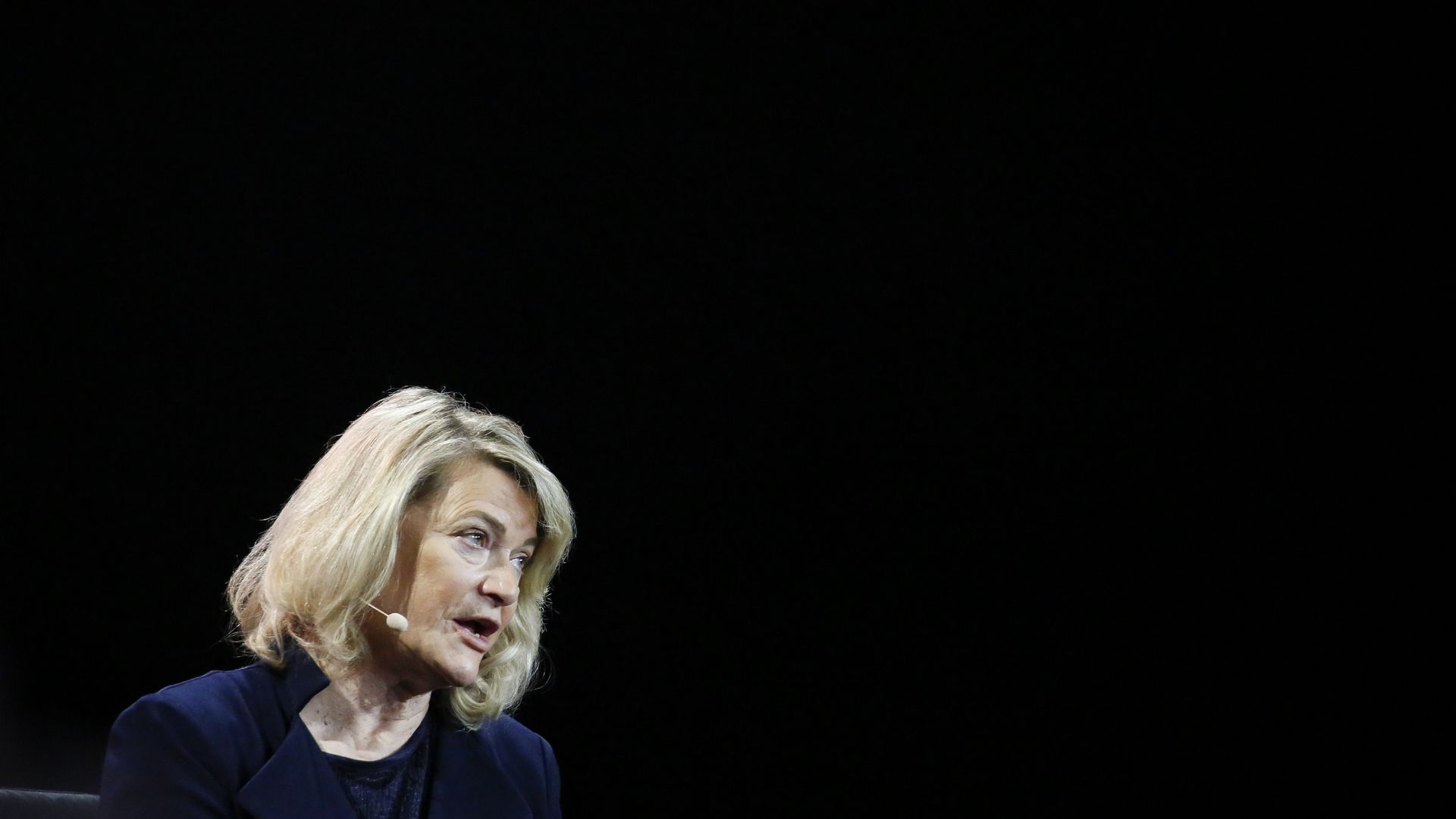
Sen. Cynthia Lummis (R-Wyo.) speaks during the Bitcoin 2022 Conference. Photo: Marco Bello/Getty Images
An SEC memo describing how companies should account for crypto custodial services — the regulator's 121st memo — could be rendered moot with the help of pro-crypto policymakers, Crystal writes.
Why it matters: The industry has balked at so-called SAB 121, saying it sets a standard so stringent that companies would be deterred from holding crypto at all.
Driving the news: Reps. Mike Flood (R-Neb.) and Wiley Nickel (D-NC) introduced a joint resolution last week to vacate the rule, while Sen. Cynthia Lummis (R-Wyo.) put forth a companion measure in the Senate.
- Be smart: It's a bicameral Congressional Review Act resolution, which seeks to vacate SAB 121 and stop the agency from issuing another rule like it.
The big picture: The issue isn't the standard that SAB 121 sets or the rule itself, but how the SEC went about trying to set and enforce it.
- If SAB 121 truly is a rule, and not just a "staff accounting bulletin" (or SAB), the SEC would've had to go through a different set of procedures, including getting commentary from the public about it. (See: The exchange rule.)
What they're saying: Since SEC published SAB 121 in March 2022, agency staff including chair Gary Gensler have stated that SAB 121 only expresses the views of its staff.
- Between the lines: It's not a rule.
The other side: Lummis has challenged SAB 121 on many occasions, raising questions about whether it did anything to protect consumers.
Context: SAB 121 asks companies holding crypto to maintain an equal asset as a liability — so $100 in bitcoin would require an additional $100 in a similar asset.
- It was also wildly unpopular with banking industry advocates, as indicated by a letter signed by the American Bankers Association, Bank Policy Institute and SIFMA.
What others are saying: When the U.S. Government Accountability Office in an October report deemed SAB 121 a rule under the Congressional Review Act, it strengthened the industry's position.
- Flashback: Commissioner Hester Peirce in her response to the bulletin when it was published said: "My concern is not with the accounting determination itself, which may be appropriate, but with the way the change is being made."
🏃 4. Catch up quick
Illustration: Shoshana Gordon/Axios
💰 The bankruptcy court will hear a motion on Feb. 22 about permitting FTX to sell its stake in AI startup Anthropic. (Blockworks)
🏴 The $400 million that got hoovered out amid the FTX bankruptcy was very likely a SIM swap attack. (Bloomberg)
🥸 Craig Wright, an Australian computer scientist claiming to be Satoshi Nakamoto, will be challenged in a UK court today. (The Guardian)
💬 Former President Trump has thoughts on CBDCs and AI. (CoinDesk)
💰 5. Oobit raises $25M in round led by Tether

Illustration: Megan Robinson/Axios
Mobile payment app Oobit raised $25 million in Series A funding led by stablecoin giant Tether, Crystal writes.
Why it matters: Tether's Oobit buy-in shows the USDT issuer's ambitions to make crypto useful in the global payments realm.
Catch up fast: Oobit launched in June 2017 to make paying for things with crypto easier.
- Its mobile app contains a tap-to-pay feature, allowing people to pay with funds from their digital wallet at stores that accept Visa or MasterCard.
- It also has an Ethereum-based token called OBT, which passes on rewards and other perks to holders.
What they're saying: "Tether's strategic investment in Oobit underscores our unwavering dedication to welcoming new users into the cryptocurrency ecosystem," Paolo Ardoino, CEO of Tether, said in a statement.
Details: Other investors in the round include CMCC Global's Titan Fund, 468 Capital, and Anatoly Yakovenko, co-founder of Solana.
Of note: This isn't the only startup to bring credit-card-like functionality to blockchains. Flexa, for example, was an early entrant to that space.
This newsletter was edited by Pete Gannon and copy edited by Carolyn DiPaolo.
📨 Re: Friday's newsletter. If you think using Netscape in the 90s was easier than using crypto now, then you must not have been the person who installed the hardware modem on your family's Windows 3.1 desktop PC. —C & B
Sign up for Axios Crypto

Brady Dale covers crypto and blockchain impacts on markets and regulation.