Axios Crypto

February 02, 2024

Today, we're digging into web history and talking about one weird policy at the SEC (and CFTC, actually).
🚨 Situational awareness: The jobs market is still ripping out there.
Today's newsletter is 1,134 words, a 4.5-minute read.
💾 1 big thing: Web history vs. crypto history (so far)

Illustration: Shoshana Gordon/Axios
The cryptocurrency industry's adoption by the public is going appreciably more slowly than the public internet, any way you look at it, Brady writes.
Why it matters: The idea that crypto is roughly on the same trajectory as the web is something that gets thrown around a lot, but it's helpful to look at hard numbers.
In the weeds: The team at mergers and acquisitions advisory Architect Partners did a year-by-year comparison of the internet's before times with the present of the still-nascent cryptocurrency sector.
- The report marks year one of the widely usable internet at 1995, the era of infinite America Online installation CD-ROMs. Similarly, it puts year one of cryptocurrency at 2017, when tokens first made ebullient speculation something of a global phenomenon.
- More importantly, that puts each genesis year four years ahead of speculative bubbles in each domain.
By the numbers: By that accounting, some comparisons become easy to make. A year after their respective bubbles, the internet saw $75 billion in investment, while cryptocurrency saw $29 billion.
- Both went through a significant downturn in investment the next year.
In 2000, the internet had an estimated 414 million users, while cryptocurrency had something like 190 million in 2022.
- And that's being generous. The authors here are counting crypto wallets as "people," but lots of people have many crypto wallets. How overstated are their numbers? There's no way to really know. (My take: a lot.)
The intrigue: Blockchains could just be a technology searching for a problem to solve, as many suggest, but it also could be that getting into crypto is much harder than getting online.
- And the report points to another major source of friction for money-on-the-internet:
- "It's hard to imagine a more formidable foe than the global financial system, one that is far more resilient than brick-and-mortar retailers resisting e-commerce," the team writes.
💭 Brady's thought bubble: It could be argued that 2013, four years out from the initial coin offering boom of 2017, should really be crypto's year one — at least in this analysis.
- (The numbers get even worse that way.)
The bottom line: If this is 2002 on the blockchains (or even if it's 2006), then we're still well out from the IPO of Facebook (now Meta 🙄) in 2012 and, remember, even then, lots of people claimed the social media giant would never make real money.
🤐 2. The SEC's gag rule

SEC commissioner Hester Peirce in December 2023. Photo: Samuel Corum/Getty
Cornerstone Research tells us that since 2013, the SEC has brought 173 cryptocurrency-related enforcement actions — 46 of them last year.
- Almost a quarter of the 173 have resulted in settlements, to the collective tune of $281 million.
- That's a lot of difficult, stressful and expensive conversations for new-ish companies, Brady writes.
Why it matters: Those of us following the push and pull of the SEC and the crypto industry have gotten all too familiar with a turn of phrase in settlements with blockchain companies: variations on "neither admitting nor denying wrongdoing."
- What many of us didn't realize is that defendants' non-denial is a matter of policy.
Driving the news: One SEC commissioner, Hester Peirce, published a dissent from the agency's decision not to change that policy this week, arguing that it denies the American public the opportunity to scrutinize the commission's work.
Background: In the '70s, the SEC decided it was important that no one ever think it sanctioned companies for violations that didn't actually occur.
- It became rule 202.5(e), which Peirce refers to as its "gag rule."
What they're saying: "The no-deny provision ensures that if a defendant reneges on a settlement and publicly denies the allegations, the Commission has the opportunity to ask a court to permit it to test that denial, controlled by the rules of procedure and evidence," secretary Vanessa Countryman explained in a letter to the New Civil Liberties Alliance on Tuesday.
The other side: "Our prohibition on denials prevents the American public from ever hearing criticisms that might otherwise be lodged against the government, let alone assessing their credibility," Peirce wrote in a dissent she published Wednesday, titled "Unsettling Silence."
Details: She argues that such a policy protects the interests of the agency and its leadership, against the public interest in an accountable state.
- "The public cannot be sure what to believe if the government actively seeks to squelch contrary voices," she writes.
Of note: The Commodities Futures Trading Commission has the same policy.
Fun fact: President Obama first nominated Peirce, but she was never considered by the Senate.
- But she was confirmed after President Trump nominated her, and then reconfirmed to serve through 2025.
The bottom line: The policy stands.
🤝 3. Speaking of settlements: Genesis settled
Illustration: Aïda Amer/Axios
Genesis, the bankrupt crypto lending unit of Digital Currency Group, settled its civil suit with the SEC, Crystal writes.
Why it matters: Amid the crypto market reawakening, former major players and the regulatory agency appear eager to tie up loose ends.
State of play: Genesis filed a motion Wednesday asking the bankruptcy court to approve the agreement, with a hearing set for Feb. 14.
Details: Under the terms of the settlement, the SEC will have a general unsecured claim against Genesis for $21 million, which would be subordinated to other priority and general unsecured claims and allowed administrative expenses.
Flashback: The SEC sued both Genesis and Gemini last January, alleging that the pair engaged in an unregistered securities offering with the contract underpinning the Gemini Earn program.
- Genesis and the SEC started negotiating the terms of the settlement in November, according to the court filing.
Between the lines: Part of the settlement requires Genesis to stay mum. 👆
💭 Our thought bubble: 🤐
🎢 4. Catch up quick

Illustration: Annelise Capossela/Axios
✂️ Ethereum sidechain builder Polygon Labs made another big cut to its workforce. (TechCrunch)
⚰️ OPNX, the exchange founded by the 3AC guys, is already shutting down. (CoinDesk)
👯♀️ Senators and reps have teamed up to condemn the SEC's internal accounting rules for crypto companies. (Blockworks)
📼 5. Culture hash: Bye-bye, BitBoy
Screenshot: Ben Armstrong (YouTube)
Here's something that happens in the cryptocurrency world when things get exciting, Brady writes.
- New people show up and flock to "gurus" who tell them what they want to hear, that numbers will go up forever and riches are one dumb token drop away.
- Such people are called "shills." Many of them get paid to tell their followers to buy into new projects.
Of note: These gurus are the same ones who teach new arrivals to throw around the word "FUD" (fear, uncertainty and doubt) every time someone has the temerity to raise doubts about their favorite fly-by-night crypto startup.
- And yet we know that lots of new projects go nowhere or blow up or were, in fact, just money grabs from the start.
Reality check: If another boom comes this year, it won't be any different.
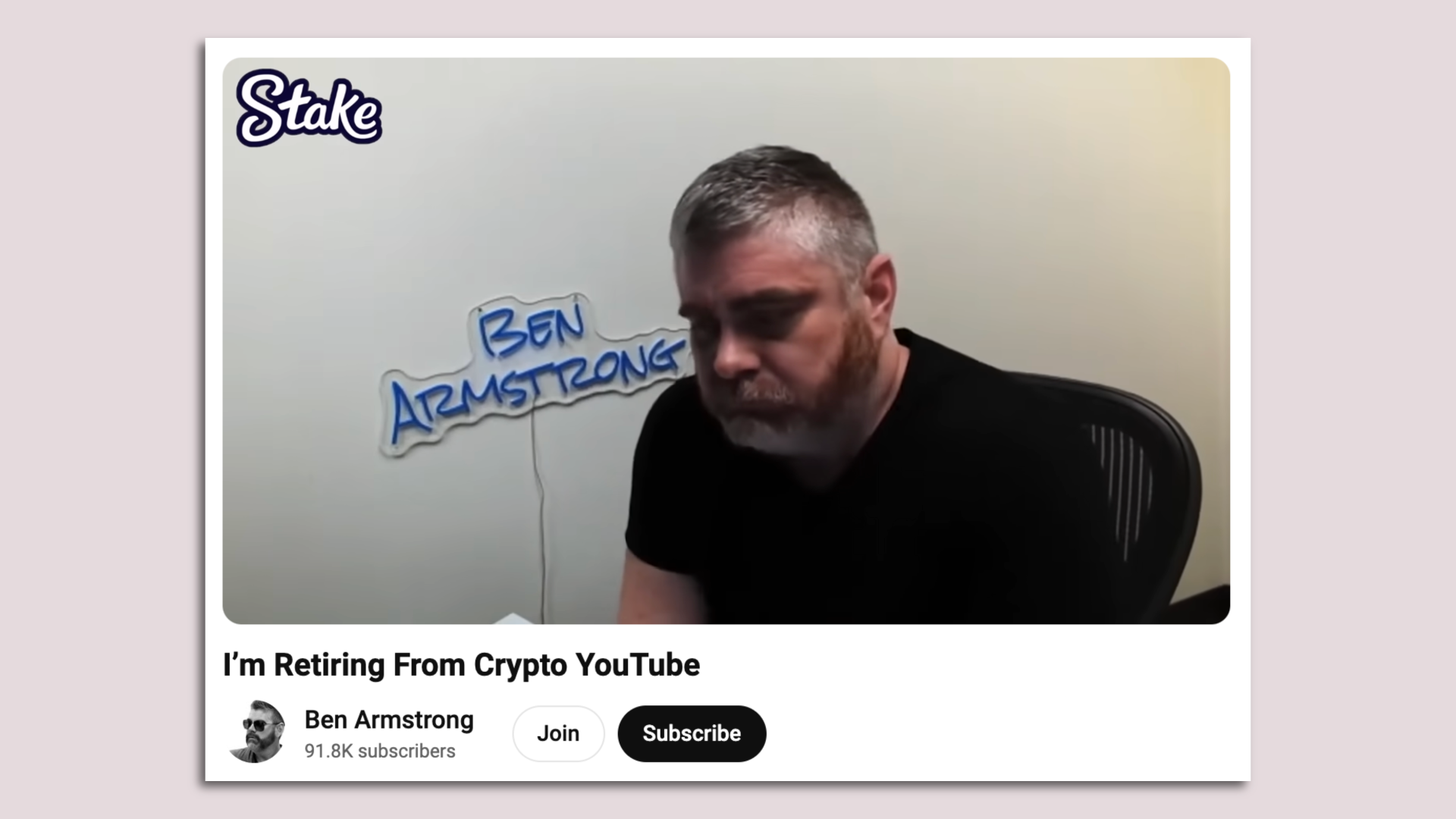
Apropos of nothing: Ben Armstrong, also known as BitBoy, posted a video where he's crying because no one is watching his daily livestream anymore.
This newsletter was edited by Pete Gannon and copy edited by Egan Millard.
If you like this newsletter, please forward it around to your friends and coworkers. —C & B
Sign up for Axios Crypto

Brady Dale covers crypto and blockchain impacts on markets and regulation.