Axios Crypto

June 20, 2023
Big nets catch big game and other things too. Plus, curbing habits.
👋 We're back and checking the inbox: [email protected]
Today's newsletter is 1,261 words, a 5-minute read.
✊ 1 big thing: The SEC's "shotgun" approach

Illustration: Aïda Amer/Axios
The Securities and Exchange Commission has been a bit extra lately by the looks of their lawsuits, Crystal writes.
Why it matters: Proving specific tokens are securities may not be the crux of the SEC's case against exchanges, though it does send a message. In recent complaints against Binance and Coinbase, the regulator's case hits right at their business models.
Between the lines: In contrast to the early cases the SEC has brought against crypto shops like Ripple, the recent ones, against Coinbase and Binance, perhaps show a broader goal — "chill the market for these tokens," Patrick Daugherty, a crypto assets professor at Cornell School of Law and former lawyer at the SEC, tells Axios.
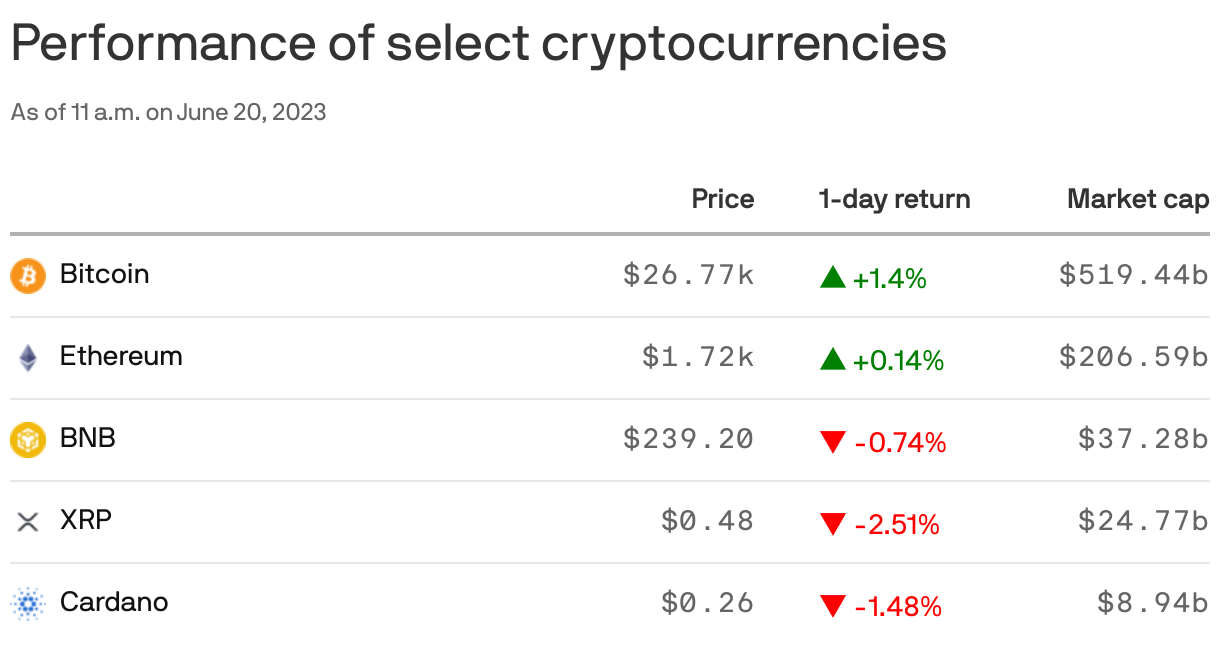
- The SEC named a couple dozen (with some overlap) including Solana (SOL), Cardano (ADA), Polygon (MATIC), plus Binance's namesake stablecoin BUSD and its native token BNB.
- "Rather than a rifle, they’ve used a shotgun,” Daugherty says.
The impact: "Let’s say you’re managing such an exchange, and the SEC has claimed one of those tokens have been listed — that means logically you’re an illegal securities exchange."
- "That means you should shut down or delist. You might do this even if you think the SEC is wrong, because it mitigates the damage."
Catch up fast: Some platforms only dabbling in crypto like Robinhood, eToro, and Bakkt in the last few weeks voluntarily halted customers from buying new positions in certain coins or delisted them.
- Of note: Each for their own reasons, and not the same tokens across the board.
What they're saying: "It's unfair," Daugherty says, speaking from the perspective of the industry. "Because you haven’t proven the case. And you haven’t charged the right people."
- Meanwhile, those behind some of the named tokens like the Solana Foundation, Cardano's blockchain and engineering firm Input Output Global (IOG) as well as Polygon have rejected regulators' claims.
- That's all they can do, given those shops are not the ones being sued.
The other side: Gurbir Grewal, director of the SEC's enforcement division, said on Friday in a talk in New York City that the industry's cries about regulation via enforcement were "catchy but tired."
- Grewal also defended the regulatory agency's approach to, for example, the Wahi insider-trading case, saying it would be impossible for the SEC to take action against every individual issuer behind the thousands of listed crypto assets.
The big picture: Industry lawyer and partner at Delta Strategy Group Kevin Batteh in a multi-tweet thread wondered if the list of the tokens would matter in the end.
- The intrigue: "Despite alleging a bunch of tokens = securities, in the Bittrex case there is no count for selling unregistered securities. In Coinbase the only unregistered securities count is the staking services. In Binance, it is just BNB, BUSD or its earn/vault/staking."
The bottom line: "Kevin’s main point is that the claims made about these particular tokens are unnecessary and surplus. Because if the SEC is right about staking as a service — the rest of it doesn’t matter,” Daugherty says.
🖐️ 2. Charted: Ctrl + Alt(s) + Del


Alts trading appears to have been interrupted by SEC complaints, Crystal writes.
Between the lines: “If I say a dozen tokens and here are the names of illegal securities, then two things will happen — people will sell them, and some exchanges will stop listing them; in fact, some have," Cornell's Daugherty says.
What's happening: SOL, ADA, and MATIC are among the large tokens in market cap terms that have been alleged to be securities recently, after which crypto-touching platforms seem to have side-stepped a potential legal battle with regulators.
- Robinhood announced it would delist the trio on June 9.
- eToro also followed suit last week, though, it decided to limit the damage by saying users couldn't add new positions in ALGO, MANA, DASH, and MATIC.
The bottom line: At troughs, following the SEC complaints, the three tokens were down roughly 30%.
🥲 3. Leaving FTX behind

Amy Wu. Photo: Courtesy of Menlo Ventures.
Amy Wu, who most recently led FTX Ventures until the crypto exchange's collapse last November, has joined Menlo Ventures as an NYC-based partner focused on consumer startups, Axios' Kia Kokalitcheva writes.
Why it matters: "Historically, [consumer startups are] over a third to a half of exit value [in VC]," partner Shawn Carolan tells Axios.
What they're saying: "Where Amy really shines is really in deeper psychology, gaming, the creator economy," explained Carolan.
- The two of them will complement each other as they'll focus on different segments of consumer tech.
- AI's intersection with the consumer will be part of Wu's wheelhouse. "The interesting question on people's minds is the net new companies that will be coming out of [the current boom] versus where incumbents are going to continue to dominate," she explains.
Zooming in: Wu is also formally "planting the flag" for Menlo Ventures — one of Silicon Valley's oldest venture firms — in New York (partner Tyler Sosin is also based there).
- "During the pandemic, there was a pretty sizable exodus of entrepreneurs there... so we've been talking about it for a while," said Carolan.
- Wu, who moved to the Bahamas during her FTX Ventures tenure and later traveled around, said she's excited to be back in NYC. Having first moved there in the early 2010s, when the city's startup scene was much smaller and more nascent, she feels "like an OG" now.
Between the lines: While investing in "blockchain" is part of the areas assigned to Wu, don't expect overzealous investing.
- "We're definitely not gonna be doing cryptocurrency speculation or anything like that," said Carolan.
- Wu said she still sees it as an investable sector, though there are a lot of challenges like regulation and fraud.
So what about FTX? "It was really difficult, I was there for a short period of time — it was 10 months and it felt like 10 years," she said. "I found out about what happened on Twitter, along with most of the employees."
- "It was a lot of learnings about the challenges of hyper-growth companies — but I would say that nothing would have prepared me for what happened," she reflects, adding that what transpired hurt a lot of people, including customers.
- For his part, Carolan said the firm "decided she was the absolute best" for the job, and it believes "she got duped along with everybody else."
The bottom line: As Axios reported in January, Menlo Ventures has been raising its newest crop of funds — a natural time for firms to add partners. (No comment from Menlo on that.)
🚴♀️ 4. Catch up quick
Illustration: Annelise Capossela/Axios
🚨 Do Kwon was sentenced to four months of jail time in Montenegro over forged documents. (CoinDesk)
👣 A crypto exchange supported by Citadel, Fidelity and Charles Schwab launches today. (Wall Street Journal)
🇬🇧 A U.K. stablecoin and crypto bill called the Financial Services and Markets Bill (FSMB) enters its final stages. (Decrypt)
😣 Crypto payments firm Wyre said it would shut down, citing market conditions. (Decrypt)
Top coins

🎈5. Culture hash: Timely wisdom
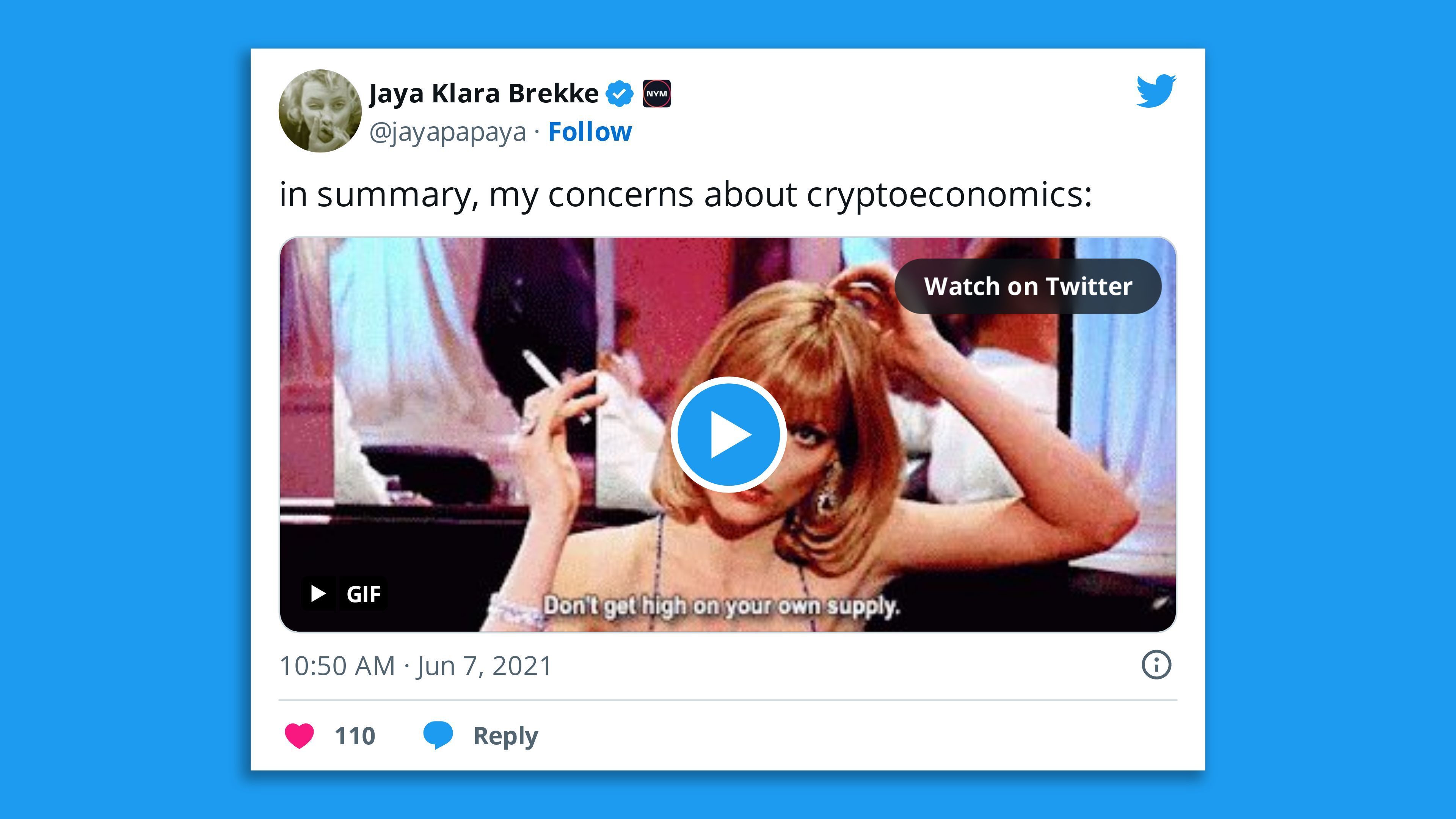
"Don't get high on your own supply" is crucial advice on the blockchains — the power to create money for yourself is best used judiciously, Brady writes.
- FTX, for example, created a token out of thin air (FTT) and then borrowed against it all over the place.
Right now, it's becoming clear that one of the most important builders in decentralized finance (DeFi), Michael Egorov, the genius behind Curve, is borrowing piles of money off his CRV token.
By the numbers: He's taken out $100 million in stablecoins.
The bottom line: If the value of CRV crashes and he gets liquidated, he's not going to care. His money is basically in dollars.
- His lenders are the ones at risk.
This newsletter was edited by Pete Gannon and copy edited by Carolyn DiPaolo.
🥶 So, do we think the big Wall Street shops are a sign of the thaw?—C & B.
Sign up for Axios Crypto

Brady Dale covers crypto and blockchain impacts on markets and regulation.