Axios Crypto

March 31, 2023
🧘♀️ Is the crypto industry manifesting a crackdown or was it in the works all along? We will never know, but wishful thinking about the White House's intentions is getting harder to come by.
Today's newsletter is 1,059 words, a 4-minute read.
1 big thing: Lawyers present Choke Point 2.0
Illustration: Natalie Peeples/Axios
A law firm that likes to take on controversial fights has made the case that anti-crypto sentiment is real and that it's hurting businesses in the U.S., Crystal and Brady write.
Driving the news: That's according to a legal argument published this week detailing Operation Choke Point 2.0 from the same law firm that argued the first one in a courtroom.
The big picture: To starve a business of financial services because of its bad reputation would be illegal, but that’s what happened to payday lenders, gun sellers and pawn shops during the Obama administration.
- And it is happening again, to crypto this time, under the Biden administration, according to Cooper & Kirk.
Fun fact: That’s the firm that trade association and payday lender Advance America hired in 2014 to sue the Federal Deposit Insurance Corporation, the Federal Reserve and the Office of the Comptroller of the Currency (OCC).
- Of note: It's also the firm that argued against gay marriage in 2013.
Flashback: The original Choke Point started in 2012 with vague policy guidance. Then, whisper campaigns and backroom threats, according to the paper. Eventually, entire swaths of business were choked off from financial services. Sound familiar?
Zoom in: The paper lays out the case that the current crackdown is unconstitutional.
- It cites case law where the courts have found the due process clause of the Constitution had been violated when the state engenders a stigma against a person or kind of business.
- In Wisconsin v. Constantineau (1971), a police officer posted a notice at retail liquor stores in Hartford to refuse sale to a local man for one year because of his "excessive drinking."
The paper also argues that bank regulators violated the Administrative Procedure Act by taking 27 months to respond to Custodia Bank’s application for a master account with the Federal Reserve when the act requires a response within one year.
- Regulators lacked the authority to deny the charter to a bank if it's state-chartered, the paper said.
Meanwhile, the situation with Protego Trust, a crypto custody firm that recently laid off half of its staff, represents a violation of the Supreme Court case Camp v. Pitts (1973), the paper said.
- In both cases, the authors argued, the OCC failed to provide adequate reasoning for refusing to license a supervisee.
- In Camp v. Pitts, it denied an application without explanation. With Protego, it allowed a temporary authorization to expire without explanation.
What they’re saying: “Operation Choke Point 2.0’s refusal to follow notice and comment rulemaking has produced the very result that the authors of the APA [Administrative Procedures Act] were seeking to avoid: arbitrary, capricious, and above all undemocratic agency action,” the paper contends.
Be smart: The firm seems to have written this whitepaper as a giant ad, seeking clients who will pay it to do its thing again.
The bottom line: “The blockchain cannot be un-invented,” the authors write.
🥷 2. Charted: More bad news


Decentralized finance has a lot of people excited, including cybercriminals, Brady writes.
Driving the news: The firm De.Fi put out a report today on exploits against projects in the crypto category, showing the top kinds of ways to steal.
Between the lines: Flash loans are one of the weirdest things crypto has created. Basically, a person can borrow any amount of money for one block (an instant in crypto time) for a small fee. This is often useful for tricking other smart contracts when attackers find a really good edge case.
- Oracles are how blockchains get information about something outside the blockchain. A blockchain knows everything about itself, nothing about anything external. Oracles are its eyes, and like the eyes, they can be tricked.
- In exit scams, someone promises to make something cool, raises money on a promise, and then disappears.
🎺 3. Trump's indictment spurs NFTs

Illustration: Sarah Grillo/Axios
For some, all publicity, even the bad, is a boon for sales, Crystal writes.
What's happening: Donald Trump NFT collectible trading cards got a boost of activity overnight after the former president was indicted yesterday by a grand jury in Manhattan over alleged hush money paid to former adult film star Stormy Daniels.
By the numbers: Sales of the NFT trading cards more than 600% in the last 24 hours to $190,000.
- The activity sent prices higher, with the floor price of those NFTs rising 20% over the same time period to about 0.55 ETH. (Roughly $1,006 based on recent prices.)
Quick take: Like the initial drop, controversy works sales.
- Yes, but: It's probably momentary. The collection ranks in the top 50 in sales volume terms for the last 24 hours, but it also falls into the bottom 50 over a 30-day period, per CryptoSlam.
- And disappears from the top 100 over the history of NFT collection sales.
Context: The digital trading card NFTs, depicting Trump in various "hero" outfits, dropped mid-December after the former president teased a "major announcement" on his branded social media account.
- 45,000 NFTs were created; the first available 44,000 sold out.
- Every NFT entered the buyer into a sweepstakes promising a chance to play a round of golf with Trump and similar prizes.
- The website selling the trading cards claims it is "not owned, managed or controlled" by the former president, but there is an associated business that licensed Trump's likeness for the cards.
The bottom line: Eh.
🚁 4. Catch up quick
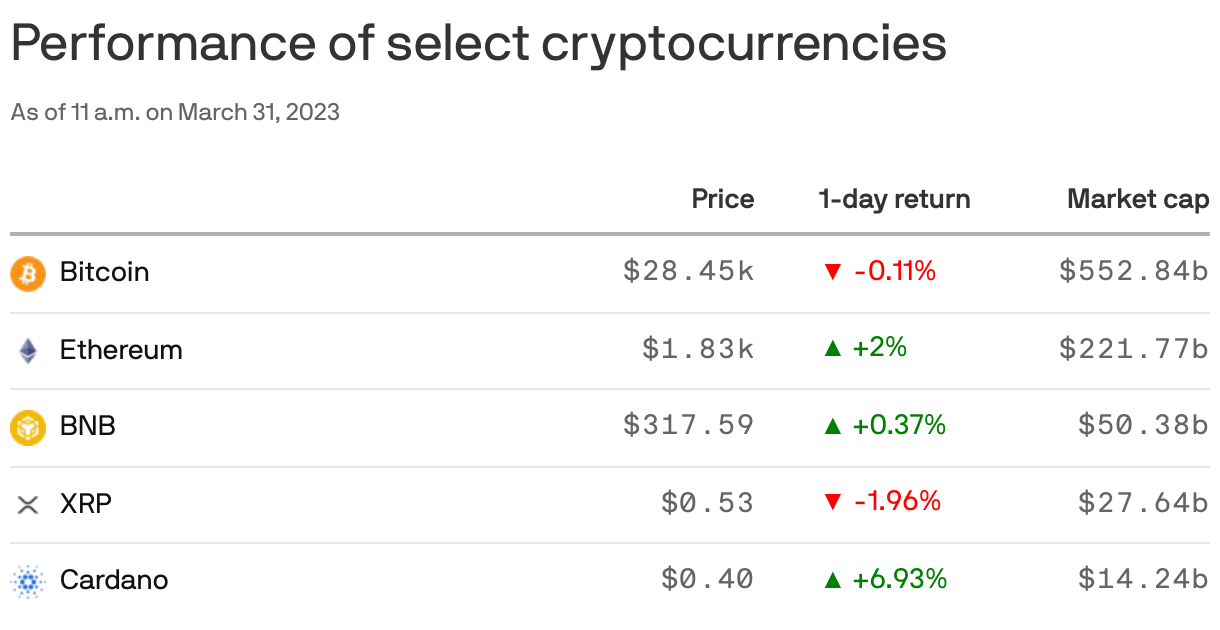
Top coins

🪖 5. Culture hash: 7 nation army won't hold me back

Screenshot: @scupytrooples (Twitter)
Sen. Elizabeth Warren may be openly against the cryptocurrency industry, but she's great at generating memes it loves, Brady writes.
Flashback: In 2021, the Massachusetts Democrat called blockchain denizens "shadowy super coders." The crowd went wild.
Driving the news: Yesterday, she put out a campaign meme that said, among other things, that she was "building an anti-crypto army."
- Folks have been running with it.
Details: The image above is one of the more obscure riffs.
- Alchemix is a DeFi project that makes self-repaying loans. Basically, you can deposit some asset, withdraw a stablecoin derivative, and it will slowly pay off the loan by yield farming the asset.
💭 Crystal's thought bubble: 100% would wear. Very "The Handmaid's Tale" meets "The Matrix." Skosh more interesting than Gwyneth's Torah-teacher and apres-ski courtroom fashion show, imho.
This newsletter was edited by Pete Gannon and copy edited by Carolyn DiPaolo.
☎️ Yesterday, we hit up the offices of everyone on the Senate Banking committee to see if any of its members would talk to us about crypto policy. We'll see if we get any bites! —C & B.
Sign up for Axios Crypto

Brady Dale covers crypto and blockchain impacts on markets and regulation.