Axios Crypto

September 30, 2022

GM! Today we're looking at bad news. Executive departures. Fake volumes. It's bad vibes to end the week, but this is a bear market.
- 🐻 Send us cute photos of bears if you stumble on any: [email protected]
Today's newsletter is 1211 words, a 5-minute read.
✌️1 big thing: Off with the heads

Illustration: Sarah Grillo/Axios
The crypto C-suite and senior leadership have seen a rash of departures recently, with some stepping down amid scandal and others merely moving on, Crystal writes.
- Executives at Celsius Network, FTX.US, Genesis Global Trading, Kraken and MicroStrategy — some of whom are considered industry OGs — announced their resignations in the last few weeks.
Flashback: "If you're unhappy and you know it, quit," was the message from major bosses to disgruntled employees during second-quarter layoffs.
- A few of those bosses appear to be taking that message to heart.
By the numbers: Overall CEO turnover in the U.S. jumped 8% in August from the previous month, led by departures in the technology and fintech sectors, according to recent research from Challenger, Gray & Christmas.
The big picture: Peak turnover tends to hit during economic highs and lows, senior vice president Andrew Challenger tells Axios.
The intrigue: While the crypto industry grapples with what appears to be an accelerating pace of quitting at companies' highest echelons, CEO turnover overall in the U.S. is roughly flat compared to last year.
- Startup founders get pushed out in favor of seasoned executives — as do CEOs who just plain mess up.
- Industry competition can also force entire swaths of firms to seek out specific skillsets — e-commerce savvy for retail, for example.
What they're saying: "Whether mistakes were made or not," Challenger says, "crypto firms are making changes at the very top."
Details: Here are some notable executive departures since August (tell us if we missed any):
Alex Mashinsky, Celsius Network (2017-Sept. 27, 2022)
- Mashinsky resigned amid Celsius Network's bankruptcy proceedings. His exit followed a series of leaked town hall meetings, during which the Celsius chief was discussing new business plans.
Brett Harrison, FTX.US (May 2021-Sept. 27, 2022)
- Harrison said he is taking an advisory role at the firm; Zach Dexter, former chief of the U.S.-regulated crypto derivatives platform LedgerX, is expected to succeed him. Recall FTX bought LedgerX just last year.
Jesse Powell, Kraken (2011-Sept. 21, 2022)
- Powell is staying on as chairman and will be succeeded by COO David Ripley. The OG crypto chief stepped down as chief after the crypto exchange nabbed headlines for its workplace culture.
Sam Trabucco, Alameda Research (2021-Aug. 24, 2022)
- Trabucco tweeted about his departure in a thread called "On happiness."
Michael Moro, Genesis (2016-Aug. 17, 2022)
- Moro stepped down as chief from the Digital Currency Group unit as the firm cut 20% of its headcount. The shakeup came after it was revealed that the unit had loaned $2.4 billion to Three Arrows Capital.
Michael Saylor, MicroStrategy (1989-Aug. 8, 2022)
- Saylor is staying on as chairman, but stepped down as CEO after leading the software company he founded to invest more than $4 billion in bitcoin.
🐲 2. Charted: Dragonchain


Old token projects never die, they just recede down in the bottom of the market cap rankings, Brady writes.
The chart: In 2017 and 2018, there was a bit of a spirit of "just add blockchain" going around, and one of the companies that arose out of that was called Dragonchain.
- It sold its DRGN token for almost $14 million in ETH and BTC back in the initial coin offering boom.
- In August, the SEC sued the issuers of its token for issuing an unregistered security.
💭 Brady's thought bubble: The company in the next item reminded me of Dragonchain.
The bottom line: The price of DRGN was already so far down, the news out of D.C. didn't really do anything.
👻 3. The SEC finds fake volume

Illustration: Sarah Grillo/Axios
The SEC brought a complaint against a fintech firm that released a token called "hydro" in 2018. At the core of its complaint, the regulator alleged the firm, Hydrogen, ran phony trades on various exchanges to support the value of its token as founders sold, Brady writes.
Why it matters: It's an accusation of what's known as "wash trading."
- Such fake volume is rife all throughout the cryptocurrency industry, meaning that much of the publicly viewable demand out there is just people sending tokens back and forth between accounts they control.
- Worse, it's used expressly to trick regular people into paying too much for a token that no one actually wants.
Details: In its complaint, the SEC alleges that Hydrogen contracted with a firm called Moonwalkers to generate volume on exchanges for its hydro token.
- Hydrogen arose out of a previous company called Hedgeable, according the complaint, which was running out of money in 2017 and pivoted to blockchain in order to raise new funds.
- Hedgeable also received an unrelated slap from the SEC in 2018.
- Hydrogen released an explainer video in 2018 that doesn't illuminate much. It wouldn't be unfair to summarize it by saying: "Fintech + blockchain = profit." (See 36 and 37 in the SEC complaint.)
What they're saying: "This matter has been dragging on for many years and wholly lacks merit. We look forward to our opportunity to be vindicated after litigation," Matthew Kane, a co-founder of Hydrogen, told Axios in an email.
Of note: Hydrogen minted 11,111,111,111 tokens and gave away a bunch to early crypto hopefuls. Then it gave away more to people who helped promote the blockchain.
- The company needed money to fund operations, but when the CEO started selling hydro to raise funds, the SEC says "he quickly learned that the considerable volume of Hydro that Hydrogen needed to sell to raise sufficient cash would significantly depress, and did significantly depress, Hydro’s price on the secondary market."
- Hydrogen sought out a market maker that would use automated trading to boost volumes on exchanges. The complaint alleges it contracted with a firm called Moonwalkers to provide these services.
- "Moonwalkers’ trading bot deployed a mix of automatic and semi-automatic functions to place-and-cancel buy and sell orders at random increments to create the false appearance of robust market activity," the complaint says.
Zoom out: There are many organizations that provide services like this. One college student in Russia gave a frank interview in 2019 about how it all works.
- Wash trading is not just for tiny tokens. In 2019, Bitwise released a detailed report showing evidence that most trading in bitcoin on exchanges was fake or "non-economic in nature."
The bottom line: The SEC has demanded a jury trial.
🐩 4. Catch up quick
🫴 Winklevoss Twins' Gemini asks MakerDAO to hold its native stablecoin "gusd" in exchange for 1.25% yield. (MakerDAO)
🚯 Texas state agencies object to Celsius Network's plan to sell its stablecoins. (CoinDesk)
🌈 Uniswap wants to raise $100 million, according to sources familiar with the matter. (Techcrunch)
🗯 The Consumer Financial Protection Bureau has fielded complaints about crypto firms including Coinbase Global, Gemini Trust and Block Inc. (Wall Street Journal)
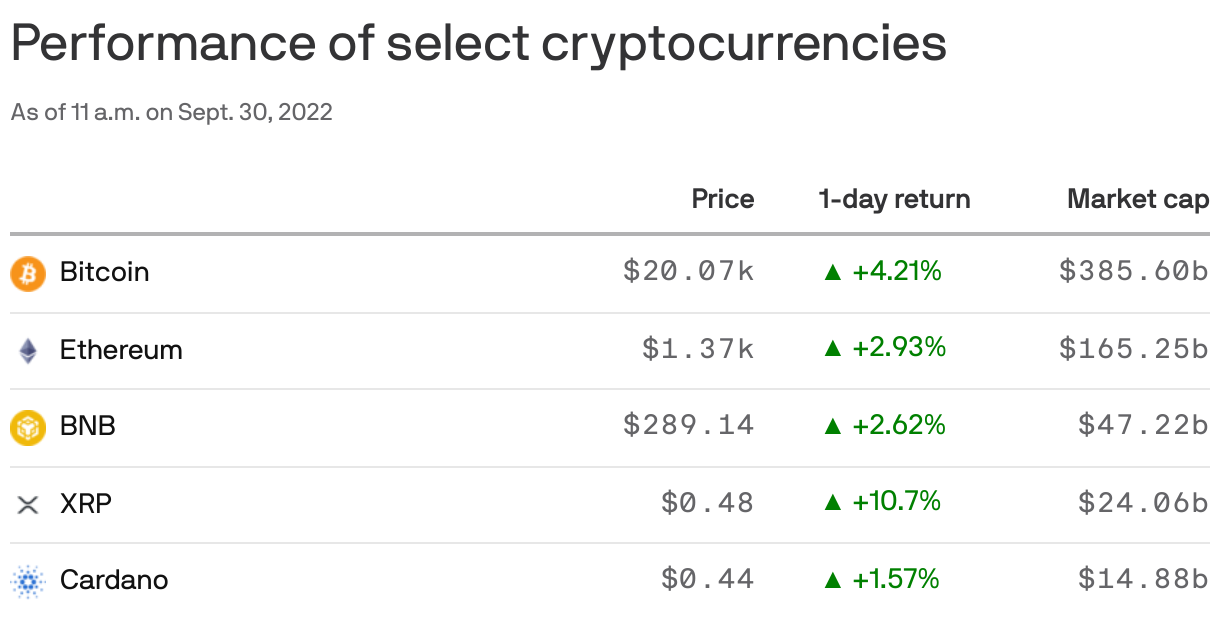
Top coins
🦀 5. Culture hash: Sideways for days

Screenshot: @MemeingBitcoin (Twitter)
Chart addiction is the worst thing about getting into cryptocurrency, Brady writes.
Be smart: The best crypto investors don't look much. They have a thesis about how they invest and they stick with it. They don't obsess over the numbers.
Context: Bitcoin's USD price has been really boring lately. It's a sideways market, meaning that bitcoin isn't really going much of anywhere, up or down.
- As we have often said: $20,000 is a psychologically important number to the market right now, as this meme illuminates (you need to click to see the whole thing, but this gets the gist).
Yes, but: 1 bitcoin = 1 bitcoin.
This newsletter was edited by Pete Gannon and copy edited by Nick Aspinwall.
Did you all know anyone can play with DALL-E — the AI artist — now? It turns out that the robots are also terrible at visualizing cryptocurrency. —B & C.
Sign up for Axios Crypto

Brady Dale covers crypto and blockchain impacts on markets and regulation.