Axios Crypto

April 24, 2023
Stablecoins remain the low-hanging fruit for crypto policy but most crypto news this year will likely come from the courts. It's all in today's edition.
Today's newsletter is 1,227 words, a 4½-minute read.
🥸 1 big thing: Weird stablecoins
Illustration: Maura Losch/Axios
While D.C. has drafted legislation that would crack down on exotic stablecoins, the crypto world is steaming ahead with new moderately exotic designs, Brady writes.
Driving the news: One new stable-ish coin was just announced for the layer2 network Optimism, and another long anticipated one is rumored to be near launch.
Why it matters: The cryptocurrency industry is not monolithic, but most people in it would like crypto-native unit-of-account one day. There's no rush about it, but it's a broadly shared goal.
- A unit-of-account is a way of measuring value. Nearly everyone on Earth has an idea of what you mean if you say something is worth $1,000. All over the world, different state-created currencies serve as units of account.
Context: Ethereum's ethers are kind of, sort of getting there in the NFT world. Most NFT traders talk about the value of their NFTs in ether. This is very much a niche sector though, and it can be a headscratcher.
- Others believe it could be better.
The latest: Ameen Soleimani, one of the industry's true iconoclasts, announced the creation of HAI for Optimism last week.
- The idea of a coin like HAI is that it starts at a peg and then gradually moves from there, following the change of its underlying basket of assets.
Zoom in: The change is smoothed using a well-worn engineering concept known as control theory. So it's not so much that it's stable. It's gradual. I've called prior iterations "gentlecoins."
- HAI is based on RAI, which runs on Ethereum. Both are meant to largely track the value of ethers, but RAI was built before the concept of liquid staking derivatives came along. It hasn't been able to integrate such assets, which has held back participation.
Meanwhile, the Curve team could launch crvUSD any day. Michael Egorov, Curve's founder, tells Axios, "It's really close."
Be smart: The core idea of crvUSD is the lending-liquidating automated market maker algorithm (LLAMA).
- This stablecoin is a novel combination of collateralized debt positions (MakerDAO) and automated market makers (Uniswap).
- In fact, Egorov tells Axios it also borrows a couple ideas from Frax Finance.
Basically, crvUSD is issued against ETH that's deposited at some fixed rate (most likely, you can borrow something like two-thirds of the value of the ETH in crvUSD, which is meant to be worth $1 each).
- If the price of ether starts to fall, it automatically sells some portion of it for stablecoins. If it rises again, stablecoins are sold for ether.
This fixes the problem of the typical crypto debt liquidation, where everything gets sold at once and debtors get bad prices for their repossessed assets.
What we're watching: Someday Aave will launch GHO as well (it's also close).
Yes, but: Don't look for any of these products to pop up in the normal economy any time soon. This is crypto-to-crypto stuff, for now.
🍥 2. A stablecoin alternative, by design

Illustration: Gabriella Turrisi/Axios
Stablecoins are arguably the most successful examples of real-world assets tokenized — little wonder why others want a piece of the market, Crystal writes.
- Ondo Finance is one of them, and is weeks away from launching a token called OMMF, a stablecoin alternative by design, according to the company.
The big picture: OMMF will effectively act as a representation of ownership in U.S. money market funds and regularly distribute the yield from those funds in OMMF tokens.
- Money market funds were invented in the 1970s as an alternative to banks, meant to offer folks a place to hold short-term deposits and earn a return — and that's also part of OMMF's appeal.
Quick take: OMMF isn't meant to be used by the masses, so it's unlikely to immediately rank alongside stablecoin juggernauts like Circle's USDC or Tether's USDT in market capitalization.
Context: "Trading desks settle trades in stablecoins all the time," Nathan Allman, chief of Ondo Finance, tells Axios. The proposition for the pros is with OMMF "they can instead onboard and settle the bitcoin-for-dollar trade in OMMF and they're actually earning yield."
- Another use case: They could use OMMF as collateral for bilateral lending, says Allman. "So if one institution lends bitcoin overcollateralized by dollars to another, today they'll often use USDC."
How it works: OMMF will be minted on a small portion of reserves that will be held on-chain in USDC, according to Allman.
- Ondo will, at first, focus on over-the-counter trading desks, serving institutional investors.
What they're saying: "The downside is [OMMF] is only accessible to accredited investors," Allman says.
Also, there are fees, including the cost of the money market fund or 0.15%, and Ondo's fee for managing it, the latter of which has not been disclosed.
- "If you don't value the things that are unique about OMMF, it totally doesn't make sense," Allman said, explaining how a regular investor seeking money market yields could simply invest in such a fund.
Details: Where the rubber meets the road for Ondo is how folks on Flux Finance, a decentralized finance protocol backed by the company, pick up OMMF.
The bottom line: "Our business today is focused both on the tokenization of all sorts of real-world assets, including regulated securities, as well as developing and incubating protocols and on-chain utility for those on-chain securities tokens," Allman said.
🌡 3. Celsius auction heats up
Photo: Jakub Porzycki/NurPhoto via Getty Images
New bidders have emerged for crypto lender Celsius, which will hold an auction tomorrow to determine who will take over the bankrupt firm’s assets, Axios' Ryan Lawler writes today in Axios Pro: Fintech Deals.
- According to a bankruptcy filing from over the weekend, two new groups will compete with initial bidder NovaWulf Digital Management, known as the stalking horse.
The big picture: The crypto-native coalitions joining the auction contrast with NovaWulf, which is relatively new to digital assets.
Details: The first is called Fahrenheit and is backed by venture capitalist Michael Arrington, former Algorand CEO Steven Kokinos, investment banker Ravi Kaza, with U.S. Data Mining Group and Proof Group joining in.
- The other new bidder is Blockchain Recovery Investment Committee, backed by the Winklevoss twins’ Gemini Trust, fund manager VanEck, Abra and Global X Digital.
What’s next: The auction is scheduled to take place at 2pm tomorrow in the office of debtors’ counsel Kirkland & Ellis.
Ryan Lawler co-authors the Axios Pro Fintech deals newsletter. Start your free trial at AxiosPro.com.
🏃 4. Catch up quick
😩 Longs got liquidated for $650 million last week. (The Block)
👩⚖️ Jury selection is set to begin in the insider trading case from OpenSea. (Bloomberg)
💎 Some very, very old crypto wallets are waking up and moving assets. (The Block)
BONUS: Paradigm released Part III of its blog series on why U.S. securities laws and regs need an update. (Paradigm)
Top coins

🤺 5. Charted: Ethereum changes its mind
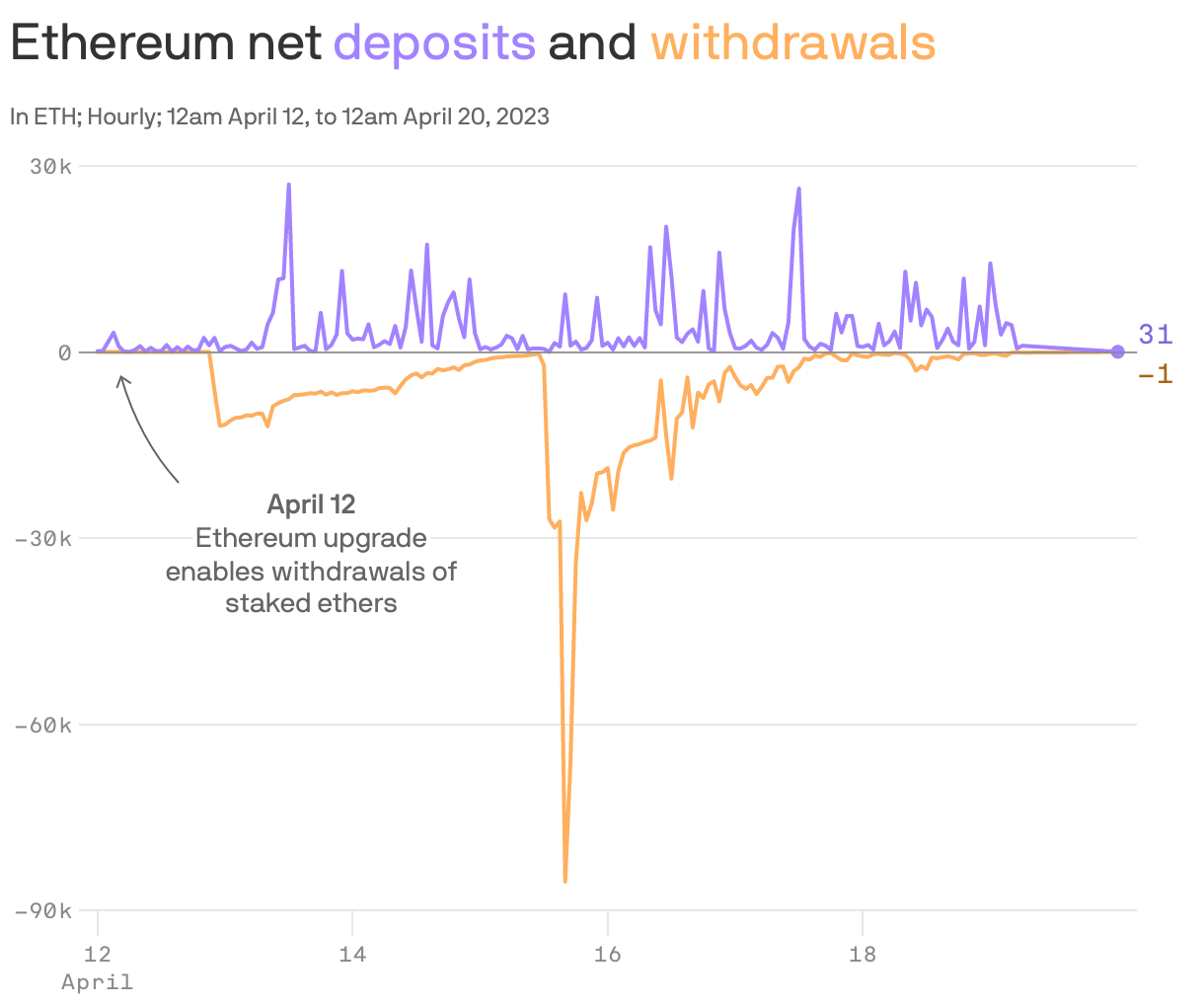
The big question when Ethereum did its last upgrade this month was: Will people quit staking altogether?
- We basically have the answer now, and it's no, Brady writes.
More than a million ethers staked to the second-largest blockchain were withdrawn fairly quickly.
- A lot of people who staked long ago likely had bills they needed to pay (such as taxes).
Yes, but: Lots of people are staking too.
- The most likely explanation is that staked ether's yield of around 4 - 5% is pretty nice in the current climate, but not knowing when capital could be withdrawn probably hindered a lot of investors before.
- That concern has now been removed, so folks are going in.
There's lots more detail about the state of Ethereum staking on Nansen's public dashboard.
This newsletter was edited by Pete Gannon and copy edited by Carolyn DiPaolo.
ICYMI: "Last Week Tonight with John Oliver" did its second treatment on cryptocurrency, recapping the big hits from 2022.—C & B
Sign up for Axios Crypto

Brady Dale covers crypto and blockchain impacts on markets and regulation.