Axios Crypto

March 25, 2025

Good afternoon! (Unless you're in Pacific or Mountain time.) We're getting close to appointing a new head of the SEC, but the agency is moving ahead at the speed of government on crypto rules anyway.
- State of play: A confirmation hearing for SEC chair nominee Paul Atkins is Thursday, in Senate Banking.
🪐 If your mood is set by bitcoin price, let us know how the year's been for you: [email protected].
Today's newsletter is 1,097 words, a 4-minute read.
1 big thing: 🔬 Everything is something
If there's one question we have dealt with in ongoing way in this newsletter, it is this: What on Earth are digital assets?
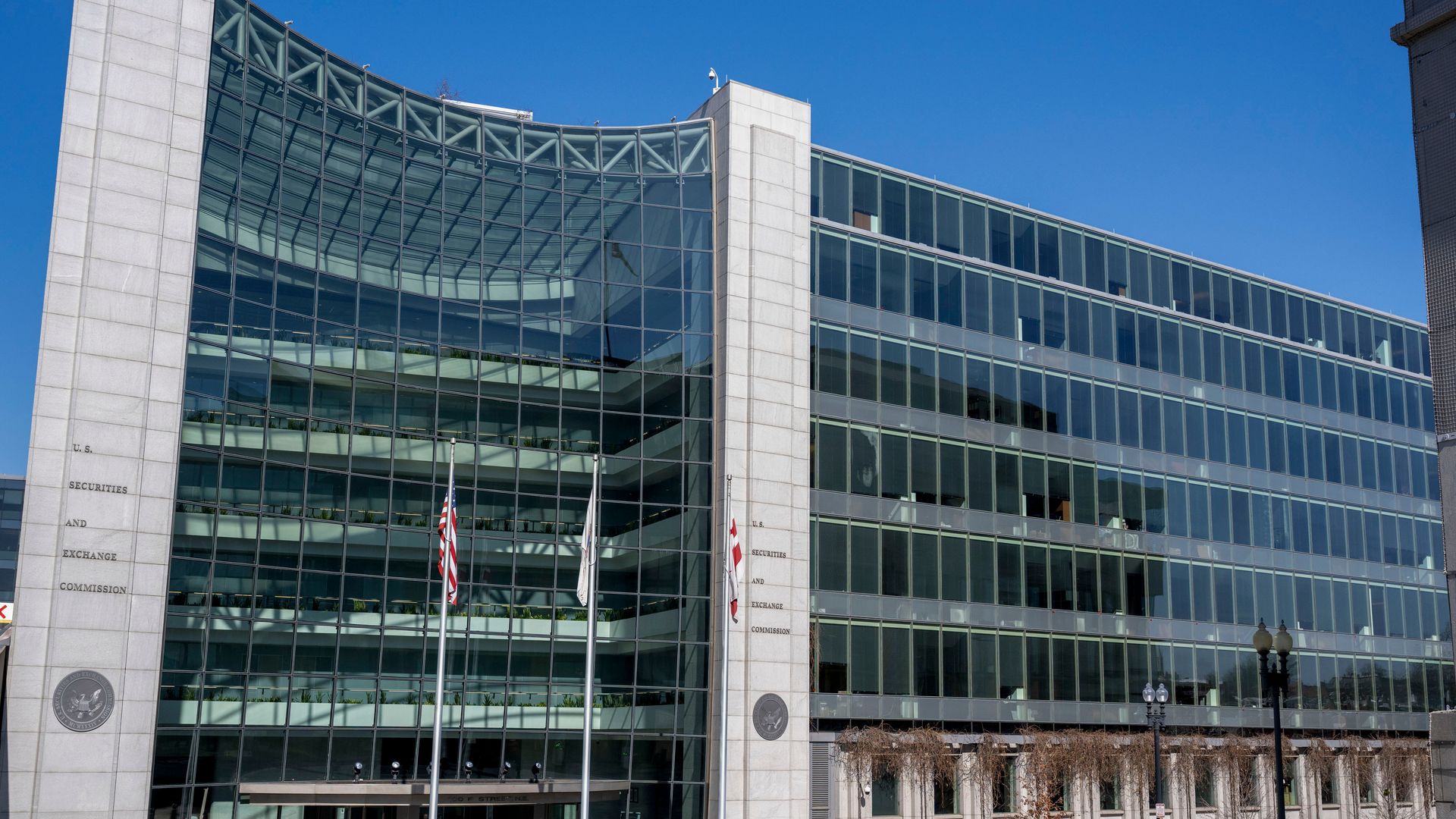
- The SEC is getting serious about the same question (though in a considerably more narrow way), kicking it off with a roundtable Friday where legal experts discussed the legal status of digital assets.
The big picture: The regulator has begun a process for issuing rules specific to the industry. These will include many firsts.
- They will govern what kinds of crypto assets need to be registered with the agency and, by extension, which exchanges need to register to offer brokering and trading services for those assets.
- The SEC has never written rules for assets connected to networks that do work autonomously (such as the cryptoasset bitcoin or the exchange Uniswap) and that no one has control over. That's a new thing under the sun.
At Friday's roundtable, the big concept was to discuss what kinds of digital asset transactions fall under SEC jurisdiction and — crucially — which ones don't.
- There were strong differences on the panel.
- "Everything is something," the panel's moderator and former SEC commissioner, Troy Paredes, said in his opening remarks.
Context: This conversation comes back to a nearly 80-year-old Supreme Court decision over how to identify a financial security. It is known as the Howey Test.
What they're saying: John Reed Stark, former SEC staffer and frequent critic of the crypto world, came to argue that just about everything in the industry is subject to SEC registration.
- He thinks the case law already supports that conclusion. "I don't think the SEC, respectfully, can just suddenly say all these cases don't exist," he said.
- A fellow crypto skeptic, Lee Reiners of Duke University, said that all of this is best left to the courts.
- "I know we all want to get to this sort of promised land of clarity, and I just, again, I don't think you'll be able to do it," he said.
The other side: "Yes, the SEC has won some cases, [but] they have not won a single case that applies Howey to secondary transactions," Miles Jennings, general counsel of a16z crypto said in his comments.
- "The last administration's approach ... did not lead to investor protection, it did not lead to capital formation, and it did not lead to efficient markets," he continued, referring to the agency's three-part mission.
- In short, Jennings urged the SEC to act sufficiently so that blockchain founders can take steps without triggering years of fear over lawsuits.
The bottom line: If the SEC put every digital asset through its rigamarole, that would make the technology useless, and that would be too bad, Rodrigo Seira, an attorney at Cooley LLP, argued.
- "Crypto, at least for me, the reason I got into this space, was because I saw it as a technology that enabled a new form of human collaboration."
Worthy of your time: Signs that even the critics think the SEC might have some legit work to do here.
2. What's this? Redefining accredited investor

The current definition of an "accredited investor" can be found in rule 501 of Regulation D, which is based on the Securities Act of 1933, but one of Friday's panelists thinks it's time to open up that rule.
- Why it matters: Because of this rule, since the initial coin offering era of 2017, regular people have been shut out of buying new tokens or coins before they hit the public market.
Zoom in: In a paper published in February, two BakerHostetler attorneys, Teresa Goody Guillén and Isabelle Corbett Sterling, proposed revisiting the notion of an accredited investor.
- "An enduring American principle is that individuals should retain the freedom to make choices about how to manage their own money. The presumption that people must be shielded from potential mistakes—based solely on their income or financial standing—undercuts this principle," they write.
State of play: Currently, an accredited investor is something (a person or a firm, etc.) with a net worth of $1 million or $200,000 in annual income ($300,000 for married couples).
- Fun fact: The word "accredited" makes it sound like the SEC has a list of approved investors somewhere.
- There is no list.
What we're watching: The paper's authors propose two additional paths to qualify.
- First, a sort of driver's license test of financial literacy, to show that the person can assess what kind of risk they are taking.
- Second, allowing people to make investments through a qualified financial adviser.
Flashback: Guillén was once rumored to be a strong contender to be the next SEC chair.
- Former commission member Paul Atkins ultimately got the nod.
3. Tornado Cash drops off Treasury sanctions list

The U.S. Treasury Department has removed the cryptocurrency privacy tool Tornado Cash from the country's sanctions list.
- Why it matters: The Ethereum-based smart contract has been a favorite tool for North Korean hackers and other bad actors to cover their tracks after stealing digital assets from exchanges and DeFi projects.
Between the lines: The nature of decentralized, leaderless software opened a novel area of law for the government.
- Crypto advocates have argued that the Biden-era sanctions around the tool set a dangerous precedent.
Catch up quick: Tornado Cash was a privacy tool on Ethereum that made it possible to deposit funds and draw them in such a way that it would be nearly impossible for a third party to connect the two transactions.
State of play: Addresses associated with Tornado Cash have now been deleted from the U.S. Treasury's list of sanctioned entities.
Between the lines: A new administration could put Tornado Cash back on the list as swiftly as the Trump administration took it off.
- And Senate Democrats have made moves (unsuccessfully) to clear up the legal gap that caused the designation to run afoul of the courts.
What we're watching: One of Tornado Cash's open source developers, Roman Storm, who was charged with conspiracy to commit money laundering and to violate sanctions.
- "Now the SDNY prosecutors should similarly reconsider their unfortunate decision to charge our client, and dismiss their case against him," Storm's attorney, Brian Klein of Waymaker LLP, said in a statement following the Treasury decision.
4. Catch up quick

👑 Treasury is reportedly looking at consolidating banking oversight. (Semafor)
🏧 TradFi is looking seriously at DeFi. (Paradigm)
💰 Trump Media will sell ETFs over Truth.fi in collaboration with Crypto.com. (Reuters)
🕵️♂️ The Office of the Comptroller of the Currency has dropped "reputational risk" from its rubric of evaluation. (Unchained)
👀 Coinbase, America's largest crypto exchange, is in advanced talks to buy the industry's leading futures site, Deribit. (Bloomberg)
This newsletter was edited by Pete Gannon and copy edited by Carolyn DiPaolo.
VCs are doing a weird flex. —Brady
Sign up for Axios Crypto