Scoop: Democrats to offer national security amendments on stablecoins

Add Axios as your preferred source to
see more of our stories on Google.
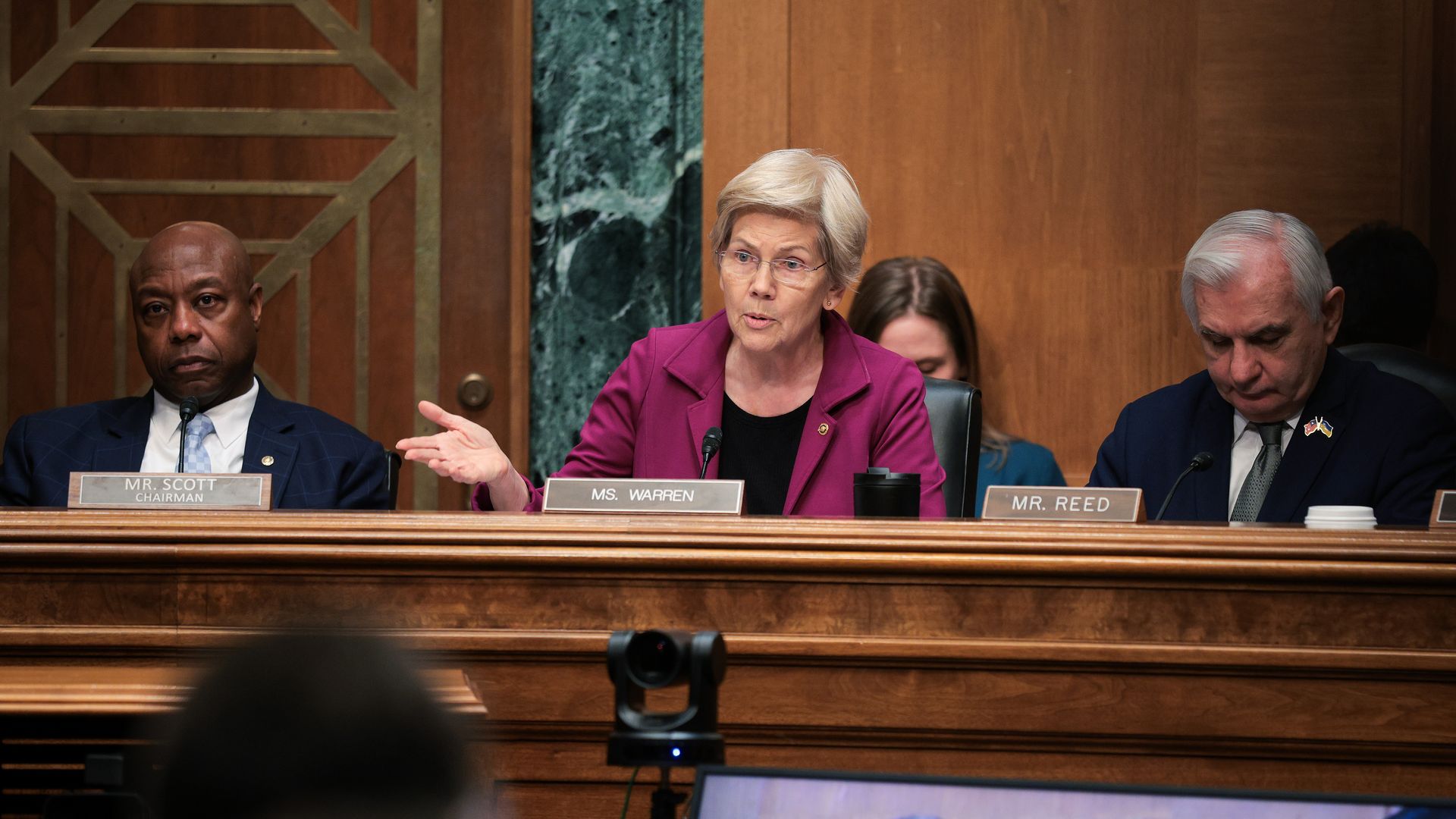
U.S. Senators Tim Scott (R-SC), Elizabeth Warren (D-Mass.) and Jack Reed (D-RI) at a Senate Banking Committee hearing in February. Photo: Kayla Bartkowski/Getty Images
Three Democratic senators will introduce amendments around national security issues Thursday morning ahead of a Senate Banking Committee markup on stablecoin legislation, Axios has learned.
Why it matters: The markup on the GENIUS Act is a key step in advancing a stablecoin bill, one of the top digital asset-related priorities for Republican lawmakers in the new Congress.
Inside the room: Senators Elizabeth Warren (D-Mass.), Andy Kim (D-NJ) and Jack Reed (D-RI) plan to propose seven amendments around enhancing national security measures in the bill, according to Democratic aides with knowledge of Thursday's committee meeting.
- The legislation, introduced by Sen. Bill Hagerty (R-Tenn.), is expected to be voted on by the Banking Committee Thursday at the 10 am ET meeting.
Catch up quick: Stablecoins are blockchain-based tokens designed to be pegged to the price of some other asset, usually U.S. dollars.
- U.S. stablecoin legislation is focused on the kind that is backed 100% by actual dollars or dollar-like instruments, such as short-term U.S. treasuries.
- "From enhancing transaction efficiency to driving demand for U.S. Treasuries, the potential benefits of strong stablecoin innovation are immense," Hagerty said in a statement Monday.
The planned amendments can be broken into a few topics:
- National security: One would require a national security assessment of any stablecoin issuer and its investors, while a second would mandate annual certifications by issuers that they have avoided entities like criminal cartels and terrorist organizations, the source said.
- Law enforcement: One amendment would clarify that dollar-backed stablecoins abroad are subject to U.S. jurisdiction, just as dollars already are.
- Illicit finance: One amendment would make explicit that Bank Secrecy Act requirements extend to third-parties (such as, in particular, exchanges) that do things like custodying and brokering stablecoins. Another would require that issuers monitor blockchain transactions of their stablecoins and submit suspicious activity reports as appropriate.
The intrigue: Courts last year threw back the U.S. sanctions against Tornado Cash, a blockchain-based privacy tool that was popular with hackers alleged to be linked to North Korea.
- The court said that U.S. law does not provide for immutable smart contracts to be classified as property.
- Thursday, Democrats plan to offer an amendment to GENIUS to close that loophole, the sources said.
Lastly, Democrats argue that GENIUS as written would allow foreign-issued stablecoins to still be traded in the U.S., even if they aren't licensed here.
- So a final planned amendment would forbid such stablecoins from being offered to U.S. users.
Brady's thought bubble: This amendment takes aim at Tether. Domiciled in El Salvador, it's the issuer of the world's largest stablecoin, USDT, which is the liquidity lifeblood of the whole industry.
- Tether has $143 billion worth of assets backing the dollar-pegged USDT, more than twice the size of its nearest rival, Circle's usd coin (USDC).
- Any measure that was able to significantly impact tether's ability to operate would likely be a massive medium-term blow to the entire industry.
Behind the scenes: Democratic staffers have given classified briefings to senators on the national security implications of the GENIUS Act as it's written, but details on the contents of these briefings could not be learned.
By the numbers: Hagerty re-released GENIUS on Monday ahead of the Thursday markup, with a new Democratic co-sponsor, and 32 more pages of language, more than 50% longer than the original draft, released in early February.
What we're watching: If GENIUS passes banking and how many Democrats ultimately get on board.
- One Democratic co-sponsor, Sen. Angela Alsobrooks (D-MD.), sits on the committee.
Go deeper: Similar issues came up Wednesday on the House side.
