
Axios Crypto

August 05, 2024

📉 Bitcoin got a beating like everything else, but prices are starting to tick back up. Plus, Genesis' bankruptcy.
Today's newsletter is 1,000 words, a 4-minute read.
1 big thing: 🖤 Bitcoin's Black Monday


Crypto's massive sell-off alongside global markets in recent days will test industry narratives that the world's largest digital asset is a risk-on investment, but also, a safe haven.
The big picture: Bitcoin's roughly 30% decline over the last seven days — coinciding with smaller, yet significant, drops in major stock indexes — doesn't help prove the latter.
- But characterizing bitcoin as a risk-on asset, which tends to do better when interest rates are low (and poorer when rates are high), oversimplifies the factors driving the world's oldest cryptocurrency, some in the industry argue.
What they're saying: "We cannot draw conclusions from a day like this," Ed Hindi, chief investment officer of Tyr Capital tells Axios this morning. "It's absolutely normal to see correlations move to 1 whenever there is so much fear in the market."
- "No asset class is going to withstand such a rush to the exit," he says. "This is pure unwinding of leverage across the board."
- Hindi explained that the combination of Japan's central bank actually hiking rates, and a U.S. Fed that has been too slow to cut rates was part of the problem.
Zoom out: In traditional finance, there is a hard line between "risk-on" assets and "risk-off" ones.
- "Bitcoin has introduced a paradigm that is challenging that distinction," ARK Invest's Yassine Elmandjra said in a research report published this year.
- "Its revolutionary technology and nascency are risk-on, while, as a monetary asset, its absolute scarcity and role as a bearer instrument are risk-off — thus blurring the traditional distinction."
Bitwise Asset Management's chief investment officer, Matt Hougan, told Axios in an interview last month: "My best feel for what really resonates with many advisers puts bitcoin in the digital gold or monetary asset camp and Ethereum in the technology camp."
State of play: Hougan this morning compared the selloff to the global capital markets panic of March 2020 "when the reality of COVID set in."
- "People smash the sell button for liquid assets during broad-based panics."
What we're watching: How investors view bitcoin when this dust settles.
- Crypto plunged steeply to below $50,000 during this morning's widespread selloff, but what's been eating the crypto market lately is macro and goes back to last week.
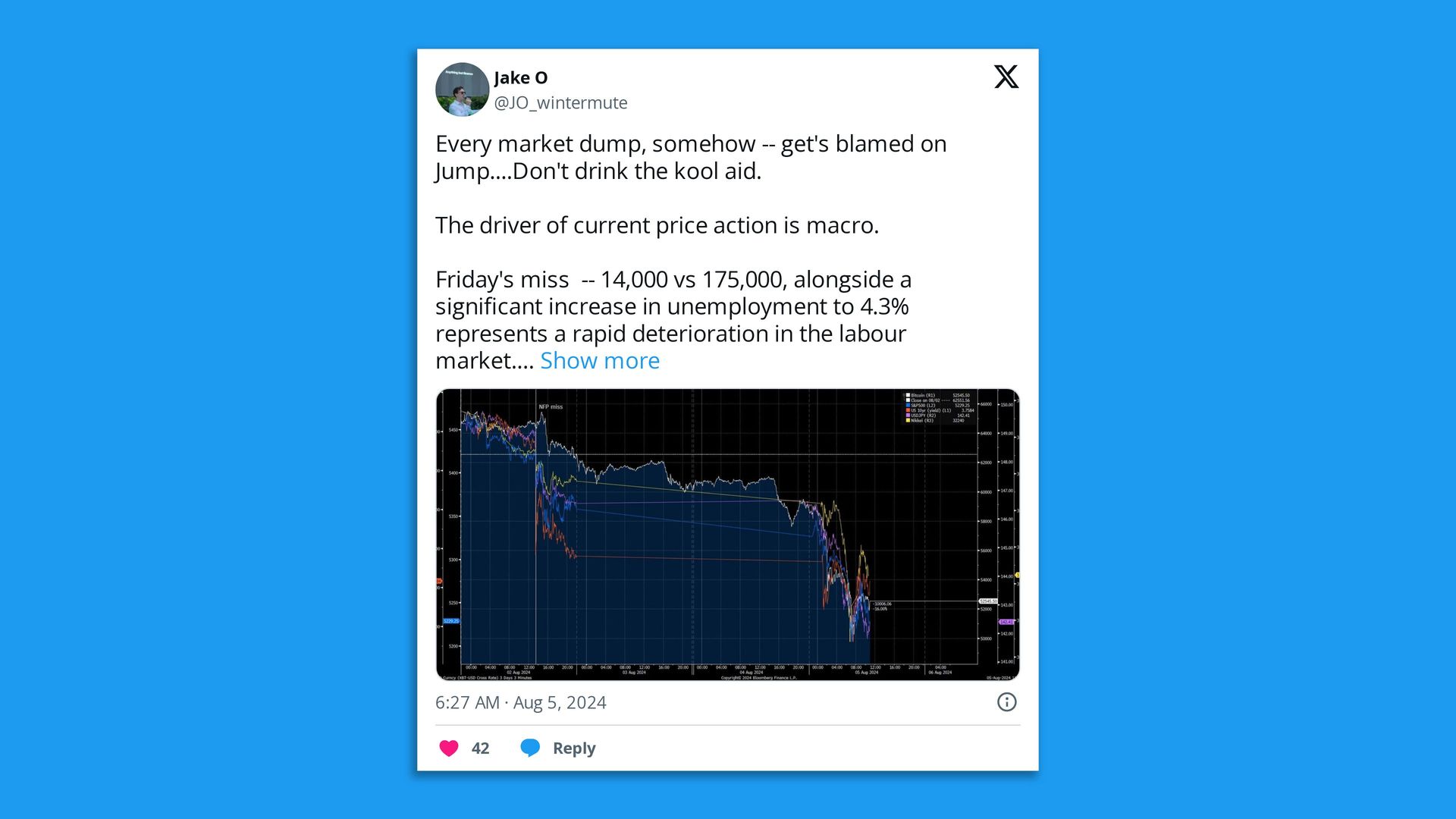
Zoom in: Hiring slowed in July, per Friday's U.S. jobs report, sparking a new "dual narrative," Jake Ostrovskis, an over-the-counter (OTC) trader at Wintermute, said on social media today.
- There's "both a potential policy mistake by the FOMC [Federal Open Market Committee] and concerns about economic growth."
- As of 11:30am ET, bitcoin has rebounded off its bottom, to $54,300.
Our thought bubble: 🤷♀️
2. 🪀 Not Jump...but a bounce
Crypto Twitter was attributing the sell-off to crypto trading firm Jump when some folks noticed that wallets previously identified as belonging to that shop were in selling mode.
Zoom in: Wintermute trader Jake Ostrovskis said not to drink the Kool-Aid.
- He attributed the crypto rout to macro expectations, and in the wee hours this morning, made a call: "The US ISM Services PMI will be in focus today, with expectations of a 51.4 reading. Any sharp decline into contraction territory (below 50) would be significant, whilst a stronger-than-expected print may result in a relief rally."
State of play: The data aligned with estimates, and now, bitcoin prices appear to be bouncing.
- Our thought bubble: ☝️ BTW, Friday's miss was 114,000 vs 175,000.
3. 🤪 Global markets go wild and woolly
There is no reason that a 0.2 percentage point rise in the U.S. unemployment rate should trigger a 12% collapse in the price of Japanese stocks. Yet that's what happened last night.
The big picture: The U.S. selloff Friday was sensible, given signs of an economic weakening evident in July jobs data. The plunge in global markets that started last night, however, looks to be driven by international financial linkages and crowded trades unwinding.
- Those effects are creating far bigger market moves than are justified by shifts in the U.S. economic outlook.
- That is a key reason the Fed will be reluctant to be seen acting rashly by cutting interest rates in advance of its Sept. 17-18 policy meeting, contrary to a swell of market chatter — and rising market-priced odds — since Friday.
- Why risk fueling further panic, in other words, when financial markets have already adjusted to make borrowing costs lower in anticipation of regularly scheduled rate cuts?
Between the lines: There are moments when markets just have a wild and woolly feel to them — when the scale of the moves is unmoored to the changes happening on the ground.
4. 🏁 Genesis wraps up bankruptcy
Crypto lender Genesis Global completed its bankruptcy restructuring Friday and began distributing about $4 billion in cash and crypto assets to creditors.
Why it matters: The distribution of funds closes the books on one of the highest-profile bankruptcies to result from the 2022 crypto collapse.
By the numbers: Bitcoin creditors will receive 51.28% recoveries as valued on an in-kind basis, and ether creditors will receive 65.87% recoveries, the firm said in a statement.
- Solana creditors will receive 29.58% recoveries, while creditors holding other altcoins will receive an average of 87.65% recoveries.
- Finally, U.S. dollar and stablecoin creditors will receive 100% recoveries in the form of U.S. dollars.
Flashback: Genesis filed for bankruptcy in early 2023, as crypto contagion destroyed several high-profile companies in the sector.
- The bankruptcy proceedings were marked by a barrage of accusations and lawsuits between Genesis parent Digital Currency Group and former partner Gemini.
- The New York attorney general sued DCG and Gemini for fraud and secured a $2 billion settlement this year.
- Genesis separately settled a civil suit with the SEC for $21 million in February.
Between the lines: Creditors also established a $70 million litigation fund to pursue cases against third parties, most notably DCG.
5. 📢 Catch up quick
📉 Pump.fun tokens have a poor success rate. (The Defiant)
🗽 Crypto startups are opening offices in New York. (Bloomberg)
👻 Liquidators on Aave make $6M amid $350M in loans breaking. (CoinDesk)
This newsletter was edited by Pete Gannon and copy edited by Carolyn DiPaolo.
Were you forwarded this email? Subscribe here.
Sign up for Axios Crypto


/2024/08/05/1722875284082.gif?w=3840)