Axios Communicators

June 12, 2025

Hi there!
- π₯Next week, Axios Communicators Pro members will receive a members-only deep dive on brand partnerships, fandoms and monetization. Join now to receive the report ahead of Cannes Lions.
- π«π· Speaking of ... Axios will host four days of unmatched access, smart conversations and unparalleled connections from June 16-19 in Cannes.
- Speakers include Gabrielle Union, will.i.am, Paris Hilton, Twitch CEO Dan Clancy, Pinterest CEO Bill Ready, Business Insider CEO Barbara Peng and more.
- π§ Check out this Giide visual overview of our plans for the week and RSVP here.
Today's newsletter, edited by Christine Wang and Kathie Bozanich, is 1,714 words, a 6.5-minute read.
1 big thing: Companies silent amid ICE raids and protests

Immigration and Customs Enforcement raids in Los Angeles County have led to public unrest, with Home Depot and Waymos as the backdrop.
Why it matters: Corporate America's muted reaction is in stark contrast with the way it responded to protests during the first Trump administration.
Catch up quick: Demonstrations broke out on Friday near a Home Depot in the LA County city of Paramount, after ICE agents carried out a deportation operation targeting day laborers.
- The Trump administration ordered National Guard troops and hundreds of Marines to quell protests over the objections of local and state officials.
- Mayor Karen Bass imposed a curfew on downtown LA to curb vandalism and looting, which in the previous days led to Waymos being set on fire.
- Anti-deportation protests took place nationwide in cities including San Diego, San Francisco, Dallas, Chicago and New York.
What they're saying: Home Depot directed inquiries to ICE and wouldn't expand when asked how the retail giant was supporting stores, employees and customers.
- Waymo suspended service in Los Angeles. A spokesperson told Axios that "safety is our highest priority ... both for people who choose to ride with us and with whom we share the streets. We are in touch with law enforcement and will retrieve our vehicles at the appropriate time."
Zoom in: Small businesses raided by ICE have issued statements in support of detained employees and members of their communities.
- ICE agents raided local San Diego restaurant Buona Forchetta on May 30, and three employees were taken away when they couldn't show identification, Axios San Diego's Andrew Keatts reports.
In response, the local restaurant issued a public statement on its Instagram account.
- "The way [the raid] unfolded was nothing short of traumatic," the statement read. "We are devastated and heartbroken. At this moment, our priority is not public perception or headlines. Our priority is our people. We are working closely with our attorneys to locate and support our detained employees and their families. ... We are also deeply moved by the outpouring of support from our community."
- Nearby businesses have shown their support through statements and donations, and the community has led ICE protests in response.
Between the lines: Trump's 2017 immigration policies and travel bans prompted many CEOs taking a political stance. Now, however, corporate America has recalibrated to strategic silence.
Yes, but: Moments arise when companies should be prepared to comment, and they must have a plan in place, says Paul Argenti, professor of corporate communications at Dartmouth's Tuck School of Business.
- "If you think about it conceptually, what is in it for a company to go up against Donald Trump? Zero, nothing ... unless it's an issue connected to you directly or there is a strategic need to comment."
- "So as it relates to Home Depot [executives], the raids and protests happened right in front" of their store, Argenti said. "How did they not comment on it? Customers, employees and community members will expect to hear from them. There's just no way [they] can get away without saying anything."
- It's an example of why all corporate communications teams need to anticipate being dragged into societal or political matters, he added.
The big picture: Even given the penchant for silence, stakeholders expect business leaders to engage on matters that impact employees, customers or the business.
- A recent Axios Communicators Pro-Gravity Research survey found that business leaders feel the most pressure from employees (69%) as it relates to engaging on immigration policies.
- 31% say they feel pressure from policymakers, while 15% say shareholders and customers demand engagement on the issue.
What we're watching: The reaction to ongoing "deportation wars" could signal corporate America's appetite for wading into political crosshairs. It's either the moment corporate America begins to engage or continues to retreat.
2. Happy employees, higher profits

Happy employees are good for business, according to a new report by Charter and hiring platform Welcome to the Jungle.
Why it matters: Employer brand and worker sentiment have taken a back seat amid economic uncertainty, a tight labor market and shifting workplace dynamics.
Yes, but: Companies with strong employer brands and high worker sentiment had significantly greater revenue growth and total stock returns over 10 years, the report finds.
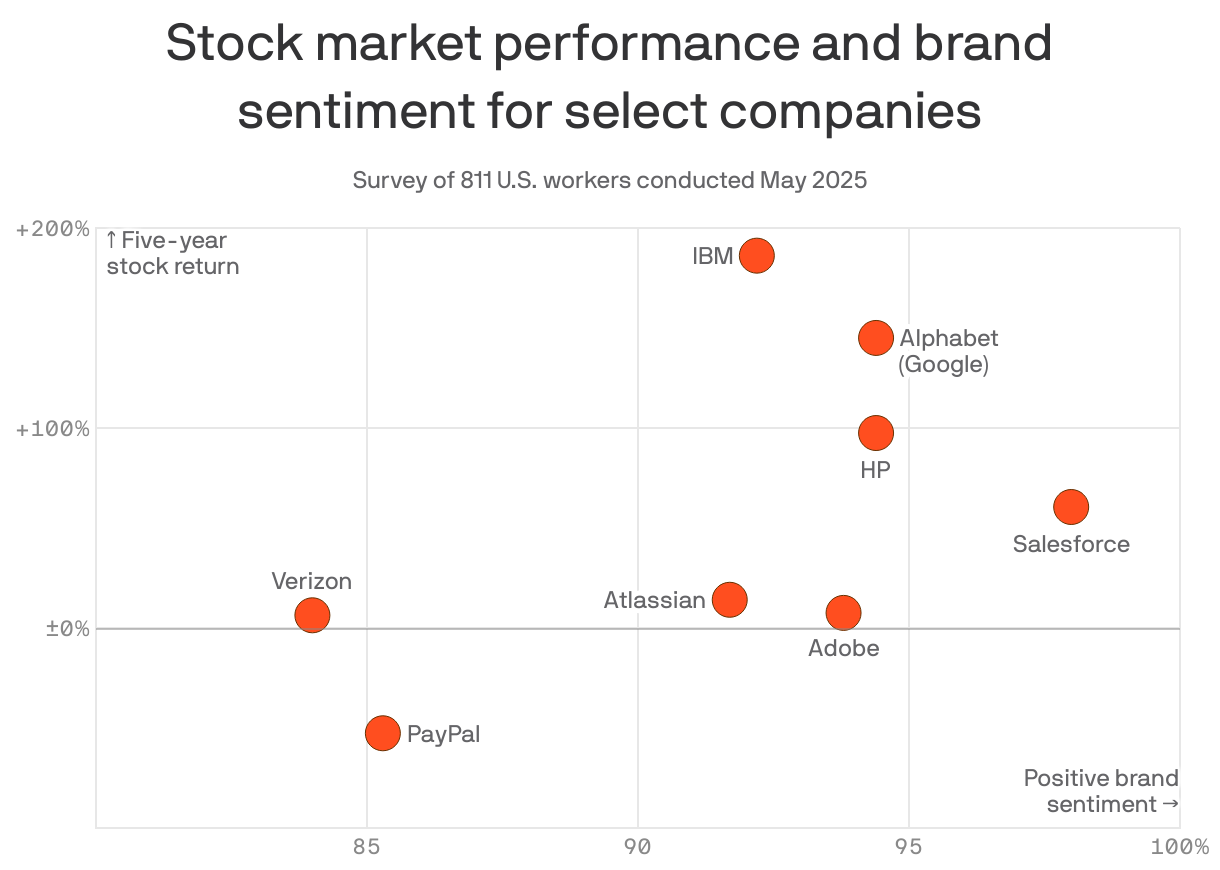
State of play: Tech companies with the highest employee sentiment scores β Salesforce, Alphabet and HP β saw significantly higher stock market returns than those with less positive sentiment β Atlassian, PayPal and Verizon.
- The correlation was observed within the financial sector too, per the report.
- JPMorgan Chase and Bank of America outperformed Citigroup and US Bancorp in worker sentiment, revenue and stock returns.
Zoom in: Companies with high scores for "communicates a clear mission" β which include Alphabet and JPMorgan β consistently outperformed peers financially too.
- This suggests clear internal communication helps align employees to the company's goals, which leads to more growth and better business performance, according to the report.
Between the lines: Work-life balance is the key driver of positive worker sentiment, followed by total compensation and benefits and opportunities for advancement.
- Only 27% point to flexibility or remote work and only 10% say diversity, equity and inclusion are signs of a good employer.
Yes, but ... ππ»
3. Entry-level worker confidence is lower than ever


It's a high-anxiety moment for entry-level workers βΒ a report from Glassdoor out Tuesday morning shows they have record-low confidence in their employers.
Why it matters: The hiring market has slowed considerably from a few years ago,Β and that's especially troubling for those at the start of their careers.
- Overall employee confidence is at a record low.
Between the lines: Entry-level work is also increasingly threatened by the advancement of AI, as Axios recently reported.
The big picture: Many workers are currently feeling stuck in their roles, as the labor market grinds slower.
- That's especially problematic for entry-level workers, because these are the folks most likely to job hop and benefit from switching β in terms of finding a job that's the right fit and increasing earnings.
The bottom line: The job market is pretty meh for a lot of people, especially those just starting out.
4. Refresher: Media relations 101
My colleague, Axios national political correspondent Alex Thompson, nabbed the attention of public relations professionals last week after tweeting that "off the record no longer applies" if a comms lead doesn't tell the truth.
π§ Why it matters: Understanding interview parameters is paramount, especially as the media landscape evolves to include creators, influencers and independent journalists.
What they're saying: Journalists and PR professionals should do everything in their power to protect the agreements they make with one another β particularly when they go off the record, says Gary Sheffer, president of Spokesman Communications and former professor of public relations at Boston University.
- Going off the record is "an important tool to deepen understanding and provide nuance or context," he told Axios.
Yes, but: "I do think there are situations where the journalist has a right to disclose that he or she was misled in a conversation, but it's not done lightly" and only with "issues that really matter to the journalist or are important to the readers and the people associated with the story."
- Knowingly misleading or lying to a reporter ruins credibility moving forward.
- "We live in a world where lies have become more commonplace and accepted," Sheffer said. "And from a PR practitioner standpoint, your only value to the company is your credibility and by lying even off the record, you lose that."
Plus, there is always "no comment." However, that often affects the sentiment of a story.
- Replacing "no comment" with simple responses improved the sentiment by at least 5%, according to a recent analysis conducted by Valentine Advisors.
- "In the textbooks, it says no comment equals we're guilty," Sheffer said.
Zoom in: As a refresher, here are the general parameters for engaging with U.S. media, which should be agreed to ahead of time by both parties.
- On the record: Everything said can be shared, quoting the source by name, title and affiliation.
- On background: The information can be shared without naming the particular source, but affiliation, rank or position can be used β for example, "a spokesperson for the company said ... "
- On deep background: The information can be shared, but how it's attributed is often vague β such as "According to a source ... " β and should be carefully discussed.
- Off the record: Information stays between the reporter and the subject. It cannot be used for publication.
- Embargoes: A great tool for sharing complicated, data-heavy reports ahead of launchβ but there must be a conversation first. Blasting embargoed materials is bad form.
The bottom line: While the shifting media landscape may feel like the Wild West, interview parameters and media relations shouldn't.
5. The most popular U.S. languages besides English and Spanish


Chinese, Tagalog and Vietnamese are the three most commonly spoken languages in the U.S. other than English and Spanish, Axios' Alex Fitzpatrick reports from new census data.
Zoom in: Spanish is far and away the predominant non-English language nationwide, with about 41.2 million speakers. Putting it aside offers insight into other population centers around the country.
- About 3.5 million people in the U.S. speak a form of Chinese, 1.7 million a form of Tagalog, and 1.5 million Vietnamese and related languages.
Zoom out: Many multilingual people speak one language at home with family, but use English at work, school and elsewhere.
- Just over 60% of people who speak a language other than English at home also say they speak English "very well," per the census data.
6. βοΈ1 thing to go: Goodyear's PR gold
After 100 years, the Goodyear blimp remains an icon of the skies.
- Why it matters: The airship doubles as one of the greatest promotional tools ever β for the Goodyear Tire and Rubber Company in Akron, Ohio β as it captures aerial footage of the world's biggest sporting events.
Flashback: The blimp program began in 1925 with the introduction of "Pilgrim" β the world's first helium-filled, non-rigid airship.
- The fleet grew over the next decade with the additions of Puritan (1928), Volunteer (1929), Mayflower (1929), Vigilant (1929), Defender (1929), Reliance (1931) and Resolute (1932).
Reality check: Today's blimps are primarily used for public relations.
- Goodyear operates four of the world's 20. They are no longer technically "blimps," as they feature semi-rigid frames designed in partnership with Germany's Zeppelin.
βοΈ Thanks for reading! Want more communicators' content? Become an Axios Communicators Pro member.
Sign up for Axios Communicators