Axios Communicators

October 09, 2025

Welcome back!
- 📺 ICYMI: The latest episode of "The Axios Show" is out, featuring bestselling author and podcaster Mel Robbins. Watch on Axios … Subscribe to our YouTube.
Today's newsletter, edited by Christine Wang and copy edited by Brad Bonhall, is 1,834 words, 7 minutes.
1 big thing: AI pop-up season

There was a line around the block in New York City's West Village this week as tech enthusiasts, creators and curious passersby waited to check out Anthropic's pop-up, the Claude cafe inside the Air Mail newsstand.
Why it matters: It's common for consumer, lifestyle and entertainment brands to invest in experiential marketing, but now AI and B2B companies are adopting the playbook.
Driving the news: Over the weekend, more than 5,000 people stopped by the Claude pop-up, while social posts about the activation received 10 million impressions, according to Anthropic.
- "We're positioning Claude as an AI tool for problem solvers, for these people that are chasing after hard problems," said Sam McAllister of Anthropic. "This pop-up was our first small physical manifestation of the brand campaign itself."
- Anthropic created a "space to reach real people, have real human interactions and show that the technology they're using can help humans be more human," says Marc Simons, co-founder of Giant Spoon. "That, I think, is the bridge [AI companies] will be trying to cross."
Cursor, the AI coding company, recently hosted a cafe pop-up in San Francisco, with plans to hold another in NYC this month.
- And this year IBM hosted a multi-day activation in Madison Square Park alongside the U.S. Open, which saw about 200,000 visitors according to foot traffic data.
What they're saying: "In a world where people are so used to experiencing everything through a screen, even in this B2B space, having an actual human live experience has a lot of value, especially when you're trying to explain relatively esoteric technology," says IBM chief communications and brand officer Sarah Meron.
- "For us, it's about finding human connection and translation points," she added. "I don't need the people who walk by our Madison Square Park activation to have a strong emotional response, but I do need them to reevaluate IBM, understand what the company does, and equate us with AI."
Between the lines: B2B experiential marketing has evolved beyond trade show floors. Companies, especially those in the AI space, are looking for ways to differentiate themselves and appeal to end users.
- "B2B event marketing has typically been so boring. It's very dry. It's a sea of sameness," Simons says.
- "Anything that a brand can do that's going to stick out and show you're actually treating this audience like they're humans is going to be a good thing," he added.
The big picture: Brand teams have long built experiential tactics into their campaign rollouts and budgets, and social media paired with young consumer interest makes it worthwhile.
- More than half of those under 35 have attended in-person brand events, per a recent Morning Consult survey.
What to watch: Expect that trend to continue as Gen Alpha and Gen Z look for more ways to unplug from devices and reconnect in person.
What's next: More consumer-facing pop-ups from deep tech, AI or traditionally B2B companies that are looking to cultivate a sense of community and build brand loyalty.
- "You're going to continue to see technology and especially AI-oriented businesses having to ensure that they are building their brand and marketing their products so that they're part of the consideration set. There's just no two ways about it," says Michael Nyman, CEO of Acceleration Community of Companies.
2. Learnings from Margit Wennmachers

Axios' Pro Rata author Dan Primack writes: Thirteen years ago, I wrote a piece for Fortune titled "Andreessen envy," which discussed how a relatively young venture capital firm had cornered the media narrative — much to the chagrin of more experienced firms.
- Not named explicitly in that piece was Margit Wennmachers, who led Andreessen Horowitz's communications efforts from its earliest days. She should have been.
- Wennmachers recently retired from A16z, but not before we discussed some of her early memories and lessons learned.
What follows was edited for length and clarity:
Axios: You had a long and successful career as an outside PR advisor. What was the pitch that compelled you to work with a16z?
Wennmachers: "These guys came along and said, 'We're not going to succeed unless we're in the list of top five VC firms, because all the good deals are competitive.'
- That was an interesting marketing challenge because they didn't really have a portfolio, and the list of top VC firms back then didn't change. How do you get on that list ahead of the results?
- But I'd worked with them before and liked that they had ambition and discipline. They didn't golf or have a vineyard or really have hobbies. A lot of VCs have a lifestyle that's not like a startup grind."
Had you been thinking about joining a VC firm?
"No. We even had been skeptical about taking lots of VC firms as clients at Outcast because the only way to be interesting is to be a thought leader, and lots of VCs didn't have the thoughts.
- A lot of VC firms also thought that marketing was beneath them."
What was your initial strategy?
"Ben wasn't very well known, so I hired Grace [Ellis]. Her job was to make sure Ben's profile was on par with Marc's.
- We also really maximized attention around key moments, like when Marc wrote about software eating the world.
- Or when we did the Skype deal, which was unusual since it was a buyout. We made calls to reporters before Microsoft did its press conference, and 80% of the coverage had us in the headline or the first paragraph. That may seem like a small thing, but it made a big difference. You become omnipresent."
What's your advice to communications leads at other VC firms?
"First, make sure you have a mandate because partnerships are next-level complicated.
- Then figure out what people at your firm are good at and what motivates them. It's their ideas that made the difference. Copying doesn't work."
What's the biggest mistake you see from peers?
"Some people in my profession are very harmony-driven, and think they can't ever have a negative headline. But that's usually chatter, not real business.
- Now, if you f**k up and have to do a product recall, or lied, those are actual problems. But most people on Twitter are just clutching pearls, and it will pass."
Go deeper ... subscribe to Axios Pro Rata
3. Charted: The shutdown news cycle
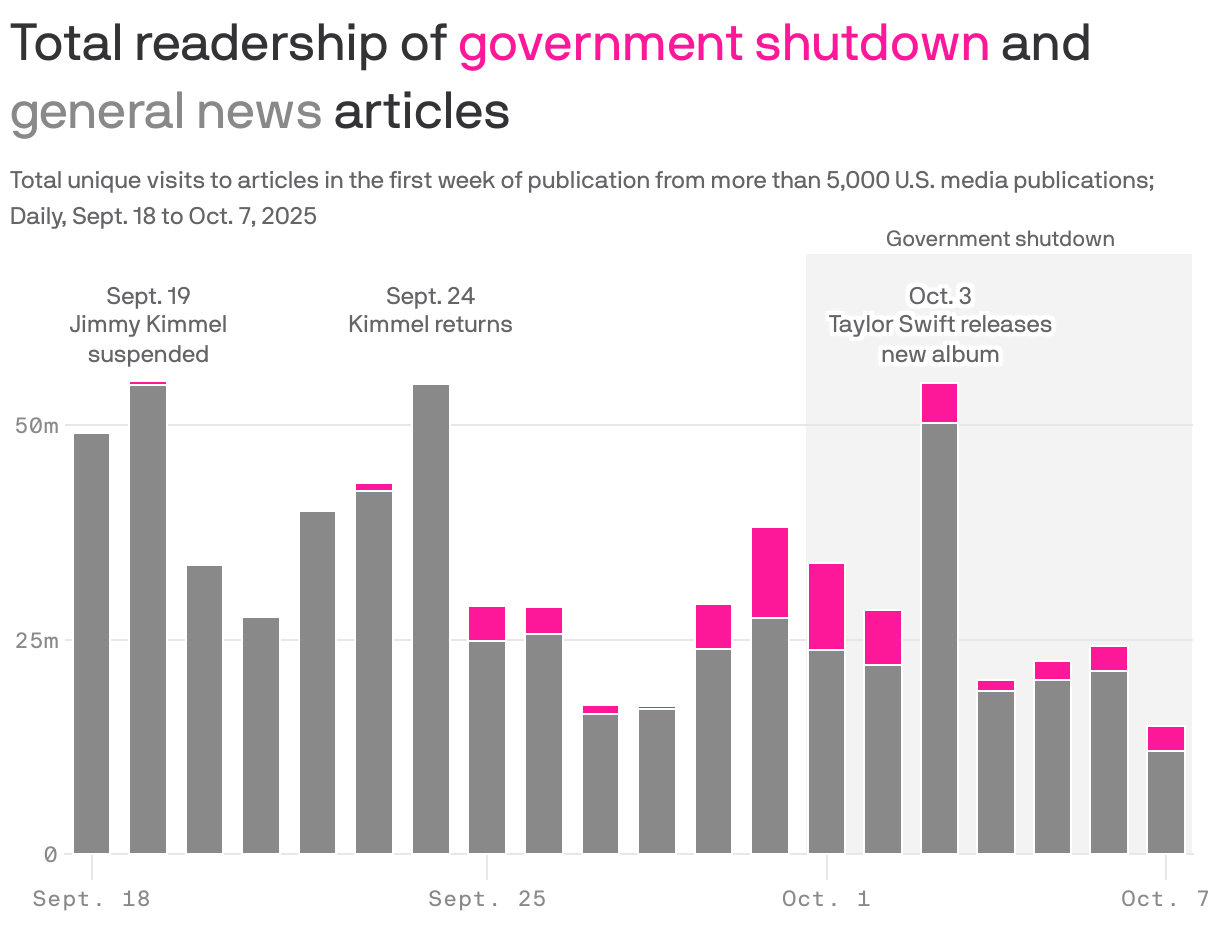
Although coverage of the government shutdown is drawing significant readership, it's low compared with the broader news cycle, according to Memo data shared with Axios.
Why it matters: This highlights the fragmented media landscape and the general population's news fatigue.
- It also highlights that any political flood-the-zone strategy isn't working.
Zoom in: Readership peaked on the first day of the shutdown (Oct. 1) and has been steadily declining since.
- Left-leaning national news outlets are getting the most readers, with the top articles being ones covering topics like potential layoffs, travel impact and the latest negotiations.
4. 📚 Reading list
❌ Activist investors are ousting CEOs at a record pace, with 25 activist-instigated CEO resignations already this year. 2024 holds the record with 27 resignations, per Barclays. (Axios)
👀 Deloitte Australia will partially refund its client, the Australian government, after delivering a report that was littered with AI-generated errors, fabricated quotes and references to nonexistent academic research papers. (ABC News)
⚖️ The Supreme Court's new term opened this week and is expected to deliver rulings on Trump's executive power, elections and campaign finance, trans athletes and conversion therapy, and Second Amendment and death penalty cases. (Axios)
📱Dave Heinzinger, who led comms at X for three months, is pushing back against the platform, warning that social media is not a replacement for journalism. (CNN)
🤡 The latest corporate pendulum swing? Leaders should stop being authentic and instead focus on building a reputation for competence or effectiveness. (Harvard Business Review)
5. ICYMI: Axios and Mixing Board join forces
Axios is combining its premium subscription — Axios Communicators Pro — with Mixing Board to create a community for modern communications and corporate affairs professionals.
Why it matters: The comms world is being upended by AI, geopolitics and media disruption, fueling a need for membership groups where practitioners swap tactics, gain insights and sharpen skills.
The big picture: I — along with the Axios newsroom — will produce and oversee all of the community's premium editorial content and events, while the Mixing Board team will support the community by leading trainings, spurring conversations and making connections.
Zoom in: The newly combined entity, "Mixing Board, powered by Axios," will support a network of more than 900 senior communication leaders.
- Members hail from companies like Amazon, American Express, Airbnb, BlackRock, BP, Coca-Cola, Delta Air Lines, Disney, Etsy, GE, GM, Instacart, Meta, Microsoft, Netflix, OpenAI, Qualcomm, Reddit, Salesforce, Samsung, SiriusXM, TikTok, T-Mobile, United Airlines, U.S. Steel, Walmart, Workday, Yahoo, and venture firms and nonprofits of all stages and sizes.
- Practitioners with 15+ years' experience and a proven record of leading teams in high-stakes moments or at notable organizations are encouraged to apply.
Zoom out: Membership groups are trending as the communications field has evolved and practitioners look for ways to hone their craft and find community.
Catch up quick: Twitter alum Sean Garrett founded Mixing Board in 2021 to help communications, marketers and brand leaders with upskilling and networking.
- In 2024, Axios HQ — the internal comms software company, which spun off from Axios in 2022 — acquired Mixing Board.
What they're saying: "Mixing Board brings together the smartest people in the industry into a community where they can connect, be sounding boards for each other and pool playbooks or best practices, while Axios Communicators Pro keeps a pulse on where the industry is headed next through premium reporting, deep research, expert-level events," says Axios HQ CEO Roy Schwartz.
- "Bring them together, and we have the most influential community of well-supported comms leaders driving their industry forward."
What to watch: News organizations and independent journalists are working to convert passive readerships into hyper-engaged communities.
6. ❤️🔥 1 fun thing: Taylor's press tour


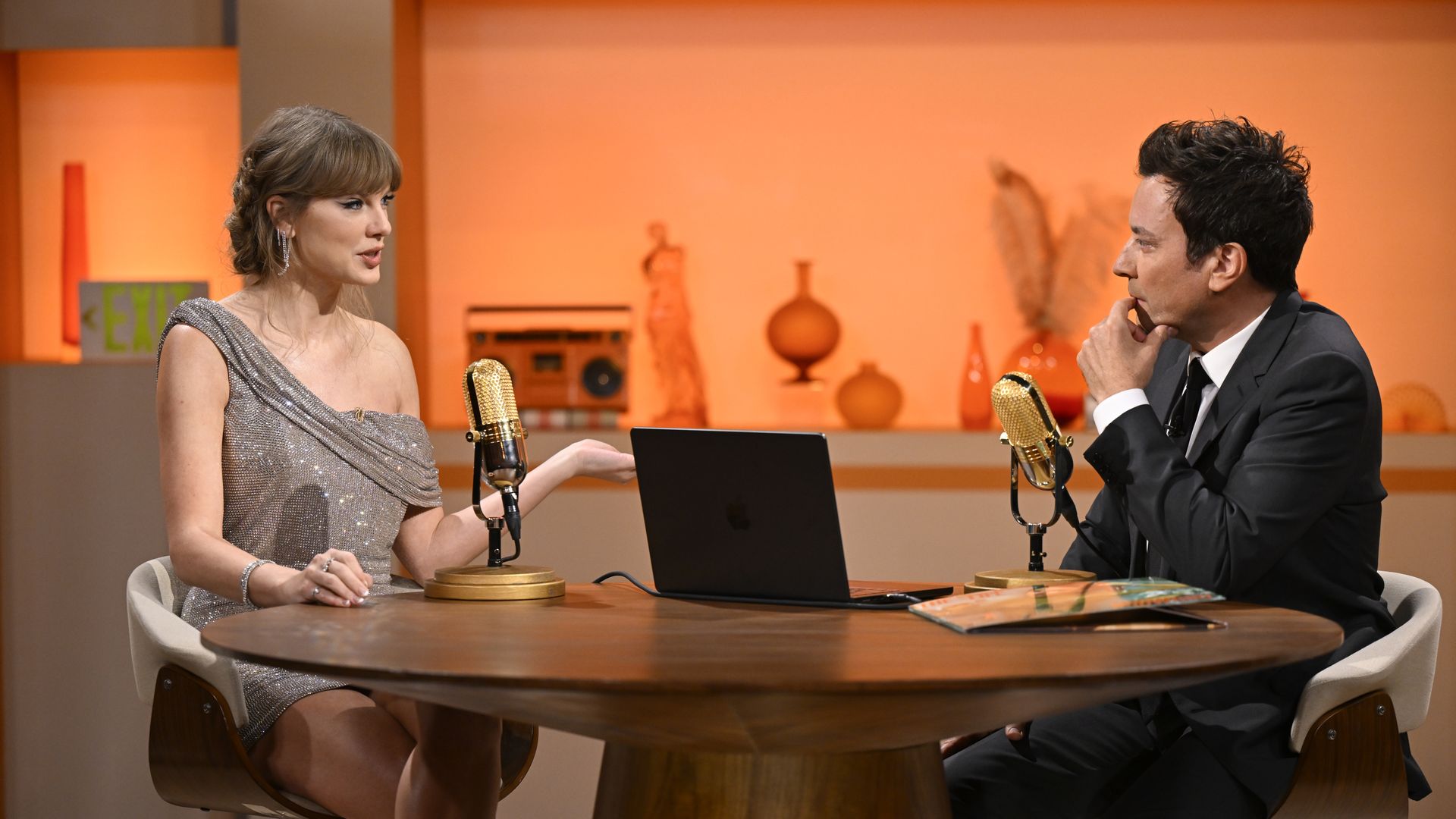
Taylor Swift has been on a rare press blitz following the release of her new album, "The Life of a Showgirl," which has already broken streaming and theatrical records.
Why it matters: Swift is reengaging in person with traditional media after years of speaking directly with her fans through her social media and on "The Eras Tour."
Driving the news: Swift's interviews in the past week include "The Tonight Show Starring Jimmy Fallon," "Late Night With Seth Meyers," "The Graham Norton Show," BBC Radio 1 and "The Morning Mash Up" on SiriusXM 1.
- Although Swift is not new to late-night TV or radio, these appearances have been the most concentrated round of interviews since "The Eras Tour" began in 2023.
The intrigue: During her appearance on Fallon, Swift addressed several rumors about her, including speculation that she had turned down the Super Bowl halftime show.
✅ Thanks for reading! Was this forwarded to you? Become an Axios Communicators subscriber today.
Sign up for Axios Communicators