Axios Communicators

April 17, 2025

👋🏻 Welcome back! Today we are talking higher education, tariffs (still), early 2000s trends, space and more.
- 🌸 But first: Join us for an Axios Communicators reception in D.C. on April 25 featuring conversations with Airbnb executive Jay Carney, among others. Request an invite.
🚨 Situational awareness: A Federal court just ruled that Google's dominance of the online advertising and ad-tech markets violates U.S. antitrust laws. The decision could scramble the massive digital ad universe.
Today's newsletter is 1,595 words, a 6-minute read.
1 big thing: Universities back in the crosshairs
The Trump administration has created a lose-lose situation for many of America's educational institutions, as it pressures universities to meet its demands or risk losing funding and tax-exempt status.
Why it matters: Universities have two options — capitulate or push back — both of which could ignite backlash and damage higher education's already flailing reputation.
Catch up quick: This week, Harvard became the first university to reject the administration's demands tied to its federal funding.
- In response, the Trump administration is freezing more than $2 billion and the IRS is taking steps to revoke the university's tax-exempt status.
- This comes after Columbia regained $400 million in federal grants and contracts the administration had pulled from the university after it agreed to meet some demands.
- Funding for Cornell, Northwestern, Brown and Princeton is also on the chopping block.
Meanwhile, Inside Higher Ed reports that over 1,300 international students and recent graduates from 210 American colleges and universities have had their legal status changed by the State Department.
- This has forced many universities to weigh in on the issue of immigration and the policies of President Trump's Federal Task Force to Combat Anti-Semitism.
What they're saying: The student visa issue reversals prove more challenging than the funding battle, says one longtime higher education communications adviser who asked to speak on background.
- "The international visa issue is in some aspects much more ominous, because it affects students, faculty and colleges from across the country. It's not just some elite Ivy League problem," the adviser told Axios.
- "It's also much trickier in that there's a lot less you can do about it, frankly. Some schools are creating easy pathways for students to get access to legal help. They're providing some funding in case students are dislocated, but there's not a whole lot more to be done."
The big picture: Universities are particularly vulnerable to these socio-political attacks given their declining reputations due to student loan debt, the high cost of tuition, and the issues of diversity, equity and inclusion, along with free speech and campus safety.
- Confidence in higher education has plummeted across all demographic groups, per a Gallup poll.
- Plus, the competing agendas of university stakeholder groups — students and prospective students, faculty, alumni and community members — make these institutions even more susceptible to backlash.
In response, several prominent institutions have expanded the comms remit to include public policy, crisis communications and issues management.
- Communication and public affairs firms have also launched dedicated higher education practices to meet the demand.
What's next: Harvard's response could either galvanize more universities to push back harder or it could lead them to conclude Harvard should fall on the sword as it is the oldest and most well-funded university in the U.S.
- Of note, administrators from Stanford and Princeton have commended Harvard for its response. Former President Obama and Sen. Bernie Sanders (I-Vt.) also applauded the pushback.
Zoom out: This moment of crisis also presents academic institutions with the opportunity to articulate their contributions and what Trump's cuts could mean for everyday Americans.
- "The area that is ripe for discussion is the impact these cuts could have on scientific research that might enhance national defense, chip technology or medical research," says Phil Singer, CEO of Marathon Strategies.
- "What are the areas that are at risk here that could have a material impact on ... the economy, national security and health?" he added.
- Johns Hopkins University has launched a "Research Saves Lives" campaign that aligns with this premise, while Harvard launched "Research Powers Progress."
The bottom line: "The communication goal [for these institutions] is to constantly reassure the very nervous, and in some cases angry or upset, stakeholders while also maintaining a competitive position during such a very disruptive time," the higher ed comms adviser said.
What to watch: A congressional hearing on these matters seems inevitable.
2. Chart: Bank CEO verbiage


Executives from America's top financial institutions have been among the most vocal about Trump's tumultuous trade policies.
- Why it matters: Their comments speak to the uncertainty many of their corporate clients are facing.
What they're saying: BlackRock CEO Larry Fink said, "Uncertainty and anxiety about the future of the markets and the economy are dominating each and every client conversation."
- "I think [companies] are trying to figure it out," said Wells Fargo CEO Charles Scharf. "Everyone is trying to assess the situation in terms of 'will there be a resolution to some of these things, what does it mean for their business,' and that's not completely clear."
- "Our clients, including corporate CEOs and institutional investors, are concerned by the significant near-term and longer-term uncertainty that has constrained their ability to make important decisions," Goldman Sachs CEO David M. Solomon said. "This uncertainty around the path forward and fears over the potentially escalating effects of a trade war have created material risks to the U.S. and global economy."
Yes, but: The volatility has also contributed to Bank of America, JPMorgan and Goldman Sachs reporting higher-than-expected quarterly earnings.
What to watch: This uncertainty has caused some CEOs to end the practice of providing forward-looking guidance in earnings calls.
- Of note, several stopped providing guidance during the COVID-19 pandemic too.
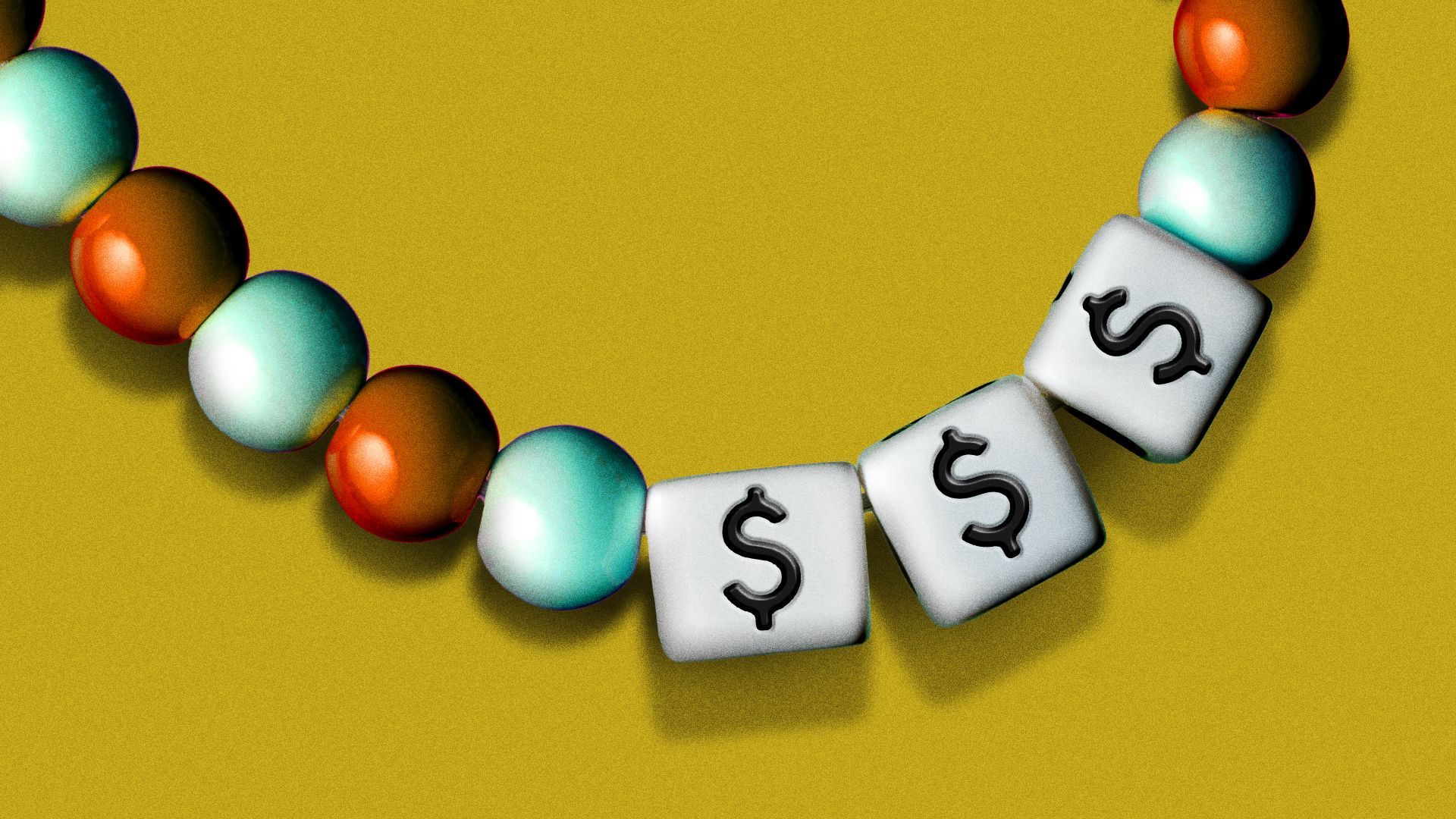
3. Teens spend big on my favorite brands from middle school

Self-reported teen spending was higher this spring than in 2024, according to a survey of thousands of teenagers released this month.
Why it matters: Teens help drive household spending choices, identify trends and put new brands on the map.
By the numbers: Teens self-reported $2,388 in annual spending this spring, marking a 6% increase from spring 2024 and 1% increase from the fall, according to the report.
- Beauty spending reached its highest point at $374, a 10% increase from the prior year.
State of play: Investment bank Piper Sandler surveyed more than 6,400 teens with an average age of 16 and found some top clothing and food retailers have shifted in recent years.
- Nike remained the top footwear brand, but interest from teen girls dropped to under 40% for the first time since 2020.
- Lululemon maintained its fall 2024 spot as the No. 3 upper-income female apparel brand, after years of ranking as No. 1. Hollister and Brandy Melville were the top two, respectively.
Between the lines: Gen Z prefers brands that will elicit nostalgia for those who were teens in the early 2000s.
- Handbag makers Coach and Kate Spade top the list, along with apparel brands American Eagle and UGG.
- Sephora, Ulta and Bath & Body Works are the top three beauty destinations for teens, the survey found.
- This is the first time Bath & Body Works has ranked in the top 10 since 2018.
Driving the news: 88% of teens own an iPhone, with many looking to social media shops and influencer marketing for fashion and beauty trends.
- Amazon, Nike and Shein remain the most shopped websites, while Uber dominates in ridesharing (76%) and DoorDash in food delivery (73%).
🥨 Eleanor's thought bubble: Just reading the list of these popular teen brands takes me back to my hometown mall (shout out Brookwood Village in Birmingham, Alabama). Is that Auntie Anne's I smell?
4. Communicator spotlight: Josh Machiz, partner at Redpoint Ventures

Josh Machiz leads the founder experience team at Redpoint Ventures, tasked with identifying marketing, content and storytelling opportunities for the firm and its portfolio companies.
- Why it matters: Redpoint — which has backed companies like Snowflake, Twilio, Stripe and Ramp — has embraced a content-first marketing strategy, with roughly 70,000 followers on Instagram and over 40,000 on TikTok.
📍How he got here: Machiz joined Redpoint from Nasdaq, where he helped develop its digital marketing strategy, most recently serving as chief digital officer.
- "I grew Nasdaq's social channels from literally zero to 3.5 million followers and then continued to ride every social media wave," he said. "I think that the exchanges hadn't really thought of marketing as an enablement for sales to win deals."
🔎 Zoom in: Machiz says he learned a lot while working with the Duolingo team on its IPO.
- "I learned how to think about your brand as an influencer and how important it is to create a face for your brand," he said.
Now, Machiz touts Redpoint's social media following and engaged audiences across audio and video platforms.
- "'The Logan Bartlett Show' is going to hit 50,000 YouTube subscribers, and has featured [interviews] with like every luminary you can you can think of, from Sam Altman to Marc Benioff, and our AI podcast, 'Unsupervised Learning' just reached 10,000 subscribers. We're really hitting our stride on the content front," he said.
🤖 Content plate: He recently binged the latest season of "Traitors" and threw a Traitors' themed birthday party last year, with the help of AI.
🧠 Best career advice: Go in with an "entrepreneurial lens."
- There are "possibilities for innovation everywhere, so don't be afraid to go in with an entrepreneurial lens, shake things up and build something that people can't live without."
Go deeper ... read his spotlight in its entirety.
5. 🥩 1 saucy thing
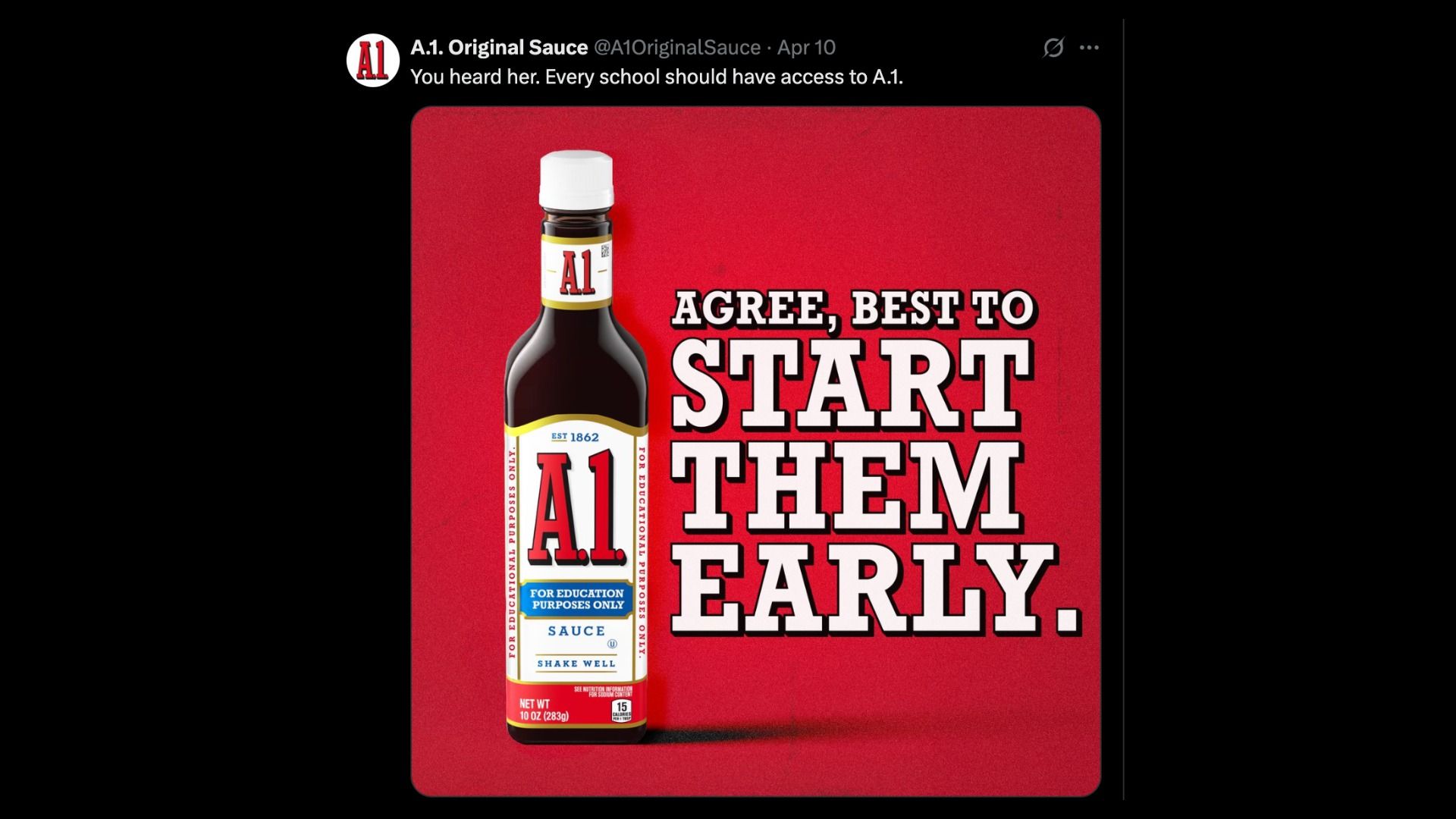
While speaking at an education summit last week, Secretary of Education Linda McMahon referred to artificial intelligence as "A1" several times. The steak sauce brand, owned by Kraft Heinz, capitalized on the moment.
- Why it matters: We haven't seen many brands engage with Trump administration officials in this way.
6. 🚀 1 meme to go
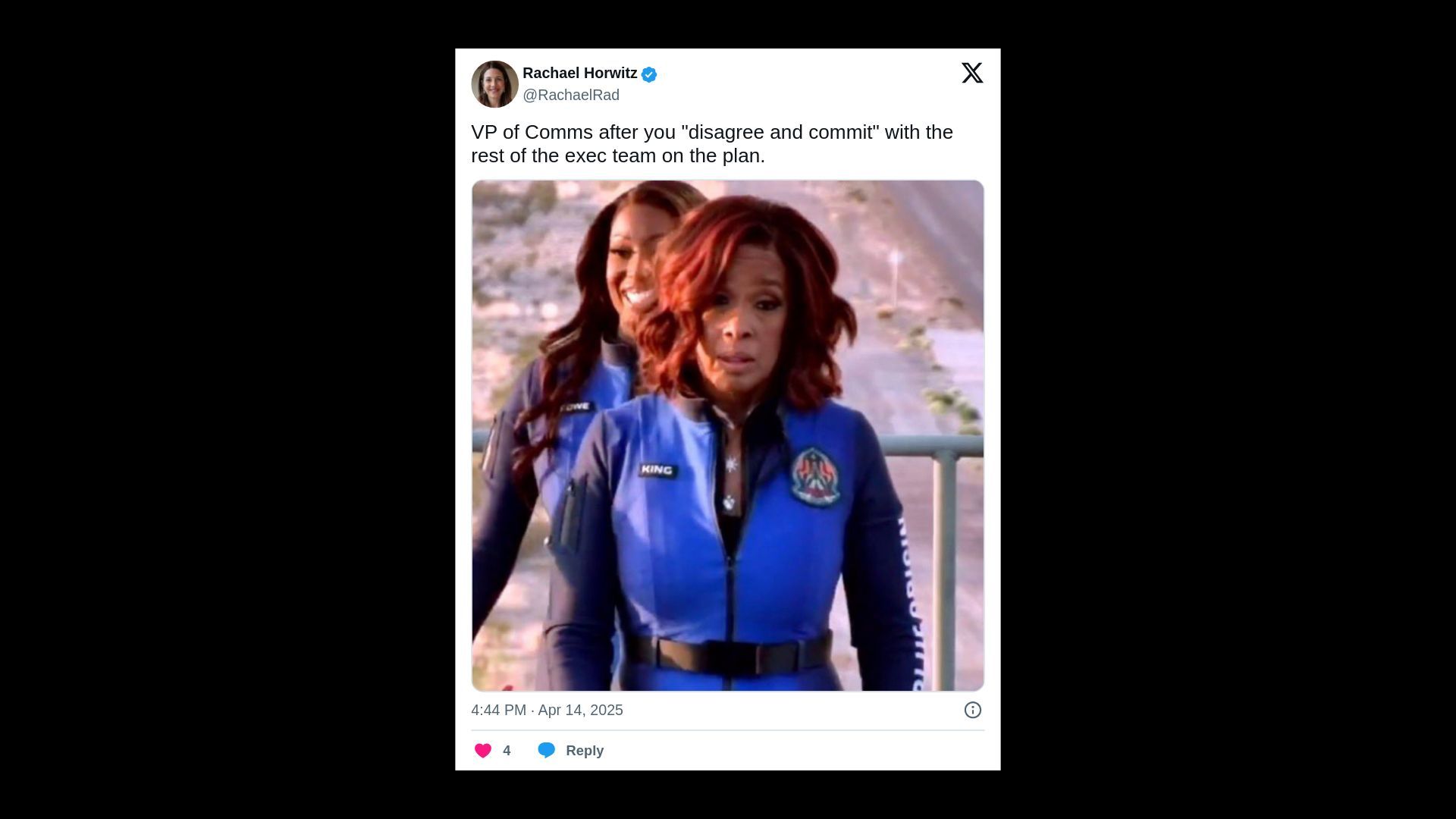
Anyone else watch live as Gayle King went to space? Anyone else see the onslaught of backlash that followed?
- Regardless of your views on space tourism and PR spectacles, I think we can all agree this post by Rachael Horwitz of Haun Ventures is perfect.
🙏🏻 Thanks to editors Christine Wang and Kathie Bozanich.
If you want more Axios Communicators content, become a Communicators Pro member.
Sign up for Axios Communicators


/2025/04/16/1744827478813.gif?w=3840)