Axios Communicators

November 20, 2025

1 big thing: Companies rethink ESG


U.S. companies are rethinking voluntary ESG reporting amid political pressures and shifting regulations.
Why it matters: What used to be key strategic narratives have fizzled out to check-the-box exercises for most.
The big picture: An ESG rebrand has been underway for years, with many opting for wording around sustainability, impact and belonging.
- A recent Teneo study found that "sustainability" is the most common keyword in report titles, while mentions of "impact" nearly doubled since 2023.
- Plus, fewer companies are setting forward-looking goals.
What they're saying: These reports are "contracting" and "becoming much more pragmatic and a lot less aspirational," says Lisa Boyd, co-head of governance and corporate stewardship practice at Joele Frank.
- "As part and parcel to pragmatism, you're going to see page count reduction. You're going to see more measured, balanced reporting. Gone are the days of big, aspirational goals."
- "The challenge is, how do you plan for the future and make reasonable choices and investments to be compliant with any regulations, but also continue to meet your stakeholders' expectations, especially investors, when so much is evolving or changing rapidly."
Case in point: The global regulatory environment is in flux, causing companies to reevaluate requirements in certain markets.
- Last week, the European Union voted to roll back its ESG reporting rules, and 90% of companies will no longer have to comply.
- California, meanwhile, is pushing to enforce a law that would require companies of a certain size to disclose carbon emissions and climate-related financial risks. As of this week, a federal appeals court has paused the law from taking effect.
Yes, but: Several U.S. companies that operate globally — including McDonald's, Mars Inc. and Amazon — are still producing lengthy impact reports.
- For the first time, Patagonia has produced a report tracking its progress toward its sustainability goals.
- In the report, Patagonia takes a very candid tone, stating, "Nothing we do is sustainable." In relation to goals like "ensuring 50% of synthetics fabrics are made from secondary waste," the company says it's "not even close."
Zoom in: Patagonia chief impact and communications officer Corley Kenna says it's about "just being honest" and avoiding the spin.
- "In our 52-year history, and three years since the ownership change, we've actually never produced a report like this," Kenna says.
- Its aim is to be transparent with employees, consumers and partners as to "where we're making progress, where we're not pleased with the progress that we're making, and where we feel pretty good."
- "For a long time, Patagonia viewed our commitments as our competitive edge," she adds. "We no longer feel that way. It's really necessary that other companies, not just Patagonia, pay more attention to the environmental issues that they create."
What to watch: AI is driving higher energy use, which will impact climate risks and ESG reporting.
- The technology will also affect how these commitments and disclosures are discovered.
- Corporate impact reports — similar to the resurgence of press releases — can serve as documents of record that can inform AI chatbots.
- "AI has scrubbed reports and other disclosures for years," says Boyd. "Companies must be cognizant of the use of technology to assess their disclosures."
2. Bonus chart: The investor angle
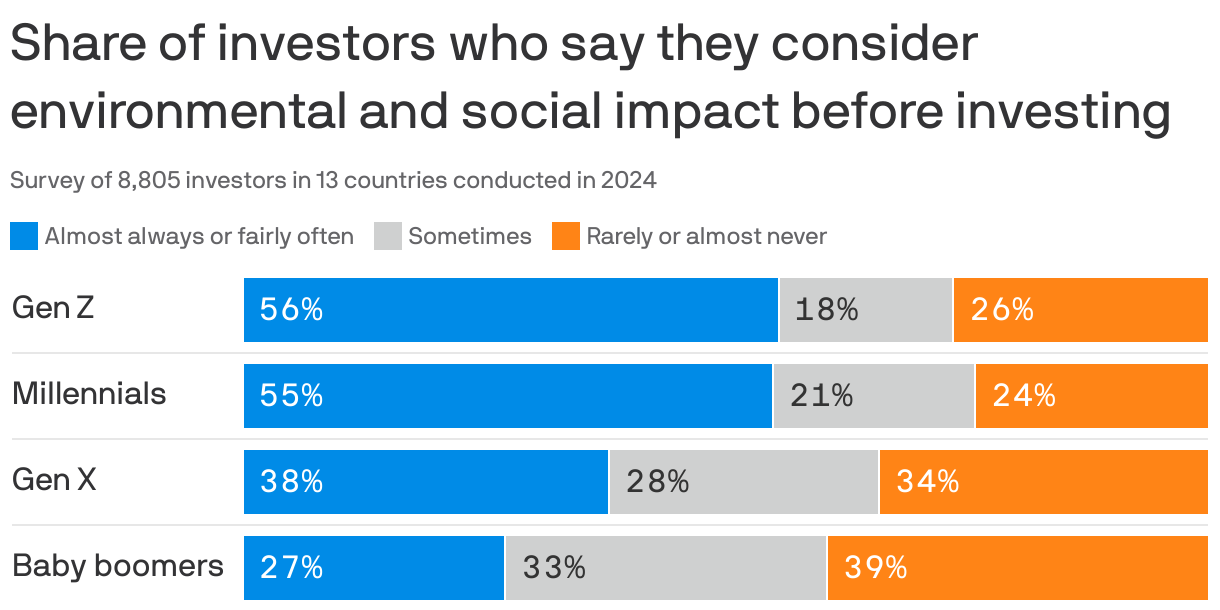
Environmental and social commitments remain an important factor for investors — particularly for Gen Zers and millennials, according to a recent World Economic Forum report.
- What they're saying: "While the policy landscape matters, businesses serve a much broader set of stakeholders whose expectations don't always fully align with political and regulatory shifts," says Courtney Urban, senior vice president of corporate reputation and brand purpose at We. Communications.
- "Communications should show how sustainability drives growth, supports company values and mitigates risk — because ESG has always been about protecting a company's long-term ability to operate and that hasn't changed."
3. Scoop: Anthropic promotes Sasha de Marigny to chief communications officer

4. ICYMI: WPP shares jump on takeover rumors




WPP saw its U.S.-listed shares soar as much as 13% on Monday after reports of takeover interest from smaller French agency Havas and private equity firms.
Why it matters: The rally underscores investors' eagerness for a shake-up after WPP's shares have declined 60% this year amid weak client spending and rising competition.
- Last year's merger of IPG and Omnicom has put pressure on WPP and its rivals to scale their offerings with data and AI-driven solutions.
Zoom in: The Times of London reported over the weekend that Havas has held talks about a potential deal with WPP, possibly buying its media arm or acquiring a stake in the company.
- The Times also cited Apollo Global Management and KKR as potential suitors.
The other side: Havas CEO Yannick Bolloré denied any talks, saying in a staff memo the company is "not in discussions with WPP," per Bloomberg.
- Apollo pointed Axios to a comment it provided to the Sunday Times that it is "neither in discussions with nor considering a bid for WPP." KKR said, "The reports on KKR are untrue."
- WPP did not comment. Havas did not respond to Axios' request for comment.
The big picture: WPP has struggled as traditional agency economics have become unreliable.
- While Publicis and Omnicom posted positive organic growth rates in the third quarter, WPP fell 5.9%. IPG saw a slight decline in organic revenue growth but improved over the last two quarters.
What to watch: Newly appointed CEO Cindy Rose, a former Microsoft executive, called WPP's recent results "unacceptable" in her first earnings call last month.
5. Mentor spotlight: John Onoda of iQ360


🌳 We're back with the mentorship series, in which we highlight communication leaders who have intentionally invested in the future of the profession.
- We jump-started this series with Jane Hynes of Google, and in the latest edition, we spotlight John Onoda, principal at iQ360.
Why it matters: Known as the "Yoda of PR," Onoda has a reputation for building careers and elevating the comms function.
Catch up quick: Over his 40-year career, Onoda has led communications at General Motors, Levi Strauss, Charles Schwab and Visa USA.
- He also managed global media relations at McDonald's and external communications for Holiday Inns and Harrah's Casinos.
- Now, Onoda serves as a principal at strategic consulting firm iQ360.
Here are key ways Onoda builds talent, according to his mentees:
- Be businesspeople first, with an expertise in communications.
- "He was the one who taught me to understand the business, follow the money, and be able to speak in business language," says Donna Uchida, former chief communications officer at Kaiser Permanente and C-suite strategist.
- "From then on, I wasn't seen as a communicator, per se, but as somebody who was a business leader, who happened to bring communications to the table," she says.
- Reinvention is a requirement if you hope to be viewed as a trusted advisor.
- "One of the things he said to me was, every year you should let go of 20% of what you do and learn 20% of something new," says Dave Samson, former chief communications officer at Levi Strauss and Chevron.
- "The 20% that you give up doesn't necessarily go away, but it becomes opportunity for somebody else on your team. If you do that, every five years, you're going to be completely reinventing yourself," he adds.
- Remember what matters. Onoda has a reputation for "guiding the whole person, not just the professional," says Suzanne Skyvara, former head of communications and marketing for Goodreads.
- "He defined a lot of people's careers, including mine," says Samson. "But he never let his career define him. He was always defined by things outside the workplace — namely his family."
What they're saying: Communicators can't solely focus on press releases or product launches, because that's not what's discussed at the board level or in the C-suite, says Onoda.
- "The mindset must be: What is the greatest value we make to the enterprise based on its strategic goals? And what are the business levers for achieving those goals?"
🧠 Best advice from Onoda: Pass it on.
- "I want to help anyone who comes across, but I'm especially gratified when I see that I've touched generous spirits who are, in turn, trying to pass it on," he said.
Go deeper ... read this spotlight in its entirety.
6. 🍿 1 media relations thing to go
Axios Communicators