Companies rethink voluntary ESG reporting amid political pressures

Add Axios as your preferred source to
see more of our stories on Google.


U.S. companies are rethinking voluntary ESG reporting amid political pressures and shifting regulations.
Why it matters: What used to be key strategic narratives have fizzled out to check-the-box exercises for most.
The big picture: An ESG rebrand has been underway for years, with many opting for wording around sustainability, impact and belonging.
- A recent Teneo study found that "sustainability" is the most common keyword in report titles, while the mentions of "impact" nearly doubled since 2023.
- Plus, fewer companies are setting forward-looking goals.
What they're saying: These reports are "contracting" and "becoming much more pragmatic and a lot less aspirational," says Lisa Boyd, co-head of governance and corporate stewardship practice at Joele Frank.
- "As part and parcel to pragmatism, you're going to see page count reduction. You're going to see more measured, balanced reporting. Gone are the days of big, aspirational goals."
- "The challenge is, how do you plan for the future and make reasonable choices and investments to be compliant with any regulations, but also continue to meet your stakeholders' expectations, especially investors, when so much is evolving or changing rapidly."
Case in point: The global regulatory environment is in flux, causing companies to reevaluate requirements in certain markets.
- Last week, the European Union voted to roll back its ESG reporting rules, and 90% of companies will no longer have to comply.
- California, meanwhile, is pushing to enforce a law that would require companies of a certain size to disclose carbon emissions and climate-related financial risks. As of this week, a federal appeals court has paused the law from taking effect.
Yes, but: Several U.S. companies that operate globally — including McDonald's, Mars Inc. and Amazon — are still producing lengthy impact reports.
- For the first time, Patagonia has produced a report tracking its progress toward its sustainability goals.
- In the report, Patagonia takes a very candid tone, stating, "Nothing we do is sustainable." In relation to goals like "ensuring 50% of synthetics fabrics are made from secondary waste," the company says it's "not even close."
Zoom in: Patagonia chief impact and communications officer Corley Kenna says it's about "just being honest" and avoiding the spin.
- "In our 52-year history, and three years since the ownership change, we've actually never produced a report like this," Kenna says.
- Its aim is to be transparent with employees, consumers and partners as to "where we're making progress, where we're not pleased with the progress that we're making, and where we feel pretty good."
- "For a long time, Patagonia viewed our commitments as our competitive edge," she adds. "We no longer feel that way. It's really necessary that other companies, not just Patagonia, pay more attention to the environmental issues that they create."
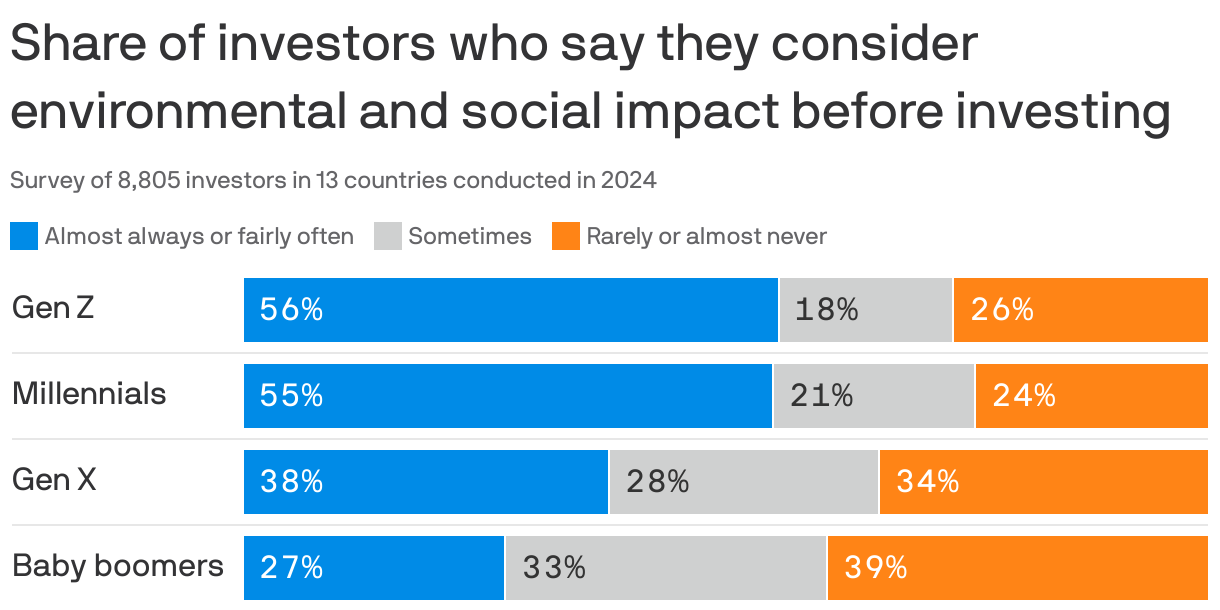
Plus, environmental and social commitments remain an important factor for investors — specifically Gen Z and millennials, according to a recent World Economic Forum report.
- "While the policy landscape matters, businesses serve a much broader set of stakeholders whose expectations don't always fully align with political and regulatory shifts," says Courtney Urban, senior vice president of corporate reputation and brand purpose at We. Communications.
- "Communications should show how sustainability drives growth, supports company values, and mitigates risk—because ESG has always been about protecting a company's long-term ability to operate and that hasn't changed," she adds.
What to watch: AI is driving higher energy use, which will impact climate risks and ESG reporting.
- The technology will also affect how these commitments and disclosures are discovered.
- Corporate impact reports — similar to the resurgence of press releases — can serve as documents of record that can inform AI chatbots.
- "AI has scrubbed reports and other disclosures for years," says Boyd. "Companies must be cognizant of the use of technology to assess their disclosures."
More on Axios:
