Axios Communicators

June 26, 2025

🦞 Greetings from Maine, where I am spending time with family and friends ahead of the July Fourth holiday. Speaking of which …
- 🗓️ The newsletter will go dark for the next two weeks, returning July 17.
- 📇 This means we will share July's Monthly Moves newsletter tomorrow. Submit your moves here.
Today's newsletter, edited by Christine Wang and Brad Bonhall, is 1,865 words, 7 minutes.
1 big thing: Battle for the brand
There's a push-pull between creating cultural relevance and avoiding corporate risk, and that tension was on display last week at Cannes Lions.
Why it matters: Those two concepts are often at odds and add to the strained relations between marketing and communications.
State of play: Throughout the week, I was having two very different conversations with communicators and marketers.
- While CMOs were focused on grabbing attention with creative — and expensive — partnerships, CCOs were talking about staying under the radar to avoid stakeholder backlash and potential reputational exposure.
- In short, CMOs want breakthrough, while CCOs want cover.
By the numbers: CEOs, for the most part, seem to be more aligned with the CCO train of thought.
- A new McKinsey & Co. study found that marketing and other parts of the business are increasingly disconnected, and only 31% of CMOs believe their CEOs are comfortable with modern marketing strategies.
- CMOs are also losing ground at the decision-making table. Forrester Research found that only 63% of Fortune 500 companies have a marketing leader who sits on the leadership team and reports directly to the CEO.
- Meanwhile, the number of CMOs at Fortune 500 companies is down from 71% in 2023 to 66% in 2024, per Spencer Stuart.
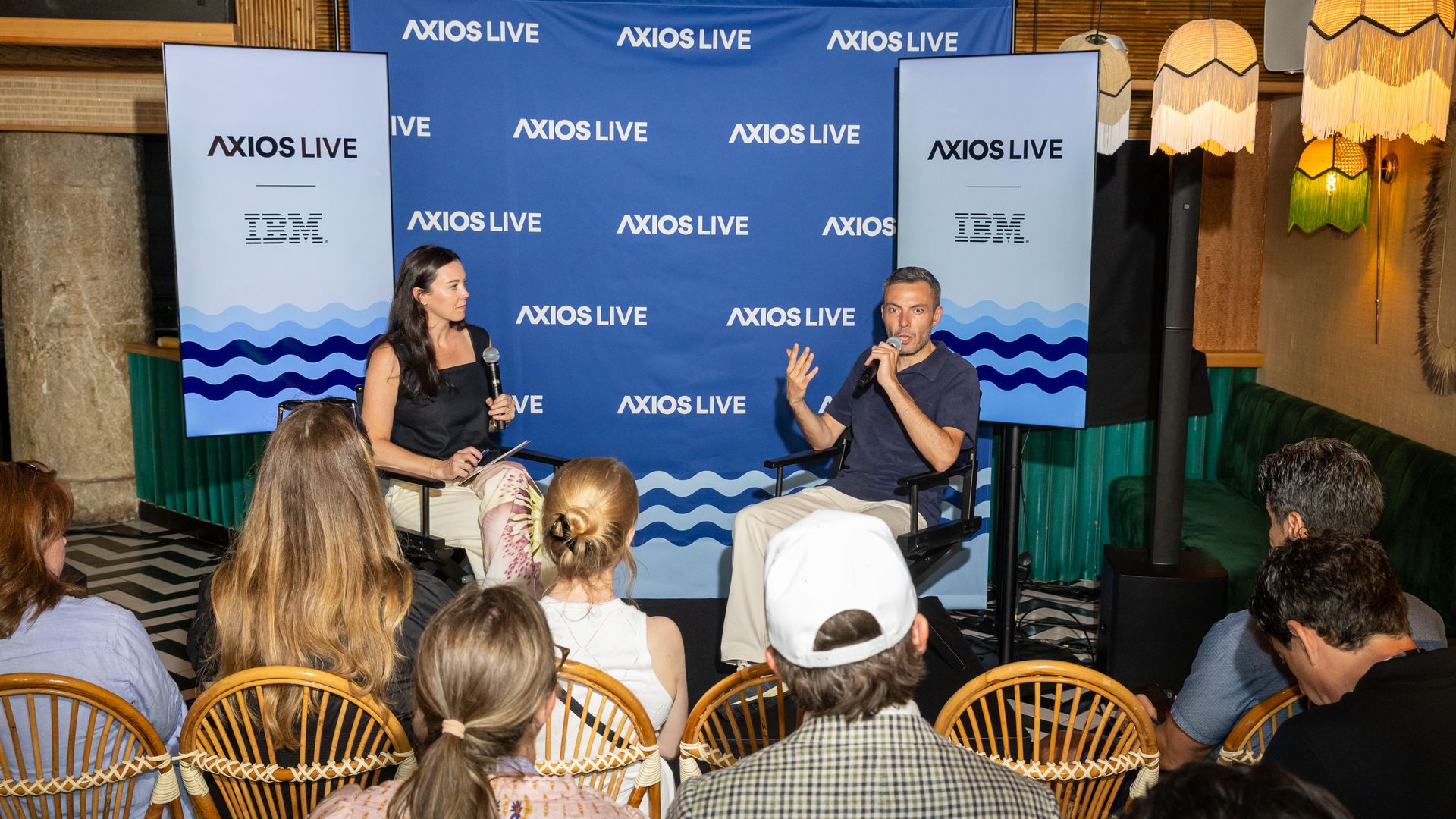
What they're saying: Heightened political polarization, economic instability, AI advancements and cultural tension have made this moment more complex than ever, Weber Shandwick global president Jim O'Leary said at an Axios event in Cannes.
- It's the battle between "cultural relevancy and cultural resilience," he said. "And I think that it's been a challenge for some companies to navigate that complexity."
- But it has led to brands being more purposeful and less performative, by tying their brand campaigns to action or back to the business, as opposed to just capitalizing on a marketing moment, he added.
Between the lines: At the heart of it, communicators and corporate affairs professionals are wary that one shallow marketing campaign could do years of reputational harm.
- Look no further than Bud Light and Target, which were still top of mind for many in attendance last week.
- "I think that for a long time, people were convinced that trust was the only thing that really mattered with reputation, that it was almost a binary — are you trusted or not trusted? And of course, for anyone sitting inside of a company or a brand, you know that there are a multitude of levers that make up reputation," said Burson global CEO Corey duBrowa.
- "It's not just what you say, it's what you do, and how that ties to values," he added.
What to watch: The shifting organizational structures of communication and marketing teams, and which function truly owns "brand."
- "What's exciting about this moment as communicators is we're finally seeing a true opportunity to try to integrate brand strategy with reputation strategy, with marketing and anything that is more enterprise-wide strategy," said Chris Foster, CEO of Omnicom Public Relations Group.
Case in point … 👇🏻
2. FTC OKs Omnicom and IPG merger with an unusual condition


The Federal Trade Commission said Monday it will approve Omnicom Group's $13.5 billion acquisition of rival The Interpublic Group, but only if the agencies agree they won't bar ads based on politics.
Why it matters: A consent order that addresses the possibility of political collusion is rare and speaks to the hyperpolitical climate facing the business community.
- The merger between Omnicom and IPG would create the largest global ad agency holding group by revenue. The deal is still pending approval from regulators in the U.K.
Zoom in: The proposed consent order imposes restrictions "that prevent Omnicom from engaging in collusion or coordination to direct advertising away from media publishers based on the publishers' political or ideological viewpoints," per the FTC.
- It also prohibits agencies from accepting requests to direct advertising spend to a certain media publisher "based on political or ideological viewpoints or political content."
- Agencies are also prohibited from declining to do business with an advertiser based on its political or ideological viewpoints.
Reality check: Regulators rarely put in place merger provisions that specifically bar this type of coordination, but political pressure around allegations of ad groups penalizing conservatives has gained steam.
3. The "no marketing" advantage
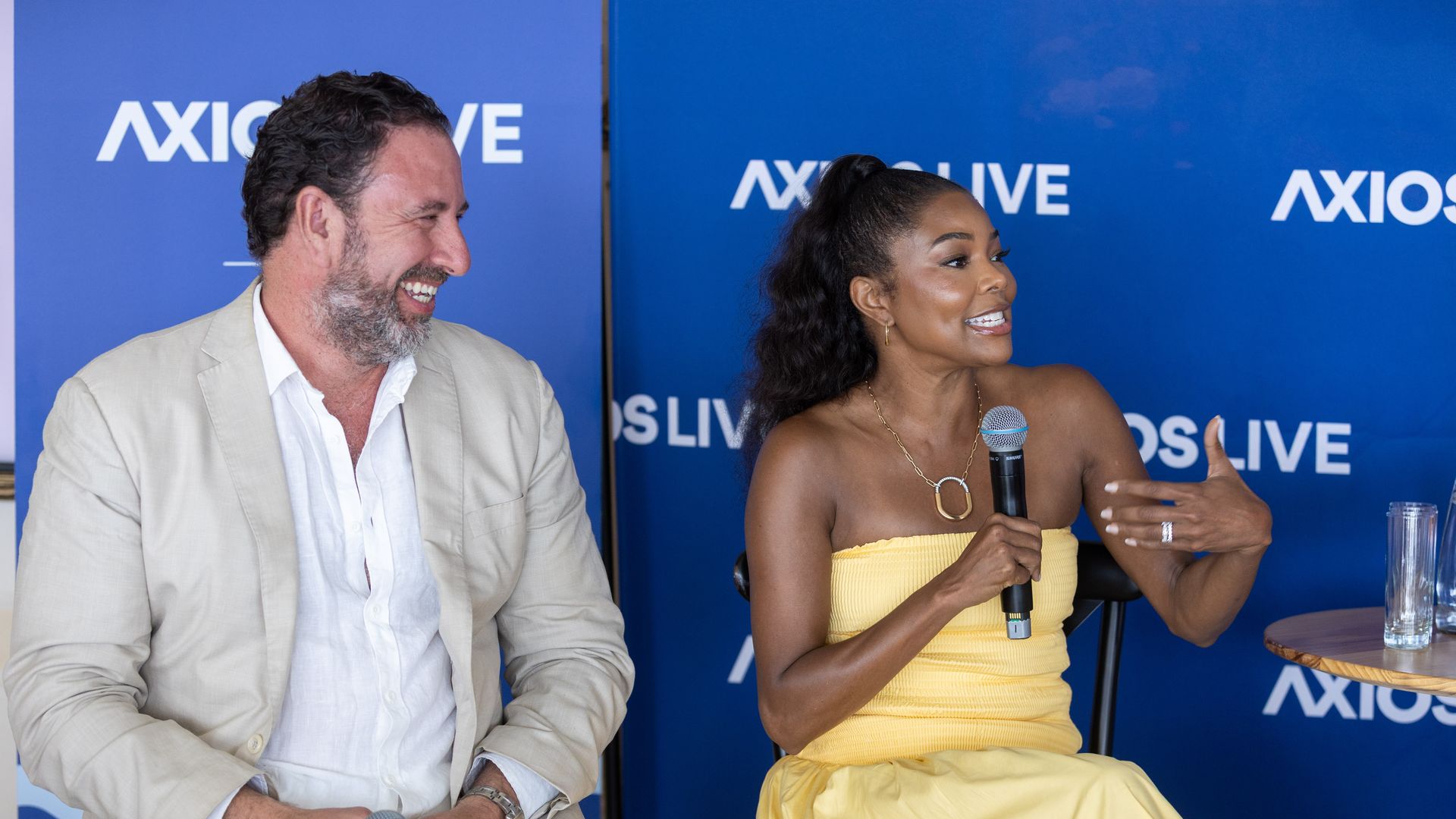
From Beast Industries to Bravo to the "Bring It On" fandom, celebrity and creator-led brands are cash cows.
Why it matters: Many of them attribute the lack of marketing spend as a reason for their business success.
Driving the news: In a conversation with Axios alongside Cannes Lions, Beast Industries CEO Jeffrey Housenbold said he was working with Jimmy Donaldson to build the "Gen Z and Gen Alpha version of Disney, a diversified media and entertainment, consumer products and services company" with an IPO on the horizon.
- Understanding how to tap into virality is a major advantage, says Housenbold.
- "We create endemic, intrinsic, contextually relevant ads, and we build a platform that's bounded by data," he said.
- "We look at over 800 million data points a day. We know what's going viral. We know how to engineer virality across all the social platforms.… Our lifetime value to customer acquisition ratios are so different than the industry because we don't have to spend very much money on marketing, which allows us to plow our profits back into innovation, into lower price, into faster distribution, into collabs and new flavors," he added.
Zoom in: Loverboy, the spirits brand founded by Bravo star Kyle Cooke, benefits from a similar playbook, he told Axios.
- "We've grossed over $50 million having not spent $1 on [marketing]. When you think about what brands, particularly in alcohol, spend, one of the biggest line budgets is advertising, and so to kind of think about things differently and launch brands digitally first, or in collaboration with someone who has a platform, it's kind of a game changer."
- Amanda Batula said her self-named swim line also spent very little on marketing given that the concept for the product was launched on the Bravo show "Summer House."
- "Everyone was highly anticipating this [swimwear launch]. Our third drop just sold out, which is what you hope for. We had to up our orders because everything sold out so fast the first time," she said.
Yes, but: For these ventures and brand partnerships to be successful, Housenbold, Gabrielle Union, Cooke and Batula all say authenticity is key.
- "I wanted to build a brand that actually reflected my morals, my values, and that contributes to my peace," Union told Axios alongside Cannes Lions.
- "For me, corporate values are huge. I do background checks on everybody. I'm not going to sign up for something because you've given me the whole song and dance. I need to know who's running the show. I look at board of directors. I look at the company makeup.… You have to walk it like you talk it," she added.
- Plus, it's about knowing who your audience is and activating them, said Hiltzik Strategies CEO Matthew Hiltzik.
By the numbers: 4 in 10 say they are "die-hard" or "avid" fans of celebrities or influencers, according to a recent Morning Consult survey.
- Roughly half of those surveyed say they are willing to make purchases based on the recommendations or involvement of their favorite public figures.
- And Gen Z and millennial consumers are the most likely to vote with their wallet.
What to watch: The talent to content to commerce business model is one that more public figures are looking to tap into — and Peter Micelli said he launched management company Range Media Partners to solve for this.
- "For us, it was how do we restore equity positions and opportunities for talented people that have community and the trust of audiences? And the data we look at is that celebrities that are authentic can have more impact on moving community than the corporation does. So as we're doing content plays, we're also looking at the broader business plays and how to build communities who are eager to be consumers," he said.
Go deeper … watch the conversations here
4. The face of the corporate brand

Companies that don't have the appetite or budget for flashy partnerships or famous spokespeople are relying on internal voices — including senior leadership — to uplift brand awareness.
Why it matters: The personal brands of CEOs and founders are just as important as the company's brand itself, potentially creating a halo effect or casting a dark cloud.
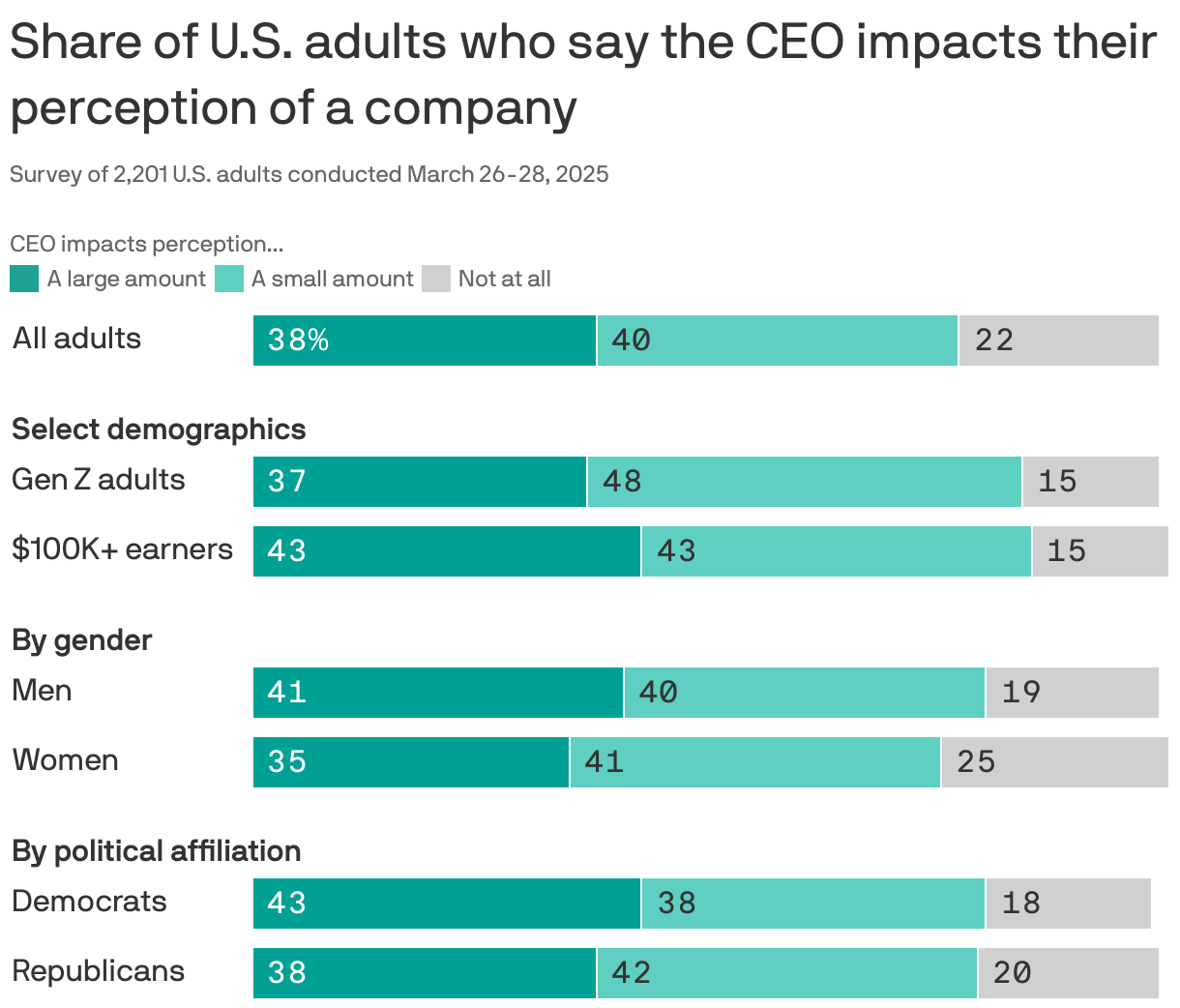
By the numbers: A plurality of Americans think CEOs need a public persona and companies with strong employer brands outperform their competition, per Morning Consult.
- Roughly 8 in 10 U.S. adults said a company's CEO impacts their perception of that company, according to the survey.
- Democrats' view of a company or brand is most likely to be swayed by their opinion of the CEO.
- 30% of those surveyed say they have purchased more from a brand or company because its CEO did something they liked. Meanwhile, slightly more (32%) have boycotted a company because of its CEO.
- 70% of Gen Z want to hear from CEOs across social media, while 55% say they'd listen to CEO interviews on podcasts.
Go deeper … View the entire report, plus receive additional insights by becoming an Axios Communicators Pro member.
5. ICYMI: X hires its third comms lead in less than a year
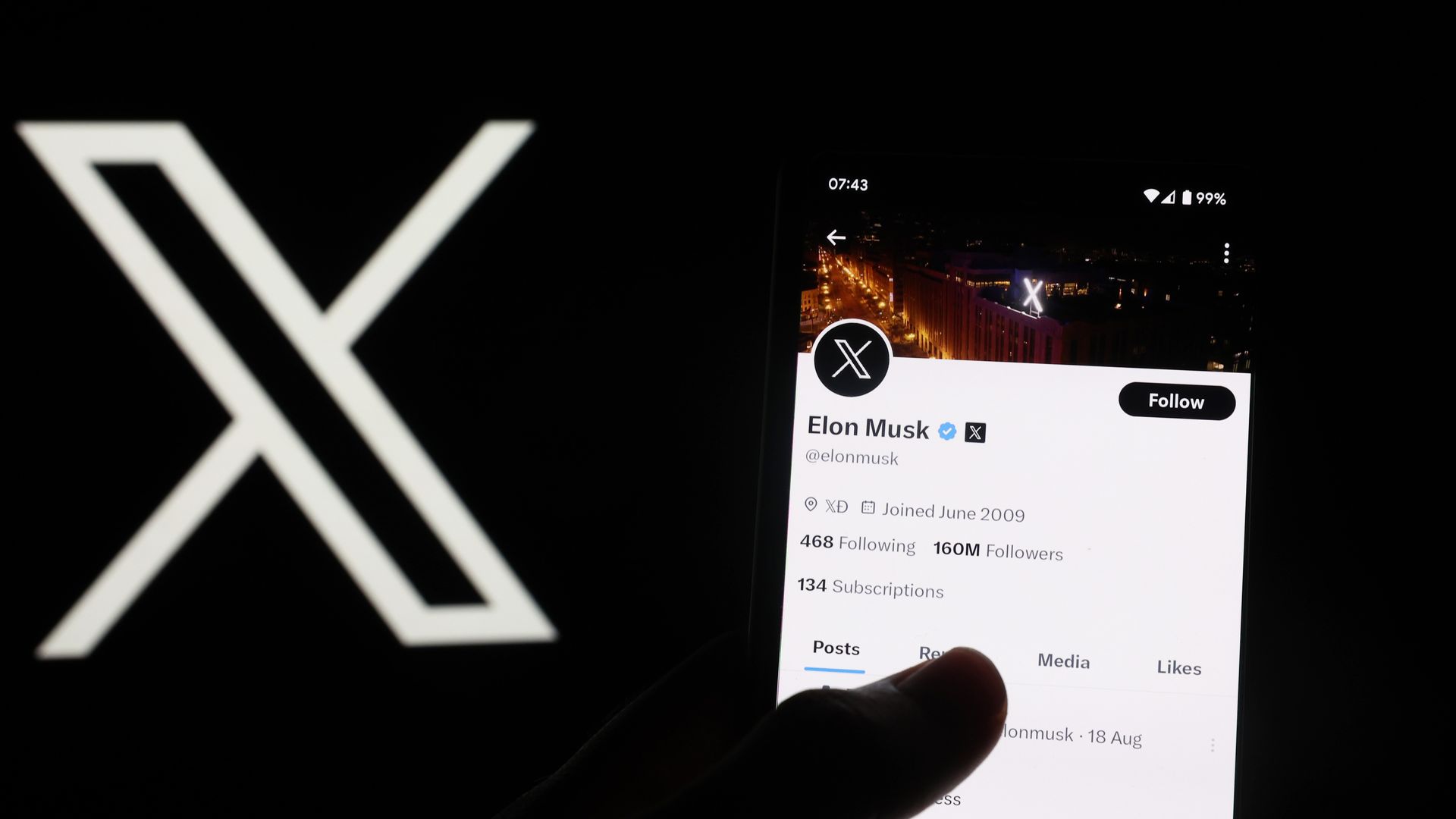
Elon Musk's X has brought on a new head of U.S. public relations, its third in less than a year, Axios has learned.
- Why it matters: Both Musk and CEO Linda Yaccarino continue to downplay the value of traditional media and public relations.
Driving the news: X has hired Rosemarie Esposito as senior manager, media strategy for the Americas and Victoria Gillespie as director, media strategy for EMEA/MENA/Africa.
Between the lines: The social media platform continues to have a strained relationship with the media and advertisers.
- At an Axios event in Cannes, Yaccarino repeatedly dismissed a Wall Street Journal report that X was threatening to sue advertisers if they didn't buy ads on the platform.
- When Axios' Sara Fischer asked Yaccarino about this, she replied by slamming the WSJ, saying "Does anyone still read that publication?"
- "I saw on the beach that they were giving it away for free this morning. So that probably says something," she added.
Details: Esposito joins X from Blue Origin, where she served three years as senior public relations manager. She held previous roles at Medidata, IBM, and Hotwire PR.
- Gillespie is the first communications hire outside of the U.S. since Musk gutted the function shortly after taking ownership. She previously led communications for Snap in the U.K. and supported corporate communications at Channel 4.
The intrigue: Esposito has not actively posted to her X account since 2023, while Gillespie has not posted on the platform since 2021 — before Musk's takeover.
6. 🦉 1 quote to go
"There's an understanding and a belief, by myself and the rest of the C suite, that in order to build a strong brand, you need a brand that breaks the mold, that is memorable, that brings something more unique, that is not what every other brand is doing. So we really try to take risks, because we want to stand out.… We have to understand our ability to produce creative work that is close to the line now, but not over the line."— Manu Orssaud, Duolingo chief marketing officer, at the Axios event in Cannes
Thanks for reading. Want more communicators content? Become an Axios Communicators Pro member.
Sign up for Axios Communicators