Axios Communicators

September 05, 2024

🏈 Happy fall and football season to those who celebrate!
- 🌎 Will you be in NYC for Climate Week and the UN General Assembly? Join us for a Communicators reception on Sept. 22 at the Axios House.
- 🚨Last chance to share your job news before Monthly Moves hits inboxes tomorrow.
Today's newsletter is 1,570 words, a 6-minute read.
1 big thing: Battling the bots
Due to a rise in bots — automated programs that simulate human engagement online — social media chatter is becoming less of a bellwether for public perception or stakeholder sentiment.
Why it matters: Knowing how and when to respond to misinformation or bot activity is now well within a communicator's job description.
- When advising executives and clients, communicators must be able to provide context on the actual sphere of influence these seemingly "viral" posts have.
Driving the news: Conservative activist Robby Starbuck has gained notoriety for his social media posts challenging the DEI policies of several big American brands — and companies like Tractor Supply, John Deere and Harley-Davidson have buckled in response.
- Meanwhile, others like Molson Coors, Lowe's and Ford have recently walked back their commitments to DEI too.
Yes, but: When you examine the engagement around these socially divisive posts, you'll find that much of the volume has been generated by social media bots, say experts from public relations and marketing firm Jackson Spalding.
By the numbers: The policy reversals of Tractor Supply, John Deere and Harley-Davidson saw 77% more media mentions and roughly 40% more social media interactions than Starbuck's initial anti-DEI campaigns, according to Newswhip data shared with Axios.
- That's because bot activity is not driven by organic posts, but rather re-posts or likes, says Justin Williams, digital and analytics discipline lead at Jackson Spalding.
- "If your first assumption is that tens of thousands of people know about this issue and have paid attention to it, then you would expect that when news comes out [about the policy change], it would actually cool things off — but the reverse occurred," he said.
- "There were fewer humans [who] were actually paying attention at that moment, but as soon as national media picked it up, it broadened the audience and diversified the number of people who were creating original content about it."
What they're saying: "Bots are used to manipulate public opinion by rigging the virality algorithm," says Guy Tytunovich, CEO of cybersecurity platform CHEQ.
- The bots are designed to trick the algorithm into "thinking" that certain posts are reliable, relevant and interesting enough to show to more people, making them appear more organically viral, he says.
- Because of this, bots can cause major divisions and threaten democracy, adds Tytunovich.
State of play: Bot activity should be expected around any potentially polarizing issue, says Williams.
- "When bots are engaged, they're basically making a Super Bowl-like event out of things that are not," says Williams. "So it's important to understand that volume does not always equal depth."
Zoom in: The PR industry is partly to blame for the outsized value placed on social media volume, says Scott Sayres, head of reputation and issues management at Jackson Spalding.
- "In the early days of social media, the very first thing we looked at was how many mentions do you have or what's your volume traffic?" Sayres says. "Now we're having to break that cycle and re-educate everybody."
- Instead, understanding the social media chatter's sphere of influence — particularly how it might be reaching your targeted audiences or key stakeholder groups — should help inform the response.
Reality check: The rising popularity and access to generative artificial intelligence is likely to increase this bot activity.
- Meanwhile, tracking and understanding virality is becoming more difficult, as platforms withhold data to avoid scrutiny over how their algorithms work.
What to watch: Some companies could see this situation as an opportunity to backtrack on social commitments that leadership might view as risky.
- "While an activist had early success in causing major U.S. brands to walk away from their employees and DEI commitments, what we are now witnessing is more likely legal and executive teams using the air cover to end these programs before the Supreme Court's affirmative action ruling begins a wave of litigation in the corporate setting,"says Mike Clement, managing director and founder of Strait Insights.
- "Current leaders and boards are making the tradeoff that litigation risk is more damaging than reputational risk and employee impact."
2. Bonus chart: Falsehoods on social media


Misinformation abounds across social media — and every crisis communications playbook should have a strategy for assessing and addressing it.
- Yes, but: Roughly 30% of businesses don't have formal crisis response plans and 23% have no plan at all, a recent Capterra survey found.
- Of the business leaders who have witnessed a crisis, 84% say they would increase crisis planning and 72% would broaden the scope of their communications plan.
Go deeper ... Crisis management for the digital age
3. Employees prioritize pay and upskilling
Employees are more concerned with pay and upskilling than in the past, according to Edelman's 2024 Trust at Work report.
Why it matters: Economic jitters are causing more division between senior executives and the broader employee base.
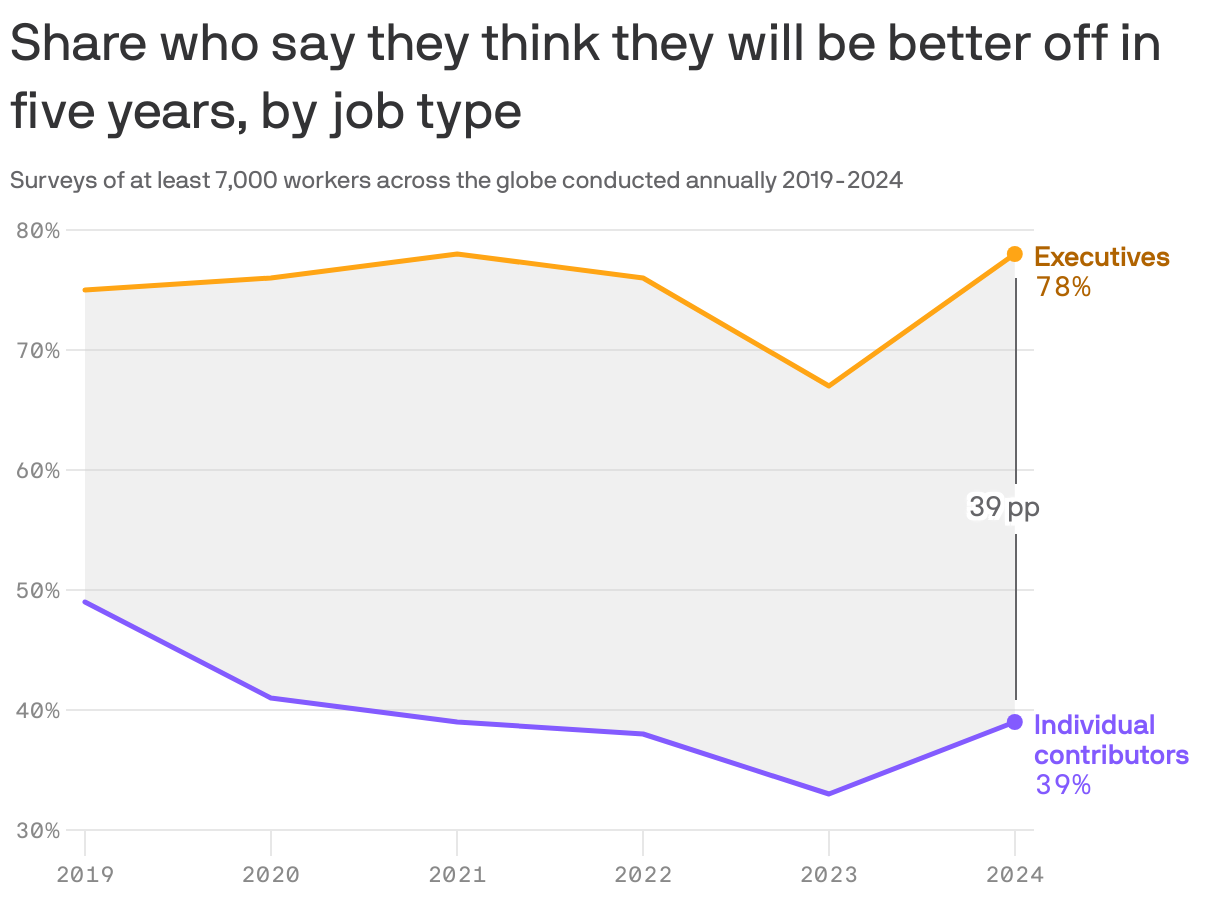
By the numbers: In a survey of 7,999 adults from July 19–25, Edelman found the economic optimism gap between executives and associate-level, individual contributors continues to worsen.
- 78% of executives are optimistic about the next five years, while only 39% of individual contributors agree.
- This gap has widened in recent years — from 26 percentage points in 2019 to 39 points now.
The big picture: Americans are struggling to pay for everyday expenses given rising costs, according to the U.S. Census Bureau.
- Plus, the steady drip of layoff news paired with labor battles and AI's unrealized impact on the workforce is causing employees to stress about job security.
Zoom in: For these reasons, sustainable employment is a top priority for job seekers, the Edelman report found.
- Roughly 9 in 10 of those surveyed expect employers to provide wages that keep up with the cost of living, while 82% say upskilling and training are also necessities.
Zoom out: Concerns over job growth have also caused a trust chasm between executives and associates.
- Associates are 2.5 times less likely to trust their CEO than those in more senior roles and are more inclined than executives to trust their coworkers.
Yes, but: "My employer" still remains the most trusted source for information, according to the report.
- Employees are 16% more likely to trust news and information shared by their employer than they are the media or national government.
What to watch: AI's looming presence is a driving factor in shifting employee mentality, says Edelman CEO Richard Edelman.
- "AI is the next globalization, meaning it's not that jobs are going to go to India, it's that jobs are going to go to machines," he said.
4. Communicator spotlight: Khobi Brooklyn of Hims & Hers

As chief communications officer of Hims & Hers, Khobi Brooklyn is tasked with building the telehealth company's brand in a crowded — and highly regulated — space.
- Why it matters: She has a track record of helping new, innovative companies within antiquated industries break through.
🗣️What she's saying: "Health care needs to change," she told Axios. "We need to focus it more on the customer and articulating that vision and creating a path for that change takes incredible focus, prioritization and creativity."
📍How she got here: Brooklyn got her start working at a PR agency before taking an in-house communications role at Tesla in 2009.
- She then joined the team at Square, overseeing product comms and brand marketing before rejoining Tesla as head of global communications in 2015.
- Brooklyn also held executive comms roles at Nike and autonomous vehicle company Aurora before joining Hims & Hers in 2023.
🏗️ How it's structured: Brooklyn reports to Hims & Hers co-founder and CEO Andrew Dudum. She oversees a team of 17 responsible for external and internal communications, as well as government relations and policy.
💡Every CEO should know that communications is not something you just slap on at the end of a project.
👟Who she's watching: The comms team at Nike and its "ability to tell incredibly engaging, compelling stories that have established an incredible connection to its consumers."
🧠 Best advice: Advocate for yourself.
Share this story and nominate a top communicator for a spotlight.
5. 1 job thing to-go: Nikki Haley joins Edelman

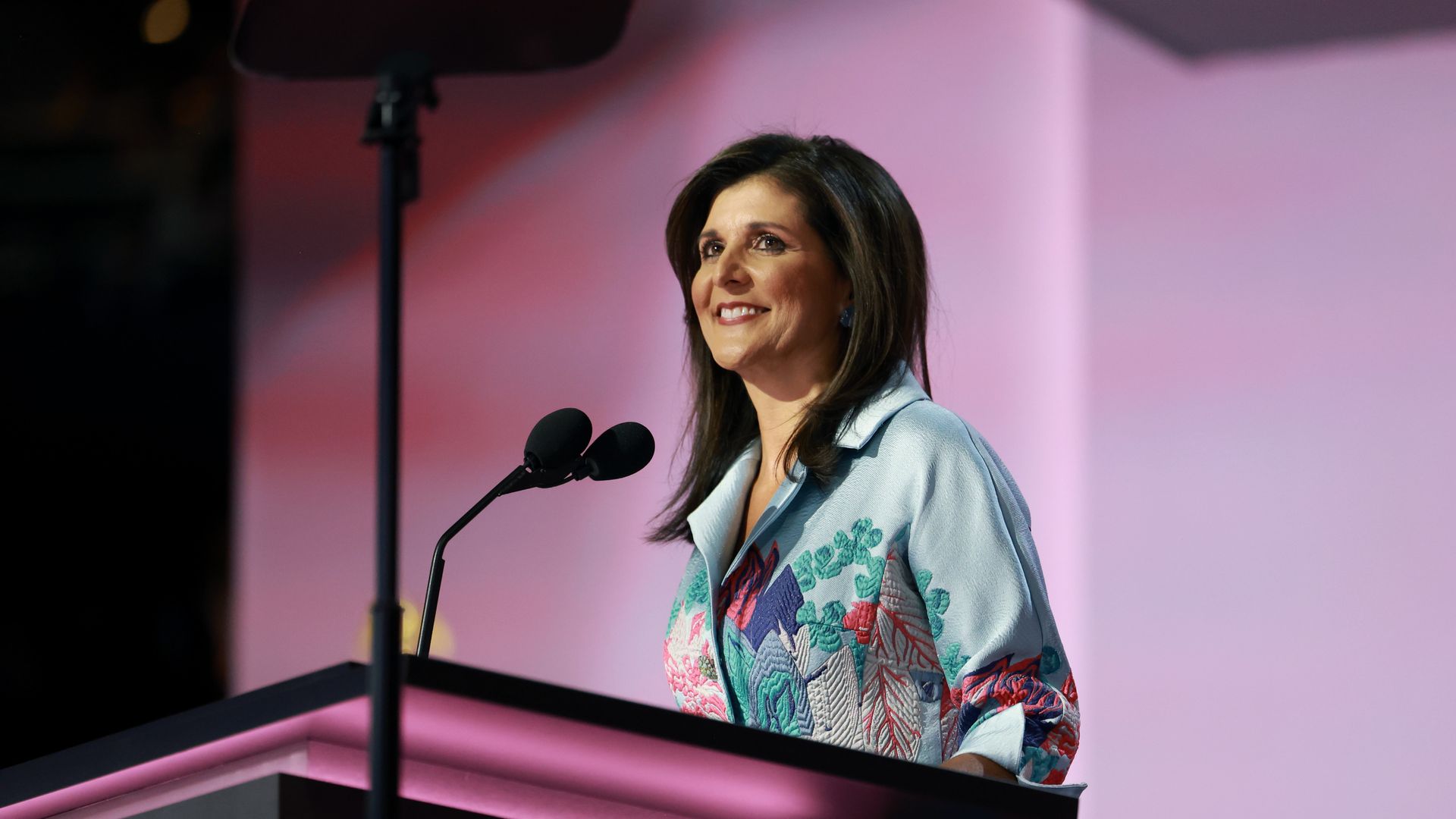
Former Republican presidential candidate and United Nations ambassador Nikki Haley will join Edelman as a vice chair within its public affairs practice.
Why it matters: It's a surprising move for a once-rumored vice presidential contender and someone who Trump said would be on his team "in some form" should he win the election.
The intrigue: Even though Haley endorsed Trump after the assassination attempt in July, this move signals Haley is pursuing other options.
- Edelman would not say whether this role precludes her from participating in political activities ahead of the election.
- The Trump campaign did not immediately respond to a request for comment.
What they're saying: Haley acknowledged in a statement that corporate reputation, business and politics have become more entangled.
- "In a time of growing complexities in business, policy, and politics — brands need to anticipate what's coming next. Whether managing a crisis or celebrating a success, industry leaders must be ready to communicate clearly and share their vision forward," she said.
The big picture: Communication and CEO advisories have long hired former diplomats, political strategists and government employees to help clients navigate global and regulatory issues.
- Now, corporations need help managing hyper politicized initiatives like diversity, equity and inclusion and sustainability.
What to watch: As the 2024 elections near and polls continue to fluctuate, advisory firms might begin to tap former Republican operatives to give them an advantage should there be a shift in power in Washington.
✅ That's all for today! Thanks to editors Nicholas Johnston and Kathie Bozanich.
Tell your friends and colleagues to subscribe.
Sign up for Axios Communicators