Axios Communicators

January 15, 2026

🥖 Greetings from Paris, where I'm making a pit stop en route to Davos. Speaking of which ...
- 🏔️ Axios House will return to the Promenade and feature interviews with Google DeepMind CEO Demis Hassabis, Bank of America CEO Brian Moynihan, Writer CEO May Habib and more. See our full lineup here and reach out if you'd like to grab coffee.
Today's newsletter, edited by Christine Wang and copy edited by Kathie Bozanich, is 1,476 words, 5.5 minutes.
1 big thing: Cost of reputation
Companies with the strongest reputations earn nearly 5% more in unexpected shareholder returns than their counterparts, according to a new analysis by Burson.
Why it matters: Placing a dollar value on reputation underscores how communications can affect business performance, proving that public perception is more than just a soft metric.
- The analysis found that across the companies studied, the magnitude of this "reputation return" could amount to $202 billion in unexpected shareholder returns, depending on industry and market cap.
How it works: Using AI and predictive modeling, Burson analyzed 66 publicly traded companies between October 2024 and October 2025 to understand how news cycles, public perception and external events shape reputation over time.
- The platform combined large-scale surveys, daily brand tracking and financial modeling, which isolated the portion of stock performance not explained by broader market trends, known as "unexpected return."
- Using this data, reputation scores are calculated across eight dimensions: citizenship, creativity, governance, innovation, leadership, financial performance, products and workplace.
- The model tracks changes in reputation and isolates the effects those shifts have on a company's stock, separating reputation-driven returns from broader market movements.
By the numbers: Top-performing companies scored 11 to 15 points higher across every dimension of reputation.
- Innovation, product delivery and governance have the most impact on reputation and financial gains, according to the analysis.
Zoom in: The workplace dimension of reputation is the most overlooked (11%) across all companies.
- With the widespread adoption of AI, public skepticism and economic concerns, the workplace has the potential to serve as a key driver of reputation value.
- "Companies with an AI people strategy that invest in upskilling employees have the potential to register higher reputational dividends than those that focus on AI as a headcount reduction mechanism," Burson global CEO Corey duBrowa tells Axios.
What they're saying: Acknowledging that reputation can generate roughly 5% in additional returns proves that the work of communications and corporate affairs can serve as a huge financial lever for companies, says DuBrowa.
- "For a long time, boards treated reputation as a soft asset, but this study should start to create a roadmap toward treating reputation as a mandatory financial asset that requires C-suite oversight and board-level investment," he adds.
Case in point ... 👇🏻
2. Zoom in: Reputation ripple by industry

Each industry has its own priorities, guardrails and key audiences, which means not every component of reputation will matter to every company in the same way.
Why it matters: Some dimensions of reputation are simply table stakes, while others offer opportunities for financial gains.
Zoom in: For example, the tech industry has relied on innovation to generate financial returns.
- Yes, but: In the age of AI, the sector is being more harshly judged on the reputation dimensions of governance, leadership and citizenship.
- The challenge ahead for tech companies is proving they can be good corporate citizens, not just disruptive forces, the analysis finds.
Meanwhile, the aerospace companies examined saw the largest year-over-year reputation gain (+5%) due to their prioritization of governance (+7.9%) and workplace (+6.2%).
- The automotive companies experienced the largest decline in the reputation dimension of citizenship as they attempted to pivot toward electric vehicles.
- This could signal that audiences perceive a gap between what auto companies say and what they do.
The financial companies examined faced the largest declines across reputation, according to the report.
- The study noted a consistent decline across leadership (-24%), governance (-11%) and citizenship (-15%). This erosion puts $4.3 billion in reputational value at direct risk.
The big picture: External factors like economic strains, regulatory expansion, AI and cultural polarization can quickly derail a company's reputation.
- "This study gives you some clues for how businesses can succeed, even in this environment, by predicting where these external forces will have an impact on a company or a brand's reputation," duBrowa said.
What to watch: All companies are vulnerable to emerging economic fault lines.
- As cost-of-living pressures rise, companies will be framed as price-setters and profit-takers, making corporate America an easy political and cultural target heading into the 2026 midterms.
3. Americans wary of Big Tech's power


A majority of Americans are concerned about President Trump's close relationships with Big Tech companies like Google, Apple, Meta, Amazon and OpenAI, per a new survey shared first with Axios.
Why it matters: Most voters say that tech companies wield too much influence in Washington amid Trump's full-throated embrace of AI and ties with the industry.
What's inside: 49% say they think that Trump is carrying out a pro-Big Tech agenda when he makes AI policies, according to the poll from Morning Consult and nonprofit advocacy group the Tech Oversight Project.
- Just 13% of those polled say families or workers benefit the most.
- 61% of those polled believe Big Tech has too much influence on D.C. policy.
Most Americans also say states should be able to pass their own AI laws and regulations and oppose federal preemption.
- 57% of those polled support states making their own regulations to address local needs and concerns about AI.
What they're saying: "Big Tech giants spent hundreds of millions to fund Donald Trump's campaign apparatus and White House ballroom, and that cozy relationship is finally catching up to Trump," said Sacha Haworth, executive director of the Tech Oversight Project.
- "If you read between the lines, the American people are getting ready to blame Trump for failing to protect families and workers."
Other notable numbers: 69% believe AI will eliminate or reduce job opportunities, and 45% think it will make the economy worse.
- 51% think AI will worsen the quality of civil discourse.
4. 🔮 Media trends to watch
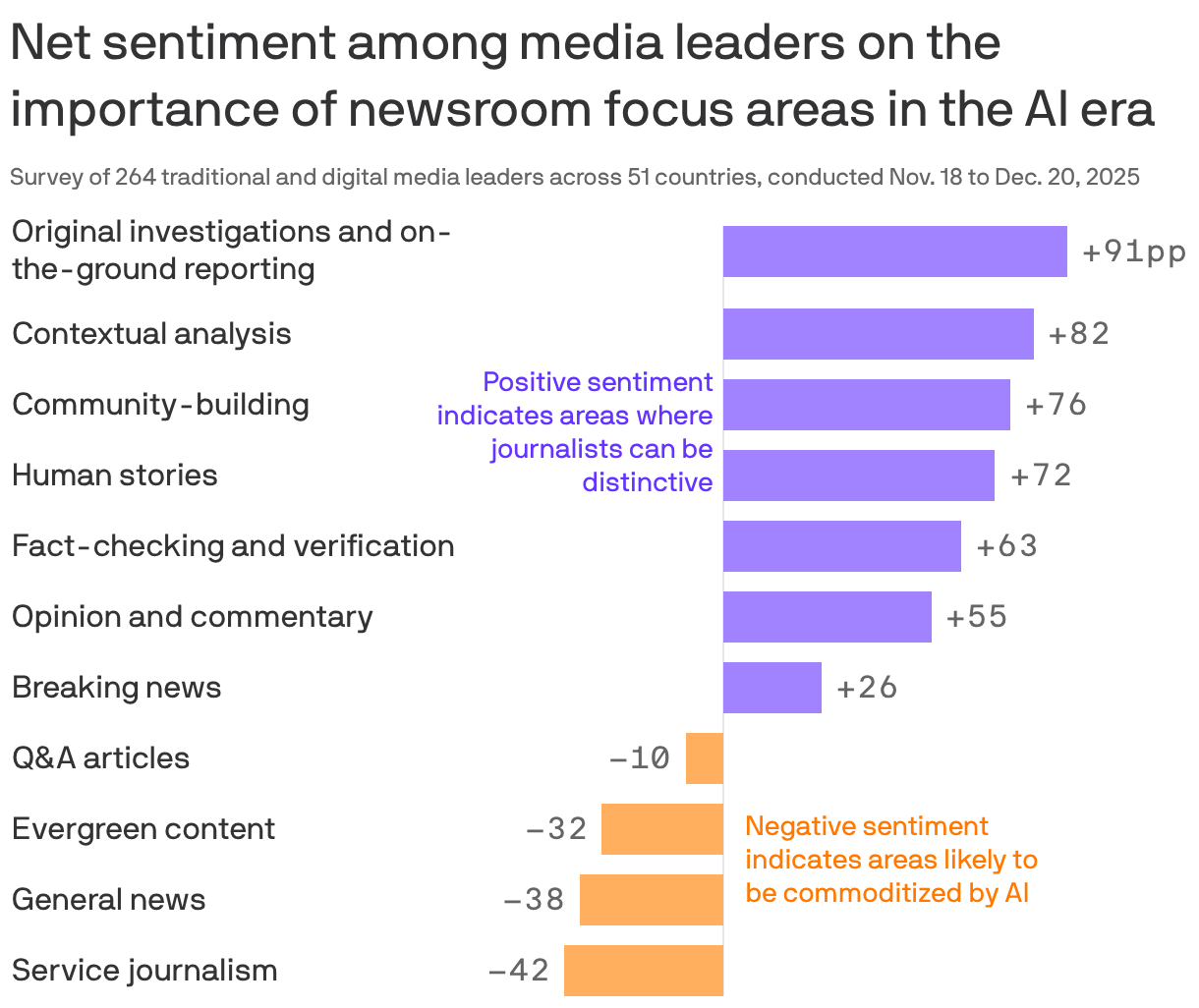
AI continues to disrupt how news and information are discovered and created, according to a report by the Reuters Institute.
Zoom in: In response, publishers are prioritizing content that cannot be easily replicated by AI, like original investigations and on-the-ground reporting, expert analysis and human stories.
- Evergreen content and general news are expected to become commoditized in the AI era, per the report.
Plus, publishers are also becoming more bullish on media like video, audio and live events.
- YouTube (+74), TikTok (+56) and Instagram (+41) are the video platforms of choice for news publishers, per the report.
What to watch: 76% of news outlets say they will encourage their reporters to behave more like creators this year, as audiences become more trusting of individual personalities over publications.
- Half of publishers plan to partner with creators, while one-third plan to bring creators in-house.
Go deeper ... read the report.
5. Bonus chart: Chatbot traffic dilemma


Global news referral traffic from Google Search and Google Discover, a mobile-first article feed within the Google app and Chrome, fell 33% and 21%, respectively, between May 2023 and November 2025, according to a new report from the Reuters Institute, citing Chartbeat data.
Zoom in: In the U.S., the declines are steeper.
- Traffic from Google Search and Discovery has fallen 38% and 29%, respectively.
Why it matters: Traffic referrals from AI chatbots are nowhere close to offsetting the referral losses from major platforms such as Google. This also includes Facebook and X, which have both changed their algorithms to rely less on links and more on video.
- "Google delivers 500 times as many referrals as ChatGPT from search alone; 1,300 times as many if you take into account Discover traffic," the report found.
6. 🎶 1 fun thing
Suno — the AI-powered music platform — created a 3.5-minute song to accompany the job description for its open head of communications role, and dare I say, it's catchy.
What they're singing: "We need a voice that's more than loud, one that moves with truth and cuts through crowds. Not just PR, but a war-room mind, a pen sharp enough to bend space and time," an AI-generated voice raps.
- "You'll touch People, Product, Policy, Press, make internal calm outta external stress. Be our compass when the beat goes strange, and own the frame when the story change," the song continues.
What to watch: How many candidates will apply with a song.
🎧 Go deeper ... Listen.
7. 💭 1 quote to go
We actually are starting to think of large language models as another stakeholder. When we're thinking about how we communicate, we also need to make sure the information we are putting out there is actually digestible by the LLMs, and so we make sure that we keep a credible and relevant voice within those systems."— Vanessa Broadhurst, Johnson & Johnson EVP of global corporate affairs, at a recent Axios Live event
✅ Thanks for reading! For exclusive reporting, deep dives and events, apply to join Mixing Board, powered by Axios.
Sign up for Axios Communicators