Axios Communicators

September 26, 2024

π Hello from NYC! I've been here for Climate Week plus meetings and guest appearances at a few corporate communication team off-sites.
- Speaking of NYC, Axios BFD is happening on Oct. 22. Get your tickets.
Today's newsletter is 1,580 words, a 6-minute read.
1 big thing: Not silent, but smarter on ESG
There's been a lot of talk about how business leaders, companies and brands are changing the way they engage with hot-button issues like geopolitics, climate or diversity and inclusion.
- But most senior communication leaders I spoke to this week said they aren't shifting their strategy towards silenceβ they are just being smarter about how and when they engage.
Why it matters: This mirrors what we've been covering here week after week. Communicators are increasingly being asked to help modern CEOs, companies and brands navigate this complex moment in time.
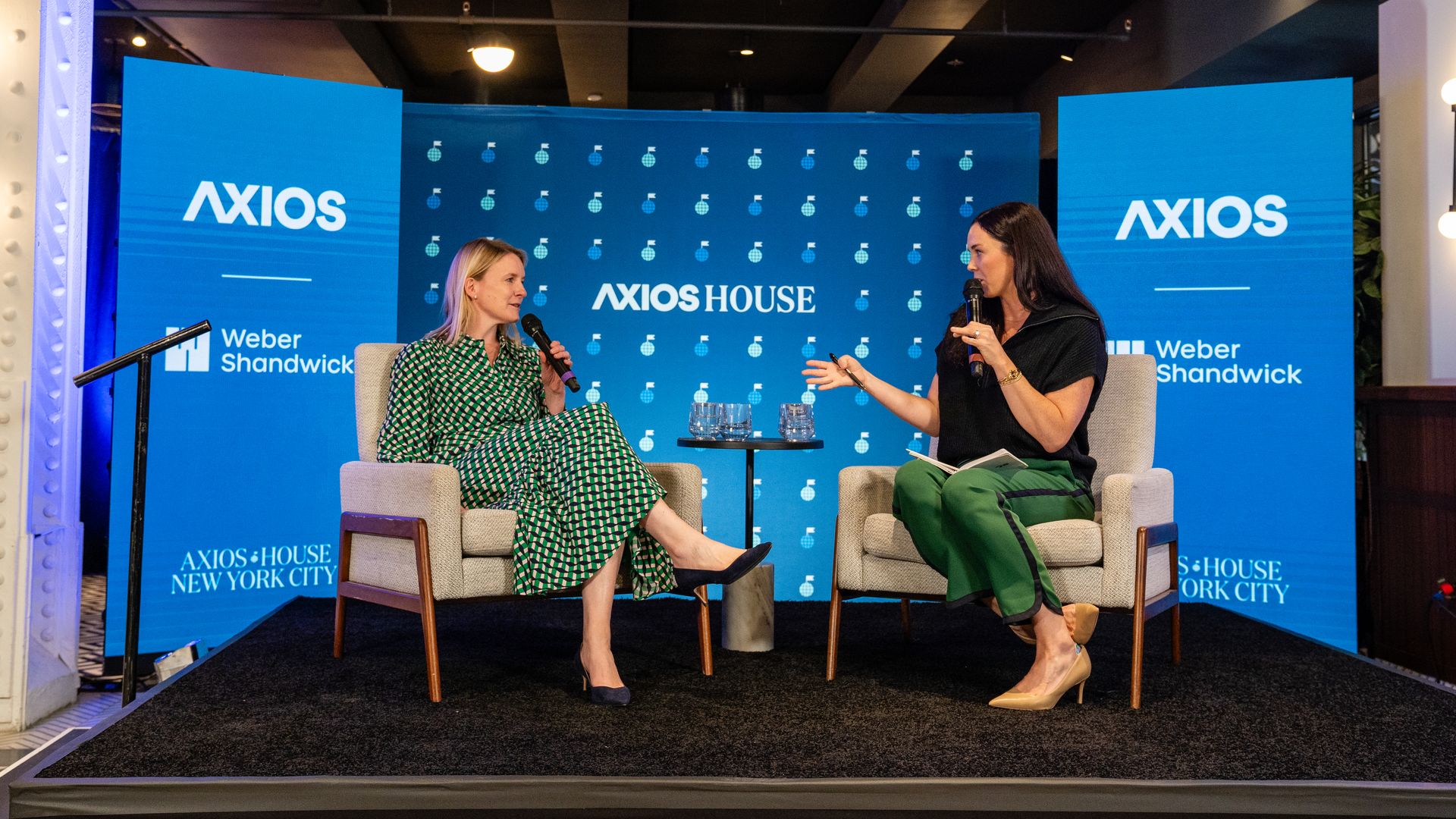
Driving the news: Roughly 150 communications and corporate affairs professionals joined us at Axios House to hear how leaders from Ralph Lauren, Danone North America and Weber Shandwick (who sponsored our event) are safeguarding against the ESG backlash movement.
Between the lines: Don't expect companies to come out louder and prouder after the election season has passed, because this isn't just a reflection of the current political environment β it's a more refined strategy all together.
- Where companies often get hung up is in response to outside geopolitical or societal events that might go against their ESG or DEI commitments.
What they're saying: It's less about reacting to outside noise and more about aligning the commitments to your business and its mission or values, says Ralph Lauren chief global impact and communications officer Katie Ioanilli.
- "There are plenty of examples where companies, brands, leaders have stumbled because they were using language to make a point that was perhaps divisive or not aligned to who they are as a brand," she says.
- "In 2020, when every company, every brand was faced with 'sign this,' 'say this,' 'do this,' I would sit with Ralph and we'd talk about it and he'd say, 'We don't have to be the first. We don't have to be the fastest. We have to stay true to who we are, we have to have integrity and it has to be authentic,'" Ioanilli added.
At Danone, they consider three things before weighing in, said senior vice president of corporate affairs Gemma Hart.
- "First: Is what's happening relevant in the outside world, or is it just relevant internally? Second: Do we have the right to talk about it? And can [we] make a difference in the world by speaking up?"
- Danone leaders then determine how and when to communicate the message to ensure they reach the stakeholders who care most, she added.
Zoom in: It's the role of communicators to understand their key audiences and help shape these messages for them, says Hart.
- "We have a huge responsibility to bring that external perspective, and then also to take what we're doing internally and to translate it in a way that lands with external audiences. A lot of what we're trying to do, especially on the ESG front, is big and messy and complicated, and our job is to we help break that into bite-size pieces so that it's accessible for people."
Yes, but: When it comes to sustainability, shoppers do care how food is sourced and clothes are made, but it's not the only factor.
- "The sustainability message still has the power to drive loyalty and connection. It just can't be the hero message," says Ioanilli. "Our hero message is about its timeless style."
The bottom line: These commitments to more sustainable or inclusive business practices aren't going anywhere, says Weber Shandwick North America CEO Jim O'Leary.
- "There's clearly deliberate effort to back away from some of that language, but I think fundamentally, what underpins DEI and ESG is very much still a priority for the world's leading businesses," he says.
2. State of sustainability reports


ESG has long been misunderstood and thus weaponized. As one corporate affairs leader said at a Climate Week lunch, "If we're using acronyms, we're losing."
- Why it matters: In response, communication teams are finessing how these commitments are messaged and shared.
By the numbers: Executive advisory firm Teneo analyzed 250 sustainability reports from S&P 500 companies published between Jan. 1 β July 30 and found that while ESG reports very much live on, the pomp and circumstance surrounding their launch is dwindling.
- Less than half of the companies issued a press release to accompany the report, compared to the 75% that did so in 2021, and only 14% provided an executive summary of their reports, down from the 26% in years prior.
- Instead, more companies are investing in sustainability-focused micro-sites within their corporate websites.
Zoom in: According to the study, these ESG reports are getting longer β as attention spans are getting shorter β with most averaging 83 pages long.
- That's a 20% increase compared to the reports from 2021.
- The shortest 2024 report came in at 15 pages, while the longest was 211 pages.
The intrigue: Language has evolved as well. "Sustainability" overtook "ESG" as the most common key word within report titles, while the mention of "impact" nearly doubled since last year.
- 94% of companies continued to use the term "DEI" within reports, and the remaining 6% focused more broadly on themes of belonging and inclusion.
- Of note: Fewer companies are including a section highlighting the progress they've made toward reaching their goals than in years past, according to the report.
What they're saying: "ESG has been highly politicized. The term has been co-opted, and yet there is a lot of new EU regulation coming out," says Martha Carter, vice chairman and head of governance advisory at Teneo.
- "It's really about companies looking at this from a broader global perspective, and not just complying with regulatory components, but looking at it from a stakeholder assessment and from a business perspective."
What to watch: Roughly 1 in 5 mention the responsible use of AI in their 2024 reports.
- There are ethical and environmental considerations when it comes to AI. Expect to see more reporting as companies incorporate it into their work flows.
π Eleanor's thought bubble: As the reports get longer and summaries disappear, I am less convinced that anyone β beyond some investors or regulators β actually reads these reports.
- It will be interesting to see which companies use them as more of a check-the-box exercise and which incorporate these ESG numbers into a broader corporate narrative.
- βAgree? Disagree? Send me your takes on these lengthy, time-consuming reports.
3. Communicators redefine their role
Throughout my conversations at Axios House and in various meetings with chief communications and corporate affairs officers this week, not once did the words "press release," "media relations" or "social media" come up.
- Instead we discussed public policy decisions, looming regulatory hurdles, amicus briefs, stakeholder management, corporate impact, sustainability and DEI strategies.
Why it matters: These conversations show where most communicators are spending their time, energy and resources.
Between the lines: A huge part of the job is to provide the appropriate context and bring the right people into the decision-making, says Ioanilli.
- "I always tell the comms team that we have two jobs: To understand the truth of the company and to put that truth into context β and that context piece is becoming increasingly important because everybody has a voice, everybody's vocalizing how they feel about anything related to your brand."
The big picture: There's a need for T-shaped communicators β those who can work as generalists but have deep expertise in areas like product, analytics, brand, sustainability, public affairs or issues management.
- This is highlighted by the rise in CCO+ roles, which outnumber traditional CCO roles for the first time, according to an analysis by the Observatory of Corporate Reputation.
- Plus, more communication executives are reporting directly to the CEO than in years past, per a Memo report.
What they're saying: CEOs are relying on communications and corporate affairs teams to help them navigate the complexities of modern business society, politics and culture, says O'Leary.
- The rising influence of communications and corporate affairs can be attributed to three things, he says.
- "One is taking much less of an intuition-based approach and much more of a data-driven technology enabled approach. The second, is they are becoming more proactive in anticipating and managing crises as opposed to playing reactive Whack-a-mole. And three, the teams are much more focused on either protecting value or creating even more value for the company."
4. Case in point: The new comms JD

Nothing quite captures the evolution of the communications role like the new language that's being used in executive-level job descriptions.
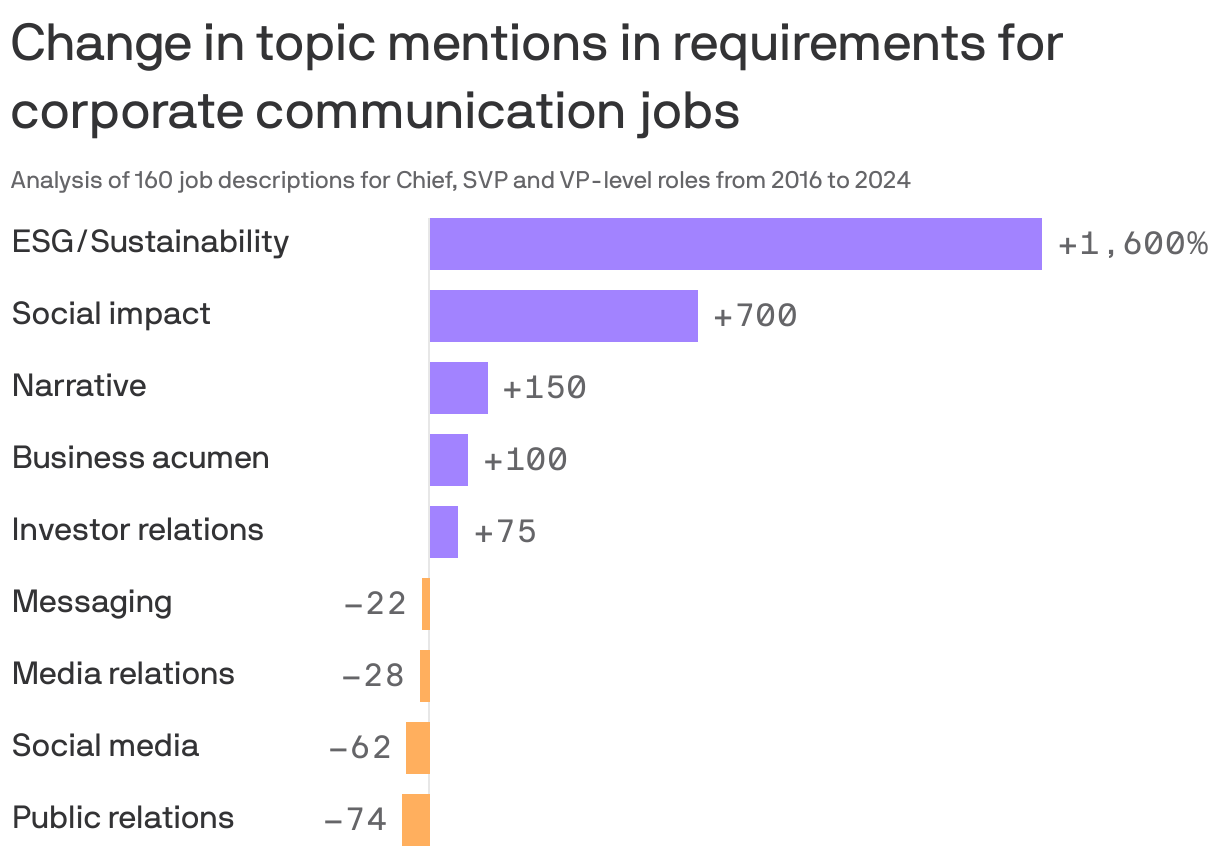
Driving the news: Executive search firm Heyman Associates examined 160 job descriptions for executive roles within corporate communications from 2016-24 and found that tactics β like PR and social media β are being deprioritized.
By the numbers: The number of job descriptions mentioning ESG and sustainability have increased 1,600% since 2016, while mentions of public relations have decreased by 74%.
- Business acumen, narrative, social impact and investor relations are also more likely to be requirements than they were in years past.
What they're saying: Subtle changes within the jobs are becoming permanent shifts, says Heyman Associates CEO Jessamyn Katz.
- "Our takeaway is that senior communications leaders are gaining a broader responsibility and representation, often helping to determine and shape strategy and initiatives at the corporate level rather than being responsible only for communications during implementation," she said in a statement.
Share this story.
5. πΈ 1 snapshot to-go
Before our Axios Communicators Climate Week event, we hosted a private reception for Communicators Pro members to mix and mingle.
- More of these gatherings are in the works, so don't miss out β join Communicators Pro today!
ππ» Thanks to editors Nicholas Johnston and Kathie Bozanich. And extra thanks to you for reaching each week!
If this was forwarded to you, subscribe here.
Sign up for Axios Communicators