Axios Communicators

October 10, 2024

✈️ Greetings from the Minneapolis airport, where I'm about to fly home after speaking with comms teams from 3M, American Express, IBM and more.
- 📆 Mark your calendar for our next Communicators Pro AMA on Oct. 17, where Axios co-founders Mike Allen and Jim VandeHei will share how the potential election outcomes could impact businesses and what it means for communicators. Become a Comms Pro member to attend!
Today's newsletter is 1,669 words, 6.5 minutes
1 big thing: Navigating the new media landscape

Newsrooms are shrinking and audiences are becoming more dispersed as independent journalists successfully launch Substacks, content creators pivot into podcasting and TikTokers report on the news.
Why it matters: This is changing how brands, executives and politicians are engaging with the media.
Driving the news: Kamala Harris appeared on the "Call Her Daddy" podcast on Sunday with the goal of sharing her story with young female voters.
- Meanwhile, Donald Trump has appeared on podcasts like "All In" and "This Past Weekend with Theo Von," and Tim Walz has engaged with TikTok series like "Subway Takes."
The big picture: As Axios founders Mike Allen and Jim VandeHei continually point out, audiences have splintered into different news bubbles based on the information they want, voices they trust and activities they are interested in.
- By engaging more with nontraditional media, companies, brands or politicians can connect with the audiences they need most in a way that feels authentic.
Between the lines: It's a "hunt where the ducks are" strategy, or as Rostra founder Lulu Cheng Meservey thinks about it, P=F/A or "pressure equals force over surface area."
- "We all have insane information overload, so if you try to spread yourself too thin and you're saying 10 different things to appeal to everyone, people are just going to forget about it," Meservey previously said at Axios Communicators Live.
- Instead, the goal should be to deliver a precise message that will reach a hyper-engaged audience and call them to action.
- These newer, niche platforms and communities make that possible.
State of play: Tech leaders and CEOs are regularly sitting down for long-form podcast interviews or engaging with influential newsletter writers to reach fellow founders, venture capitalists, employees or potential talent.
- And while legacy media outlets have a strong hold on big tent pole business events, it's only a matter of time before podcasters and content creators take on Davos. They already did so this summer at political events like the DNC and RNC or global stages like the Olympics.
What they're saying: The best approach is to first think about the audience the company or brand needs to penetrate to achieve its goals, says Josh Rosenberg, CEO and co-founder of Day One Agency.
- "A lot of what we think about is, who is the client trying to reach? What is the conversation our brands want to be a part of, and then who are the influential voices that are driving that conversation?" he added.
Plus, these targeted strategies can also be a means for more traditional coverage.
- "More often than not, the hyper niche audiences are where the conversations start, and then you might see something appear in the New York Times or the Wall Street Journal after it's already been covered on Substack or within other online communities," says Rosenberg.
Yes, but: Many executives still want to see themselves on the cover of a glossy or their company written about in a major business publication.
- In response, communication teams are having to educate the C-suite on the evolving media landscape, says Tina McCorkindale, president of the Institute for Public Relations.
Reality check: While the role of traditional media shouldn't be ignored, communication teams must be cognizant of what Rosenberg refers to as "data dissonance" or the idea that volume doesn't always equal depth.
- "When everything has a billion views or a billion impressions, who's actually, listening? How is that actually moving the needle?" he said.
What to watch: As AI continues to disrupt the media landscape, trusted individuals with a unique voice or domain expertise have the potential to be more influential than ever.
Case in point... 👇🏻
2. The new media rules of engagement
As I was working on this story, two of my favorite newsletters hit my inbox and included some familiar names and faces.
- Oliver Darcy's Status newsletter featured an interview with Axios CEO Jim VandeHei, while Emily Sundberg's Feed Me newsletter was sponsored by Hinge (the fourth big brand to advertise on her Substack).
Why it matters: Clearly they knew these platforms would help them reach a particular audience (aside from me).
What they're saying: "Our marketing and communications approach centers around thoughtfully engaging our target audiences... so we're always experimenting with new channels and unique voices to reach them," says Tamika Young, vice president of global communications at Hinge.
- "As more people tap into Substack for meaningful and informative content from perspectives they love following, we are continuing to explore potential long-term opportunities on the platform."
Zoom in: The rules for engagement with nontraditional outlets or independent creators can vary.
- "It is still super relationship-driven," says Rosenberg. "But research is always part of what we do at the beginning, and really understanding the outlet and the reporter, or creator, and understanding what they cover to make sure that the story is right for them."
Plus, because most of these creators, editorial influencers and writers — sometimes called "editfluencers" — don't sit in traditional newsrooms, more vetting is needed.
- It can also require more money, as some writers, influencers and creators work off affiliate links, sponsored content or partnerships.
- This can quickly eat into a comms team's budget and further blur the lines with marketing.
Yes, but: A lot of legacy media have embraced pay-to-play practices too, specifically in the events space.
The bottom line: As news consumption habits shift, comms teams will have to be more strategic about where they take their message and how they spend their dollars.
3. Who TikTok users rely on for news

More Americans are flocking to TikTok for news and information, but they aren't necessarily following media organizations or journalists on the platform, according to a new report from Pew Research Center.
- Why it matters: Instead, they are relying on creators, entertainers and influencers to deliver the news — even as mis- and disinformation campaigns continue.
State of play: More than half of Americans say they at least sometimes get news from social media platforms, according to Pew.
- Among those who use TikTok, 52% regularly get news there, up from 22% in 2020.
- About 4 in 10 Americans between the ages of 18-24 discover news from the app.
- Instagram LinkedIn, Twitch and Nextdoor are also gaining traction as news sources.
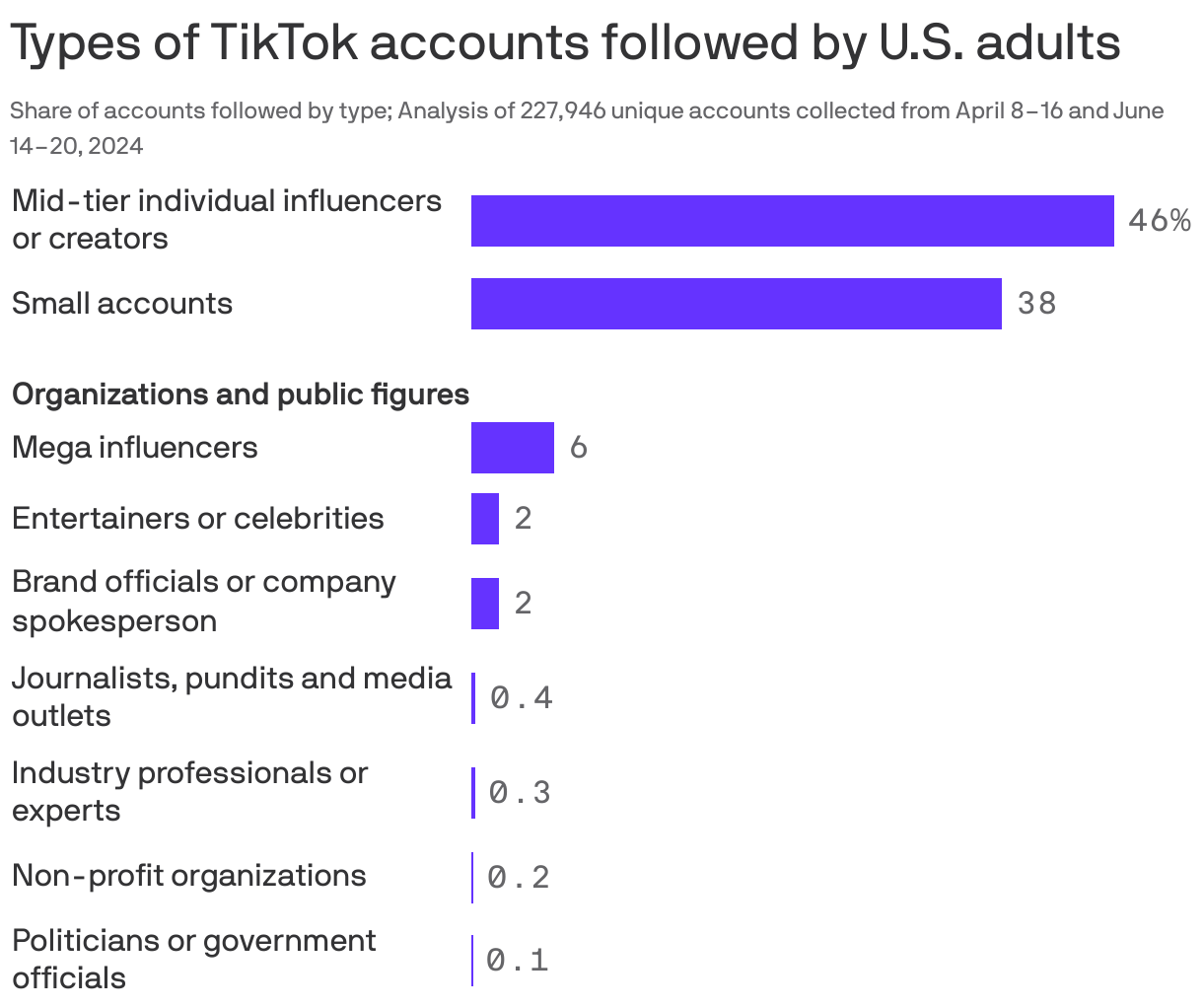
By the numbers: Given the personalized nature of the TikTok algorithm, Pew examined 227,946 accounts to better understand the following habits of U.S. adults across the platform.
- The report found that close to half of accounts with U.S. followers were mid-tier influencers or creators, while 38% were smaller accounts — like friends or family members — and 2% were celebrities, brand accounts and spokespeople.
- Less than 1% of accounts with U.S. followers on the platform were journalists or media entities.
Between the lines: Creators often reference mainstream media coverage or news stories in their content, so traditional news does reach TikTok users even if they aren't following specific journalist or publication.
What they're saying: "To the extent that people are getting news about politics or current events on TikTok, it is coming from people who don't necessarily look like traditional journalists, and it's probably interspersed with a lot of very nontraditional content — like skits, funny dances or promotional content, " says Aaron Smith, managing director of Pew Research Center's data labs.
- "It speaks to this broader notion that people's world news or politics comes as a side dish to their main course of gossipy entertainment news and the content of the creator that they happen to be interested in."
Yes, but: Some legacy media outlets — like the Washington Post, CNN, ESPN and MSNBC — do have millions of followers on the app.
- Meanwhile, CNN correspondent Max Foster has amassed 1.2 million followers, while independent journalists like Cleo Abram and Taylor Lorenz have more than 1.5 million and 500,000 followers, respectively.
- However, these numbers are small compared to the accounts of internet creators like Khaby Lame (162.8M) or Mr. Beast (104.5M) and celebrities like Will Smith (75.1M) or Selena Gomez (58.2M).
What to watch: Social media remains a hotbed for the spread of mis- and disinformation, with many looking to local and legacy news in times of crisis.
4. Communicator Spotlight: Andrew Noyes of Daily Harvest

Andrew Noyes has spent his career helping companies become better known and understood.
- Now, he leads communications and corporate affairs for sustainably sourced food company, Daily Harvest.
🗣️ What he's saying: "In the simplest terms, my job is telling the story of a mission-driven, sustainably sourced food brand in a very crowded space," says Noyes.
- "We have to tell that story in a way that advances our business goals and broader mission, while also connecting with consumers in an authentic and meaningful way, whether they're discovering our products through our [direct-to-consumer] channels, on Amazon or at their local grocer's freezer aisle."
📍 How he got here: Noyes got his start as a journalist covering tech policy before taking a role at Facebook as its first D.C.-based communications hire.
- From there, he held positions at Uber, Sean Parker's civic engagement startup Brigade, and food tech company Eat Just before joining Daily Harvest in 2023.
- He also currently serves as a communications advisor to early-stage startups at the intersection of food, tech and climate solutions, like Savor and Zero Acre Farms.
📈 Trendspot: The sway of micro-influencers
- "After doing a really deep dive on who our customers are, who our customers could be, and how we reach those potential demographics, we've then found constituencies of micro-influencers can work harder for us and make the dollar stretch further. We also have an affiliate program with publishers," he added.
🚴♂️ De-stress routine: Peloton. Noyes has completed more than 6,300 workouts to date.
🧠 Best advice comes from his first editor at his hometown newspaper, The Register-Herald in Beckley, West Virginia:
- "Be true to yourself, whether it's in your personal life or in your business dealings."
5. 🗣️ 1 quote to-go
"We don't live in an age when everyone gets their news from three white guys at 6:30 every night."— Former Obama White House spokesperson Eric Schultz to Politico, following Harris' "Call Her Daddy" appearance
🙏🏻 Thanks to editors Nicholas Johnston and Chris Speckhard. And extra thanks to you for reading each week!
If this was forwarded to you, subscribe here.
Sign up for Axios Communicators