
Axios Communicators

November 14, 2024

It's Thursday again, and today I'm resharing some of my favorite charts.
- 🎟️ But first: Tickets are going fast for our Axios Communicators Live event on Dec. 5 in NYC. Don't miss out — reserve your spot!
- 🏔️ Plus, Axios returns to Davos on Jan. 19-23 for a full slate of live programming. I'll be there, along with Axios' Dan Primack, Ina Fried and more. Get updates and ping me if you'll be in town too.
Today's newsletter is 1,553 words, a 6-minute read.
1 big thing: CCO succession planning
An executive recruiter recently told me the lack of succession planning in the communications and corporate affairs space keeps them up at night.
Why it matters: If not addressed, the rapid elevation and expansion of the communications function could cause a delay in the talent pipeline.
State of play: A recent Memo report found that 56% of CCOs are reporting to the CEO — an increase of 34 percentage points since last year.
- A separate report by the Observatory on Corporate Reputation found that CCO+ roles have increased by roughly 88% within the Fortune 1000 since 2019, outnumbering traditional CCO roles for the first time.
What they're saying: Because the role is getting bigger and becoming more visible to the C-suite and board, the skill set is changing, says Korn Ferry global managing director Richard Marshall.
- "What's required for the rising stars is really going to be more enterprise leadership and a broader skill set — functional expertise is going to be table stakes," he said. "Business and financial acumen, the ability to work as a problem solver and an interoffice diplomat are things that are going to be the differentiators for the next-generation talent."
- Because of this, many recruiters are looking for T-shaped communicators — talented generalists who also have deep expertise in specialized areas and can marry strategy with traditional communication tactics.
- The ability to work across all areas of communication is now a basic requirement, says KC Partners founder Brooke Kruger.
- "Just a few years ago, comms teams were spread out, and people could focus on just one thing," she said. "Now, communicators are expected to have a broader skill set, be experts in lots of things, think two steps ahead and be able to pinch hit."
Between the lines: Usually, the CCO is tightly bound to the rise and fall of the CEO, which can make succession planning more novel, says Marshall.
- "While historically other functions like legal, finance and HR have a more structured mentoring or succession planning program, it's relatively new for [the communications] profession," he said. "Some of the top leaders are growing their talent, giving rotational assignments and helping to build out their skill set, but I would say it's more in the nascent stages."
Reality check: In this multigenerational workforce full of new, competing stakeholder dynamics and an increasingly fragmented audience landscape, seasoned communicators can learn from younger colleagues.
- Strategic communication firm Foretell recently launched an incubator program to offer development and two-way mentorship for its 50 members.
- The Estée Lauder Companies has long offered the CEO Global Reverse Mentor Program, which pairs young employees with senior-level executives.
And public relations agency Zeno Group recently launched Project Gap, a global advisory board comprised of Gen Z and young millennial employees to help close the gap between current and future firm leadership and ensure adequate representation across decision-making teams.
- Zeno Group planner Emma Campher told Axios she wanted to join the GAP advisory board to create better understanding across generations and dispel myths while becoming "more involved in working directly on some of the pressing needs that the agency and broader communications industry is facing."
- "The communications landscape has changed, business and what people expect of business has changed," Zeno Group global CEO Barby K. Siegel said. "And if we don't listen to and bring our generations forward, that will have a real impact on not only the work we do today — because we'll only be seeing it through a very narrow lens —but also on the future our industry."
What to watch: A contingent of chief communication officers has reached burnout or are nearing retirement, which could free up opportunities for the next generation.
🌳What's next: We want to highlight the communication leaders prioritizing mentorship in an upcoming "Comms family tree" feature.
2. Bonus chart: CCO path


Re-upping one of my favorite data visuals, which tracks the career paths of Fortune 100 chief communication officers.
Zoom in: 62% of CCOs were promoted from within and 10% are company lifers.
- 43% of CCOs started in the corporate world, followed by politics and government (24%), PR agencies (17%) and journalism (8%).
What to watch: Many from the Biden and Harris administration will be on the job hunt, and while the politics-to-TV pundit pipeline has become common, corporate communication teams also benefit from political prowess.
- Obama-era communicators like Robert Gibbs, Jay Carney and Josh Earnest landed big corporate gigs following their time in the White House.
What they're saying: Political communicators are uniquely suited for this moment, says Erin Pelton, founder of Foretell and State Department alum.
- "They can not only move really, really fast, but they also understand how the world works, anticipate stakeholder dynamics and anticipate what's coming — which is extremely valuable if your mandate is to protect the brand," says Pelton.
- "To get to the C-suite, you can't just know your business — you have to know how your business intersects with the world," she added.
What's next: Executive recruiters Axios spoke to say hiring was on pause due to the uncertainty of the 2024 election cycle. Now, many expect to see more movement by the end of the first quarter.
3. How young voters were informed
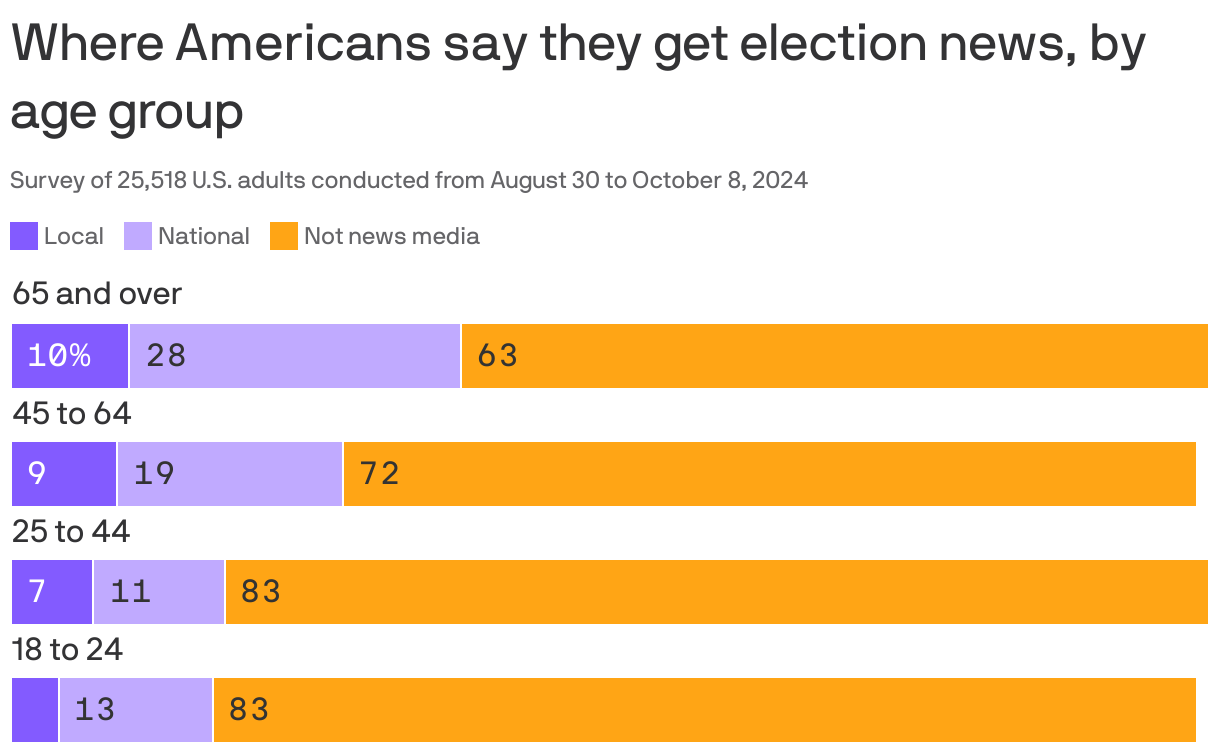
Young voters relied more on their peer groups — in person and online — than traditional news outlets for information on the 2024 election, a study by the Civic Health and Institutions Project found.
- Why it matters: This further highlights the changing media landscape, as more young people flock to nontraditional platforms.
By the numbers: In a survey of 25,518 U.S. adults from Aug. 30 to Oct. 8, researchers found those ages 18-44 were 20% more likely than those 65 and older generations to rely on their personal networks for election information.
- According to the report, Democrats and independents are more likely to rely on news media, whereas Republicans more often get information from personal networks or word of mouth.
What they're saying: For messages to cut through, they need a lot of repetition, and digital algorithms can expedite that, says John Wihbey, an associate professor of media innovation and technology at Northeastern University.
- "Within communications research, there's this idea about two-step flow models, where people seldom receive information directly from mass media, but instead through thought leaders, personal networks or social groups. This study suggests that this phenomenon may be more pronounced," he said.
- Communicators "need to figure out how to harness these thought leader networks that are more localized and more particular to specific communities," Wihbey added.
Go deeper ... Axios' Sara Fischer lays out the MAGA influencer map.
4. Communicating in the next administration
With a new administration and Republican-led Congress waiting in the wings, in-house teams are dusting off their internal communication playbooks.
Why it matters: Some Trump administration policy proposals might force business leaders to weigh in on political issues that impact employees.
By the numbers: According to a recent Morning Consult survey, a focus on internal communication is more favorable among general consumers than externally advocating for policy issues.
- Meanwhile, communicating with employees about issues that affect them is expected, per the survey.
- 64% think employers should address and offer internal resources if the Affordable Care Act is repealed, while 62% say employers should communicate internally if mass deportations occur.
Zoom in: Teams are also bracing for the political tension to spill into the workplace, should rhetoric around social issues become more charged.
- Because of this, two-thirds of employees say they do not want any discussion of politics at work following the election of Trump.
Of note: Employees are also paying attention to how their executives are reacting to the election results.
- So far, 28 American CEOs have issued statements congratulating President-elect Trump and expressed a commitment to industry-related policy collaboration, per a recent analysis by Gravity Research.
- Tech executives are dominating engagement, with roughly 61% of the statements originating from this sector.
- According to Morning Consult, most believe the financial and tech sectors stand to benefit the most from a second Trump presidency.
5. Another bonus chart: The decision tree


At this point, most communication teams have established processes for determining how and when to respond to political, societal or cultural events.
Why it matters: With a new administration and Congress coming, it might be time to refresh those decision trees.
- Here's the one we drafted in the early days of Axios Communicators.
❓Yes but: Two years, more geopolitical conflicts and several culture wars later, what's missing? What else should be reconsidered?
- Share your suggestions here.
6. 💥 1 list to-go
Fortune came out with its inaugural list of the most powerful people in business based on how "their actions and words influence what others think and do."
Why it matters: CEO reputation can cast a halo effect across business reputation.
- Plus, it's another list you can pitch your executives for.
State of play: 70 of the top 100 run American companies, 15 from Asia, 14 in Europe and one from the Middle East. 18 are women.
Of note: The top 10 most influential all hold the CEO title ...
- Elon Musk, Tesla and SpaceX
- Jensen Huang, Nvidia
- Satya Nadella, Microsoft
- Warren Buffett, Berkshire Hathaway
- Jamie Dimon, JPMorgan Chase
- Tim Cook, Apple
- Mark Zuckerberg, Meta
- Sam Altman, OpenAI
- Mary Barra, GM
- Sundar Pichai, Alphabet
What's next: We will dive into this more in a future edition of the newsletter.
- Keep sending your recommendations for strong communicators in the C-suite.
🙏🏻 Thanks to editors Nicholas Johnston and Kathie Bozanich.
If this was forwarded to you, subscribe here and to go deeper, become an Axios Communicators Pro member.
Sign up for Axios Communicators