
Axios Communicators

January 30, 2025

📊 Welcome back to another edition of Axios Communicators. This time we're bringing you several interesting bar charts, plus more.
- ✍🏼 But first: Want extra content, data and opportunities to convene? Sign up for an Axios Communicators Pro membership.
Today's newsletter is 1,517 words, a 5.5-minute read.
1 big thing: CEOs feel unprepared
If it's hard to be a CEO right now, then that difficulty is sure to extend to those who advise them.
Why it matters: Only 17% of CEOs feel their communications and public affairs functions are "very equipped" to keep pace with rapid economic, geopolitical and cultural changes, a new report from The Weber Shandwick Collective found.
What they're saying: "The increased volatility, at least in the U.S., is something that [CEOs] are concerned about. And unfortunately, for whatever reason, they don't think that their communications teams are equipped to fully address or navigate that," CEO of The Weber Shandwick Collective, North America and Global President Jim O'Leary said at a sponsored Axios conversation in Davos, Switzerland.
- "What maybe is potentially most disappointing is that a lot of the people in our profession feel like over the past several years we've gained a significant amount of influence at the C-suite level because the role of comms is much more materially important to the success or failure of a company than it's ever been."
By the numbers: Weber Shandwick surveyed 200 global executives from Nov. 14 to Dec. 4, 2024, and found that roughly 7 in 10 anticipate heightened volatility in the year ahead, and few feel prepared.
And executives aren't likely to turn to their comms or public affairs teams for guidance.
- Overall, only 27% reported increased confidence in their communications and public affairs function over the past three years, with a majority of CEOs (59%) saying their confidence in the team remained unchanged.
- Of note, leaders of larger companies and those operating in more than 20 countries were more likely to report a loss in confidence in comms and public affairs teams.
Zoom in: Executives are also navigating the competing demands and expectations of their stakeholder groups.
- According to the report, CEOs are prioritizing customers first — with 86% naming this group as "very important" — followed by investors and shareholders (73%), employees (45%), policymakers (32%), partners and suppliers (24%), and local communities (22%).
Yes, but: While policymakers might not be the top audience, several CEOs are tripping over themselves to appeal to the new Trump administration.
The big picture: Corporate America found itself in the political crosshairs with the new Washington taking shape. This prompted several companies to revise their diversity, equity and inclusion policies and sustainability commitments.
What to watch: New governments are forming across the globe and are proposing policies that may affect business operations, supply chains, investments and reputation, the report points out.
- This creates more opportunity for communication and public affairs teams, said O'Leary.
- "No scenario plan is ever going to survive contact with the amount of volatility that's out there in the world. So in addition to being able to plan for and be resilient through all of the change, you also have to have an enormous amount of agility in the year to come."
2. Yes, but: Comms expansion


Even given their wavering confidence levels, CEOs are investing more in some communication and public affairs functions.
State of play: According to the report, most plan to expand resources for marketing and brand building, communications, crisis, and government relations.
- Meanwhile, about 1 in 4 plan to pull back on environmental, social and governance and DEI efforts.
3. Bonus chart: Reputational threats


C-suite leaders feel the least prepared to address violent and nonviolent attacks or protests, getting caught in the political crosshairs and division within the workplace, the Weber Shandwick report found.
What to watch: U.S. companies should also be wary of fast-moving foreign entities that could disrupt industries, affect market value and threaten reputation.
More on that in item No. 4... 👇🏻
4. DeepSeek's PR cycle
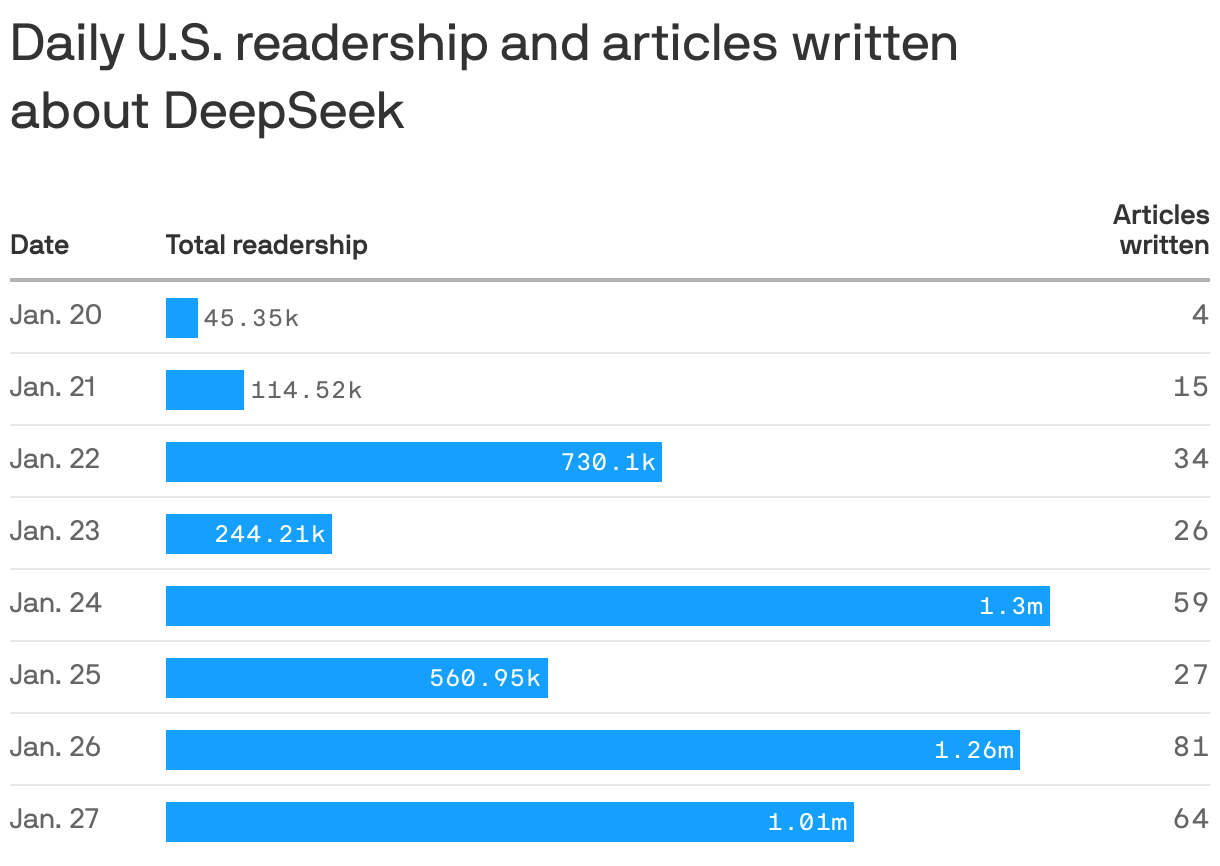
Nvidia and other AI-driven stocks were down at the beginning of this week following the frenzied rollout of DeepSeek's R1 model.
Why it matters: DeepSeek's press coverage highlights the impact communications can have on the market.
Catch up quick: DeepSeek, a China-based research lab, recently launched generative AI products that compete with the likes of OpenAI and Anthropic, but DeepSeek's were developed for a fraction of the cost.
- As Axios' Ben Berkowitz points out, this drove fears "the planned AI spending boom, with its hundreds of billions of dollars in [capital expenditures] on data centers and chips and power, might not be necessary if there's a way to do it faster, cheaper and better with old hardware." Those concerns led to the shift in the market.
- Meanwhile, there are concerns DeepSeek has allegedly stolen OpenAI models and could cause broader security risks.
What they're saying: "The biggest story in AI isn't about the technology but instead, the narrative that drives it," Kyle Arteaga, CEO of The Bulleit Group wrote in a recent post.
- "This isn't just about AI. It's about geopolitics, trust and the influence of strategic narratives in shaping markets, industries and power," he added.
What we're watching: AI competitors are on high alert, monitoring the media coverage and quickly shaping the narrative.
- Meta has assembled "war rooms" to assess its Chinese competitor, according to The Information, while Microsoft CEO Satya Nadella and IBM CEO Arvind Krishna both took to LinkedIn to declare that efficiency and accessibility are good for the AI industry at large.
The bottom line: Much of the AI race will be shaped by strategic messaging.
5. 📚 Reading list ...
Here's the news I'm tracking this week ...
- ❓What we know so far about the midair collision between an American Airlines passenger plane and U.S. military aircraft. (Axios)
- 🗄️ The White House is offering a buyout to federal workers who don't want to return to the office. (Axios)
- 💰Public Policy Holding Company will acquire TrailRunner in a $33 million deal. (Investing.com)
- 🤝 More consolidation in holdco land, with HUNTER and KWT Global combining. (PR Newswire)
- 🥊 Salesforce execs took every opportunity to bash Microsoft's AI Copilot in Davos last week. Now, Microsoft CCO Frank Shaw is pushing back in a LinkedIn post. (LinkedIn)
- 💭 My thought bubble: This is another example of a more aggressive approach many corporate communicators are taking.
- ❌ An underwriting agency is partnering with a London-based crisis communications group to create an insurance policy "specifically designed to protect individuals against cancel culture, and to mitigate reputational damage caused by negative media and social media coverage." (Financial Times).
- 💭 My thought bubble: This feels like a gimmick. Either that, or you're all in the insurance business now.
- 🤐 Higher ed thinks corporate America should adopt its neutrality policies and "keep [their] mouths shut." (The New York Times).
- 💭 My thought bubble: It tracks that this op-ed was written by law professors.
- 😳 Gen Z isn't meshing with the modern workplace, as bosses sack young workers at record speeds. One in 6 bosses say they're hesitant to hire recent college grads again. (Fortune).
- 🐉 Bonus: I just started "Onyx Storm." Reach out if you want to talk dragons.
6. Communicator spotlight: Amy Call Well, EY's global COO

Amy Call Well oversees all communications, marketing and branding for EY, one of the largest accounting and consulting firms in the world.
- Why it matters: The firm is going through a transformation, with Janet Truncale becoming global chair and CEO last year and having recently launched a major update to "modernize and refresh" the EY brand, Well told Axios.
🗣️What she's saying: The brand effort is "part of a bigger thought process that we're going through within the comms team," Well said.
- "The big trends we're looking to solve are: What are your audience expectations? How do you stay in touch with how the audience sees you? And how do you have consistency?"
📍How she got here: Before joining EY, where she's been for more than 16 years, Well held communication roles in the U.S. Senate and White House Office of Management and Budget.
- "I started out doing public affairs for the firm, and then at some point, I took on partnerships, including World Economic Forum and Milken, and executive positioning," she said. "Eventually, I took on all of external comms. I did an eight-year stint as chief of staff to two different CEOs before taking on the CCO role."
- The chief of staff role allowed her to better "understand the different demands that are on the business" and "the stakeholders that the CEO has to deal with."
🏗️ How it's structured: Well reports to Truncale and oversees a global team of 600 across EY's business units.
📱Trend spot: Navigating the changing media landscape.
👀 Who she's watching: Well follows B2B companies, EY competitors and those navigating crises. When it comes to specific professional communicators, she's watching Microsoft CCO Frank Shaw.
🧠 Best advice came from a former EY CEO: Find the signal from the noise.
Go deeper ... read the spotlight in its entirety.
7. 📸 1 fun thing: Media mixer
M13 partner Christine Choi, Daly founder Alex Daly and Teneo senior managing director Leigh Gallagher hosted the second annual media mixer at Liz's Book Bar in Brooklyn last night.
The intrigue: Communicators from across industries and agencies both big and small were represented. What really fascinated me was the media in attendance — from well-known Substack writers and podcasters to cable TV producers, NPR hosts and traditional print journalists.
- When asked how the guest list was curated, Choi said, "The group is a human expression of where media is today."
Speaking of which...
8. 💭 1 quote to go
"Millions of Americans, especially young people, have turned from traditional television outlets and newspapers to consume their news from blogs, social media and other independent outlets. It is essential to our team that we share President Trump's message everywhere and adapt this White House to the new media landscape."— White House press secretary Karoline Leavitt, at her first press briefing on Tuesday
🙏🏻 Thanks to editors Nicholas Johnston and Kathie Bozanich and an extra thanks to you for reading!
Was this forwarded to you? Subscribe here.
Sign up for Axios Communicators