Axios Communicators

June 05, 2025

Welcome back!
- π«π· Axios is returning to Cannes Lions this year (June 16β20), and our main stage lineup is bigger and better than ever.
- Speakers include Gabrielle Union, Paris Hilton, Bethenny Frankel, will.i.am, Pinterest CEO Bill Ready, Yahoo CEO Jim Lanzone, Business Insider CEO Barbara Peng, Spotify's Dustee Jenkins and more.
- See the agenda & RSVP here.
- π Reminder: Monthly Moves hits inboxes tomorrow. Share your jobs updates here.
Today's newsletter, edited by Nicholas Johnston and Amy Stern, is 1,849 words, a 7-minute read.
1 big thing: Identifying the boycotters
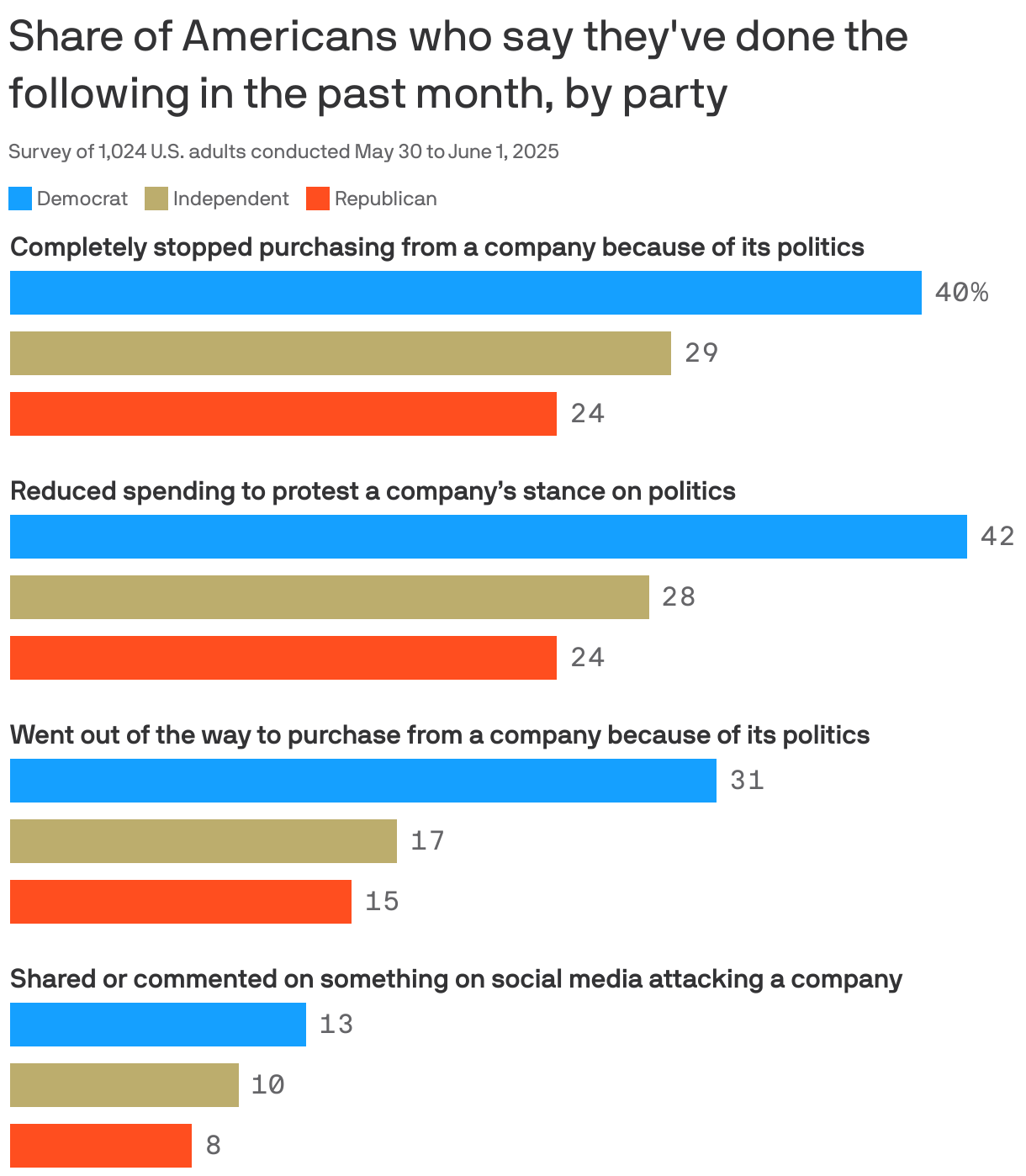
A plurality (47%) of Americans think it's inappropriate for companies to publicly comment on political or social issues, according to a recent CLYDE/Ipsos survey.
- Yes, but: 6 in 10 say companies have a responsibility to speak out on issues that may affect their employees, and roughly half say they should speak out on issues that affect customers.
Why it matters: These murky expectations highlight the complicated environment businesses are currently operating in.
What they're saying: "Businesses need to understand how their brand aligns to current issues and the values that matter to their customer base," says Mallory Newall, vice president at Ipsos.
- "Brands cannot please everyone, and wading into the political fray does not come without risk. It needs to be done in a strategic way. However, there are potential upsides if companies have a clear understanding of who they're talking to and who their customers are. Those who act inauthentically will lose ground in this environment," she added.
State of play: There's a disconnect in what consumers say and what they do.
- 53% of Americans say they are less likely to buy from a company that takes a stance they don't agree with, but only 30% actually do.
Between the lines: A company's political or social stances influence Democrats more than Republicans, per the survey.
- Democrats are more likely to boycott (40%) than Republicans (24%), but they are also 2x more likely to go out of their way to support a brand that aligns with their values.
- Target is the latest American corporation to grapple with these boycotts, following its retreat from diversity, equity and inclusion efforts.
Of note: Boycotting is a luxury afforded to those with disposable income, per the survey.
- Households with incomes of $100k and above are 50% more likely to stop buying from a company they disagree with than those households making $50k and below.
What to watch: 67% of Democrats say they are closely tracking how companies respond to pending Supreme Court decisions, compared to 52% of Republicans.
- There is more appetite across party lines for business commentary on economic issues β like inflation and trade policies β than other policy issues.
The bottom line: "The data suggest that Democratic consumers are much more likely to actually follow through on the threat to withhold or reduce spending when they disagree with brands during this era of complete GOP control," says Matt House, managing partner at CLYDE.
- "Brands with progressive-leaning customers would be wise to weigh this factor when considering political engagement, especially given how much attention those customers will put on company responses to Supreme Court cases as the term wraps up."
2. Streaming platforms scale back Pride Month messaging


Most major streaming services have yet to highlight Pride Month shows and movies this year.
Why it matters: The move reflects growing corporate caution amid rising backlash against diversity and inclusion efforts.
State of play: Hulu and Peacock are the only platforms with a featured banner or list of titles on their homepages dedicated to the month that celebrates the LGBTQ+ community.
- So far, Netflix, HBO Max and Apple TV+ are the only streamers to join Hulu and Peacock in acknowledging Pride Month on social media.
3. Americans are skeptical of corporate Pride support

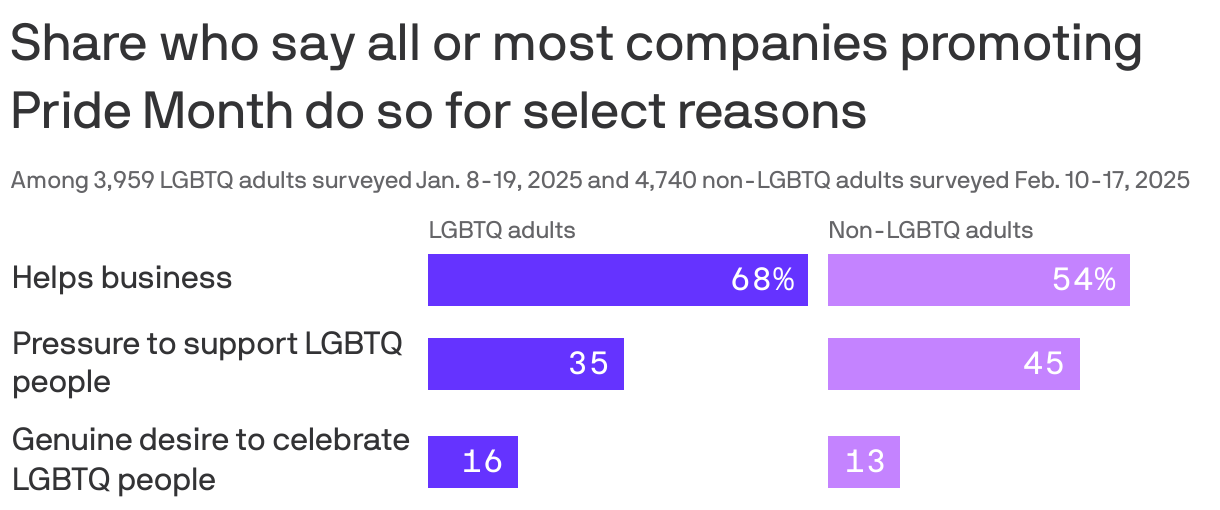
Many Americans say companies support Pride Month more for profit or pressure than principle, according to Pew Research Center data.
By the numbers: Among LGBTQ adults surveyed in mid-January, 68% said all or most companies promoting Pride Month do so because they think it's good for business. 35% said it's because companies feel pressured to do so, and 16% said it's out of genuine desire, per Pew's findings.
- Among non-LGBTQ adults surveyed in mid-February, those shares were 54%, 45% and 13%, respectively.
Zoom in: There's a notable partisan split here.
- Some 61% of non-LGBTQ Republicans say all or most companies promoting Pride Month do so because they feel pressured, compared to 30% of non-LGBTQ Democrats.
- Non-LGBTQ Republicans are also far more likely to say that among companies promoting Pride, few or none do so out of genuine beliefs (63% vs. 37%).
The bottom line: While many Pride events benefit from companies' financial backing, Pew's findings show that people often view corporate Pride support as superficial rather than wholehearted allyship.
4. ICYMI: Nike names Michael Gonda as chief communications officer
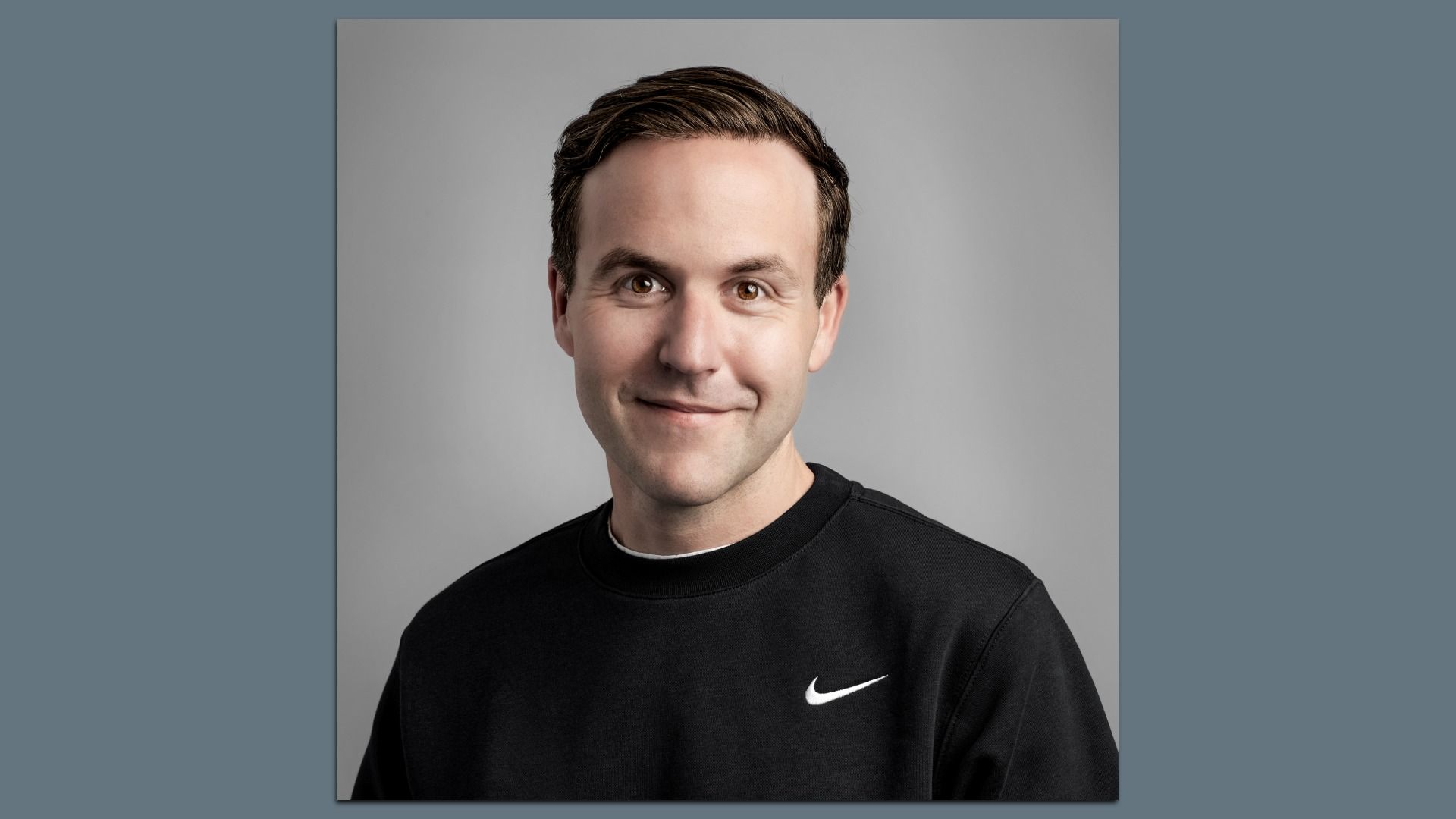
Nike has hired McDonald's chief impact officer of North America, Michael Gonda, as executive vice president and chief communications officer, Axios is first to report.
- Why it matters: Nike is in the midst of a turnaround following declining sales and the appointment of a new CEO, Elliott Hill, last fall.
Details: Gonda will serve on Nike's senior leadership team and report to Hill.
- He will oversee the team responsible for global communications, corporate and brand reputation, issues management and employee engagement.
- He is succeeding KeJuan Wilkins, who departed Nike in March. Gonda will begin his post on July 7.
Catch up quick: At McDonald's, Gonda oversaw all communications, government relations, sustainability and philanthropy in the U.S. and Canada.
- Prior to joining McDonald's in 2019, he oversaw corporate affairs at Chobani.
Between the lines: Gonda directed the fast-food chain's response following President Trump's controversial campaign stop at McDonald's.
- He also helped the company navigate the E. coli outbreak related to slivered onions in 2024.
What they're saying: "Nike has always been more than a brandβit's a storyteller, a cultural force and a catalyst for belief," said Gonda.
- "I'm deeply honored to join a company that has shaped how people see themselves and the world around them, and am humbled to help Nike tell the stories that matter, connect even more deeply with athletes and communities, and write the next ambitious chapter with Elliott and this team."
5. Scoop: House kicks Omnicom, IPG probe to FTC
The Federal Trade Commission has fully taken over the congressional antitrust probe into the Omnicom/IPG merger, sources told Axios' Sara Fischer and Kerry Flynn.
- Why it matters: Sources interviewed by the FTC about the deal say the questioning so far lacks any sort of political undertones. But industry leaders aren't ruling out external political pressure, given the Trump administration's track record.
π‘ Read this story in its entirety by becoming a Media Trends Executive member.
6. Communicator spotlight: Josh Earnest of United Airlines

As United Airlines' executive vice president of communications and advertising, Josh Earnest is responsible for sharing how the airline differs from its competitors.
- Why it matters: Much of the job is spent protecting the brand amid ongoing crises β from COIVD-19 groundings, to the Boeing quality control issues, to the recent air traffic challenges at Newark Liberty International Airport, one of United's hubs.
π£οΈ What he's saying: Travelers have to relinquish control to the airline that's getting them from point A to point B, which "makes the association that fliers have with our brand all the more important," Earnest told Axios.
- "When people are sitting on that plane, they are feeling out of control. When you're sitting on an airplane, sometimes you don't even have access to WiFi β although we're doing a lot to try to fix that β and you're arriving whenever we decide to arrive. Hopefully your bags will make it, but we're the ones looking out for them. And you're certainly counting on United to keep you safe."
βοΈ State of play: United operates nearly 70% of the flights at Newark, which means the airline has a huge stake in the recent flight disruptions caused by air traffic control issues.
- "A lot of the challenges at Newark are totally outside of the control of United Airlines. We're talking about air traffic controllers, state and local regulators at the New York and New Jersey Port Authority, federal regulators at the FAA and the Department of Transportation, and the air traffic controllers union," he said.
Yes, but: While things might be outside of United's control, its brand is impacted, and it's "not an option for us to sit on the sidelines," Earnest said.
- Most recently, United slashed ticket prices for Newark-based flights and partnered with JetBlue to allow for more flight options out of nearby Kennedy International Airport.
π Zoom in: Earnest sits on the executive team, reporting to United president Brett Hart.
- He oversees a team of about 140 people who are responsible for the airline's global communications, advertising and community engagement strategies.
- The team structure "allows us to integrate the creative, paid efforts with our aggressive, proactive earned efforts," he said.
- "There's no enterprise that can rely on one channel of communication, and it just means that there's a higher premium placed on a well-integrated communication strategy."
- "We will often use notes to our employees to drive news coverage. If you think about it, it used to be the other way. We would worry that notes we're sending to our employees could get out. And what do we do to try to prevent that? ... Now we like the benefit of the public seeing that we're transparently communicating with our employees about what's happening."
π Catch up quick: Before joining United, Earnest spent more than two decades in politics, most recently serving as White House press secretary during the Obama administration.
π§ Best career advice: Work on something that you care about and believe in.
7. π― 1 food thing to go
A new battle is cooking in the fast-food industry's six-year Chicken Sandwich Wars β wraps instead of rolls, writes Axios' Kelly Tyko.
- Why it matters for communicators: The chicken wrap wars are an opportunity for fast-food chains to embrace their historically quirky brand voices.
Catch up quick: Popeyes took the first shot Monday when it released three new chicken wraps.
- McDonald's then announced that its Snack Wrap will return in July, months after teasing the popular item's comeback.
- Wendy's Grilled Chicken Ranch Wrap debuted in March 2023, and Burger King launched its BK Royal Crispy Wraps in August 2023.
What to watch: Social media chatter and how brand voice comes into play.
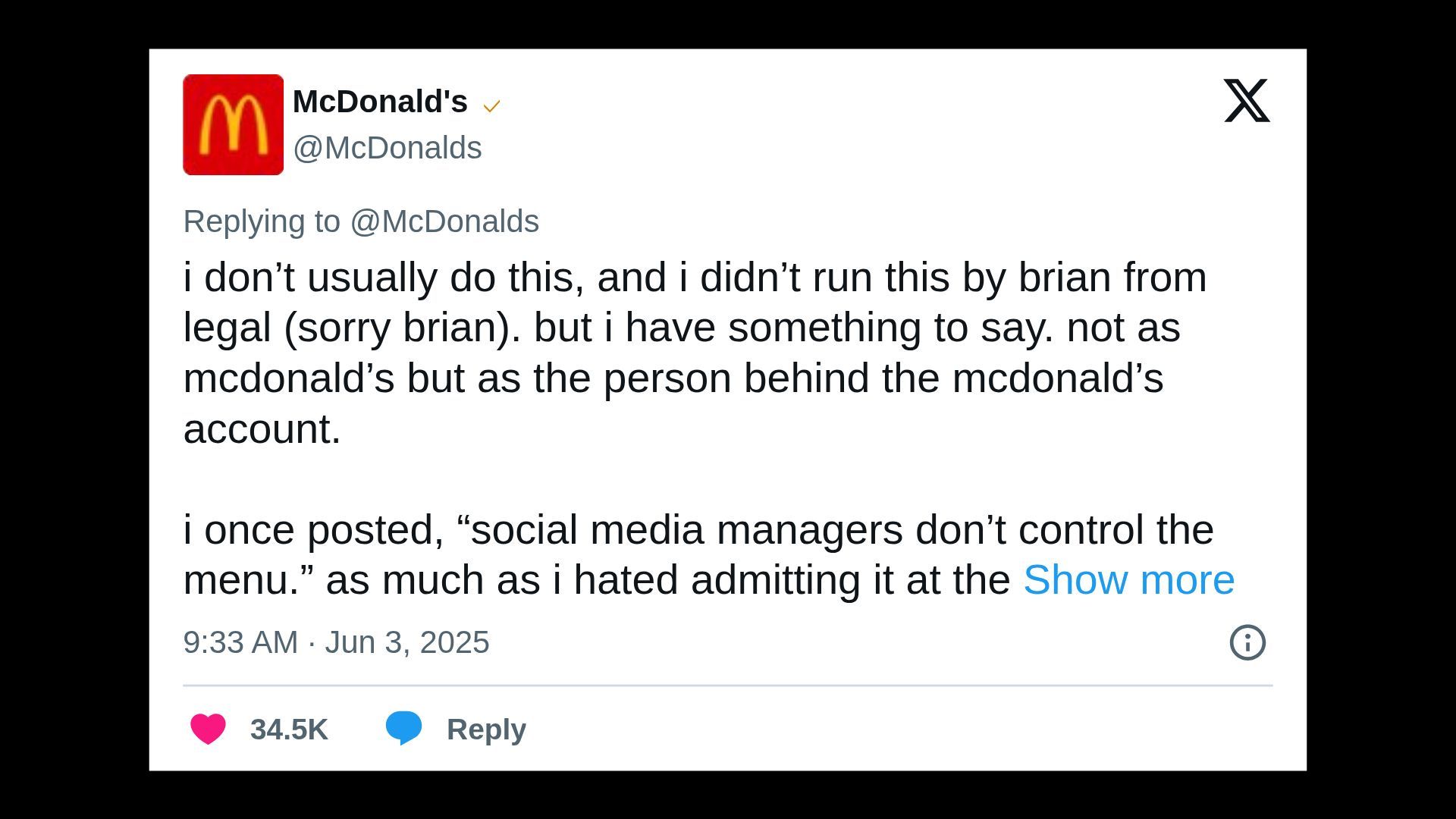
- In one X post, the McDonald's team broke the fourth wall, writing, "i have something to say. not as mcdonald's but as the person behind the mcdonald's account. i once posted, "social media managers don't control the menu." as much as i hated admitting it at the time, it's true."
- The post went on to say, "from the bottom of my heart, thank you. today, i woke up with an even greater feeling of gratitude and pride. because finally after 9 years, i get to announce the day the Snack Wrap returns."
- The fast-food giant also launched a new website Snackwrapfiles.com, which it calls the "content hub for the most anticipated menu item of the decade."
ππ» Thanks for reading! For more Axios Communicators content, become a member of Communicators Pro.
Sign up for Axios Communicators