Axios Communicators

January 09, 2025

Welcome back. Our thoughts are with all those impacted by the wildfires in California. For updates, follow Axios coverage here.
- 📇 Reminder: Monthly moves will hit inboxes tomorrow. Last call for your job updates.
- 🩺 Join me in San Francisco on Monday, Jan. 13, for an Axios event alongside the J.P. Morgan Health Care Conference, featuring conversations with Hims & Hers chief corporate affairs officer Khobi Brooklyn, founder and CEO of Abridge Shiv Rao and PhRMA CEO Stephen J. Ubl. Register here.
Today's newsletter is 1,549 words, a 6-minute read.
1 big thing: Let's talk about astroturfing

The drama surrounding the film "It Ends With Us" and its stars Justin Baldoni and Blake Lively was the comms topic du jour over the holiday break.
- Lively filed a complaint last month with the California Civil Rights Department accusing Baldoni, who also directed the movie, and his PR team of orchestrating a smear campaign against her.
- Baldoni has denied the allegations and has since filed a libel suit against the New York Times.
- Private texts were disclosed. Publicists started suing each other. It got messy, fast.
Why it matters: The practice of "astroturfing" — defined as "disguising an orchestrated campaign as a spontaneous upwelling of public opinion" — is a tactic corporate communicators should prepare for.
State of play: PR professionals who work in politics and Hollywood will tell you that astroturfing isn't new, but social media algorithms have breathed new life into this strategy.
- Algorithms "have one objective, and that's getting more eyeballs to the platform," says David Krejci, media forensics expert and partner at Finn Partners. "The phrase 'the algorithm is the new gatekeeper' is absolutely true."
- "Negativity gets a lot more of an emotional reaction and response from us as human beings. When [the algorithms] see a bunch of people engaging with something, of course, they are not interpreting it as positive or negative. They interpret it as engaged with and that's why it starts to grow and spread."
Between the lines: At the center of Lively's allegations of a smear campaign are viral interview clips over the years that paint her in a negative light.
- "Once a PR crisis begins, all of a sudden a litany of past mistakes becomes part of the narrative," says Krejci.
- For this reason, PR professionals must monitor digital footprints and "go find skeletons in the closet, because they always resurface during a significant crisis for any company or public figure," he adds.
These past clips made it easy for internet users to roll with a seemingly preexisting narrative.
- "One of the key tenets of a classic whisper campaign is a retrospective tone, so that when you first start seeing these mentions or news, it's framed as if it's been going on already," says Justin Williams, digital and analytics practice leader at Jackson Spalding.
Yes, but: Before responding, it's important to establish reality versus virality and determine whether this retrospective narrative has impacted business performance and hurt reputation among key audiences.
- Oftentimes, the data isn't there and the engagement isn't long-lasting, says Williams.
What they're saying: "I don't think that everyone should be on such a high horse," says the owner of a strategic communications firm that represents many celebrity clients, who asked to speak on background.
- "If your primary strategy is pointing a finger at someone else for how they raised the negatives about your own client, it means you probably didn't do your job right in the first place. Maybe you should be focusing more on how to improve your own client's message," this comms executive added.
Zoom in: This drama is calling attention to celebrity PR's cutthroat nature and murky practices.
- "The business has just gotten worse and worse in terms of margins, in terms of the impact of the [SAG-AFTRA] strike and in terms of consolidation," says the comms executive.
- Because of this, insecurity has increased, leading to more "publicist-on-publicist crime," they added.
What to watch: Critics of corporate strategies are citing their social media campaigns — and the chatter they create — as drivers for change.
- Most recently, this strategy has been deployed by critics of corporate diversity plans. (More on that below).
The bottom line: There's no way to prevent astroturfing, but you can reduce the risk by auditing your digital footprint, identifying potential reputational vulnerabilities and monitoring the sentiments of your key audiences.
- "Reputation and values do matter, and that's what you fall back on when you're being attacked by third parties," says Scott Sayres, head of reputation and issues management at Jackson Spalding. "Your track record and the way you communicate to all of your stakeholders, employees, customers, other businesses, is what you're judged by."
2. Bonus chart: Lively chatter

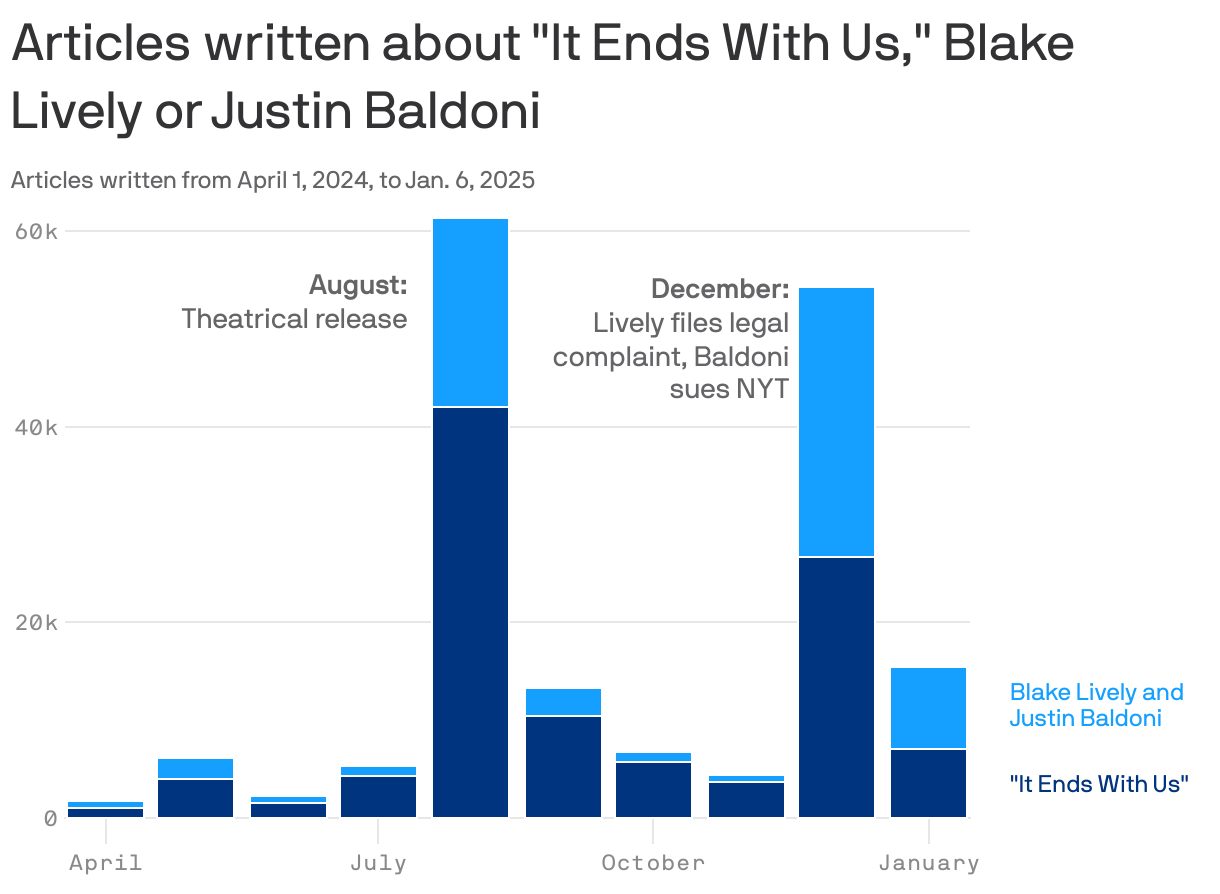
Even taking into account the alleged astroturfing strategy, most coverage quickly died down and audiences moved on.
By the numbers: By November, stories written about Lively and Baldoni were down 96% since the film's release and most of the social media commentary had ramped down.
- Yes, but: After the legal complaint was filed by Lively and covered by the New York Times, mentions spiked from 704 articles in November to 27,615 in December — a 3,800% increase — according to Muck Rack data.
💭 Our thought bubble: The Streisand effect strikes again, which should always be considered when responding to online chatter.

3. The hot new publishing platform is a legal filing
Filing a legal complaint is rapidly becoming the self-publishing option of choice for individuals looking to make explosive public allegations — regardless of whether they care about a judge finding in their favor.
Why it matters: In an era of steadily declining trust in media, the dry formalities of a legal template not only provide an imprimatur of institutional credibility but also offer the freedom to go into extreme detail without seeming petty or self-indulgent.
Driving the news: Lively's complaint immediately changed her public reputation.
- Baldoni then filed his own lawsuit laying out his side of the story. It's a defamation suit against the New York Times but in practice fires back in the PR war with Lively. (The Times has denied defaming Baldoni.)
Flashback: Similar tactics were employed by actor Sophie Turner, who fired off a legal complaint against her soon-to-be ex-husband Joe Jonas invoking international child abduction clauses through the Hague Convention.
- Legal filings have been part of Drake's arsenal in his longstanding rivalry with fellow musician Kendrick Lamar.
- Women have used lawsuits as a way to go public with accusations that powerful men — including Sean "Diddy" Combs and Leon Black — have committed sexual assault. (Both denied wrongdoing and neither were convicted of a crime, but the suits impacted their careers — and, in the case of Combs, helped land him in jail.)
Where it stands: The internet has given the power of the printing press to everyone. But because of that, self-published posts on X, Medium or a personal blog are often treated with skepticism, and journalists often avoid reporting on them.
The bottom line: Lawsuits are often used to inflict expensive litigation on others. Now they're also being used to try to bring about outcomes no jurist can hand down in judgment.
4. Anti-DEI shareholder proposals tripled since 2020

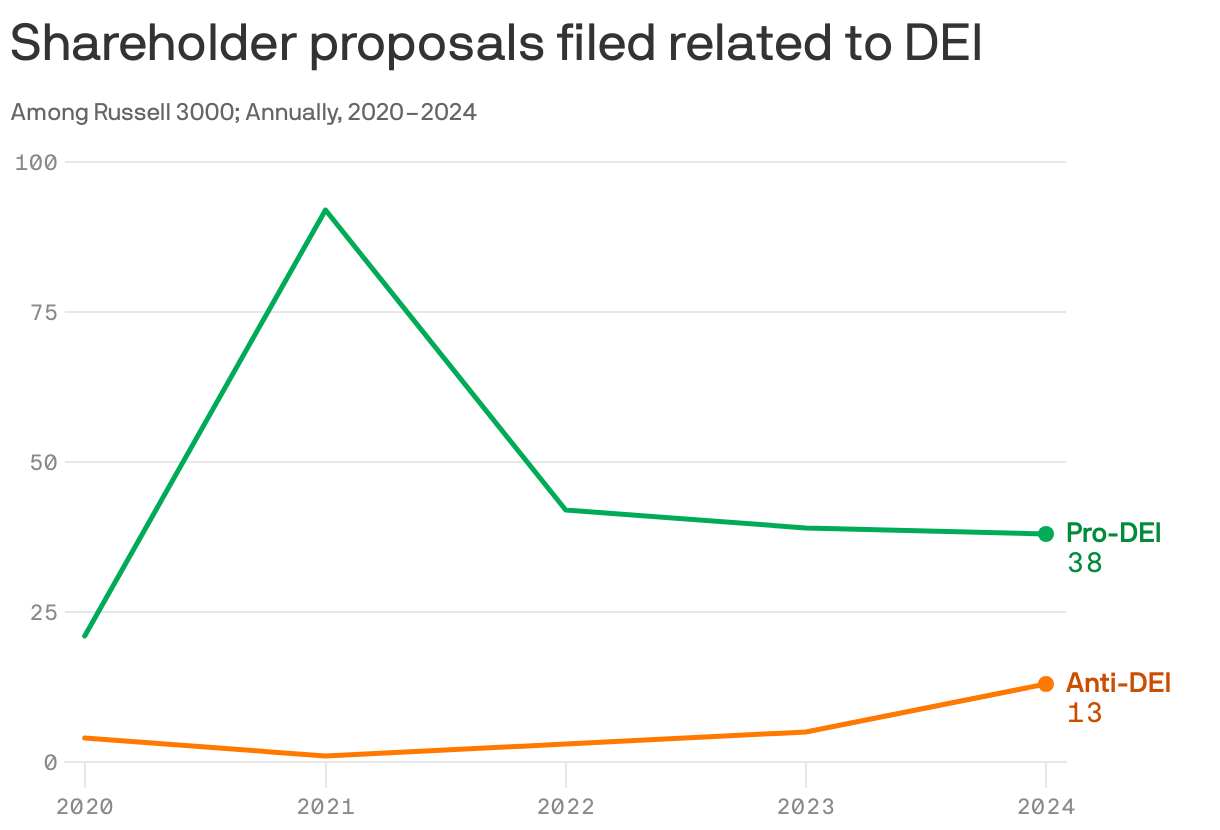
Anti-DEI shareholder proposals have surged over the past few years.
Why it matters: These measures are a somewhat obscure but important piece of the pushback against corporate diversity, equity and inclusion (DEI) efforts — programs meant to broaden a company's hiring pool of candidates and make employees from different backgrounds feel more welcome.
Zoom in: Anti-DEI proposals typically ask public firms to scrutinize their DEI policies to see if they pose legal, financial or reputation risks.
- There were 13 anti-DEI proposals at Russell 3000 firms last year. That's still a fraction of the pro-DEI proposals, but they have more than tripled since 2020.
- The companies targeted were biggies like Alphabet, Apple, Coca-Cola, Starbucks and Boeing, which dismantled its DEI department last year.
State of play: Over the holidays, Costco grabbed headlines when it put out a robust defense of its DEI efforts in response to one of these proposals from conservative think tank National Center for Public Policy Research.
- "Our efforts at diversity, equity and inclusion remind and reinforce with everyone at our Company the importance of creating opportunities for all," Costco's board of directors wrote.
- "We believe that these efforts enhance our capacity to attract and retain employees who will help our business succeed."
Where it stands: These proposals almost always get voted down, but the point isn't to win votes, says Andrew Jones, senior researcher at the Conference Board.
- The idea is to "bring scrutiny to DEI and amplify broader opposition," he says. Those efforts appear to be working.
- This week, McDonald's was the latest major company to announce it was scaling back its DEI efforts.
5. 👀 1 quote to-go
When traditional media ditches traditional media relations ...
"We will stop the dedicated practice of publicity for our journalism across broadcast and traditional media outlets. ... We need our journalism to be accessed at an even greater rate and we no longer believe traditional outreach is the way to get us there."— Washington Post chief communications officer Kathy Baird, writing in a memo announcing team restructuring.
🙏🏻 Thanks to editors Nicholas Johnston and Kathie Bozanich. And extra thanks to you for reading each week!
If this was forwarded to you, start the year off right and subscribe here.
Sign up for Axios Communicators