The PR astroturfing strategy explained

Add Axios as your preferred source to
see more of our stories on Google.

Illustration: Aïda Amer/Axios
The drama surrounding the film "It Ends With Us" and its stars Justin Baldoni and Blake Lively was the comms topic du jour over the holiday break.
- Lively filed a complaint last month with the California Civil Rights Department accusing Baldoni, who also directed the movie, and his PR team of orchestrating a smear campaign against her.
- Baldoni has denied the allegations and has since filed a libel suit against the New York Times.
- Private texts were disclosed. Hollywood publicists started suing each other. It got messy, fast.
Why it matters: The practice of "astroturfing" — defined as "disguising an orchestrated campaign as a spontaneous upwelling of public opinion" — is a tactic corporate communicators should prepare for.
State of play: PR professionals who work in politics and Hollywood will tell you that astroturfing isn't new, but social media algorithms have breathed new life into this strategy.
- Algorithms "have one objective, and that's getting more eyeballs to the platform," says David Krejci, media forensics expert and partner at Finn Partners. "The phrase 'the algorithm is the new gatekeeper' is absolutely true."
- "Negativity gets a lot more of an emotional reaction and response from us as human beings. When [the algorithms] see a bunch of people engaging with something, of course, they are not interpreting it as positive or negative. They interpret it as engaged with and that's why it starts to grow and spread."
Between the lines: At the center of Lively's allegations of a smear campaign are viral interview clips of her over the years that paint her in a negative light.
- "Once a PR crisis begins, all of a sudden a litany of past mistakes becomes part of the narrative," says Krejci.
- For this reason, PR professionals must monitor digital footprints and "go find skeletons in the closet, because they always resurface during a significant crisis for any company or public figure," he adds.
These past clips made it easy for internet users to roll with a seemingly preexisting narrative.
- "One of the key tenets of a classic Hollywood whisper campaign is a retrospective tone, so that when you first start seeing these mentions or news, it's framed as if it's been going on already," says Justin Williams, digital and analytics practice leader at Jackson Spalding.
Yes, but: Before responding, it's important to establish reality versus virality and determine whether this retrospective narrative has impacted business performance and hurt reputation among key audiences.
- Oftentimes, the data isn't there and the engagement isn't long-lasting, says Williams.
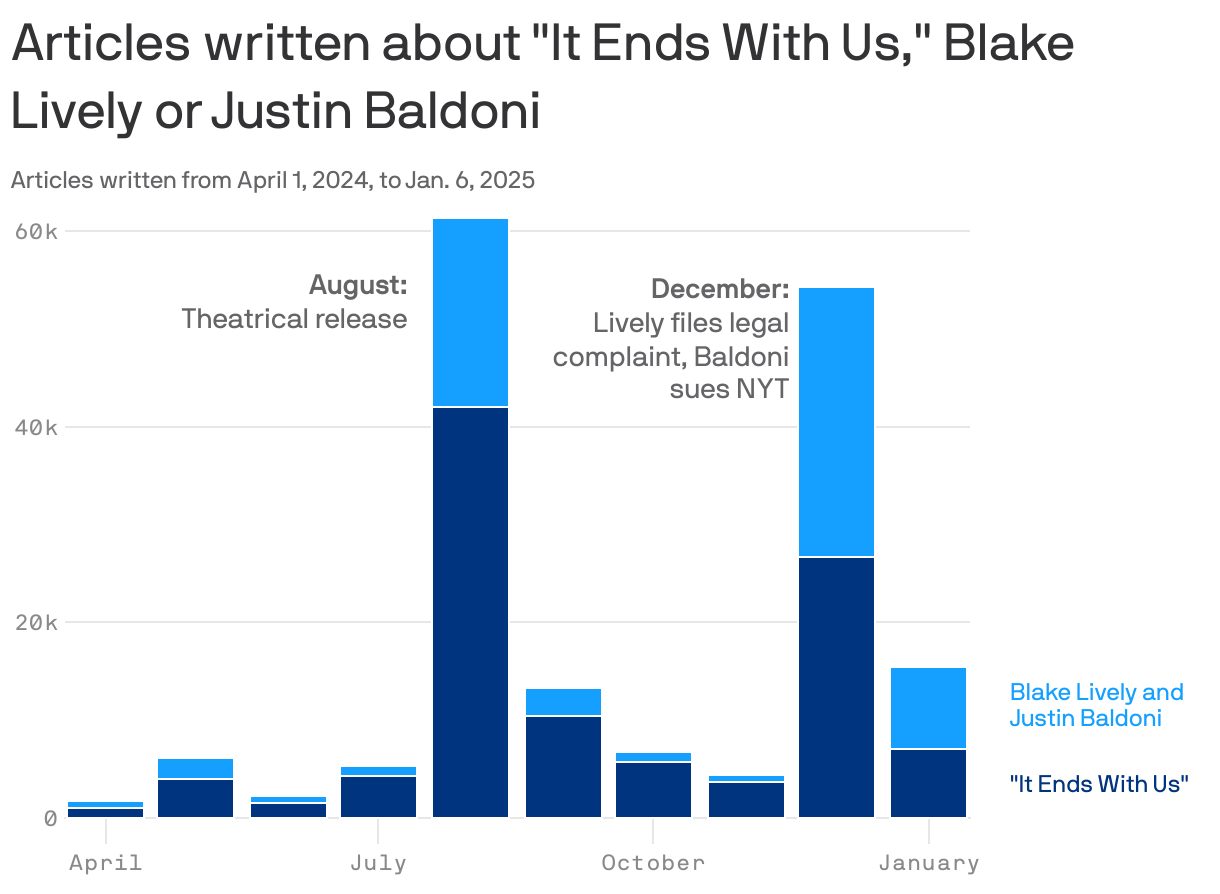
By the numbers: By November, stories written about Lively and Baldoni were down 96% since the film's release, and most of the social media commentary had ramped down.
- After the legal complaint was filed by Lively and covered by the New York Times, mentions spiked from 704 articles in November to 27,615 in December — a 3,800% increase — according to Muck Rack data.
What they're saying: "I don't think that everyone should be on such a high horse," says the owner of a strategic communications firm that represents many celebrity clients, who asked to speak on background.
- "If your primary strategy is pointing a finger at someone else for how they raised the negatives about your own client, it means you probably didn't do your job right in the first place. Maybe you should be focusing more on how to improve your own client's message," this Hollywood comms executive added.
Zoom in: This drama is calling attention to Hollywood PR's cutthroat nature and murky practices.
- "The business has just gotten worse and worse in terms of margins, in terms of the impact of the [SAG-AFTRA] strike and in terms of consolidation," says the comms executive.
- Because of this, insecurity has increased, leading to more "publicist-on-publicist crime," they added.
What to watch: Beyond Hollywood, critics of corporate strategies are citing their social media campaigns — and the chatter they create — as drivers for change.
- Most recently, this strategy has been deployed by critics of corporate diversity plans.
The bottom line: There's no way to prevent astroturfing, but you can reduce the risk by auditing your digital footprint, identifying potential reputational vulnerabilities and monitoring the sentiments of your key audiences.
- "Reputation and values do matter, and that's what you fall back on when you're being attacked by third parties," says Scott Sayres, head of reputation and issues management at Jackson Spalding. "Your track record and the way you communicate to all of your stakeholders, employees, customers, other businesses, is what you're judged by."
More on Axios: The hot new publishing platform is a legal filing
