Axios Closer

September 29, 2026

Tuesday ✅.
Today's newsletter is 894 words, a 3½-minute read.
📉 The dashboard: The S&P 500 closed down 0.2%.
- Treasury 30-year yields ticked up, hitting their highest level since 2002.
🔥 Today's stock spotlight: Carnival (+13.4%) beat quarterly expectations, saying a significant rebound in demand over the past three months, along with operational improvements, fully offset higher fuel costs.
1 big thing: Telecom turf war

Elon Musk's plan to turn SpaceX into a major threat to the legacy telecom companies is "not a viable strategy," AT&T CEO John Stankey tells me.
🛰️ Catch up quick: Starlink, SpaceX's satellite business, already competes with traditional telecom companies for home and business internet customers — and it's now talking about a mobile business that would put it in more direct competition with wireless carriers.
- "I anticipate us to be able to acquire quite a few of their customers because I think our service will be better," SpaceX president Gwynne Shotwell said in August on SpaceX's first earnings call after going public.
- 📉 The shot across the bow caused shares to drop the next day for AT&T, Verizon and T-Mobile.
Between the lines: To become a true fourth U.S. mobile carrier, SpaceX would need more terrestrial infrastructure to provide the capacity of a traditional cellular network — an expensive endeavor.
- 📡 But SpaceX believes it has a more efficient option: install small cellular base stations alongside Starlink dishes on homes and businesses.
- The ground network could add capacity where satellites alone aren't enough — without requiring SpaceX to build a traditional sprawling network of large cell towers, Musk says.
👎 AT&T's Stankey said the economics and technical aspects of that plan don't line up.
- "It would cost as much to do that as it would to build a macro network to be able to handle those capabilities," he says.
- "There's all kinds of other issues, like you can't radiate cellular signals from somebody's house without their permission, unless somebody changes the law on that. We can go down a whole bunch of reasons why that won't effectively work."
SpaceX reps did not immediately respond to a request for comment.
Zoom out: AT&T, meanwhile, is betting on its strategy of deploying fiber infrastructure to boost its internet business at a time when AI is driving booming demand.
- The latest: AT&T announced a $3 billion deal with Corning today to provide materials for its continued buildout, saying fiber is three times faster than satellite.
- 🥊 "Nothing beats it," Stankey says, adding, "satellite, at its best — if everything happens right over the next 10 years" — is "still not going to beat fiber."
The bottom line: The competition between SpaceX and the major telecom companies is heating up.
2. Bad aura for IPOs
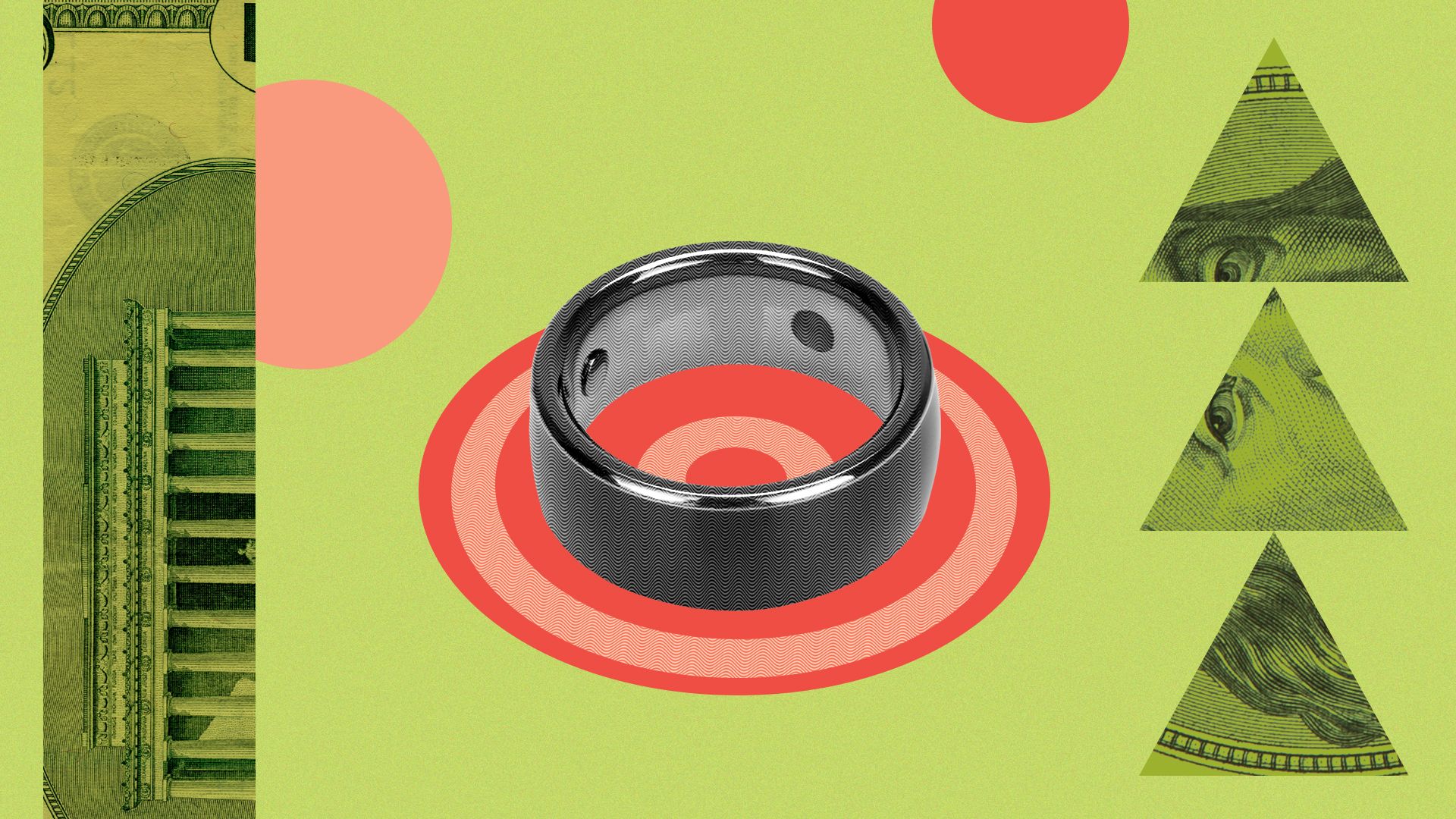
Smart ring maker Oura delayed an IPO that had been expected to raise up to $2.2 billion, citing "market conditions," Axios' Dan Primack writes.
- 🪟 Why it matters: The IPO window is narrowing. This is the third official postponement this month, while others have informally delayed.
Behind the scenes: Oura basically couldn't get the price it wanted, in part because of market turmoil driven by volatility in bond yields and oil prices, according to a source familiar with the situation.
- Most shares were being sold by insiders, rather than by the company itself, which put a premium on pricing.
🏷️ Follow the money: The offering was around 5x oversubscribed, the source says, but that doesn't mean that prospective investors were willing to buy at the top of Oura's $40–$44 per share range.
⌚️ What we're watching: Oura's IPO had been viewed as a proxy to see whether Wall Street would treat a wearables company like a health-tech company, rather than as a consumer electronics company. That determination will have to wait.
3. All the OpenAI headlines

OpenAI's annual recurring revenue is nearing $70 billion, as enterprise sales more than doubled since July, sources familiar with the financials tell Axios' Madison Mills.
- The company's annualized revenue run rate has grown more than 70% since the beginning of Q3, while its business-to-business revenue has more than doubled.
💰 Meanwhile, OpenAI is looking to raise at least $30 billion in a new funding round after pushing back its IPO plans, Bloomberg reports, seeking a valuation of around $1.4 trillion.
- It will have to juggle a lawsuit filed today by a public interest law group over the rogue hacking incident of tech company Hugging Face, Axios' Avery Lotz reports.
- The intrigue: The case tests an increasingly urgent question as AI agents gain power: Who bears legal responsibility when an agent blows past its guardrails and causes real-world harm?
OpenAI also launched dots, its take on the AI assistant and an answer to Meta's Muse.
4. Other happenings
🤖 Anthropic's IPO prospectus warns investors that its technology could pose "existential risk" to humanity, while also noting nearly $4.6 billion in revenue for 2025 and a $518 billion in future cloud, computing and infrastructure obligations. (Reuters)
🌮 El Pollo Loco is expanding farther beyond its West Coast roots, disclosing plans to launch 15 restaurants in the New York area over the next five years. (CNBC)
🗓️ On this day in 1913, the inventor of the diesel engine disappeared while traveling on a ship from Belgium to England to discuss the idea of installing diesels on British submarines. His death was ruled a suicide, but is shrouded in conspiracy theories.
Today's newsletter was edited by Pete Gannon and copy edited by Sheryl Miller.
- Did a friend forward this to you? Sign up here to get Axios Closer in your inbox.
Sign up for Axios Closer